



Premium File
117 Q&A
$76.99$69.99
BCS ISEB-SWT2 Exam Questions & Answers, Accurate & Verified By IT Experts
Instant Download, Free Fast Updates, 99.6% Pass Rate
117 Questions & Answers
Last Update: Oct 24, 2026
$69.99
BCS ISEB-SWT2 Exam Screenshots
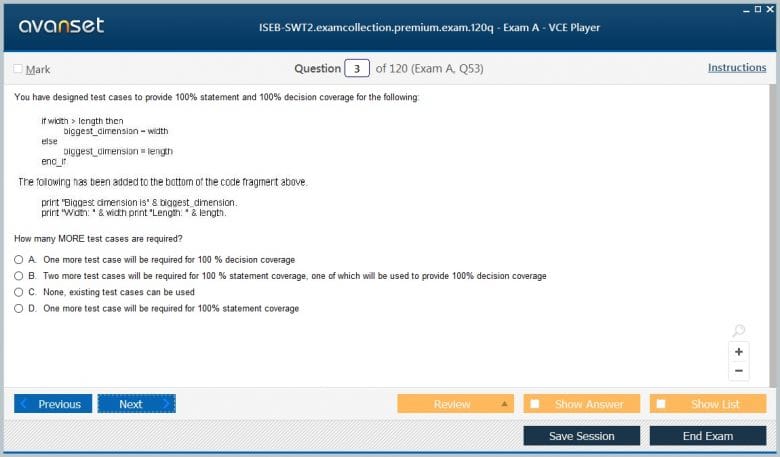
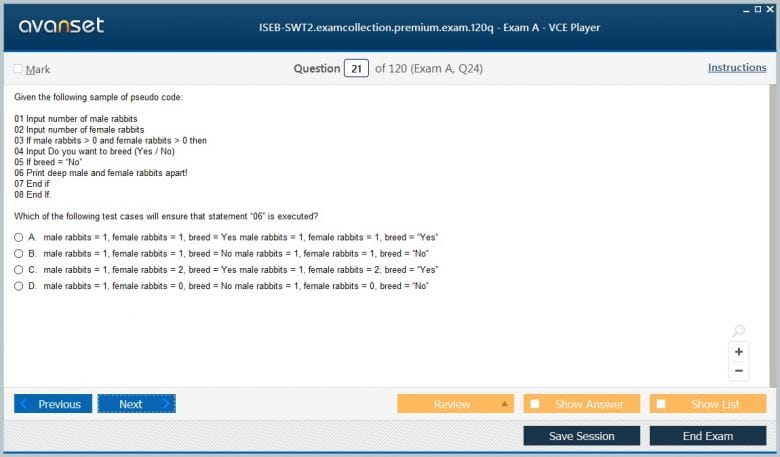
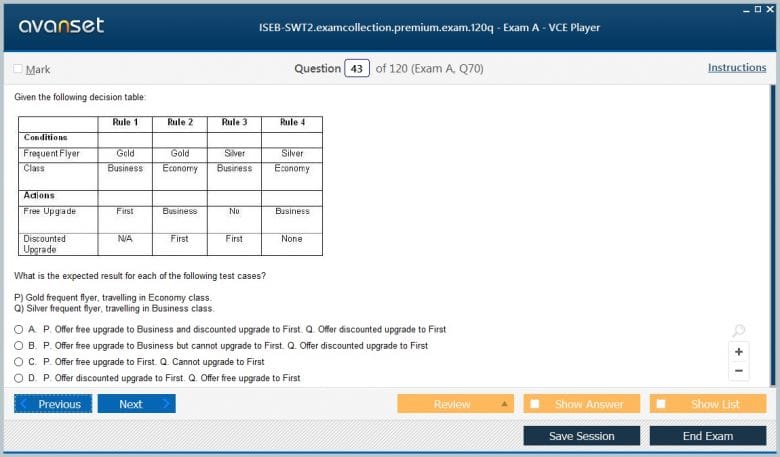
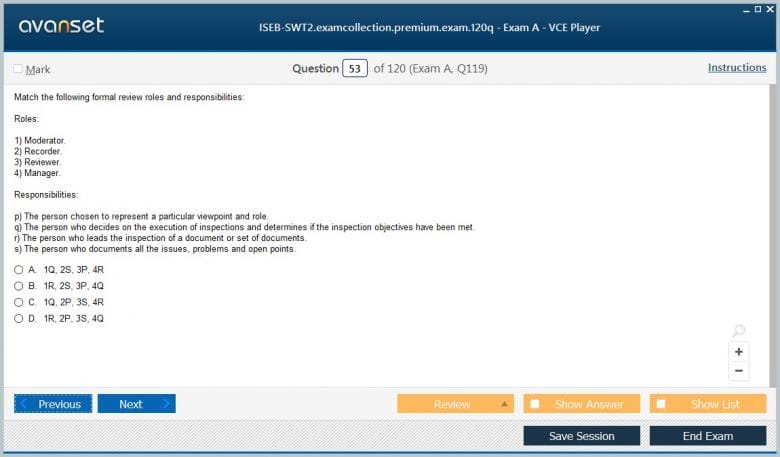
BCS ISEB-SWT2 Practice Test Questions in VCE Format
| File | Votes | Size | Date |
|---|---|---|---|
File BCS.realtests.ISEB-SWT2.v2026-08-26.by.jenson.72q.vce |
Votes 1 |
Size 471.31 KB |
Date Aug 26, 2026 |
File BCS.Test4prep.ISEB-SWT2.v2019-02-25.by.Marcus.68q.vce |
Votes 3 |
Size 705.15 KB |
Date Feb 26, 2019 |
File ISEB.ActualTests.ISEB-SWT2.v2013-01-25.by.Anonymous.120q.vce |
Votes 12 |
Size 715.95 KB |
Date Jan 27, 2013 |
BCS ISEB-SWT2 Practice Test Questions, Exam Dumps
BCS ISEB-SWT2 (ISTQB-ISEB Certified Tester Foundation Level (BH0-010)) exam dumps vce, practice test questions, study guide & video training course to study and pass quickly and easily. BCS ISEB-SWT2 ISTQB-ISEB Certified Tester Foundation Level (BH0-010) exam dumps & practice test questions and answers. You need avanset vce exam simulator in order to study the BCS ISEB-SWT2 certification exam dumps & BCS ISEB-SWT2 practice test questions in vce format.
ISEB-SWT2 belongs to an older BCS/ISEB Foundation Certificate in Software Testing exam lineage. It should now be treated as historical study context rather than as a current booking target. BCS currently offers ISTQB Certified Tester Foundation Level v4.0, whose examination uses 40 multiple-choice questions in 60 minutes with a 65% pass mark. Holders of earlier Foundation versions keep their certificates, but new candidates should prepare from the current v4.0 syllabus.
The continuity between the old and new paths is important. Fundamental ideas such as why testing is necessary, test levels, static testing, test design, defect management, and test-process thinking remain recognizable. What changes is the current terminology, structure, emphasis, and exam source. A legacy ISEB book can help explain concepts, but it should not decide final scope for a 2026 candidate.
ExamCollection readers can use BCS certifications and ISTQB certifications for the broader ecosystem. The direct current destination is ISTQB Certified Tester Foundation Level v4.0. The old ISEB Intermediate software-testing qualification is historically relevant to the earlier progression but has itself been replaced in the BCS portfolio.
Testing is not a guarantee that software contains no defects. Its purpose is to evaluate work products, find failures and defects, reduce risk, provide information for decisions, and build confidence in quality. Candidates should distinguish testing from debugging: testing can reveal a failure or defect, while debugging investigates causes and changes the product to remove them.
The value of a test depends on what risk or requirement it addresses. Repeating easy tests that always pass may increase a test count without increasing useful knowledge. A stronger strategy focuses effort where failure would matter and where uncertainty is high, while still maintaining sufficient breadth for regression and contractual or regulatory obligations.
Foundation testing has long emphasized principles such as the impossibility of exhaustive testing, the value of early testing, defect clustering, the pesticide paradox or the need to refresh tests, context dependence, and the fact that absence of detected errors does not prove usefulness. The current syllabus should supply exact wording, but the reasoning behind the principles remains durable.
These principles affect decisions. If exhaustive testing is impossible, selection and prioritization are necessary. If defects cluster, evidence from one component can justify deeper attention there. If tests never evolve, they may stop detecting new classes of problem. If testing is context dependent, the strategy for a medical device cannot simply be copied to a low-risk marketing site.
Testing is more effective when it begins with requirements, designs, user stories, models, and other early work products rather than waiting for executable code. Reviews can find ambiguity and inconsistency before implementation multiplies their cost. Test analysis can also expose requirements that are difficult to observe or verify, prompting clarification while change is still cheaper.
Different development lifecycles alter when and how testing occurs. Sequential, iterative, incremental, and agile delivery patterns create different rhythms, but the tester still needs traceability from test basis to conditions, cases, results, and defects. The core question is how the team obtains timely quality information at each point where a decision is made.
Reviews, inspections, walkthroughs, static analysis, and other static techniques examine work products without running the code in the way dynamic testing does. They can detect ambiguity, inconsistency, standards violations, unreachable code, interface mismatches, security concerns, and maintainability issues early. The participants and formality should match the objective and risk.
Static testing also spreads understanding. A requirement review may align business, development, and testing interpretations before implementation starts. A code review can identify design or maintainability concerns that a functional test would never reveal. Foundation candidates should understand what static techniques can detect and when a dynamic test is still necessary to observe runtime behavior.
Black-box techniques derive tests from specified behavior rather than internal code structure. Equivalence partitioning, boundary value analysis, decision-table testing, and state-transition testing help select representative cases from very large input and behavior spaces. The supporting ExamCollection article on black-box and white-box testing can deepen the contrast between specification-based and structure-aware perspectives.
White-box techniques use knowledge of internal structure to measure or improve structural coverage, while experience-based techniques use tester knowledge, defect patterns, checklists, and exploration. Strong test design combines perspectives instead of treating one family as sufficient. A boundary-focused black-box set may still miss an unexecuted internal branch, while structural coverage can miss an omitted business rule.
Component, integration, system, and acceptance testing differ in object, environment, responsibility, and defect focus. Test types such as functional, performance, security, usability, compatibility, and regression address different quality characteristics or change risks. Candidates should avoid assuming that a test level automatically determines a test type.
Regression testing is especially important after change because existing behavior can be damaged even when the new feature works. Confirmation testing checks whether a specific defect was fixed; regression testing checks for unintended side effects. The two are often performed together, but the purpose is different and exam questions may depend on that distinction.
A useful defect report records enough evidence for another person to understand, reproduce, assess, and manage the problem. That may include environment, version, preconditions, steps, data, expected and actual results, logs, screenshots, severity, and references to requirements or tests. More detail is not always better if it obscures the essential evidence.
Defect severity and priority also answer different questions. Severity concerns impact, while priority concerns when the organization chooses to address the issue. A low-severity defect in a highly visible release path may receive urgent priority; a severe defect in unreachable legacy functionality may be scheduled differently. Testers provide evidence while governance decides release and remediation tradeoffs.
Tools can support management, static analysis, automation, performance measurement, defect tracking, environments, data, reporting, and other activities. Tool adoption can fail when teams automate unstable processes, underestimate maintenance, ignore skills, or choose technology before defining the problem they want to solve. Foundation-level knowledge should include both benefits and risks.
Automation is particularly valuable for repeatable regression checks, but it does not replace judgment. Exploratory investigation, usability evaluation, new risk discovery, and interpretation of unexpected behavior still require people. A balanced approach uses tools to make repetitive evidence cheaper and faster while preserving human attention for uncertainty and complex decisions.
Candidates holding old ISEB/ISTQB Foundation study material should first separate durable concepts from obsolete exam assumptions. Build a checklist from the current CTFL v4.0 syllabus and mark which topics are fully covered, partly covered, or missing in the older resource. Then use current official sample questions to learn today’s terminology and cognitive expectations.
This method avoids two extremes: discarding useful foundational knowledge or assuming an old exam code is equivalent to the current syllabus. The credential ecosystem has evolved, and BCS now clearly presents CTFL v4.0 as the Foundation path. Final revision should therefore be driven by that current source, not by ISEB-SWT2 question banks or retired course structures.
Legacy material remains useful when it explains how the testing profession developed, but they should never blur current status. ISEB-SWT2 helped establish a common foundation for software-testing knowledge; CTFL v4.0 is the present examination target and should control current preparation.
The best preparation habit is to connect every testing term to an information need. Ask what risk the test addresses, what evidence it will produce, what decision that evidence supports, and what remains unknown afterward. That mindset survives syllabus changes because it reflects the purpose of professional testing rather than the wording of one historical exam.
Test planning should identify objectives, scope, risks, approach, resources, environments, data, responsibilities, schedule, entry or readiness assumptions, and completion criteria at a level appropriate to the context. Plans are not valuable because they predict every detail; they are valuable because they make the intended test approach visible and allow changes to be managed. Agile teams may represent this information differently from sequential projects while preserving the same need for shared expectations.
Metrics should be chosen for decisions rather than for decoration. Pass percentages, defect counts, coverage measures, execution progress, escaped defects, and automation results can all be useful, but each can mislead without context. A high pass rate may reflect shallow tests; a high defect count may reflect strong testing or poor quality. Foundation candidates should learn what a measure says and what it cannot establish.
Modern testing also extends beyond pre-release execution. Shift-left practices move feedback earlier through reviews, static analysis, component tests, and early collaboration; production monitoring and operational feedback can provide later evidence about reliability and user impact. This does not make traditional system and acceptance testing obsolete. It broadens the quality-information loop across the product lifecycle.
Agile and cross-functional delivery make tester communication especially important. Testers contribute examples, questions, risk analysis, acceptance criteria, exploratory insight, and automation strategy alongside developers, product specialists, and users. Independence can still provide a valuable perspective, but independence does not require isolation. Current CTFL study should therefore connect testing roles with collaboration as well as with formal test activities.
Traceability helps connect requirements, risks, test conditions, cases, results, and defects so teams can understand both coverage and change impact. It should be proportionate to the project: regulated systems may need formal evidence, while smaller products can use lighter links. The purpose is not paperwork for its own sake but the ability to explain what was tested, why it mattered, and what evidence supports the quality decision.
Go to testing centre with ease on our mind when you use BCS ISEB-SWT2 vce exam dumps, practice test questions and answers. BCS ISEB-SWT2 ISTQB-ISEB Certified Tester Foundation Level (BH0-010) certification practice test questions and answers, study guide, exam dumps and video training course in vce format to help you study with ease. Prepare with confidence and study using BCS ISEB-SWT2 exam dumps & practice test questions and answers vce from ExamCollection.
Purchase Individually
Site Search:

SPECIAL OFFER: GET 10% OFF

Pass your Exam with ExamCollection's PREMIUM files!
SPECIAL OFFER: GET 10% OFF
Use Discount Code:
MIN10OFF
A confirmation link was sent to your e-mail.
Please check your mailbox for a message from support@examcollection.com and follow the directions.

Download Free Demo of VCE Exam Simulator
Experience Avanset VCE Exam Simulator for yourself.
Simply submit your e-mail address below to get started with our interactive software demo of your free trial.