



Premium File
413 Q&A
$76.99$69.99
GIAC GSNA Exam Questions & Answers, Accurate & Verified By IT Experts
Instant Download, Free Fast Updates, 99.6% Pass Rate
413 Questions & Answers
Last Update: Nov 10, 2026
$69.99
GIAC GSNA Exam Screenshots
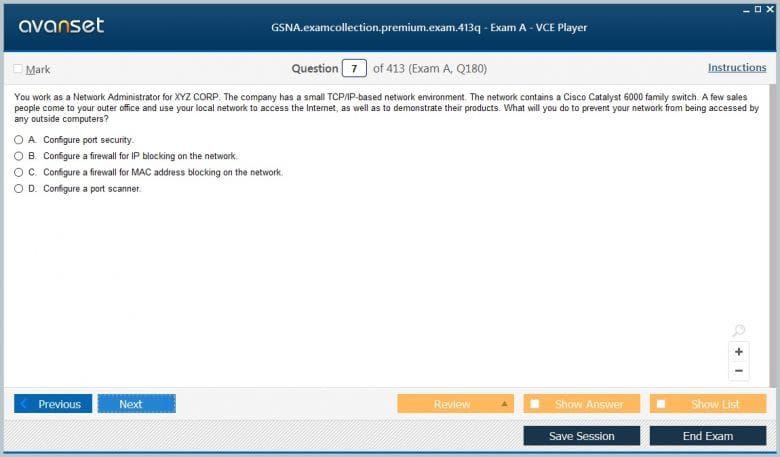
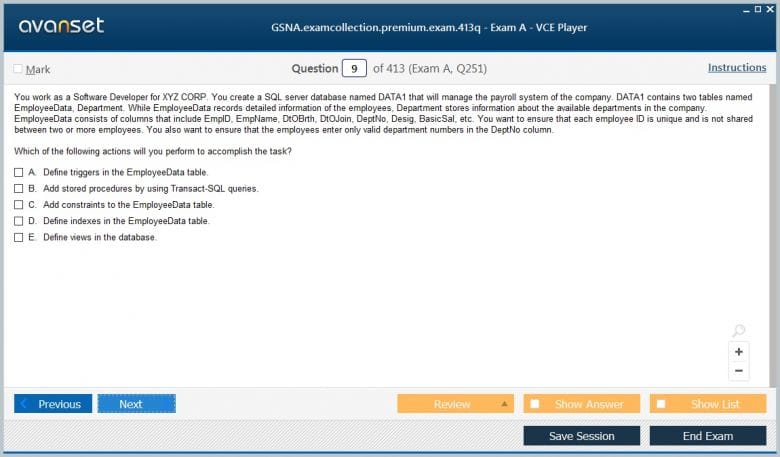
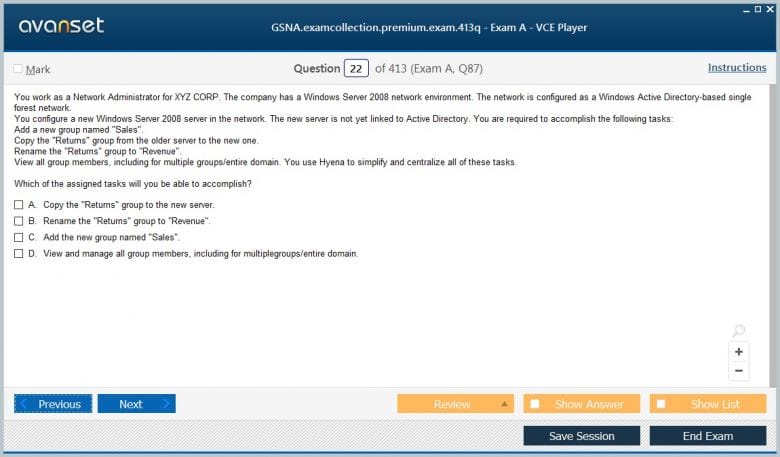
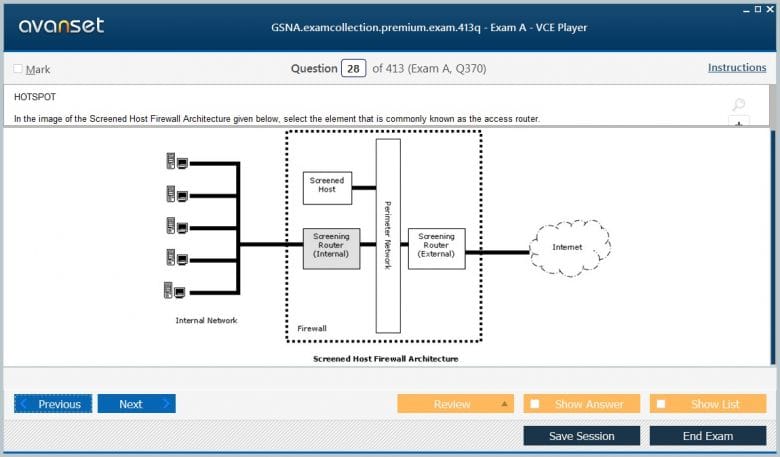
GIAC GSNA Practice Test Questions in VCE Format
| File | Votes | Size | Date |
|---|---|---|---|
File GIAC.examlabs.GSNA.v2026-07-04.by.jacob.247q.vce |
Votes 1 |
Size 1.04 MB |
Date Jul 04, 2026 |
File GIAC.Prep4sure.GSNA.v2019-02-08.by.Anna.243q.vce |
Votes 2 |
Size 1.12 MB |
Date Feb 10, 2019 |
GIAC GSNA Practice Test Questions, Exam Dumps
GIAC GSNA (GIAC Systems and Network Auditor) exam dumps vce, practice test questions, study guide & video training course to study and pass quickly and easily. GIAC GSNA GIAC Systems and Network Auditor exam dumps & practice test questions and answers. You need avanset vce exam simulator in order to study the GIAC GSNA certification exam dumps & GIAC GSNA practice test questions in vce format.
GSNA, the GIAC Systems and Network Auditor certification, is no longer a normal new-registration path. GIAC currently marks the credential as in abeyance and offers renewal rather than a new certification attempt. That status matters because the body of knowledge remains useful even though a learner should not plan around GSNA as if it were an actively sold 2026 exam. The page is best understood as a map of technical auditing skills: risk assessment, evidence collection, operating-system review, network and perimeter auditing, web-application controls, logging, and continuous monitoring.
Within the GIAC certifications family, GSNA historically occupied a specialist audit position. Readers looking for currently active alternatives may compare its audit perspective with broader security coverage in GSEC security essentials or the governance and control orientation of CISA. The enduring value of GSNA is not a memorized checklist; it is the ability to turn technical observations into defensible conclusions about risk, control effectiveness, and remediation.
A technical audit is not the same as running a collection of security tools. The auditor starts with a purpose, scope, control expectation, and evidence plan. A review of administrator access has different evidence requirements from a network-segmentation review, and a web-application audit differs again from a continuous-monitoring assessment. Strong audit work identifies the question before collecting data so that every command, log export, configuration sample, interview, and observation can be tied to a control objective.
That discipline prevents two common failures: gathering huge volumes of evidence with no decision framework, and reaching a conclusion from one convenient artifact. A configuration file can show intended policy, but logs and live settings may reveal how the system actually operates. A manager can describe a process, while ticket history may show whether it is followed consistently. The practical audit mindset is therefore triangulation: compare policy, configuration, activity, and exceptions until the conclusion is supported by more than one source.
A well-designed evidence request also considers sampling. In a large estate, an auditor may not be able to inspect every endpoint, administrator, firewall rule, and application transaction. Samples should therefore be selected according to the risk question: critical systems, recent changes, privileged populations, unusual exceptions, and representative normal systems may all deserve inclusion. The sampling rationale should be documented so that a reader understands what the evidence can and cannot support.
GSNA objectives place basic risk assessment close to the center of the audit process. A finding is useful only when the auditor can explain what asset or process is exposed, which threat or failure mode matters, how likely exploitation or misuse may be, and what consequence could follow. A weak cipher on an isolated lab service and the same weakness on an externally exposed payment system do not carry the same operational meaning, even if a scanner produces the same technical label.
Risk-based auditing also helps prioritize limited audit time. High-value identities, internet-facing services, remote administration paths, sensitive data stores, critical logging systems, and controls that support many other controls deserve more attention than low-impact settings. Readers who want a broader assurance comparison can use the CISA and CRISC risk perspective to see how audit evidence and risk management intersect without becoming the same discipline.
Network auditing requires more than confirming that a firewall exists. The auditor needs to understand address ranges, routing, trust boundaries, administrative paths, remote access, cloud connections, wireless segments, third-party links, and the location of monitoring controls. A rule base can be technically valid while the architecture around it permits an unexpected bypass path. That is why diagrams, route information, firewall policy, VPN configuration, and observed traffic all matter together.
The same principle applies to segmentation. A stated production-to-development boundary is meaningful only if the auditor can test or verify how it is enforced. Broad any-to-any rules, management interfaces exposed to ordinary user networks, unreviewed VPN routes, and stale exceptions can undermine the intended design. The objective is to determine whether actual reachability matches the organization’s declared trust model, not merely whether a device has a configuration file.
Cloud and hybrid environments add policy layers that may not look like traditional perimeter devices. Security groups, network access controls, private endpoints, cloud firewalls, route tables, identity-aware proxies, and service policies can jointly determine reachability. An auditor needs to trace the effective path rather than checking each control independently. Contradictory rules across layers can create exposures that remain invisible if the review never reconstructs end-to-end traffic behavior.
Operating-system auditing typically examines accounts, privileges, authentication controls, services, patching, logging, file permissions, scheduled activity, remote administration, and security configuration. On Windows, domain policy and local settings can interact in ways that are easy to misread from a single host. On Unix and Linux systems, account files, sudo rules, service configuration, ownership, permissions, and shell history may each reveal different parts of the control picture.
Logs are especially important because they show whether controls are being exercised. A secure setting today does not prove that it was present during the period under review, and an account that looks harmless may have a history of privileged activity. The Windows security auditing material is useful supporting context because it reinforces the difference between simply enabling logs and designing an audit trail that can actually answer questions later.
Web applications concentrate identity, authorization, input handling, session state, and sensitive data in one place, which makes them a natural audit focus. An auditor should understand who can access each function, how roles are enforced, what data is collected and stored, how sessions are protected, and whether validation occurs on the server rather than only in the browser. Evidence can include configuration, role matrices, test accounts, logs, code review results, and controlled functional testing.
The purpose is not to turn every audit into a penetration test. Vulnerability testing can support an audit, but the auditor is often asking a broader question: is the organization operating a control effectively and consistently? A useful example is input validation. A penetration tester may prove a SQL injection path; an auditor may also examine development standards, testing evidence, remediation tracking, and recurrence across applications. The SQL injection prevention discussion shows how a technical weakness can be connected to a repeatable control process.
Periodic audits provide snapshots. Continuous monitoring asks whether important conditions can be observed between review cycles: privileged account changes, disabled logging, firewall-rule modifications, anomalous authentication, policy drift, configuration changes, or failures in security tooling. This does not eliminate formal audits, but it gives auditors better evidence and helps control owners detect problems before the next scheduled assessment.
The challenge is signal quality. A control that generates thousands of unowned alerts is not automatically effective. Useful monitoring defines what condition matters, who receives the signal, what response is expected, and how the organization proves that alerts are reviewed. An auditor should therefore examine both telemetry and the workflow around it. The strongest evidence shows that monitoring leads to accountable action rather than simply producing dashboards.
An audit finding becomes useful when a reader can understand four things: what was observed, what requirement or expectation it violates, why the gap matters, and what kind of corrective action would close it. Mixing those elements together produces ambiguous reports. A statement such as “logging is weak” is difficult to act on; a finding that identifies missing event categories, affected systems, retention gaps, and the resulting investigation risk is far more actionable.
Reports should also distinguish isolated exceptions from systemic patterns. One stale account may require cleanup; repeated stale privileged accounts across multiple systems may indicate a lifecycle-control problem. Evidence should be reproducible, sensitive details should be handled carefully, and remediation should be specific enough for an owner to verify later. The auditor’s credibility depends as much on the clarity of the evidence trail as on technical skill.
Follow-up is part of the audit lifecycle as well. A remediation ticket marked complete is not proof that risk was removed. Closure should include evidence that the configuration changed, that the intended control now operates, and that the fix did not create an unintended side effect elsewhere. For systemic findings, auditors may also need to verify the process change that prevents recurrence rather than validating only the originally sampled systems.
Because GIAC marks GSNA in abeyance, the sensible 2026 use of the material is professional development or renewal context rather than preparation for a new registration. Practitioners can still use the objective areas as a structured checklist for technical-audit capability: scoping, risk, Windows and Unix review, network and perimeter assessment, web applications, logging, continuous monitoring, and reporting. Those skills transfer directly into internal audit, security engineering, compliance validation, and control assurance work.
Candidates seeking a live credential should verify the active options that match their role instead of choosing by name alone. CISA preparation can provide a governance-oriented route, while active GIAC credentials may better fit hands-on defense or engineering. The lesson from GSNA remains valuable: good assurance work is evidence-driven, risk-aware, technically literate, and written so that another professional can follow the reasoning from observation to conclusion.
That distinction keeps the page useful without implying current registration availability.
Go to testing centre with ease on our mind when you use GIAC GSNA vce exam dumps, practice test questions and answers. GIAC GSNA GIAC Systems and Network Auditor certification practice test questions and answers, study guide, exam dumps and video training course in vce format to help you study with ease. Prepare with confidence and study using GIAC GSNA exam dumps & practice test questions and answers vce from ExamCollection.
Purchase Individually
Site Search:

SPECIAL OFFER: GET 10% OFF

Pass your Exam with ExamCollection's PREMIUM files!
SPECIAL OFFER: GET 10% OFF
Use Discount Code:
MIN10OFF
A confirmation link was sent to your e-mail.
Please check your mailbox for a message from support@examcollection.com and follow the directions.

Download Free Demo of VCE Exam Simulator
Experience Avanset VCE Exam Simulator for yourself.
Simply submit your e-mail address below to get started with our interactive software demo of your free trial.