


Premium File
614 Q&A
$76.99$69.99
ECCouncil CEH 312-50 Exam Questions & Answers, Accurate & Verified By IT Experts
Instant Download, Free Fast Updates, 99.6% Pass Rate

312-50 Premium File: 614 Questions & Answers
Last Update: Jul 17, 2026
312-50 Training Course: 182 Video Lectures
312-50 PDF Study Guide: 545 Pages
$79.99
ECCouncil CEH 312-50 Exam Screenshots
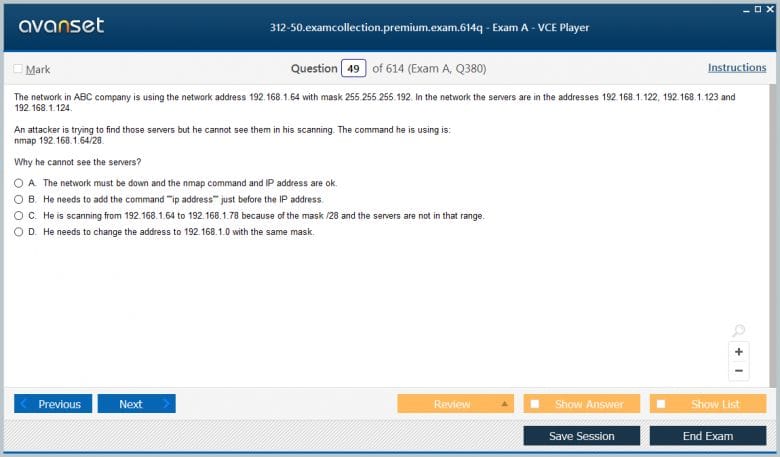
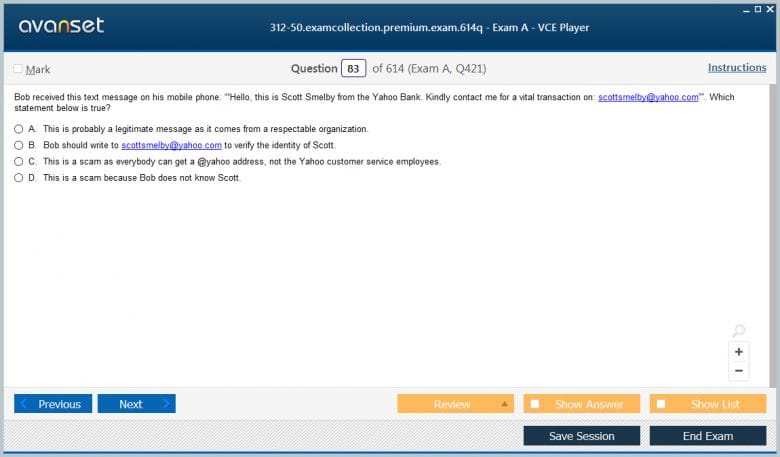
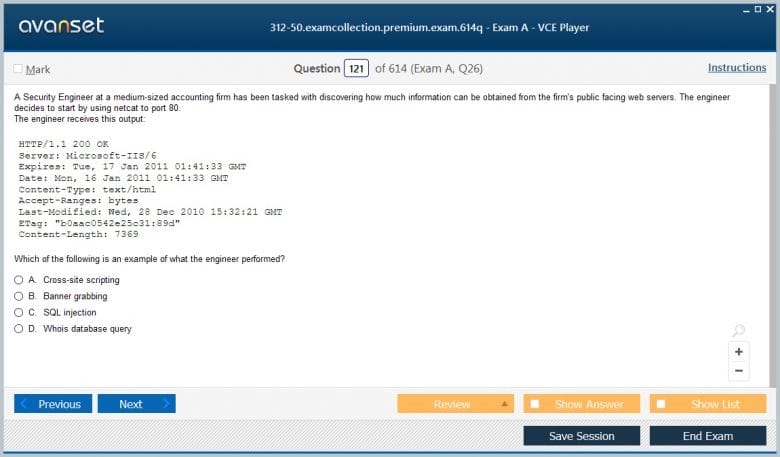
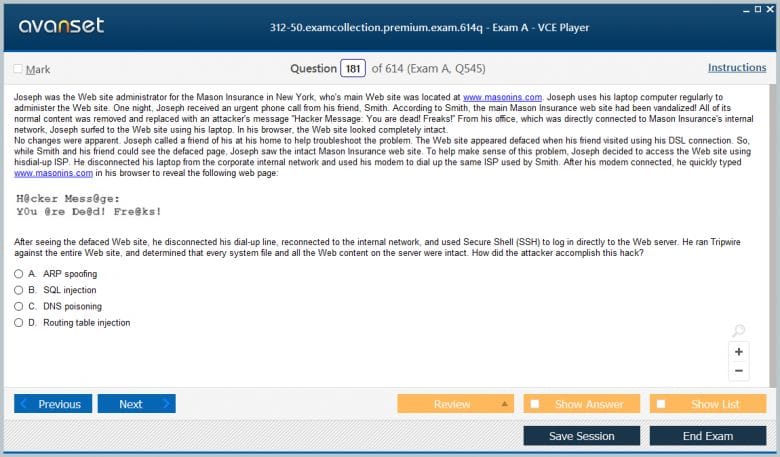
ECCouncil CEH 312-50 Practice Test Questions in VCE Format
| File | Votes | Size | Date |
|---|---|---|---|
File ECCouncil.realtests.312-50.v2026-04-30.by.lixiuying.360q.vce |
Votes 1 |
Size 1.47 MB |
Date Apr 30, 2026 |
File ECCouncil.Pass4sureexam.312-50.v2019-02-16.by.Donna.335q.vce |
Votes 7 |
Size 1.3 MB |
Date Feb 19, 2019 |
File ECCouncil.Test4prep.312-50.v2018-07-01.by.Betty.300q.vce |
Votes 6 |
Size 1.23 MB |
Date Jul 05, 2018 |
File ECCouncil.ActualTests.312-50.v2017-03-15.by.DAD.426q.vce |
Votes 12 |
Size 773.53 KB |
Date Mar 15, 2017 |
File ECCouncil.BrainDumps.312-50.v2016-08-09.by.Worm.260q.vce |
Votes 8 |
Size 192.97 KB |
Date Aug 09, 2016 |
File ECCouncil.Braindumps.312-50.v2015-03-06.by.Harold.859q.vce |
Votes 5 |
Size 3.79 MB |
Date Mar 06, 2015 |
File ECCouncil.Examsheets.312-50.v2014-02-04.by.Batista.878q.vce |
Votes 413 |
Size 8 MB |
Date Feb 06, 2014 |
File ECCouncil.ExamCollection.312-50.v2013-07-01.by.QusaiAlHaddad.878q.vce |
Votes 129 |
Size 9.41 MB |
Date Jul 05, 2013 |
Archived VCE files
ECCouncil CEH 312-50 Practice Test Questions, Exam Dumps
ECCouncil 312-50 (CEH Certified Ethical Hacker (312-50v9)) exam dumps vce, practice test questions, study guide & video training course to study and pass quickly and easily. ECCouncil 312-50 CEH Certified Ethical Hacker (312-50v9) exam dumps & practice test questions and answers. You need avanset vce exam simulator in order to study the ECCouncil CEH 312-50 certification exam dumps & ECCouncil CEH 312-50 practice test questions in vce format.
The EC-Council 312-50 exam is the qualifying assessment for the Certified Ethical Hacker credential, one of the most recognized certifications in the information security industry. It validates a professional's ability to think and act like a malicious attacker in order to identify and remediate vulnerabilities before they can be exploited. Unlike certifications that focus purely on defensive security, the CEH takes a distinctly offensive perspective, testing knowledge of attack tools, techniques, and methodologies that real threat actors use in the field.
The certification is relevant across a wide range of security roles including penetration testers, security analysts, vulnerability assessment specialists, and security operations center professionals. Organizations that handle sensitive data or operate in regulated industries frequently list the CEH as a preferred or required qualification for security positions. Passing the 312-50 exam demonstrates that a candidate possesses both the theoretical knowledge and the applied awareness needed to participate meaningfully in an organization's offensive security program.
Several training providers that offer 312-50 preparation courses include money-back guarantees as part of their value proposition. These guarantees typically promise a refund of the course fee if a candidate does not pass the exam after completing the training program. Before enrolling in any such program, candidates should read the terms of the guarantee carefully because the conditions attached to these offers vary significantly between providers and can be more restrictive than the marketing language suggests.
Common conditions attached to money-back guarantees include requirements to complete a minimum percentage of the course content, attempt the exam within a specified timeframe after finishing the training, achieve a minimum score on included practice exams before the actual attempt, and submit documented proof of exam failure through official score reports. Candidates who approach these programs with a genuine commitment to completing the material fully will typically find the guarantee conditions reasonable to meet. Those who treat the guarantee as a safety net without engaging seriously with the content often discover that they have not met one or more of the qualifying conditions when they attempt to claim a refund.
The 312-50 exam is organized around a set of knowledge domains that collectively cover the full scope of ethical hacking practice. The domains include background knowledge about ethical hacking concepts, footprinting and reconnaissance, scanning networks, enumeration, vulnerability analysis, system hacking, malware threats, sniffing, social engineering, denial of service attacks, session hijacking, evading intrusion detection systems, hacking web servers and applications, SQL injection, hacking wireless networks, hacking mobile platforms, and cloud computing security among others.
Each domain carries a specific weight in the overall exam, and candidates who allocate study time proportionally to domain weight perform better than those who study topics in equal depth regardless of their exam significance. The official EC-Council exam blueprint published on their website provides the authoritative breakdown of domain weights. Reviewing this blueprint before beginning any study program allows candidates to build a preparation plan that prioritizes the highest-value areas while still ensuring adequate coverage of lower-weighted domains that can still affect the final outcome.
Footprinting and reconnaissance represent the first phase of any ethical hacking engagement and form a significant portion of the 312-50 exam content. This phase involves collecting as much information as possible about a target organization using passive and active techniques before any direct interaction with the target's systems occurs. Candidates must understand the distinction between passive reconnaissance, which uses publicly available information without touching the target's infrastructure, and active reconnaissance, which involves direct interaction that the target could potentially detect.
Tools and techniques covered in this domain include DNS interrogation methods, WHOIS lookups, Google hacking techniques using advanced search operators, social media intelligence gathering, email harvesting, and network scanning at a preliminary level. Candidates should be comfortable not just naming these tools but understanding what information each one is designed to extract and how an attacker would use that information to inform subsequent phases of an attack. The exam frequently presents scenarios where candidates must identify the most appropriate tool or technique for a specific reconnaissance objective.
System hacking is one of the most heavily tested domains on the 312-50 exam because it covers the core activities of a successful intrusion. This domain encompasses gaining access to systems through password attacks and exploitation, escalating privileges once initial access is achieved, maintaining access through backdoors and rootkits, and covering tracks to avoid detection. Each of these phases has specific techniques and tools associated with it that candidates must be able to identify and apply in scenario-based questions.
Password attacks receive particular attention within this domain. Candidates should understand the differences between dictionary attacks, brute force attacks, rainbow table attacks, and hybrid approaches. The concept of password hashing and how different hashing algorithms affect the feasibility of cracking attempts is important background knowledge. Tools such as Hashcat and John the Ripper are referenced in this context, and candidates should understand their general capabilities and the conditions under which each type of attack is most effective rather than memorizing specific command syntax.
The malware threats domain covers the types of malicious software that attackers deploy and the techniques used to analyze and respond to them. Candidates must understand the functional differences between viruses, worms, trojans, ransomware, spyware, adware, and rootkits. Beyond classification, the exam tests knowledge of how each type of malware propagates, persists on infected systems, and achieves its objectives. This operational understanding is more valuable for exam performance than simple memorization of definitions.
Malware analysis techniques including static analysis, dynamic analysis, and behavioral analysis appear in this domain. Static analysis involves examining malware code or structure without executing it, while dynamic analysis involves running the malware in a controlled environment and observing its behavior. Candidates should understand what each approach can reveal, what its limitations are, and when each is appropriate. The concept of malware obfuscation techniques, including packing and encryption used by attackers to evade detection, is also tested and connects directly to the domain on evading intrusion detection systems.
Web application security is a major focus area in the 312-50 exam, reflecting the central role that web applications play as attack surfaces in modern enterprise environments. The OWASP Top Ten list of web application vulnerabilities provides a useful framework for organizing study in this area, as many of the vulnerabilities it describes appear directly in exam questions. Injection attacks, broken authentication, sensitive data exposure, security misconfigurations, and cross-site scripting are all topics that the exam approaches with meaningful technical depth.
SQL injection receives particularly detailed coverage because it remains one of the most prevalent and damaging web application vulnerabilities in practice. Candidates should understand the mechanics of different SQL injection types including in-band, inferential, and out-of-band approaches. Error-based and blind SQL injection techniques, as well as methods for using SQL injection to achieve privilege escalation or command execution, are within scope. Tools such as SQLmap are referenced in this context, and candidates should understand its capabilities and appropriate use cases without needing to know every command-line option.
Social engineering is a domain that differs from the technical attack areas in that it focuses on manipulating human behavior rather than exploiting software vulnerabilities. The 312-50 exam tests knowledge of social engineering techniques because they represent some of the most effective attack vectors available to real-world threat actors. Phishing, spear phishing, vishing, smishing, pretexting, baiting, and tailgating are all techniques candidates must understand at both a conceptual and operational level.
The psychological principles that underpin social engineering attacks are also within scope. Concepts such as authority, urgency, social proof, reciprocity, and scarcity describe the cognitive mechanisms that attackers exploit to manipulate targets into taking actions against their own interests. Candidates who understand why social engineering techniques work, not just what they are called, will perform better on questions that present novel scenarios requiring the application of these principles rather than simple recall of terminology.
Wireless security is a dedicated domain in the 312-50 exam that covers the vulnerabilities inherent in various wireless networking standards and the techniques attackers use to exploit them. The evolution of wireless security protocols from WEP through WPA to WPA2 and WPA3 is important background knowledge, as is understanding why older protocols are considered insecure and what specific weaknesses attackers target in each. The four-way handshake in WPA2 and the attacks that target it, including offline dictionary attacks against captured handshakes, are specific technical areas where exam questions test detailed knowledge.
Rogue access points, evil twin attacks, deauthentication attacks, and wireless packet capture are practical attack techniques that appear in this domain. Candidates should understand how each attack is executed at a conceptual level, what tools are commonly used, and what defensive measures can detect or prevent each type of attack. The exam approaches wireless security from both offensive and defensive perspectives, reflecting the ethical hacker's responsibility to not only know how attacks work but to recommend appropriate countermeasures to the organizations they are hired to protect.
Cloud computing security has become an increasingly significant portion of the 312-50 exam as organizations have migrated substantial portions of their infrastructure to cloud platforms. Candidates should understand the shared responsibility model that governs security obligations between cloud providers and their customers, as misunderstanding this model is a frequent source of security gaps in real-world cloud deployments. The division of responsibility differs between infrastructure-as-a-service, platform-as-a-service, and software-as-a-service models, and these distinctions appear in exam scenarios.
Cloud-specific attack techniques including container security vulnerabilities, serverless function exploitation, storage bucket misconfigurations, and identity and access management weaknesses are all within scope. Candidates should also understand cloud security assessment methodologies and how traditional penetration testing approaches must be adapted for cloud environments where the tester does not have physical or administrative access to underlying infrastructure. Many cloud providers have specific rules governing security testing of their platforms, and awareness of these constraints reflects the responsible and legally compliant approach that the CEH credential is designed to represent.
The 312-50 exam includes practical scenario questions that reward candidates who have genuine hands-on experience with the tools and techniques in the exam syllabus. Building a personal lab environment for ethical hacking practice is one of the most valuable investments a candidate can make during preparation. A basic lab can be constructed using virtualization software such as VMware Workstation or VirtualBox running intentionally vulnerable virtual machines alongside an attack platform such as Kali Linux.
Intentionally vulnerable virtual machines including Metasploitable, DVWA, and VulnHub machines provide safe and legal targets for practicing exploitation techniques without risking damage to real systems or violating laws against unauthorized computer access. Candidates should work through common attack scenarios in their lab including exploitation of known vulnerabilities, privilege escalation from standard user to administrative access, web application attacks against DVWA, and wireless analysis using compatible hardware. The habit of documenting lab exercises, including the tools used, commands executed, and results observed, builds the kind of structured thinking that carries over directly into exam performance.
The ethical and legal dimensions of the CEH certification are not merely introductory content to skim through before reaching the technical material. They represent a fundamental component of what the credential means and appear throughout the exam in ways that require genuine understanding rather than surface familiarity. Candidates must know the difference between authorized penetration testing conducted under a signed agreement and unauthorized access that constitutes criminal activity regardless of the tester's intentions.
Key legal concepts including the Computer Fraud and Abuse Act in the United States and equivalent legislation in other jurisdictions provide the legal framework within which ethical hackers operate. The concept of a rules of engagement document, the purpose of a get-out-of-jail letter, and the importance of scope definitions in penetration testing agreements are all practical knowledge areas that the exam tests. Candidates who understand that the ethical hacker's authority is entirely derived from explicit written authorization will approach both exam questions and real-world engagements with the correct mindset.
The final weeks before the 312-50 exam should be dedicated to consolidation rather than introducing new material. Candidates who have followed a structured preparation plan through the preceding months are best served by reviewing notes, revisiting weak areas identified through practice exams, and ensuring comprehensive familiarity with the tools, techniques, and concepts across all exam domains. Attempting full-length timed practice exams in conditions that simulate the actual testing environment builds the stamina and time management discipline needed for a 125-question assessment.
On exam day, candidates should approach each question methodically rather than allowing difficult items to consume disproportionate time. The 312-50 exam allows four hours for 125 questions, which provides an average of approximately two minutes per question. Questions that are unclear on first reading should be flagged for review and returned to after completing the rest of the exam. Reading each question carefully and eliminating clearly incorrect answers before selecting among the remaining options is a strategy that consistently improves performance compared to rushing through questions or second-guessing initial responses.
The EC-Council 312-50 Certified Ethical Hacker certification is a genuinely challenging credential that rewards candidates who prepare with discipline, intellectual honesty about their knowledge gaps, and a serious commitment to hands-on practice. The money-back assurance programs offered by reputable training providers add a layer of confidence to the investment, but they are most valuable to candidates who engage fully with the training content and meet all qualifying conditions rather than relying on them as a financial fallback for underprepared attempts.
The domains covered by this exam collectively describe the full lifecycle of an ethical hacking engagement, from the initial reconnaissance phase through exploitation, post-exploitation, and reporting. Each domain builds on the others, and candidates who invest in understanding the connections between domains, rather than studying each in isolation, develop the kind of integrated knowledge that scenario-based questions are specifically designed to reward. The technical depth required across areas like system hacking, web application attacks, wireless security, and cloud environments means that no single preparation resource is sufficient on its own, and combining official EC-Council materials with hands-on lab practice and supplementary resources produces the best outcomes.
Beyond the exam itself, the knowledge developed through thorough CEH preparation has immediate and lasting professional value. Organizations across every industry are investing heavily in offensive security capabilities as they recognize that purely defensive strategies are insufficient against sophisticated threat actors. Professionals who can think like attackers, identify vulnerabilities before they are exploited, and communicate findings in actionable terms are in high demand and command competitive compensation. The CEH credential serves as a recognized signal of that capability, opening doors to penetration testing roles, security consulting opportunities, and senior positions within security operations teams that would otherwise require longer track records to access. The effort invested in passing the 312-50 exam, done properly and thoroughly, translates into career advancement opportunities that extend well beyond the certification itself and continue to compound in value as the security profession grows in strategic importance across every sector of the global economy.
Go to testing centre with ease on our mind when you use ECCouncil CEH 312-50 vce exam dumps, practice test questions and answers. ECCouncil 312-50 CEH Certified Ethical Hacker (312-50v9) certification practice test questions and answers, study guide, exam dumps and video training course in vce format to help you study with ease. Prepare with confidence and study using ECCouncil CEH 312-50 exam dumps & practice test questions and answers vce from ExamCollection.
Purchase Individually


ECCouncil 312-50 Video Course

Top ECCouncil Certifications


Top ECCouncil Certification Exams
Site Search:

SPECIAL OFFER: GET 10% OFF

Pass your Exam with ExamCollection's PREMIUM files!
SPECIAL OFFER: GET 10% OFF
Use Discount Code:
MIN10OFF
A confirmation link was sent to your e-mail.
Please check your mailbox for a message from support@examcollection.com and follow the directions.

Download Free Demo of VCE Exam Simulator
Experience Avanset VCE Exam Simulator for yourself.
Simply submit your e-mail address below to get started with our interactive software demo of your free trial.