



Premium File
70 Q&A
$76.99$69.99
NCMA CPCM Exam Questions & Answers, Accurate & Verified By IT Experts
Instant Download, Free Fast Updates, 99.6% Pass Rate
70 Questions & Answers
Last Update: Oct 29, 2026
$69.99
NCMA CPCM Exam Screenshots
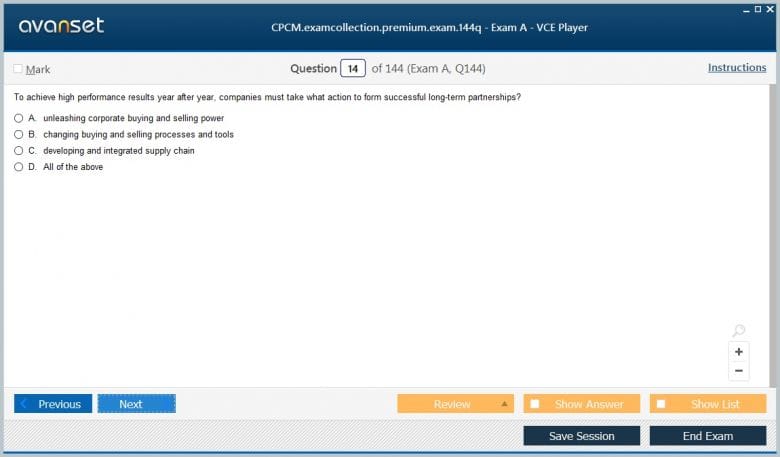
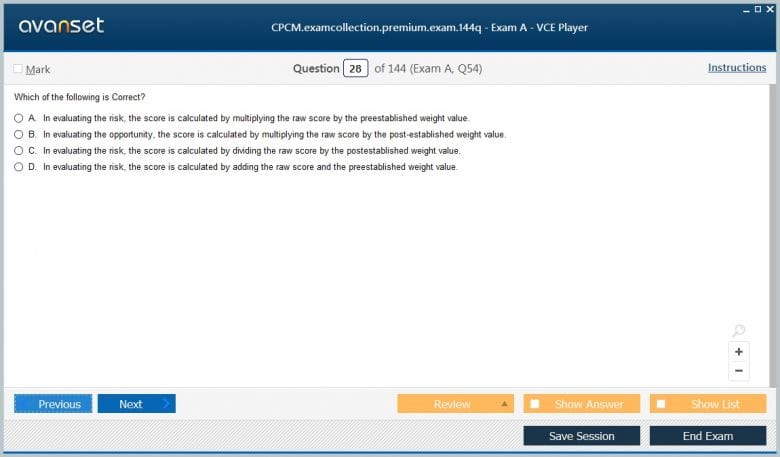
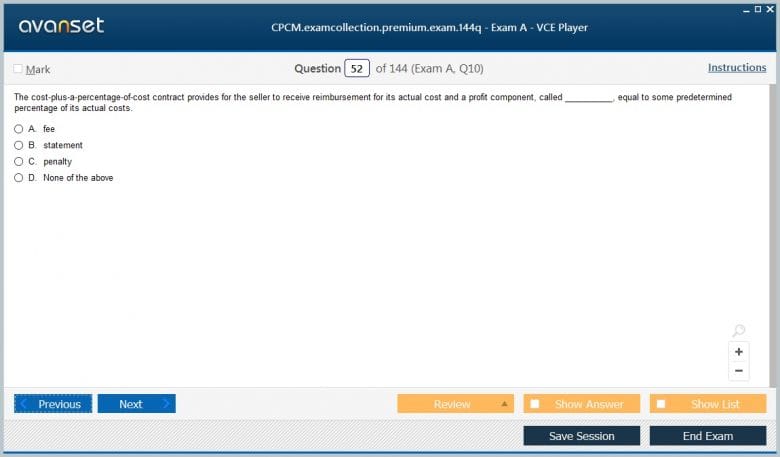
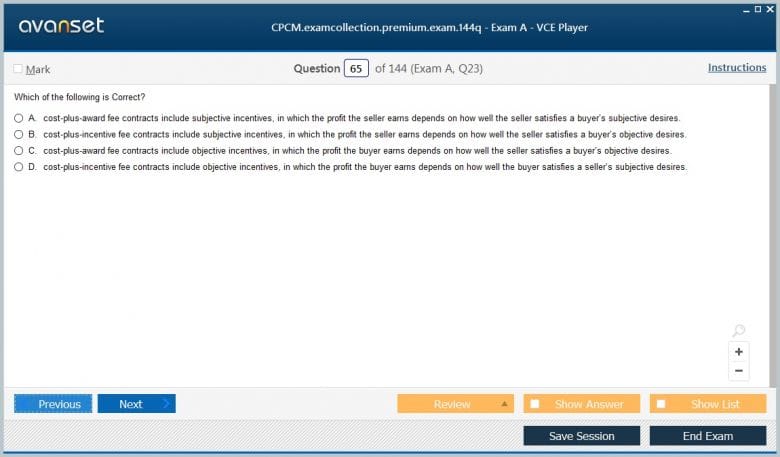
NCMA CPCM Practice Test Questions in VCE Format
| File | Votes | Size | Date |
|---|---|---|---|
File NCMA.questionspaper.CPCM.v2026-08-16.by.lucy.86q.vce |
Votes 1 |
Size 73.82 KB |
Date Aug 16, 2026 |
File NCMA.Passcertification.CPCM.v2019-03-17.by.Christopher.86q.vce |
Votes 3 |
Size 75.68 KB |
Date Mar 20, 2019 |
NCMA CPCM Practice Test Questions, Exam Dumps
NCMA CPCM (Certified Professional Contracts Manager) exam dumps vce, practice test questions, study guide & video training course to study and pass quickly and easily. NCMA CPCM Certified Professional Contracts Manager exam dumps & practice test questions and answers. You need avanset vce exam simulator in order to study the NCMA CPCM certification exam dumps & NCMA CPCM practice test questions in vce format.
The CPCM exam leads to the Certified Professional Contract Manager credential from the National Contract Management Association. NCMA describes CPCM as its pinnacle certification, based on competencies in the Contract Management Body of Knowledge and the Contract Management Standard. The current 2026 handbook specifies a four-hour examination with 180 multiple-choice questions, including 10 unscored beta items and scenario-based questions, and a passing score of 72.2 percent.
CPCM is intentionally broader than memorizing one procurement regulation. The NCMA certifications distinguish the professional credential from more environment-specific certifications. CPCM asks whether a contract manager can operate across the acquisition lifecycle, understand both buyer and seller perspectives, manage relationships and risk, interpret obligations, support negotiations, administer performance, and close the agreement responsibly.
The most useful study model is to treat a contract as a living commercial system. It begins with a business need, becomes a solicitation or opportunity, turns into negotiated commitments, is executed through performance and change, and eventually ends through completion, termination, or transition. Every stage creates information and risk that affect the next stage.
Good contract management starts before a document is drafted. Stakeholders need a clear requirement, acquisition strategy, market understanding, budget or pricing assumptions, risk allocation, schedule, evaluation approach, and governance plan. Ambiguous requirements create disputes later because the parties can perform exactly what they believed was requested and still disagree about success.
Practice converting a business request into measurable outcomes and acceptance criteria. Identify dependencies, constraints, assumptions, and information that potential suppliers need in order to price intelligently. Then ask which risks should be retained, transferred, shared, mitigated, or monitored. Risk allocation should follow the party best able to manage the risk, not simply the party with more negotiating power.
Make-or-buy and acquisition-planning decisions should also consider the organization’s ability to manage the resulting contract. A technically attractive sourcing strategy can fail if the buyer lacks the data, staff, acceptance criteria, or governance needed to administer it. Define success measures, stakeholder roles, decision rights, and information needs before solicitation. The contract-management lifecycle begins when the requirement is shaped, not when a signature appears.
Whether the environment is public or private, evaluation should connect published requirements to evidence in the proposal. Criteria, weighting, technical capability, past performance, price, risk, and commercial terms all influence the decision. The contract manager supports a process that is fair, consistent, and documented enough to withstand later scrutiny.
Build evaluation scenarios where the cheapest proposal is not the lowest-risk option. Practice explaining why a higher price might be justified by delivery capacity, warranty, lifecycle cost, service level, or risk reduction. Then consider the opposite: where attractive technical features do not justify a price premium because they do not support the actual requirement.
Evaluation discipline requires consistency between the solicitation, evaluation method, and documented decision. Criteria should be meaningful enough to separate proposals and clear enough that evaluators can apply them consistently. Price analysis, cost analysis, technical merit, risk, past performance, and commercial terms may carry different weight depending on the acquisition. The record should show how the selected offer met the stated basis rather than reconstructing a rationale after the choice was made.
Effective negotiation begins with objectives, priorities, alternatives, authorities, facts, and an understanding of the other party’s interests. Price matters, but contracts also allocate schedule risk, intellectual property, warranty, liability, payment timing, acceptance, data rights, confidentiality, change procedures, termination, and many other commercial issues.
Prepare a negotiation plan with target, minimum acceptable position, tradeable items, non-negotiable constraints, and a strong alternative if agreement is not reached. Look for trades where the parties value terms differently. A concession should ideally purchase something in return rather than being made simply to keep the discussion comfortable.
A signed document is only useful if the parties understand what they promised. Scope, deliverables, milestones, payment, acceptance, responsibilities, incorporated documents, order of precedence, change authority, and remedies should work together. Ambiguous cross-references and conflicting attachments can create expensive disputes even when each section looked reasonable in isolation.
Authority is equally important. Contract managers need to know who can bind the organization and who can merely provide technical direction. If project personnel informally order additional work without contractual authority, the organization can create performance and payment disputes. Clear governance protects both parties.
Once performance begins, the contract manager tracks obligations, deliverables, schedule, invoices, acceptance, service levels, reporting, compliance, insurance, warranties, and other commitments. The objective is not to police the supplier for minor mistakes; it is to keep the agreement aligned with business outcomes and address deviations before they become crises.
Create an obligations matrix with owner, due date, evidence, status, and escalation threshold. Include customer obligations as well as supplier obligations. Many performance problems occur because the buying organization did not provide access, decisions, data, or dependencies on time. A balanced administration process makes both sides’ responsibilities visible.
Performance management works best when evidence is collected continuously. Milestones, service levels, inspection results, invoices, deliverable acceptance, communications, risks, and corrective actions should be linked to the obligations they support. Waiting until renewal or dispute to assemble the record creates uncertainty. A contract manager should be able to answer what was promised, what happened, what was accepted, what changed, and what remains open without relying on institutional memory.
Business needs evolve, but every change can affect price, schedule, resources, risk, acceptance, and downstream obligations. A disciplined change process defines who may request a change, what analysis is required, who approves it, and when the supplier is authorized to proceed. Verbal agreement may feel efficient until the parties later remember different terms.
Practice evaluating a change request by separating the business need from the proposed solution. Determine whether the change is inside the existing scope, whether consideration or price adjustment is required, and what other clauses are affected. Update the baseline only after the authorized modification is complete.
Risks identified before award can change after performance begins, and new risks can emerge through market conditions, cybersecurity, subcontractors, supply chains, regulation, staffing, or financial stress. Contract managers should monitor leading indicators and understand which contractual rights or collaborative actions are available before failure occurs.
A risk register should connect probability and impact to an owner and response. It should also distinguish business risk from contractual remedy. Having a right to terminate does not make termination the best business outcome. Sometimes the stronger response is a corrective action plan, revised milestone, additional assurance, or negotiated restructuring.
Disagreements often turn on what the parties knew, agreed, communicated, delivered, and accepted. Good records include the executed contract, modifications, correspondence, meeting decisions, performance data, notices, invoices, acceptance evidence, and issue logs. Documentation should be created as part of normal administration, not reconstructed after a dispute begins.
When conflict emerges, separate facts from positions. Identify the contractual requirement, the actual event, the evidence, and the remedy each party believes applies. Escalate according to the agreement and organizational policy. Early, precise communication can prevent a manageable issue from becoming a legal dispute.
Completion involves more than the final invoice. Closeout may require confirming deliverables, resolving open changes or claims, releasing retained amounts, returning property, documenting intellectual-property or data obligations, recording warranties, archiving records, and transferring operational responsibilities. Some obligations survive termination or completion and must remain visible.
For study, use NCMA’s current handbook and CMBOK as the primary references, then reinforce the lifecycle with scenarios. The broader NCMA is useful, but CPCM success depends on integrating the competencies rather than treating them as independent chapters. A decision in source selection can create an administration issue; a weak change process can become a claim; a poor closeout can leave unresolved risk.
The scenario-based questions matter because contract management rarely presents perfect choices. The organization may need speed, but governance still matters. A supplier may be underperforming, but replacement may create greater operational risk. A clause may permit a remedy, but the relationship may be more valuable if the problem is corrected cooperatively.
Build practice around explaining why an action is appropriate, not merely recognizing terminology. Ask which stakeholder owns the decision, what evidence is needed, what contractual authority applies, how the action affects the other party, and what record should be created. CPCM is ultimately a lifecycle-management credential: it tests whether commercial commitments can be created, governed, changed, and completed with professional discipline.
A useful final-review technique is to work one scenario across the entire lifecycle. Start with a vague business need, choose a sourcing strategy, develop evaluation criteria, negotiate a difficult term, administer a performance problem, process a change, and close the agreement. At every stage, identify authority, evidence, risk, communication, and documentation. This exposes weak links between topics and mirrors the way contract decisions compound over time.
During revision, connect terminology to artifacts a contract manager would actually use: acquisition plans, evaluation records, negotiation memoranda, contract clauses, change documentation, performance reports, invoices, correspondence, risk registers, claim files, and closeout records. Ask what decision each artifact supports and what evidence it should contain. This artifact-based approach helps turn a broad body of knowledge into an operational lifecycle and makes scenario questions easier because you can picture the record that should exist before a professional takes action.
Go to testing centre with ease on our mind when you use NCMA CPCM vce exam dumps, practice test questions and answers. NCMA CPCM Certified Professional Contracts Manager certification practice test questions and answers, study guide, exam dumps and video training course in vce format to help you study with ease. Prepare with confidence and study using NCMA CPCM exam dumps & practice test questions and answers vce from ExamCollection.
Purchase Individually
Site Search:

SPECIAL OFFER: GET 10% OFF

Pass your Exam with ExamCollection's PREMIUM files!
SPECIAL OFFER: GET 10% OFF
Use Discount Code:
MIN10OFF
A confirmation link was sent to your e-mail.
Please check your mailbox for a message from support@examcollection.com and follow the directions.

Download Free Demo of VCE Exam Simulator
Experience Avanset VCE Exam Simulator for yourself.
Simply submit your e-mail address below to get started with our interactive software demo of your free trial.