
- Home
- Checkpoint
- CCSA R80 (Check Point Security Administration R80) Dumps
Pass Your Checkpoint CCSA R80 Certification Easy!
Checkpoint CCSA R80 Certification Exams Questions & Answers, Accurate & Verified By IT Experts
Instant Download, Free Fast Updates, 99.6% Pass Rate.

Check Point Certified Security Administrator (CCSA R80)
Includes 536 Questions & Answers
$69.99
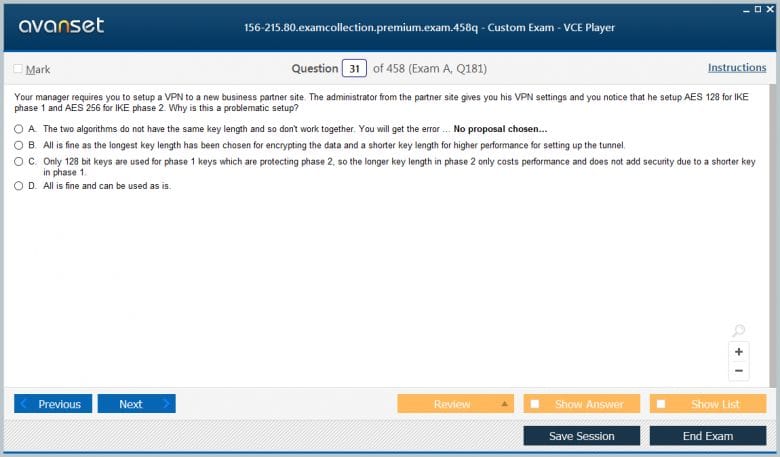
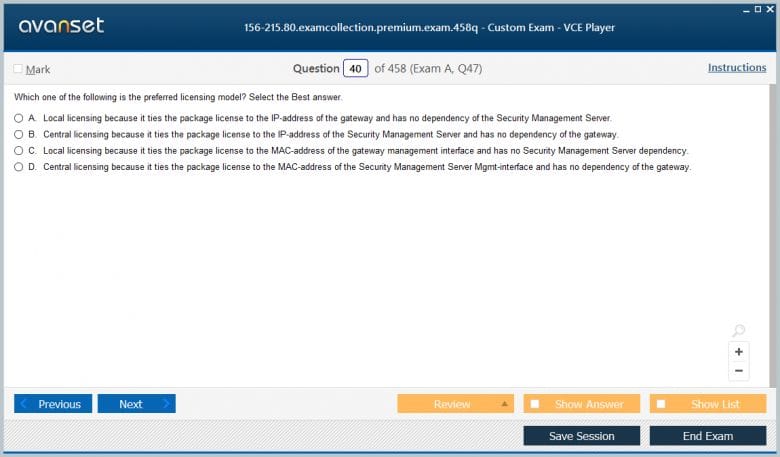
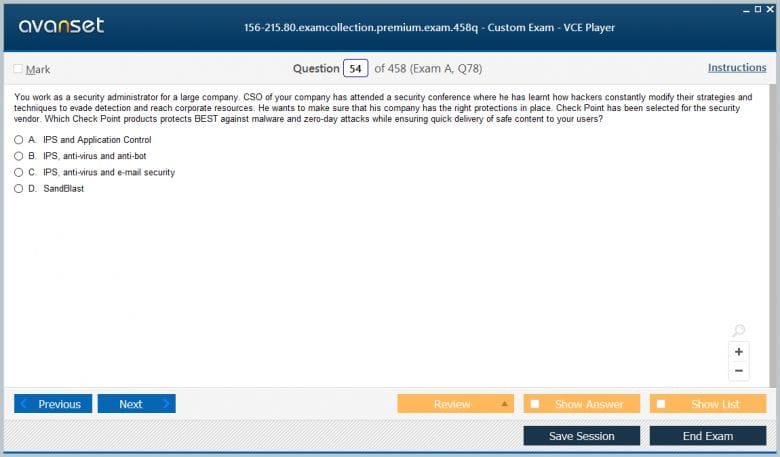
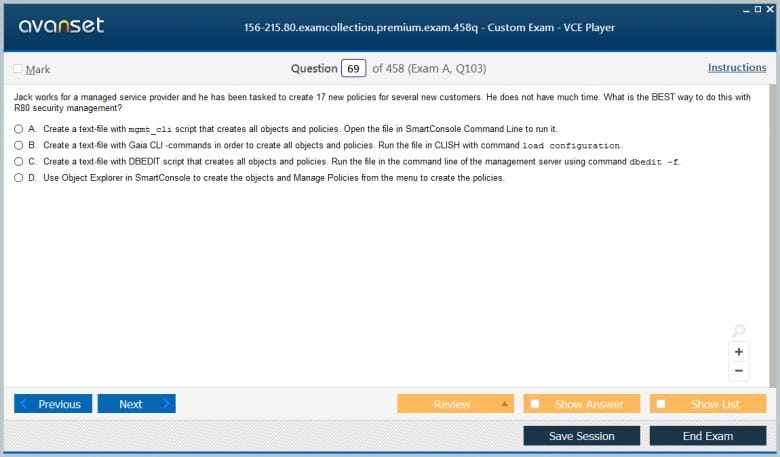
Checkpoint CCSA R80 Certification Exams Screenshots
CCSA R80 Product Reviews
Download Free CCSA R80 Practice Test Questions VCE Files
| Exam | Title | Files |
|---|---|---|
Exam 156-215.80 |
Title Check Point Certified Security Administrator (CCSA R80) |
Files 18 |
Checkpoint CCSA R80 Certification Exam Dumps & Practice Test Questions
Prepare with top-notch Checkpoint CCSA R80 certification practice test questions and answers, vce exam dumps, study guide, video training course from ExamCollection. All Checkpoint CCSA R80 certification exam dumps & practice test questions and answers are uploaded by users who have passed the exam themselves and formatted them into vce file format.
CCSA R80: What the Legacy Check Point Certification Still Teaches
Among Check Point certifications, CCSA R80 represents an earlier generation of the Certified Security Administrator pathway. Its exam, 156-215.80, was introduced for the R80 platform generation and validated the skills administrators needed to configure and manage Check Point security gateways and management systems of that era. It is now a legacy certification version: current Check Point training and testing has moved to CCSA R82 and exam 156-215.82.
That does not make R80 material meaningless. Many core ideas—stateful firewall policy, object management, NAT, logging, VPNs, identity, policy installation, and operational troubleshooting—continue to underpin Check Point administration. The important editorial distinction is time. The 156-215.80 exam documents a historical version of the credential, while new candidates should use the current 156-215.82 exam objectives for certification preparation.
Why R80 was an important platform generation
R80 marked a major change in the Check Point management experience and policy architecture compared with earlier releases. It strengthened the unified management model and made layered policy, application-aware controls, logging, and administration more central to day-to-day workflows. For many administrators, learning R80 meant learning not only new interface details but a more structured way to manage access control and threat-prevention policy.
CCSA R80 therefore focused on practical administration. Candidates needed to understand management and gateway roles, define network objects, construct access-control policy, install policy correctly, configure NAT, work with logging, and support common security features. These are durable skills because later versions build on the same operational logic even as capabilities and interfaces evolve.
The historical CCSA R80 launch is useful context for seeing how the credential was positioned when the version was current. Today it should be read as a snapshot of that generation rather than as a current exam-preparation authority.
Policy order and object quality remain timeless lessons
One of the strongest lessons from R80 is that a firewall policy is an ordered decision system. The gateway evaluates traffic against policy conditions and applies the first relevant outcome according to the rulebase structure. A broadly permissive rule can therefore undermine carefully written rules below it. A restrictive rule placed in the wrong position can break legitimate application traffic.
Good object management makes those policies readable. Hosts, networks, groups, services, and gateways should represent real entities with names and definitions another administrator can understand. Reusing a poorly defined object across many rules magnifies the problem. CCSA R80 preparation was useful because it forced candidates to connect abstract objects to the packet flows they represented.
The firewall concepts behind that behavior extend beyond Check Point. The distinction between stateful and stateless firewalling explains why a gateway can track connection state and handle return traffic differently from a simple stateless filter. Understanding the concept makes version-specific configuration easier to reason about.
NAT and routing explain many “firewall” problems
Administrators often encounter a failed connection and assume the access rule is responsible. R80 training reinforced a more disciplined approach: verify address objects, routing, NAT, interface state, and policy before changing anything. Network Address Translation can alter source or destination information, which affects how traffic is routed and how remote systems respond.
Automatic NAT provides convenience for common object-based cases, while manual NAT supports more explicit matching and translation requirements. The correct choice depends on the topology and desired behavior. Candidates should be able to follow the traffic before and after translation rather than memorize a configuration recipe.
This troubleshooting mindset remains highly transferable. If the packet never reaches the gateway, adding a rule will not help. If the route sends return traffic elsewhere, the firewall may appear to block a session it never sees completely. If NAT changes the address expected by another security control, the resulting symptom may be far from the configuration mistake.
Logging turned policy into evidence
R80 administration emphasized visibility through logs. A rulebase tells an administrator what should happen; logs show what the gateway actually observed and decided. Effective troubleshooting uses both. The administrator identifies the expected rule, filters the logs for the relevant flow, confirms the matched rule and action, and then investigates upstream or downstream components if policy is not the cause.
The general principles of firewall and router logging remain useful: timestamps must be trustworthy, filters should match the investigative question, and retention needs to reflect operational and compliance requirements. Logging should also be deliberate. Recording every possible event without a way to search or prioritize it can create volume without insight.
Historical CCSA study materials that teach candidates to read traffic logs, policy-install events, and gateway status can therefore still improve practical skills, even though the current management interface and product capabilities have moved forward.
Identity and application awareness changed policy context
Traditional firewalling makes decisions primarily from network addresses and ports. Check Point's identity and application controls expanded that context. Identity Awareness can associate traffic with users or groups, while Application Control and URL Filtering can distinguish application behavior that shares the same common ports.
These features teach an enduring security lesson: network location alone is often insufficient context for access decisions. A policy can become more meaningful when it understands who is accessing a service and what application is being used. At the same time, richer context creates more dependencies. Identity acquisition can fail, application classification can change, and HTTPS encryption can limit inspection unless the environment is configured to handle it appropriately.
R80-era administrators therefore needed both policy knowledge and troubleshooting discipline. A user-based rule that fails may not be a rule-order problem; the gateway may simply not have the expected identity. That habit of checking the data behind a policy decision remains valuable in R82 environments.
VPNs required administrators to think beyond a single gateway
VPN configuration forces several systems to agree: peer identity, encryption settings, network definitions, routing, access policy, and sometimes NAT behavior. A tunnel can establish successfully while application traffic still fails, or phase-one negotiation can fail before policy rules are relevant. CCSA R80 introduced administrators to that multi-layer troubleshooting model.
The general principles in VPN architecture and tunneling remain useful because they explain the purpose of authentication, negotiation, encryption, and encapsulation independent of the Check Point version. Product knowledge is easier to retain when candidates know which protocol problem each setting is solving.
Supporting an actual R80 environment requires historical accuracy
Legacy certification material has a second audience beyond exam history: engineers who still encounter older Check Point estates. In that setting, current R82 instructions are not automatically safer simply because they are newer. An administrator has to work from the software version actually deployed, confirm supported procedures for that release, and understand the organization's upgrade constraints. A mature environment may contain older gateways because of application dependencies, appliance lifecycle, change-control requirements, or a staged migration program.
That makes version labeling operationally important. Check Point retired the CCSA R81.20 exam (156-215.81.20) on June 30, 2026, reinforcing that R81.20 is now part of the legacy certification sequence alongside R80. Runbooks should state which software release they apply to, screenshots and command examples should be dated or versioned, and engineers should avoid mixing R80, R81.20, and R82 procedures in the same undocumented workflow. Historical knowledge becomes useful when it is precise; it becomes risky when it is treated as timeless implementation guidance.
An upgrade from an R80-era environment is not merely a certification update. It is a platform change that can affect management compatibility, gateway software, policy behavior, inspection features, logging, and operational tooling. The right approach begins with inventory: management servers, gateways, clusters, blades, VPN peers, licenses, hardware support, and integrations. From there, teams can plan sequencing, backups, compatibility checks, validation, and rollback.
Certification study benefits from the same migration mindset. Instead of asking which R80 facts should be discarded, separate stable concepts from release-specific details. Keep the packet-flow reasoning, policy discipline, NAT concepts, and troubleshooting habits. Replace the exam code, objective list, interface details, and feature assumptions with the current R82 equivalents. That is how legacy knowledge becomes a foundation rather than a source of outdated answers.
R80's place in the certification progression
When R80 was current, CCSA formed the administration foundation for more advanced Check Point work. The associated expert path was CCSE R80, which expected deeper skills around advanced configuration, VPNs, clustering, management, upgrades, and troubleshooting. That relationship is important when interpreting old certification records: CCSA R80 and CCSE R80 belong to the same historical platform generation.
The modern equivalent is different in version but similar in progression. Current candidates begin with the broader CCSA certification through its R82 implementation and can progress to CCSE R82. The current credential path should guide new exam preparation even if an organization still operates older Check Point software.
How to use R80 resources in 2026
The best use of R80 material is conceptual and environmental. If an administrator supports an actual R80 deployment, historical documentation and training can explain the behavior of that environment. If a candidate is studying for a current certification, R80 resources can reinforce fundamentals but should be checked against R82 objectives before any version-specific fact is memorized.
Create two columns in your notes: durable concept and version-specific implementation. Stateful inspection, least privilege, rule ordering, NAT reasoning, log-based troubleshooting, and VPN fundamentals belong in the durable column. Exam codes, menu locations, supported blades, interface behavior, and release-specific procedures belong in the version-specific column. That separation prevents legacy knowledge from being mistaken for current certification scope.
CCSA R80 is therefore best understood as a historical certification with continuing instructional value. It captures an important stage in Check Point administration and teaches operational habits that still matter. But certification candidates should keep the chronology explicit: 156-215.80 belongs to R80, whereas the current R82 path and 156-215.82 exam represent the active administrator certification today.
ExamCollection provides the complete prep materials in vce files format which include Checkpoint CCSA R80 certification exam dumps, practice test questions and answers, video training course and study guide which help the exam candidates to pass the exams quickly. Fast updates to Checkpoint CCSA R80 certification exam dumps, practice test questions and accurate answers vce verified by industry experts are taken from the latest pool of questions.

Checkpoint CCSA R80 Video Courses

Top Checkpoint Certifications



Top Checkpoint Certification Exams
Site Search:




The bundle is very good indeed! I bought it a couple of weeks ago and was able to pass my exam today with a really high score. I was not expected at all to score that high, but I managed to do it with your help, ExamCollection. Thank you!
I can guarantee you that the free VCE files are valid and will help you to learn the content of the CCSA R80 exam. I decided to get both the paid and free version of files to check if it works for me during my preparation days. Thankfully, the result I got for my test was astonishing. My efforts finally paid off!
The dumps that are offered on this website helped me the second time in a row. I got all the needed materials from my friend, so the dumps for the CCSA R80 test were a useful addition to my learning process. When I will come again for another exam, I will definitely buy the bundle to thank you for your hardwork!
The bundle is very good indeed! I bought it a couple of weeks ago and was able to pass my exam today with a really high score. I was not expected at all to score that high, but I managed to do it with your help, ExamCollection. Thank you!
It was an unbelievable experience! This is my first time using this type of preparation resources. I bought the bundle and a VCE reader to open the files without any problem, and this duo helped me to pass the 156-215.80 exam. The bundle really includes 534 questions, which gives the opportunity to cover various details from the exam content. Thank you, ExamCollection, for this gem!