



Premium File
122 Q&A
$76.99$69.99
IBM C9530-001 Exam Questions & Answers, Accurate & Verified By IT Experts
Instant Download, Free Fast Updates, 99.6% Pass Rate
122 Questions & Answers
Last Update: Oct 30, 2026
$69.99
IBM C9530-001 Exam Screenshots
IBM C9530-001 Practice Test Questions in VCE Format
| File | Votes | Size | Date |
|---|---|---|---|
File IBM.prep4sure.C9530-001.v2026-07-19.by.anna.73q.vce |
Votes 1 |
Size 569.51 KB |
Date Jul 19, 2026 |
File IBM.Actualtests.C9530-001.v2019-03-25.by.Dylan.48q.vce |
Votes 2 |
Size 768.02 KB |
Date Mar 28, 2019 |
IBM C9530-001 Practice Test Questions, Exam Dumps
IBM C9530-001 (IBM Integration Bus v10.0 Solution Development) exam dumps vce, practice test questions, study guide & video training course to study and pass quickly and easily. IBM C9530-001 IBM Integration Bus v10.0 Solution Development exam dumps & practice test questions and answers. You need avanset vce exam simulator in order to study the IBM C9530-001 certification exam dumps & IBM C9530-001 practice test questions in vce format.
C9530-001, IBM Integration Bus V10.0 Solution Development, is explicitly marked by IBM as withdrawn. IBM’s archived certification page says it was replaced historically by C9530-404 and describes an intermediate developer expected to build, deploy, tune, and support message-flow applications across multiple transports and formats. The modern product line has moved to IBM App Connect Enterprise, and the approved inventory contains a current ACE V12 developer exam relationship.
The exam’s strongest feature is its breadth. Development represented the largest objective area, but architecture, installation, configuration, deployment, extension, troubleshooting, tuning, and security were also tested. That reflects production integration work accurately. A message transformation is only useful if the flow can connect to real systems, survive bad data, recover from failure, expose diagnostics, scale under load, and be deployed with controlled configuration.
Before choosing nodes, describe the systems that need to communicate. Identify producer and consumer, transport, message format, ordering requirements, transaction expectations, latency, volume, security, and error behavior. A request/reply integration has different operational properties from publish/subscribe or asynchronous point-to-point messaging. Architecture choices should follow the business interaction rather than a developer’s favorite node.
IBM’s archived objectives included core IIB architecture and topologies because the runtime context shapes every flow. The broader data integration discussion is useful here: integration is not simply moving fields between systems; it is creating a dependable contract between independently changing applications and data models.
IIB V10 used applications, services, and libraries to organize deployable and reusable artifacts. Good structure makes ownership and dependencies visible. Shared libraries can reduce duplication, but they also create coupling: changing a shared definition can affect multiple consumers. Keep reuse intentional and version it carefully.
Message models are essential when data is not self-describing or when validation matters. DFDL can describe non-XML formats, while XML schemas and other definitions can formalize structured messages. A model should capture the contract accurately enough that invalid data fails predictably rather than being silently reinterpreted. Integration defects are often data-contract defects disguised as mapping problems.
The IBM blueprint referenced graphical mapping, ESQL, Java, and XSLT. These are not interchangeable merely because each can transform data. Graphical maps can make straightforward mappings accessible; ESQL is deeply integrated with message trees and flow logic; Java can support complex reusable logic; XSLT is specialized for XML transformations. Choose the approach the team can support and that expresses the transformation clearly.
Keep business rules separate from incidental format conversion where possible. A flow that mixes validation, routing, enrichment, transformation, database updates, and error recovery into one monolithic block becomes difficult to test. Use subflows or reusable components to expose responsibilities. The goal is not maximum modularity; it is a structure where failures can be located and changes do not require understanding the entire integration estate.
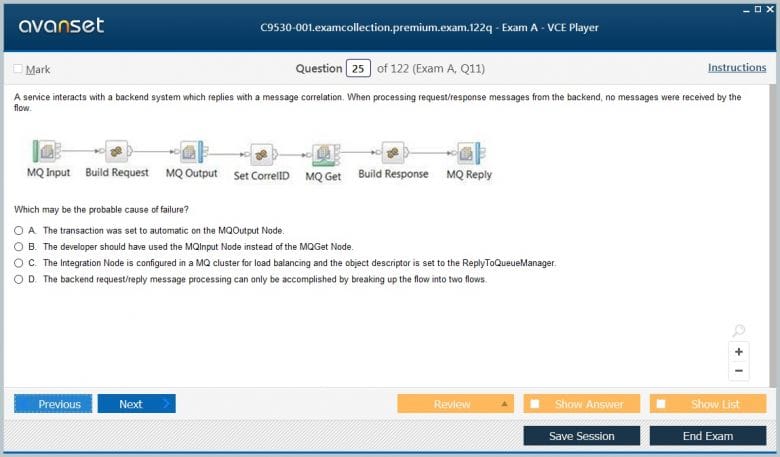
IIB supported point-to-point, publish/subscribe, request/reply, fan-out, collection, decision, and other routing patterns. Each pattern changes delivery, ordering, timeout, and recovery considerations. A synchronous request can tie client availability to a back-end service. Asynchronous messaging can decouple availability but requires durable queues, correlation, retry strategy, and eventual error handling.
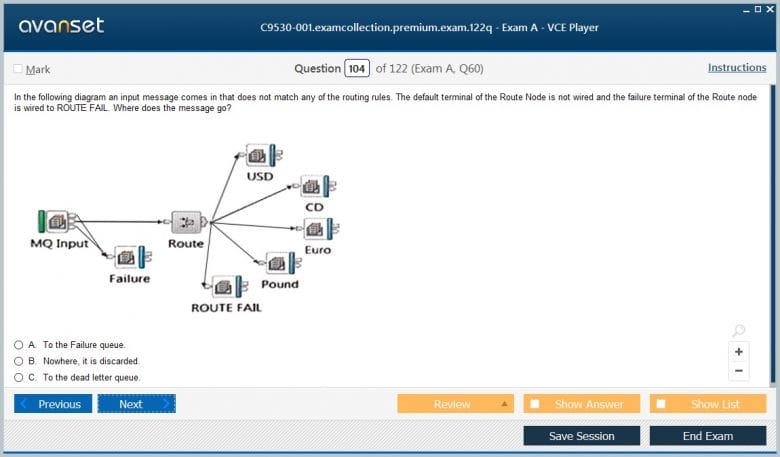
Design the failure path at the same time as the success path. What happens when a target is unavailable? Is the message retried, moved to an error queue, returned to the caller, or stored for later repair? How are duplicate deliveries handled? How is a partial fan-out reconciled? These questions determine whether integration remains trustworthy under stress.
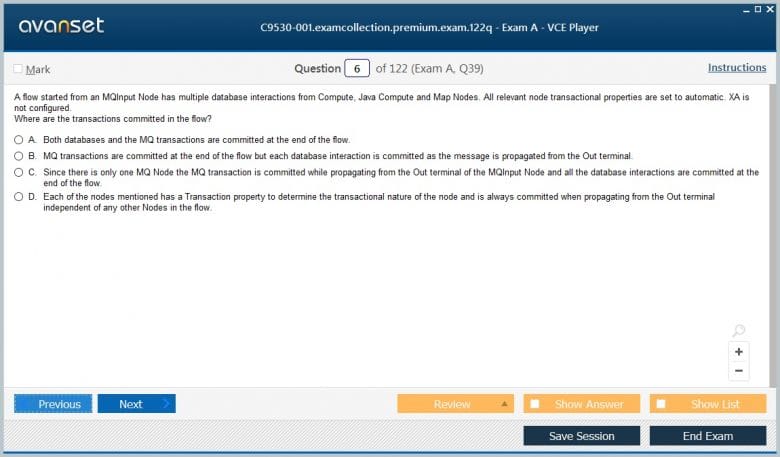
An integration flow may read from MQ, update a database, call a service, and write another message. Not all resources can participate in the same transaction, and not every interaction should. The developer needs to decide what must succeed or fail together and what can be compensated later. Transaction boundaries should align with business consistency, not simply with the boundaries of one message flow.
Idempotency is important when retries are possible. If the same message is processed twice, can the target safely recognize the duplicate? A retry strategy without duplicate protection can turn a temporary timeout into duplicate orders, payments, or updates. Store correlation identifiers and design downstream operations so support teams can reconstruct what happened.
IBM’s objectives covered assembling and deploying applications, configurable services, user-defined properties, deployment properties, and the web administration console. The architectural lesson is separation. Endpoint hostnames, queue names, credentials, database connections, and operational thresholds should not require editing transformation logic for every environment.
Package known artifacts, externalize environment-specific values, and promote them through test stages with validation. Record what version was deployed and which configuration accompanied it. A deployment is complete only when the flow connects to expected dependencies, security works, and a representative message can pass through the intended route.
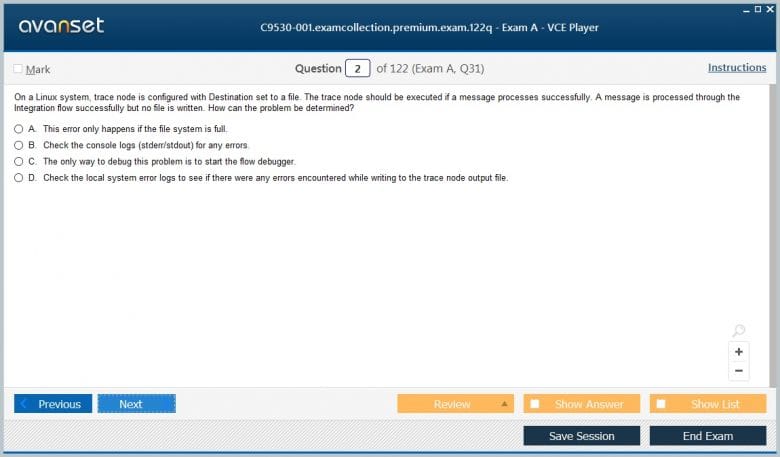
The archived exam devoted a substantial share to troubleshooting and tuning. Tools included the flow exerciser, debugger, trace nodes, user trace, logging, Record & Replay, message-flow statistics, and resource statistics. These tools answer different questions. Use a debugger or flow exerciser to understand logic in controlled conditions; use targeted traces to inspect runtime behavior; use statistics to find throughput or resource constraints.
Production support starts with a message identifier, timestamp, flow, integration server, input transport, and expected output. Follow that message through logs and downstream systems. Avoid logging sensitive payloads indiscriminately. The principles in modern monitoring still apply: diagnostics are most useful when normal behavior is measured and failures can be correlated across components.
Workload management, additional instances, multithreading, caching, database behavior, MQ configuration, and transformation cost can influence throughput. Measure before changing concurrency. More flow instances can improve throughput until a shared database, queue, CPU, or downstream API becomes the bottleneck. At that point more concurrency can increase queueing and failure.
Separate latency from throughput. A flow may process many messages per second while individual requests are too slow, or it may have excellent response time at low volume but collapse under load. Use representative message sizes and distributions in performance tests. Also validate ordering and transaction behavior after tuning; a faster flow that violates required sequence or duplicate handling is not an improvement.
Integration flows can carry credentials, personal data, financial messages, and privileged commands. Secure transport, authenticate endpoints, authorize administrative access, protect stored credentials, and validate untrusted input. IBM’s exam objectives included basic security and the PEP node, reinforcing that policy enforcement is part of solution development rather than a separate appliance concern.
API-style integrations make contract and security design particularly visible. The broader discussion of modern APIs is useful for thinking about versioning, consumers, interfaces, and governance. Whether the transport is HTTP, JMS, or MQ, the integration layer should expose only the capabilities and data that consumers actually require.
External resources and adapters need explicit connection contracts. IIB flows often depend on IBM MQ, databases, web services, JCA adapters, registries, or other enterprise systems. Connection details, credentials, retry behavior, transaction participation, and failure semantics should be documented for each dependency. A flow that transforms data correctly can still be unreliable if its database pool is exhausted or an adapter retries indefinitely after a remote outage.
Test resource failure intentionally. Stop a target service, expire a credential in a non-production environment, delay a response, or provide malformed data and observe what the flow does. The goal is to make failure predictable: messages should be retained or routed appropriately, support teams should receive useful evidence, and recovery should not require guessing which transactions completed.
The product name changed, but the integration engineering role continued. The approved site inventory includes IBM Integration Bus V10 certification context, which is useful for the historical generation. More importantly, it also contains C1000-171, IBM App Connect Enterprise V12.0 Developer. IBM community and training information identify ACE V12 as the current developer certification path, providing a clear forward relationship without pretending the old IIB exam remains active.
Observability should be designed into flows before production. Use correlation identifiers, meaningful error messages, bounded payload logging, and metrics that show throughput, latency, failures, retries, and queueing. Support staff should be able to move from a business transaction to the relevant flow instance without searching every log manually. This is especially important in integration estates where one transaction crosses several independent systems.
Do not assume every IIB V10 node, administration command, or deployment practice transfers unchanged into ACE V12. Use current product documentation for exact implementation. What does transfer is the engineering discipline: define contracts, choose routing and transaction patterns deliberately, externalize configuration, build failure handling, instrument flows, and prove behavior under load.
The transition visible across IBM certifications is from the Integration Bus exam generation toward App Connect Enterprise. A strong integration developer can explain not only how a message is transformed, but also how it is secured, routed, retried, traced, scaled, and recovered when one of the connected systems fails.
Go to testing centre with ease on our mind when you use IBM C9530-001 vce exam dumps, practice test questions and answers. IBM C9530-001 IBM Integration Bus v10.0 Solution Development certification practice test questions and answers, study guide, exam dumps and video training course in vce format to help you study with ease. Prepare with confidence and study using IBM C9530-001 exam dumps & practice test questions and answers vce from ExamCollection.
Purchase Individually
Site Search:

SPECIAL OFFER: GET 10% OFF

Pass your Exam with ExamCollection's PREMIUM files!
SPECIAL OFFER: GET 10% OFF
Use Discount Code:
MIN10OFF
A confirmation link was sent to your e-mail.
Please check your mailbox for a message from support@examcollection.com and follow the directions.

Download Free Demo of VCE Exam Simulator
Experience Avanset VCE Exam Simulator for yourself.
Simply submit your e-mail address below to get started with our interactive software demo of your free trial.