



Premium File
60 Q&A
$76.99$69.99
IBM C2090-623 Exam Questions & Answers, Accurate & Verified By IT Experts
Instant Download, Free Fast Updates, 99.6% Pass Rate
60 Questions & Answers
Last Update: Sep 21, 2026
$69.99
IBM C2090-623 Exam Screenshots
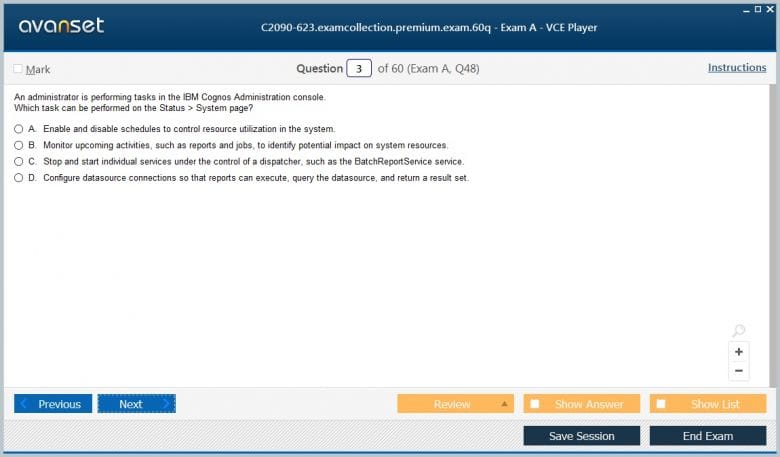
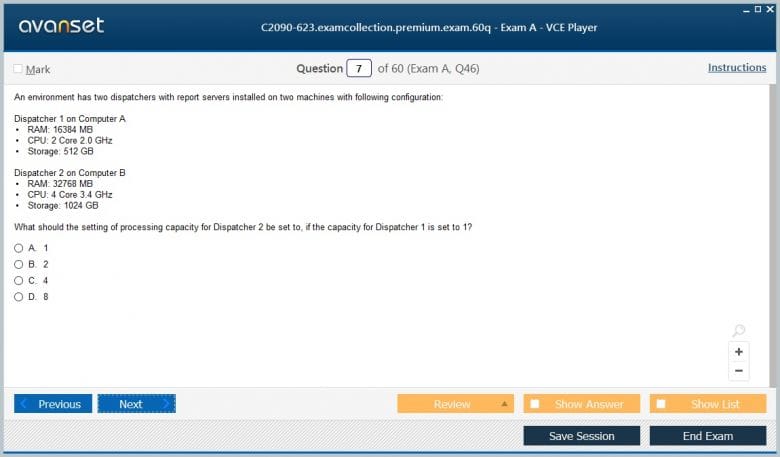
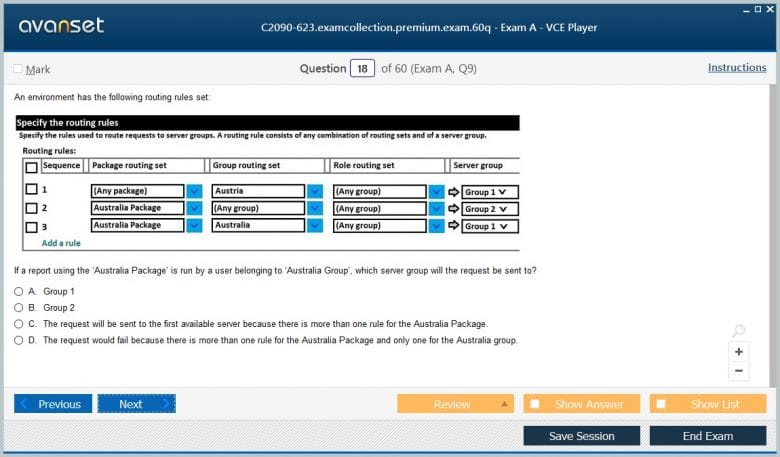
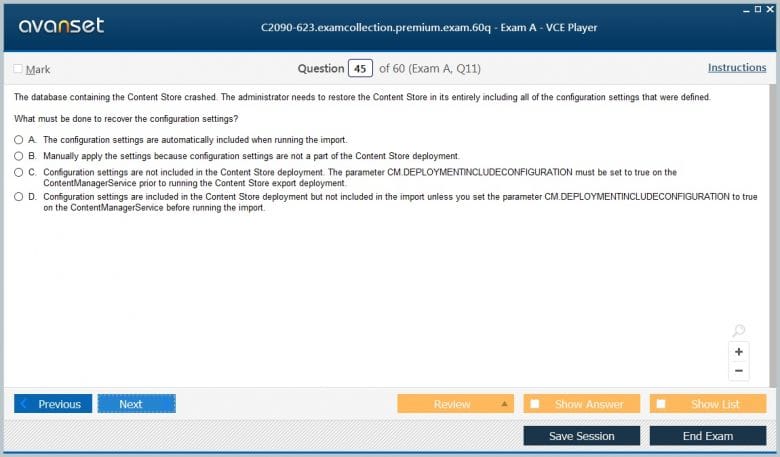
IBM C2090-623 Practice Test Questions in VCE Format
| File | Votes | Size | Date |
|---|---|---|---|
File IBM.selftestengine.C2090-623.v2026-07-19.by.hamza.28q.vce |
Votes 1 |
Size 247.17 KB |
Date Jul 21, 2026 |
File IBM.Passcertification.C2090-623.v2019-03-08.by.Francesco.38q.vce |
Votes 3 |
Size 265.14 KB |
Date Mar 10, 2019 |
IBM C2090-623 Practice Test Questions, Exam Dumps
IBM C2090-623 (IBM Cognos Analytics Administrator V11) exam dumps vce, practice test questions, study guide & video training course to study and pass quickly and easily. IBM C2090-623 IBM Cognos Analytics Administrator V11 exam dumps & practice test questions and answers. You need avanset vce exam simulator in order to study the IBM C2090-623 certification exam dumps & IBM C2090-623 practice test questions in vce format.
C2090-623, IBM Cognos Analytics Administrator V11, belongs to an earlier Cognos certification generation. IBM community discussions from the period show candidates taking the V11 administrator exam, while IBM’s current certification catalog has moved to a Cognos Analytics v12 Administrator credential. The useful way to study C2090-623 now is therefore historical and architectural: understand what an administrator had to keep stable, secure, observable, and recoverable in a shared analytics environment.
Cognos administration sits between infrastructure and business intelligence. Reports, dashboards, packages, data sources, schedules, users, security namespaces, gateways, dispatchers, content, and configuration all have to cooperate. A report problem might originate in the data source, permissions, a package, a dispatcher, a schedule, network connectivity, or resource pressure. Administrators need a system view that can separate those layers before changing anything.
Start by mapping how a user request moves through Cognos Analytics. The browser reaches a gateway or web tier, services process the request, content and configuration are consulted, queries reach data sources, and output returns to the user. Depending on topology, multiple dispatchers or servers may share work. The point of learning components is not to memorize a diagram; it is to know where a failure can occur and which evidence belongs to each component.
Build troubleshooting cases around the path. If login succeeds but a report fails, authentication may not be the primary problem. If one report is slow while others are healthy, investigate its query, data source, package, or execution characteristics before restarting services. If a whole environment becomes unavailable, start with platform-wide dependencies. Good administration narrows the blast radius before taking action.
Administrators need to understand where configuration is stored, how components discover and trust one another, and how environment-specific values such as URLs, ports, namespaces, data-source connections, and cryptographic settings are maintained. A configuration that works on one server may fail after a move if hostnames, certificates, firewall rules, or service accounts are different. Documentation of these dependencies is as important as the initial installation.
Change control should include configuration exports or backups, a record of the prior state, and a test that validates the complete user path after modification. Upgrades and fixes need the same discipline. It is not enough for services to start; schedules, data-source connectivity, authentication, content access, rendering, and integration points should all be verified. That operational habit remains relevant when moving from V11 thinking to the current V12 administration model.
Cognos content includes reports, dashboards, folders, packages, schedules, prompts, outputs, and other artifacts that users depend on. Administrators manage more than file-like objects. They must preserve ownership, permissions, deployment relationships, and the structure that lets users find trusted content. Uncontrolled duplication can make it difficult to know which report is authoritative, while aggressive cleanup can remove dependencies that a scheduled process still uses.
Content moves between environments, so deployment planning should account for source and target differences. Namespaces, data-source names, permissions, and configuration can vary. A deployment should be reviewed after import rather than assumed to be complete. The general ideas in data analytics help explain why this matters: analytics only creates value when consumers can trust the information and the process that produced it.
Cognos environments often integrate with external authentication providers and then apply platform authorization to folders, reports, data, and administrative functions. Administrators should distinguish authentication from authorization. The namespace may establish identity, but Cognos permissions determine what that identity can see or execute. Groups and roles make policy manageable; direct user grants can become difficult to audit as the organization changes.
Test security from the user’s perspective. A person may authenticate successfully but still lack access to a package or report. Conversely, an overly broad inherited permission may expose content unintentionally. The principles in access control and accountability are useful here: administrators need both least-privilege design and enough logging to explain who changed or used sensitive resources.
Reports are only as reliable as their connection to underlying data. Administrators configure or support data-source connections, credentials, drivers, connection pools, and tests. A successful connection test does not prove every report will perform well, but a failed connection can immediately narrow the problem. When multiple reports against one source fail at the same time, that shared dependency becomes a stronger suspect than the Cognos rendering layer.
Performance investigation should include the database side as well as Cognos. Long-running queries, contention, poor indexes, stale statistics, or network latency can surface as “Cognos is slow.” Conversely, overloaded dispatchers or inefficient scheduling can make healthy databases appear slow. The platform administrator’s job is to collect enough evidence to route the problem correctly rather than assigning blame based on where users first notice it.
Scheduled reports, jobs, bursts, and deliveries concentrate work into predictable windows. Administrators should understand concurrency, queues, priorities, output handling, credentials, and failure notification. A report that completes quickly for one interactive user may become expensive when hundreds of scheduled instances start together. Capacity planning therefore needs the schedule as well as average daytime usage.
Review failed and delayed schedules for patterns. A repeated failure at the same time can indicate contention, maintenance, credential expiry, or a data-source availability window. A growing queue can signal resource saturation. Monitoring should connect platform metrics with the business schedule so that administrators can tell the difference between expected peaks and abnormal behavior. Generic monitoring principles such as those described in modern monitoring are helpful even when the Cognos tools themselves are different: observe service health, workload, and change over time.
Logs are most useful when administrators know what question they are trying to answer. Authentication errors, dispatcher failures, data-source errors, report execution messages, and configuration problems leave different evidence. Collect timestamps, user or request identifiers, affected services, and recent changes. Avoid turning on maximum tracing everywhere as a first response; excessive detail can add overhead and obscure the useful signal.
Audit data can support usage analysis as well as incident investigation. Which reports are heavily used? Which schedules consume capacity? Which content is abandoned? Which users or teams depend on a service that is planned for change? These questions make platform administration more proactive. Usage evidence can guide cleanup and capacity decisions without treating popularity alone as proof of business value.
Performance problems can involve server resources, service configuration, report design, data-source queries, caches, schedules, or network paths. Tuning should start with a reproducible workload and a baseline. Change one meaningful factor, measure again, and keep a rollback path. A global setting that speeds one workload may harm another, so broad configuration changes need evidence.
Current Cognos administration continues to emphasize monitoring, troubleshooting, performance tuning, security, and server/content administration, even though the credential generation has changed. That continuity is useful: C2090-623 can still teach the operating model, but exact screens and defaults should be checked against the version actually deployed.
The Cognos content store, configuration, cryptographic material, deployment archives, and related platform dependencies need an explicit recovery plan. Backing up only report output is not enough, and backing up a database without knowing how it relates to the application tier can still leave a difficult restore. Administrators should document what must be recovered together, what can be recreated, and which credentials or keys are required before a restored environment can serve users safely.
Lifecycle planning also reduces surprise. Operating systems, browsers, database drivers, authentication providers, Java levels, and Cognos fixes have their own compatibility constraints. Before a platform upgrade, inventory those dependencies and test representative workloads. The goal is not merely to get the new version installed; it is to prove that business reports, schedules, security, and data connections still work. Recovery planning and upgrade planning are two sides of the same responsibility: knowing how to return the analytics service to a trusted state.
Administrative maturity also means knowing which actions belong to the platform team and which belong to report authors, database teams, identity teams, or network operations. Clear ownership shortens incidents because evidence reaches the right specialist quickly. Define escalation paths for authentication, data-source, content, infrastructure, and performance issues, and preserve enough shared documentation that one team can describe the problem without requiring every other team to rediscover the environment.
The historical exam is best understood as a platform-administration credential, not simply a reporting test. A capable administrator can trace a request, separate content from infrastructure problems, protect access, manage scheduled demand, and make changes without destroying evidence. Those habits remain valuable across Cognos versions.
Across IBM certifications, the V11 administrator exam now serves as historical Cognos context rather than a current enrollment path. For current credentialing, IBM now describes a Cognos Analytics v12 Administrator role. The internal inventory does not contain a dedicated v12 exam destination, so it is better to state that transition clearly than manufacture a link to an unrelated exam.
Go to testing centre with ease on our mind when you use IBM C2090-623 vce exam dumps, practice test questions and answers. IBM C2090-623 IBM Cognos Analytics Administrator V11 certification practice test questions and answers, study guide, exam dumps and video training course in vce format to help you study with ease. Prepare with confidence and study using IBM C2090-623 exam dumps & practice test questions and answers vce from ExamCollection.
Purchase Individually
Site Search:

SPECIAL OFFER: GET 10% OFF

Pass your Exam with ExamCollection's PREMIUM files!
SPECIAL OFFER: GET 10% OFF
Use Discount Code:
MIN10OFF
A confirmation link was sent to your e-mail.
Please check your mailbox for a message from support@examcollection.com and follow the directions.

Download Free Demo of VCE Exam Simulator
Experience Avanset VCE Exam Simulator for yourself.
Simply submit your e-mail address below to get started with our interactive software demo of your free trial.