



Premium File
63 Q&A
$76.99$69.99
IBM C2090-616 Exam Questions & Answers, Accurate & Verified By IT Experts
Instant Download, Free Fast Updates, 99.6% Pass Rate
63 Questions & Answers
Last Update: Oct 21, 2026
$69.99
IBM C2090-616 Exam Screenshots
IBM C2090-616 Practice Test Questions in VCE Format
| File | Votes | Size | Date |
|---|---|---|---|
File IBM.braindumps.C2090-616.v2026-07-22.by.jasmine.34q.vce |
Votes 1 |
Size 51.25 KB |
Date Jul 22, 2026 |
File IBM.Test4prep.C2090-616.v2019-03-04.by.Horacio.39q.vce |
Votes 5 |
Size 52.34 KB |
Date Mar 10, 2019 |
IBM C2090-616 Practice Test Questions, Exam Dumps
IBM C2090-616 (DB2 11.1 Fundamentals for LUW) exam dumps vce, practice test questions, study guide & video training course to study and pass quickly and easily. IBM C2090-616 DB2 11.1 Fundamentals for LUW exam dumps & practice test questions and answers. You need avanset vce exam simulator in order to study the IBM C2090-616 certification exam dumps & IBM C2090-616 practice test questions in vce format.
C2090-616, DB2 11.1 Fundamentals for LUW, was positioned by IBM as the entry point into the Db2 11.1 Linux, UNIX, and Windows certification path. IBM’s historical training roadmap placed the exam before the deeper DBA test, and IBM community guidance described the target candidate as someone who understood basic day-to-day administration, SQL, database objects, security, and transaction isolation. That makes this a fundamentals exam in the real sense: it tests whether the pieces of a relational database fit together coherently.
The code is now historical, so preparation should not be framed as a current credential recommendation. Its blueprint is still useful for learning how Db2 works. A beginner should leave the topic able to explain what the product does, how data is organized, how SQL changes or retrieves that data, how transactions protect consistency, and how access is controlled. Those relationships matter more than memorizing menus or command switches.
Db2 manages structured data while coordinating concurrency, recovery, security, optimization, and persistent storage. That sentence contains most of the exam’s conceptual terrain. The database is not simply a set of files, and SQL is not simply a way to look up rows. Db2 maintains metadata, enforces rules, logs changes, chooses access paths, resolves simultaneous activity, and exposes administrative controls that let applications share data safely.
Build the initial mental model from instance to database to schema to object. Understand where tables, views, indexes, sequences, routines, triggers, and packages fit. Then map each object to a purpose. A table stores base data; a view can present a controlled logical projection; an index supports access and constraints; a trigger reacts to data events; a routine packages reusable logic. When an exam scenario names an object, first ask why that object exists.
Rows and columns are only useful when their meaning is stable. Keys identify entities, foreign keys express relationships, nullability controls whether values may be absent, and constraints prevent invalid states. Data types matter because they define valid values, storage behavior, comparison rules, and sometimes function compatibility. Fundamentals preparation should include creating objects and predicting what happens when data violates a rule.
Indexes are often introduced as a performance feature, but they also participate in uniqueness and influence how the optimizer reaches data. A useful beginner exercise is to compare a table scan with indexed access and then ask what the index costs during inserts or updates. The discussion in SQL database integrity extends the same idea: dependable systems are built by enforcing valid state, not by hoping every application always behaves correctly.
SELECT, INSERT, UPDATE, and DELETE are the visible center of relational work, but each statement operates inside a transaction context. Candidates should be comfortable filtering rows, joining tables, grouping results, using aggregate functions, sorting output, and understanding how predicates change the result set. Equally important, they should recognize the difference between changing data and making that change durable.
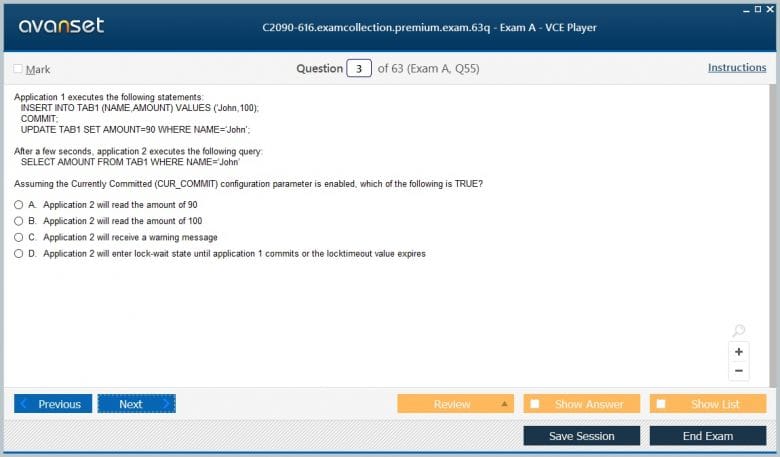
COMMIT establishes a transaction boundary; ROLLBACK abandons work that has not been committed. SAVEPOINT can create a finer recovery point within a unit of work, and autocommit changes how application statements are grouped. These controls are not exam trivia. They determine whether a multi-step business operation is applied completely or left in an inconsistent intermediate state. A basic SQL reference such as common SQL queries can help with syntax, but transaction reasoning is what turns syntax into safe application behavior.
Databases become interesting when many sessions operate at the same time. Isolation controls which changes one unit of work may observe from another and how much locking or waiting is required to preserve the chosen guarantee. Beginners should be able to reason about dirty reads, nonrepeatable reads, phantoms, lock waits, and the trade-off between concurrency and consistency without reducing the topic to acronym memorization.
Ask scenario questions. If a report needs a stable answer while transactions continue, what level of consistency is required? If an application reads a row and later updates it, what can change in between? If a long-running transaction holds locks for too long, what happens to other work? These questions make isolation concrete. The goal is to choose behavior that matches the business operation rather than always selecting the strongest or weakest setting.
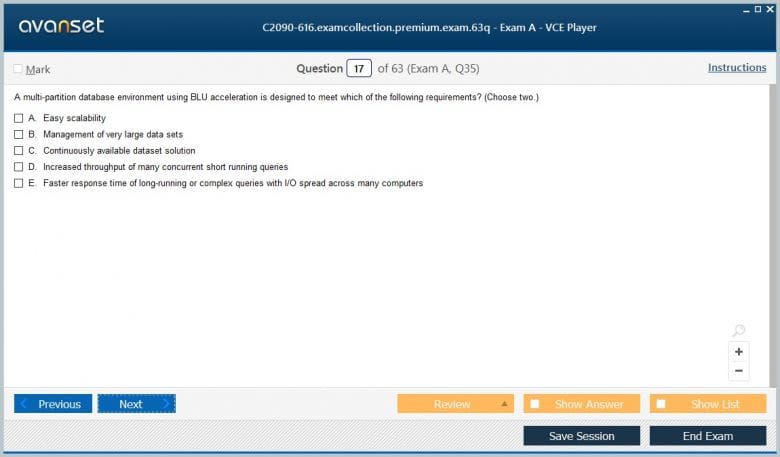
Db2 11.1 supported more than one physical and logical way to organize data. Historical study objectives included concepts such as range partitioning, multidimensional clustering, insert-time clustering, materialized query tables, temporal data, and BLU Acceleration. A fundamentals candidate did not need to be an expert in every advanced feature, but did need to recognize the problem each feature addressed and when it could change administration or query behavior.
That distinction is useful when reading product material today. A feature name should trigger questions about workload shape: transactional or analytical, high insert volume or stable history, predictable partition key or multidimensional access, current-state reporting or time-aware analysis. The broader comparison of relational and NoSQL data models also helps place Db2 in context: relational systems trade on structured schema, transactional guarantees, and powerful declarative querying.
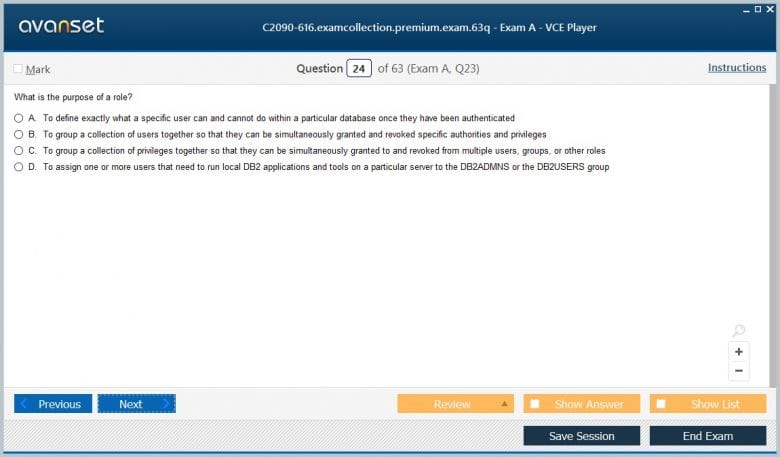
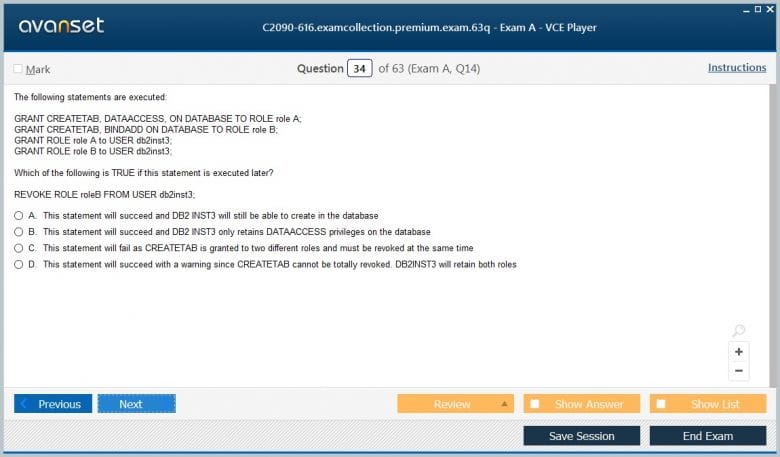
A database needs to know who is connecting and then decide what that identity may do. Db2 uses authorities, privileges, roles, and object ownership to express access. A beginner should distinguish system-level administrative capabilities from privileges on a particular database object. Granting SELECT on a table is conceptually different from granting an authority that can administer the database.
Features such as row and column access control or label-based access control add finer policy layers in environments that need them. The important study habit is to map security controls to the data they protect and to the identities that require access. Access control and accountability provides a useful general security lens: least privilege is stronger when access is understandable and actions can be traced.
Even an entry-level database user benefits from understanding configuration, backup, logging, and basic monitoring. A database can be logically well designed and still fail because storage fills, logs are mishandled, permissions drift, or no tested backup exists. Learn what administrators are trying to preserve: availability, recoverability, performance, integrity, and controlled access.
Backup and recovery deserve special attention because they clarify the difference between data existing now and data being recoverable after an incident. Image copies and logs support different recovery actions, and retention choices influence how far back the organization can go. The database recovery planning discussion is useful background for understanding why a backup schedule is only one part of a recovery strategy.
The historical IBM roadmap connected C2090-616 with deeper administration study, including Db2 11.1 DBA for LUW. That relationship is pedagogically useful even though both codes belong to an older certification generation. Fundamentals should give you the vocabulary and system model needed to reason about monitoring, utilities, high availability, workload management, tuning, and recovery at a professional DBA level.
Do not rush past fundamentals because advanced features appear more impressive. Production incidents are frequently rooted in basic misunderstandings: transaction boundaries, privileges, object dependencies, locking, statistics, or recovery assumptions. If you can explain those mechanisms clearly and predict their consequences, you have the base needed for more advanced Db2 work.
Db2 fundamentals also include programmable database behavior. Stored procedures, user-defined functions, and triggers move some logic close to the data. They can reduce application duplication or enforce consistent behavior, but they also create dependencies that administrators and developers must be able to find. A trigger that changes another table may surprise an application that expects one statement to affect one object. A routine can simplify a client while requiring careful authority and deployment management. Learn what each mechanism contributes before learning syntax.
Structured data in Db2 is not limited to conventional scalar columns. Historical objectives included XML and related query capabilities, reminding candidates that relational engines can manage more than one representation. The practical lesson is to choose a model that fits access and integrity needs. XML support does not eliminate relational design, and relational tables do not make every semi-structured problem simple. Fundamentals should make you comfortable asking how the data is stored, indexed, validated, queried, and moved between applications.
Product awareness is part of fundamentals too. Db2 11.1 existed in an ecosystem that included drivers, client connectivity, tooling, and options for transactional, warehouse, and hybrid workloads. A beginner does not need to memorize packaging, but should recognize that an application reaches the database through supported interfaces and that deployment choices affect administration. When a connectivity problem appears, identify the driver, server endpoint, authentication path, and database alias before assuming the SQL itself is wrong.
In the wider history of IBM certifications, C2090-616 belongs to the Db2 11.1 LUW generation; current Db2 documentation should govern present-day product syntax and support. The exam’s lasting lesson is that relational systems become much easier to manage when objects, SQL, transactions, security, and operations are learned as one connected model.
Go to testing centre with ease on our mind when you use IBM C2090-616 vce exam dumps, practice test questions and answers. IBM C2090-616 DB2 11.1 Fundamentals for LUW certification practice test questions and answers, study guide, exam dumps and video training course in vce format to help you study with ease. Prepare with confidence and study using IBM C2090-616 exam dumps & practice test questions and answers vce from ExamCollection.
Purchase Individually
Site Search:

SPECIAL OFFER: GET 10% OFF

Pass your Exam with ExamCollection's PREMIUM files!
SPECIAL OFFER: GET 10% OFF
Use Discount Code:
MIN10OFF
A confirmation link was sent to your e-mail.
Please check your mailbox for a message from support@examcollection.com and follow the directions.

Download Free Demo of VCE Exam Simulator
Experience Avanset VCE Exam Simulator for yourself.
Simply submit your e-mail address below to get started with our interactive software demo of your free trial.
I need test for C2090-616 - DB2 11.1 Fundamentals for LUW