



Premium File
60 Q&A
$76.99$69.99
IBM C2090-600 Exam Questions & Answers, Accurate & Verified By IT Experts
Instant Download, Free Fast Updates, 99.6% Pass Rate
60 Questions & Answers
Last Update: Sep 24, 2026
$69.99
IBM C2090-600 Exam Screenshots
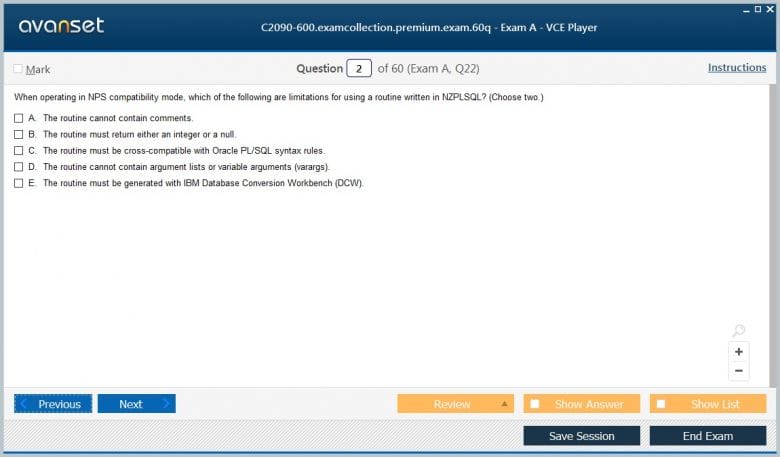
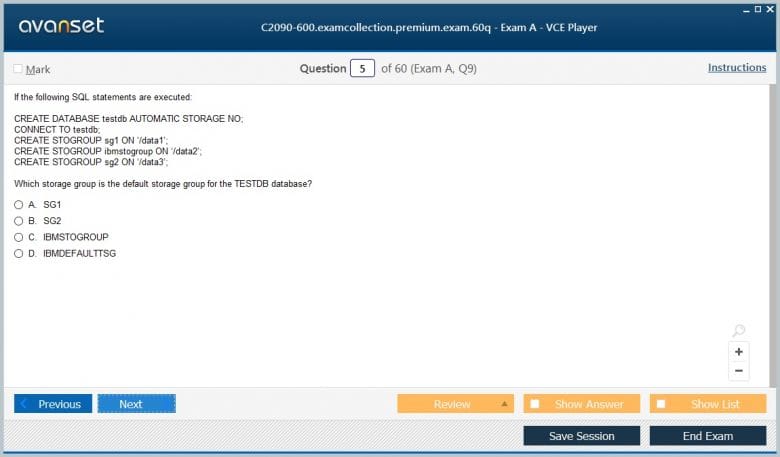
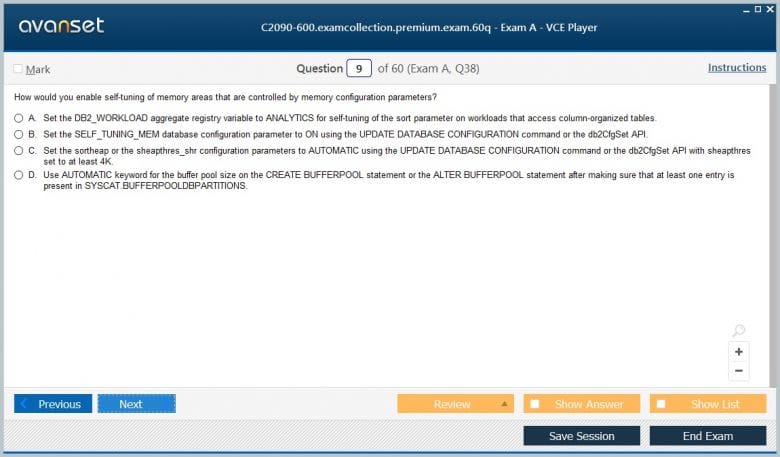
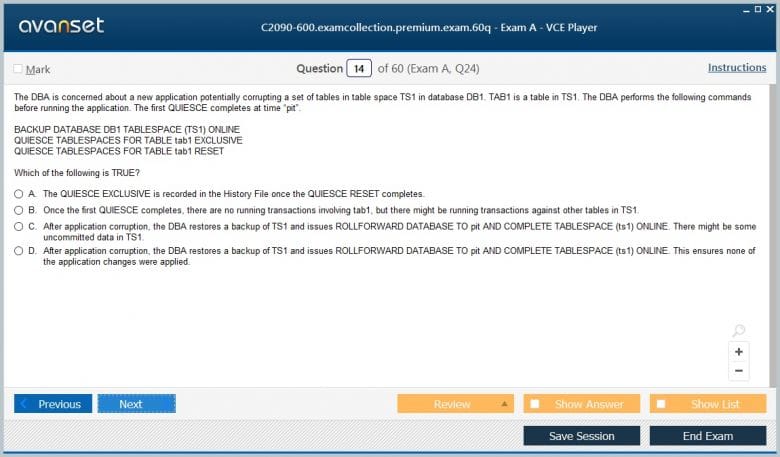
IBM C2090-600 Practice Test Questions in VCE Format
| File | Votes | Size | Date |
|---|---|---|---|
File IBM.Test4prep.C2090-600.v2026-10-13.by.Roberta.33q.vce |
Votes 3 |
Size 146.13 KB |
Date Oct 17, 2026 |
IBM C2090-600 Practice Test Questions, Exam Dumps
IBM C2090-600 (IBM DB2 11.1 DBA for LUW) exam dumps vce, practice test questions, study guide & video training course to study and pass quickly and easily. IBM C2090-600 IBM DB2 11.1 DBA for LUW exam dumps & practice test questions and answers. You need avanset vce exam simulator in order to study the IBM C2090-600 certification exam dumps & IBM C2090-600 practice test questions in vce format.
C2090-600, IBM DB2 11.1 DBA for LUW, belongs to an older Db2 certification generation. IBM’s historical training roadmap placed it after the Db2 11.1 fundamentals route and advanced administration study, so the exam was aimed at practitioners who could move beyond definitions into day-to-day database operations. Treating the code as legacy is important: the durable value is in the DBA reasoning it tested, not in presenting C2090-600 as a current credential.
The exam’s subject is still a useful way to organize production database knowledge. A Db2 administrator has to connect configuration, storage, workload management, monitoring, backup and recovery, security, SQL behavior, and availability. Those areas interact. A tuning change can affect memory pressure; a storage decision can alter utility duration; a recovery design can fail if logs or image copies are not available when needed. The strongest preparation therefore starts with operational consequences rather than isolated commands.
A Db2 LUW environment has layers: the operating system, Db2 instance, databases, buffer pools, table spaces, schemas, tables, indexes, packages, utilities, and client connections. Administrators need to know which layer owns a setting and which tools reveal its state. A database configuration parameter cannot solve an operating-system bottleneck, while an instance-level change may affect more than one database. Learning the scope of a setting prevents the common mistake of changing the widest possible control to fix a local symptom.
Practice by tracing real events through the stack. When an application reports a slow transaction, identify the connection, workload, SQL statement, access path, locks, buffer activity, I/O, and relevant configuration before deciding what to alter. The companion Db2 11.1 Fundamentals for LUW exam sits at the conceptual layer below this work; C2090-600 assumes those basics and asks what an administrator should do with them in a running system.
Tables and columns describe information, but table spaces, page sizes, storage groups, partitioning, indexes, compression, and clustering characteristics determine how that information behaves under load. A good DBA can explain why an index speeds one access pattern while increasing write and maintenance cost, why a table-space decision affects backup or restore scope, and why compression can reduce I/O while adding CPU work. These are trade-offs, not features to enable mechanically.
Data integrity is part of physical administration as well. Constraints, transaction boundaries, recovery objects, and carefully managed utilities protect the state that applications depend on. The broader principles in SQL database integrity are relevant because corruption, invalid assumptions, or uncontrolled change can turn a performance problem into a correctness problem. Production DBAs must preserve correctness before optimizing speed.
Db2 provides monitoring interfaces and diagnostic utilities that help administrators see connections, activities, waits, locks, memory use, I/O, and other runtime behavior. Historical Db2 11.1 study materials commonly emphasized operational tools such as db2pd, monitoring functions, EXPLAIN information, and administrative views. The exact command syntax is version-specific, but the reasoning remains stable: observe the system, isolate the constrained resource, and only then change configuration or SQL.
A useful study exercise is to build a baseline for a healthy workload. Record representative transaction rates, response times, CPU, reads, writes, lock waits, sort activity, logging pressure, and high-cost SQL. A later incident is easier to analyze when “normal” has a measurable meaning. Monitoring without a baseline often produces large amounts of data but little diagnosis. This is why performance work should begin with questions such as what changed, where time is spent, and whether the bottleneck is persistent or workload-specific.
Administrators do not need to write every application query, but they do need to understand how the optimizer chooses access paths. Statistics, cardinality estimates, predicate selectivity, join order, indexes, sort requirements, and table organization can all change the cost of a statement. EXPLAIN information is useful because it converts a vague complaint into a plan that can be inspected. The objective is not to force a favorite access method; it is to understand why Db2 chose the plan and whether the underlying information is accurate.
RUNSTATS, reorganization, index maintenance, and package behavior must be coordinated. Collecting new statistics can improve estimates but can also change plans. Reorganizing an object can restore clustering but consume I/O and maintenance time. A DBA should know which action changes physical layout, which changes optimizer knowledge, and which changes executable access paths. For candidates who need to sharpen the SQL layer itself, frequently used SQL queries provide a simpler reference point before moving back into optimizer and administration decisions.
Db2 recovery depends on image copies, logs, retention policy, restore procedures, and a clear understanding of recovery objectives. A backup that has never been restored is only an assumption. Administrators should know how full and incremental strategies differ, how rollforward recovery uses logs, why archive log availability matters, and how recovery scope changes when a single object, database, or broader environment is affected. The correct design starts from acceptable data loss and outage, not from a default command copied into a schedule.
Recovery practice should include failure scenarios: damaged storage, accidental object change, an unavailable backup location, incomplete logs, a failed restore, or a disaster that removes the primary site. The foundations of database recovery planning reinforce the key idea that recoverability is proven through tested procedures. A DBA should be able to explain both the technical sequence and the business impact of each recovery option.
High availability can involve redundancy, clustering, HADR, multiple database partitions, or other designs depending on the environment. These features reduce certain risks, but they introduce their own operational states and dependencies. For HADR, for example, the administrator needs to understand primary and standby roles, synchronization behavior, log movement, takeover, client rerouting, and what happens when network or storage conditions change. “There is a standby” is not the same as “the service will recover within the required time.”
Availability testing should include the application path, not just the database engine. If the database changes role successfully but clients cannot reconnect, DNS or routing is stale, credentials differ, or dependent services remain unavailable, the business still experiences an outage. Build runbooks around end-to-end service restoration and assign decision points: when to wait, when to fail over, how to avoid split-brain conditions, and how to return to normal operation safely.
Db2 security combines authentication, database authorities, privileges, roles, object ownership, trusted contexts, encryption options, and operating-system controls. Administrators should separate the question “who is this user?” from “what may this identity do?” and “how will the action be recorded?” Excessive authority makes incidents harder to contain, while fragmented grants make access difficult to understand. Role-based administration and carefully scoped service identities create a clearer permission model.
Auditability matters because privileged activity needs evidence. Changes to objects, authorities, configuration, and recovery settings should be attributable and reviewable. The principles in access control and accountability fit database administration directly: controls should prevent inappropriate actions while preserving a trail for the actions that are permitted. Security configuration is strongest when operational teams can explain both prevention and detection.
Db2 administrators automate backups, maintenance, monitoring, health checks, utility execution, and deployment because manual repetition does not scale. The danger is turning a bad assumption into a scheduled process. A job that reorganizes every table regardless of condition, collects statistics at the wrong time, or removes recovery objects too aggressively can produce reliable damage. Automation therefore needs thresholds, logging, exception handling, validation, and a clear owner.
Operational scripts should also be reversible where practical. Record the configuration before changing it, validate return codes, preserve diagnostic output, and make rollback steps explicit. Changes should move through environments with the same discipline applied to application releases. This is especially important for memory, workload management, security, or storage controls whose effects may not appear immediately.
Workload management is another place where system thinking matters. Classes, service definitions, thresholds, and resource controls exist to protect important work from less important work, but a policy has to match the business. A reporting query that is harmless at noon may compete with month-end processing at a different time. Learn to recognize when the correct response is SQL tuning, capacity, scheduling, or workload governance rather than simply increasing a memory or concurrency limit.
Db2 11.1 also expanded analytical capabilities such as BLU Acceleration. Columnar techniques, compression, vector processing, and analytic-friendly access patterns illustrate why a DBA must know the workload before choosing a design. Features that are excellent for scan-heavy analytics may not be the right answer for every transactional object. Treat product capabilities as options that solve particular problems, then validate them with workload evidence.
C2090-600 is best used as a historical production-DBA map: build a system model, gather evidence before tuning, design recovery before failure, and connect availability and security controls to real service requirements. The specific Db2 11.1 commands belong to their version, but the habits remain valuable in newer database releases.
Keep the old exam in context through IBM certifications rather than treating it as a present-day enrollment route. For current work, validate product documentation and supported release practices separately. The enduring standard is operational judgment: knowing what a change affects, how to prove that it worked, and how to recover when it does not.
Go to testing centre with ease on our mind when you use IBM C2090-600 vce exam dumps, practice test questions and answers. IBM C2090-600 IBM DB2 11.1 DBA for LUW certification practice test questions and answers, study guide, exam dumps and video training course in vce format to help you study with ease. Prepare with confidence and study using IBM C2090-600 exam dumps & practice test questions and answers vce from ExamCollection.
Purchase Individually
Site Search:

SPECIAL OFFER: GET 10% OFF

Pass your Exam with ExamCollection's PREMIUM files!
SPECIAL OFFER: GET 10% OFF
Use Discount Code:
MIN10OFF
A confirmation link was sent to your e-mail.
Please check your mailbox for a message from support@examcollection.com and follow the directions.

Download Free Demo of VCE Exam Simulator
Experience Avanset VCE Exam Simulator for yourself.
Simply submit your e-mail address below to get started with our interactive software demo of your free trial.