



Premium File
106 Q&A
$76.99$69.99
IBM C2090-101 Exam Questions & Answers, Accurate & Verified By IT Experts
Instant Download, Free Fast Updates, 99.6% Pass Rate
106 Questions & Answers
Last Update: Sep 20, 2026
$69.99
IBM C2090-101 Exam Screenshots
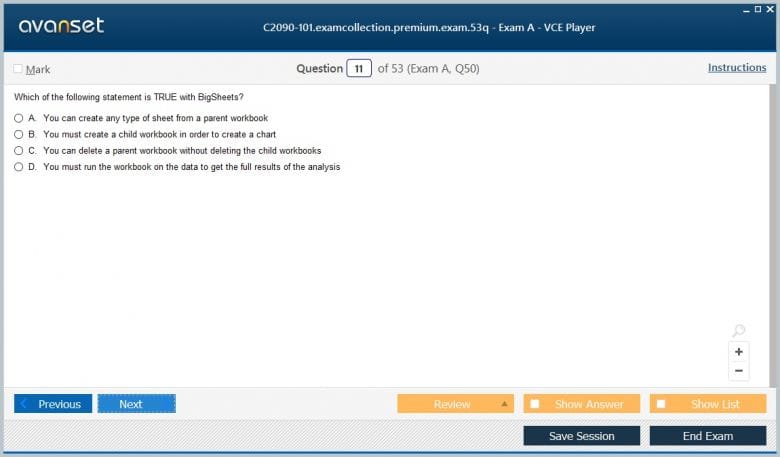
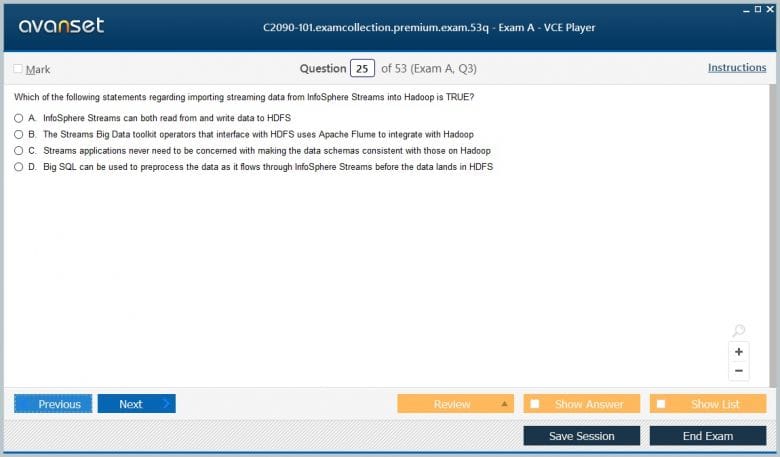
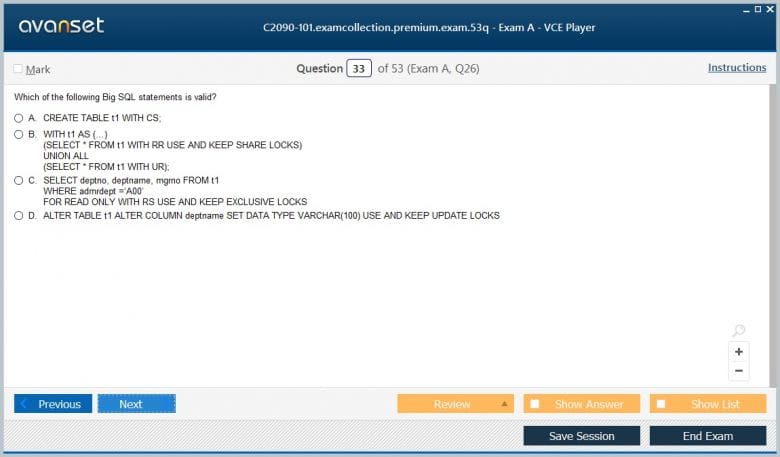
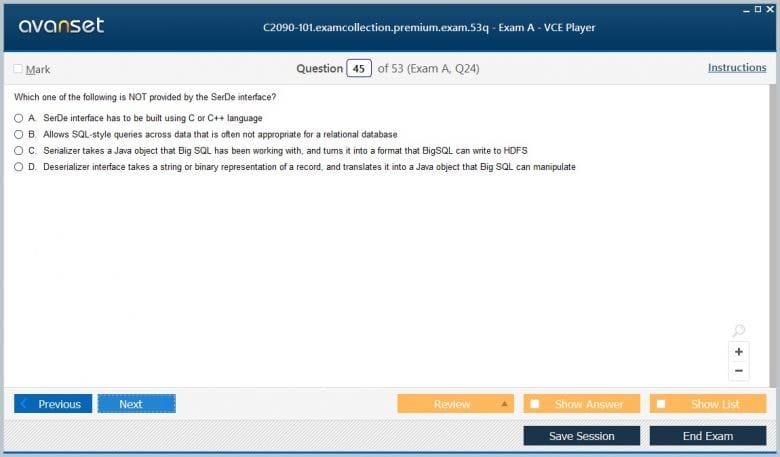
IBM C2090-101 Practice Test Questions in VCE Format
| File | Votes | Size | Date |
|---|---|---|---|
File IBM.braindumps.C2090-101.v2026-09-22.by.blade.64q.vce |
Votes 1 |
Size 94.03 KB |
Date Sep 22, 2026 |
File IBM.test-king.C2090-101.v2020-04-30.by.wangtao.44q.vce |
Votes 2 |
Size 60.11 KB |
Date Apr 30, 2020 |
File IBM.real-exams.C2090-101.v2020-03-13.by.said.32q.vce |
Votes 2 |
Size 46.05 KB |
Date Mar 13, 2020 |
File IBM.Pass4sures.C2090-101.v2019-02-06.by.abdul.30q.vce |
Votes 3 |
Size 39.15 KB |
Date Feb 06, 2019 |
IBM C2090-101 Practice Test Questions, Exam Dumps
IBM C2090-101 (IBM Big Data Engineer) exam dumps vce, practice test questions, study guide & video training course to study and pass quickly and easily. IBM C2090-101 IBM Big Data Engineer exam dumps & practice test questions and answers. You need avanset vce exam simulator in order to study the IBM C2090-101 certification exam dumps & IBM C2090-101 practice test questions in vce format.
C2090-101, IBM Big Data Engineer, came from an era when “big data” platforms were often discussed as a distinct technology stack. The exam is historical, but the engineering challenge it represented has not disappeared: ingest high-volume and high-variety data, choose appropriate storage and processing models, build reliable transformations, protect sensitive information, and deliver results that analysts, applications, or machine-learning systems can actually use.
The most useful way to revisit the exam is therefore not to memorize an old product catalogue. Treat it as a systems-design exercise across ingestion, distributed storage, batch and stream processing, data quality, governance, operations, and consumption. Modern IBM data platforms have changed considerably, but current DataStage and data-fabric tooling still emphasize controlled movement and transformation of enterprise data. The durable competency is designing pipelines whose performance and meaning remain understandable as scale grows.
Big-data architecture decisions depend on volume, velocity, variety, veracity, retention, latency, and access pattern. A telemetry stream with millions of small events has different needs from multi-terabyte historical files or relational change data. Before selecting storage or compute, define arrival rate, event size, transformation complexity, query patterns, recovery objectives, and how long raw versus curated data must remain available.
The familiar five Vs of big data are useful only when they lead to engineering choices. “Velocity” should translate into buffer size, back-pressure behavior, checkpoint frequency, and acceptable lag. “Variety” should translate into schema strategy and parsing controls. “Veracity” should translate into validation, quarantine, lineage, and data-quality ownership.
Data can arrive through files, message systems, databases, APIs, logs, sensors, and replication streams. The ingestion layer should record source, time, partition or offset, schema or format, and processing status so operators can tell what has been received and what still needs work. Idempotency is critical: replaying an input after failure should not silently double-count business events.
Design for burst behavior as well as average throughput. Queues, staging areas, partitioning, and flow control allow the system to absorb temporary spikes without losing data. If producers can outrun consumers indefinitely, the system needs a scaling or retention strategy. If events can arrive late or out of order, downstream logic must define how those cases affect aggregates and state.
Large-scale data systems divide information across nodes, partitions, files, or object-storage structures. Engineers need to understand how partitioning affects parallelism, skew, locality, fault recovery, and query cost. A partition key that looks reasonable on a whiteboard may overload one node if a small number of values dominate the dataset. Good design tests the distribution with realistic data rather than assuming uniformity.
File and table layout also influences downstream efficiency. Many tiny files create metadata and scheduling overhead; huge files can reduce parallelism or complicate recovery. Compression saves storage and I/O but consumes CPU. The big-data engineering role is largely about these trade-offs: making raw scale manageable while preserving the business meaning required by consumers.
Batch and streaming systems also differ in how they express time. Event time represents when something happened in the business; processing time represents when the platform handled it. Late events, clock skew, and replay can make those diverge. If a metric such as hourly transaction count depends on event time, the pipeline needs a windowing and correction policy. Otherwise the same event can appear in different periods depending on when infrastructure happens to process it.
Schema evolution deserves equal discipline. Producers may add fields, change allowed values, or alter nested structures. Consumers should tolerate compatible additions where appropriate but fail visibly on breaking changes. Keep sample payloads and contract tests for critical sources. A big-data platform that accepts any structure without governance eventually pushes parsing uncertainty into every downstream job.
Batch and streaming jobs often clean, parse, join, aggregate, enrich, and derive new fields. Keep low-level transformations reproducible and testable. Business logic such as customer segmentation, fraud flags, or operational thresholds should be explicit so stakeholders can challenge or revise it without reverse-engineering a long pipeline. A transformation should have defined inputs, outputs, quality rules, and failure behavior.
Parallel execution creates additional questions: can the operation be partitioned safely, does it require a shuffle or global sort, how much intermediate data is produced, and what happens if a task retries? Engineers should identify expensive joins, skewed keys, unbounded state, and unnecessary data movement. Performance tuning is most effective when it begins with data shape and algorithm choice rather than only adding hardware.
Large datasets amplify bad assumptions. Missing identifiers, malformed timestamps, inconsistent units, duplicate events, stale reference data, and schema drift can corrupt millions of records quickly. Define quality rules near the point where the meaning is known, route invalid records to a quarantine path, and preserve enough context for correction and replay. Silent coercion is dangerous because it turns data defects into believable output.
Ownership matters as much as validation. Engineering teams can detect that a product code is unknown, but a business owner must decide whether the code is invalid, newly introduced, or missing from the reference feed. The article on data-engineering foundations reinforces the broader point: reliable data products combine technical pipelines with contracts about meaning, quality, and responsibility.
Big-data platforms often centralize information from many systems, increasing the impact of weak access control. Engineers should classify sensitive fields, minimize unnecessary copies, separate service identities, encrypt appropriate traffic and storage, and restrict administrative access. Logs and temporary staging areas require attention because they can expose the same data as the final curated store without receiving the same security review.
Masking, tokenization, aggregation, or row and column controls may be needed for development and analytics. Security should also survive lineage: a protected source should not become an unprotected derivative simply because it was transformed. The relationship between data engineering and governance is why modern architectures increasingly combine catalog, lineage, policy, and integration rather than treating security as a final deployment step.
Lineage is also a security tool. If a sensitive source feeds ten derived datasets, teams need to know where its fields were copied, transformed, aggregated, or removed. A catalog or lineage graph helps incident response and deletion requests because the organization can trace affected downstream assets. Without lineage, every privacy or security investigation becomes a manual search across pipelines and storage locations.
Nonproduction environments deserve the same inventory discipline. Developers often create extracts for debugging or performance tests and forget to remove them. Establish expiration, ownership, and automated cleanup for temporary datasets, especially when they contain production-derived information. Data sprawl is a common side effect of engineering convenience and can erase the benefits of controls on the primary platform.
Data observability should include freshness and completeness at the business level, not only infrastructure health. A job can be green while one region stopped sending data three hours ago. Compare expected source counts, partitions, or heartbeat records and surface anomalies before analysts discover them in a report. The more automated the platform becomes, the more important these semantic checks are because there may be no operator watching individual files arrive.
A production pipeline needs service-level measures. Track ingestion lag, processing duration, failed partitions, retry volume, queue depth, data-quality rejects, storage growth, and consumption latency. Alerting should distinguish a transient retry from a persistent condition that threatens an SLA. Operators also need runbooks that explain how to restart from a checkpoint, replay an interval, or verify that a recovery did not create duplicates.
Capacity management includes cost. A pipeline that scans entire datasets for small incremental changes or retains every intermediate copy forever may be technically functional and financially unsustainable. The comparison in data science, big data, and analytics roles is helpful because engineering should optimize for the consumer’s decision need, not for maximum processing complexity.
Different consumers need different forms of data. Analysts may prefer curated tables with stable semantics; applications may need APIs or low-latency stores; machine-learning teams may need feature-ready histories; auditors may need immutable evidence and lineage. The engineering layer should define contracts around schema, freshness, availability, and change so consumers are not surprised by upstream refactoring.
Version schemas and transformations deliberately. A field rename can break dashboards and models even when the raw data remains correct. Backward-compatible changes, deprecation windows, data contracts, and lineage reduce that risk. Modern data products are successful when teams can evolve pipelines without forcing every downstream consumer into emergency rewrites.
Data products also need retirement rules. When a dataset or interface is replaced, identify consumers, publish a deprecation window, and monitor remaining use before removal. Without that discipline, engineering platforms accumulate stale outputs that still consume storage, compute, and support attention long after their business purpose has disappeared.
Read C2090-101 as an architecture lesson, not a current IBM credential. The IBM Big Data Engineer exam code is part of a retired certification generation. Its lasting value is that it forces an end-to-end view of data engineering: understand workload shape, preserve recoverability during ingestion, partition intelligently, control transformation, measure quality, protect data, operate the pipeline, and serve defined consumers. Those concerns still describe serious data-engineering work even though specific platforms have changed.
For current IBM technology, verify present capabilities in DataStage, watsonx.data, and other active services instead of mapping old product names forward mechanically. The IBM certifications catalog provides the historical credential context for C2090-101. A strong learner should be able to explain why a pipeline is reliable under scale and failure, not merely identify which legacy component once performed a particular task.
Go to testing centre with ease on our mind when you use IBM C2090-101 vce exam dumps, practice test questions and answers. IBM C2090-101 IBM Big Data Engineer certification practice test questions and answers, study guide, exam dumps and video training course in vce format to help you study with ease. Prepare with confidence and study using IBM C2090-101 exam dumps & practice test questions and answers vce from ExamCollection.
Purchase Individually
Site Search:

SPECIAL OFFER: GET 10% OFF

Pass your Exam with ExamCollection's PREMIUM files!
SPECIAL OFFER: GET 10% OFF
Use Discount Code:
MIN10OFF
A confirmation link was sent to your e-mail.
Please check your mailbox for a message from support@examcollection.com and follow the directions.

Download Free Demo of VCE Exam Simulator
Experience Avanset VCE Exam Simulator for yourself.
Simply submit your e-mail address below to get started with our interactive software demo of your free trial.