



Premium File
60 Q&A
$76.99$69.99
IBM C1000-026 Exam Questions & Answers, Accurate & Verified By IT Experts
Instant Download, Free Fast Updates, 99.6% Pass Rate
60 Questions & Answers
Last Update: Oct 27, 2026
$69.99
IBM C1000-026 Exam Screenshots
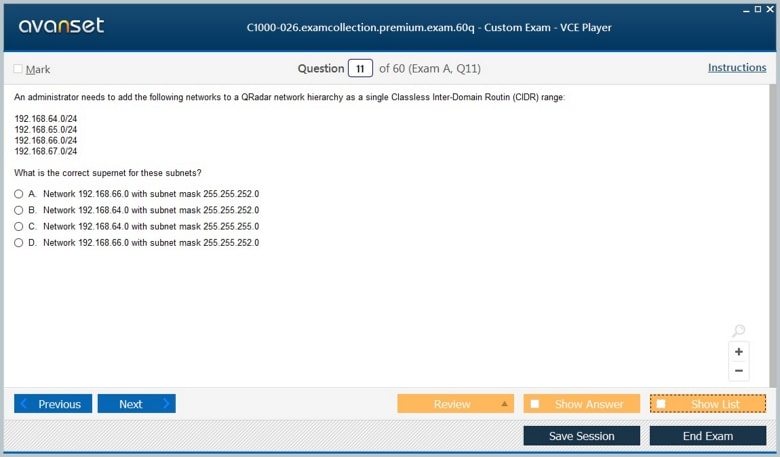
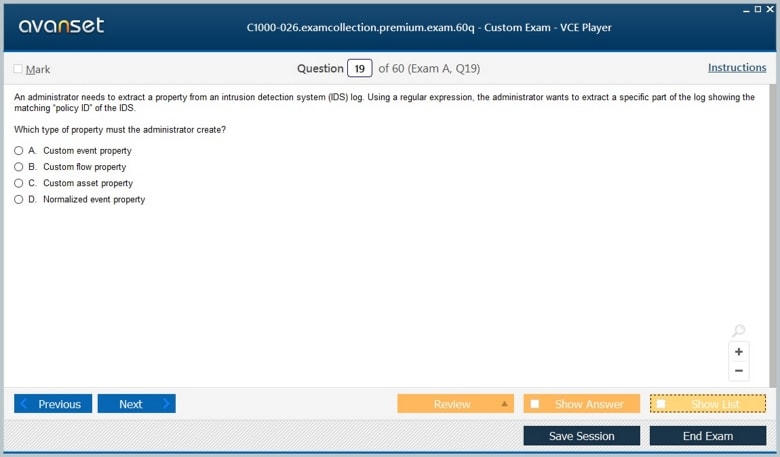
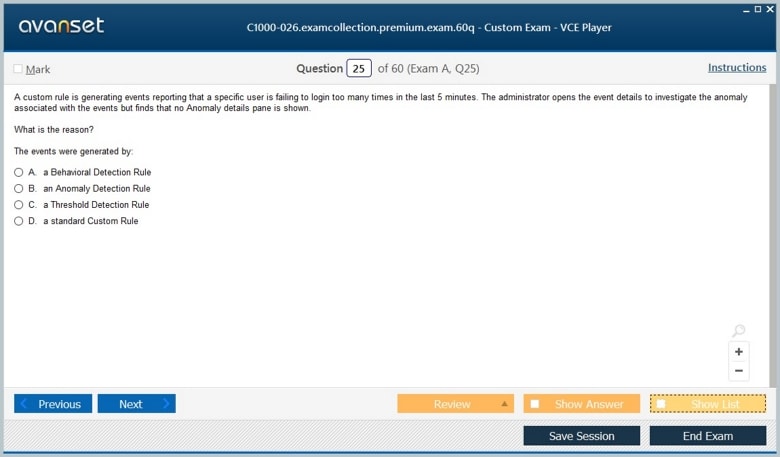
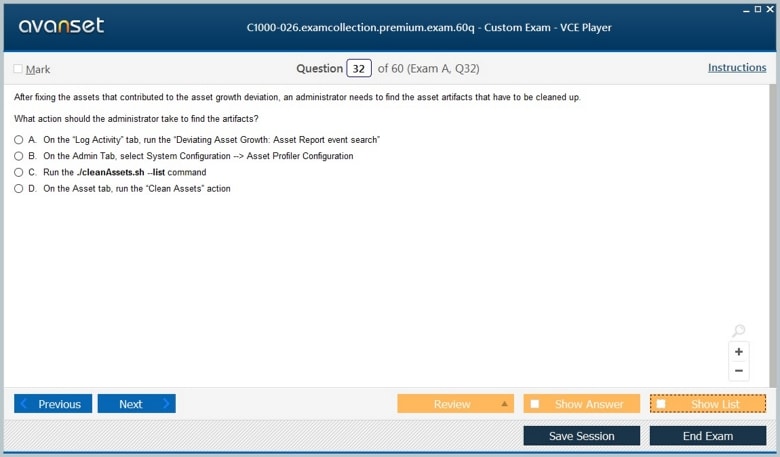
IBM C1000-026 Practice Test Questions in VCE Format
| File | Votes | Size | Date |
|---|---|---|---|
File IBM.braindumps.C1000-026.v2026-07-15.by.darcey.28q.vce |
Votes 1 |
Size 46.58 KB |
Date Jul 14, 2026 |
File IBM.questionpaper.C1000-026.v2020-03-19.by.zhangli.32q.vce |
Votes 2 |
Size 53.22 KB |
Date Mar 19, 2020 |
File IBM.Testking.C1000-026.v2019-12-04.by.Paul.29q.vce |
Votes 4 |
Size 51.24 KB |
Date Dec 08, 2019 |
IBM C1000-026 Practice Test Questions, Exam Dumps
IBM C1000-026 (IBM Security QRadar SIEM V7.3.2 Fundamental Administration) exam dumps vce, practice test questions, study guide & video training course to study and pass quickly and easily. IBM C1000-026 IBM Security QRadar SIEM V7.3.2 Fundamental Administration exam dumps & practice test questions and answers. You need avanset vce exam simulator in order to study the IBM C1000-026 certification exam dumps & IBM C1000-026 practice test questions in vce format.
C1000-026 covered IBM Security QRadar SIEM V7.3.2 Fundamental Administration. The exam is retired, and QRadar certification has moved to newer versions, so this page should be read as a V7.3.2 administration blueprint rather than a current appointment guide. Its technical scope remains useful because reliable security monitoring still depends on administrators who can keep data collection, correlation, retention, performance, backup, upgrades, and platform health working together.
An administrator is responsible for the quality of the environment that analysts depend on. If log sources stop parsing, time is wrong, custom properties fail, disk fills, retention is misconfigured, or services are unhealthy, the SOC may still have dashboards but the evidence is incomplete. Preparation should therefore focus on operational cause and effect: every configuration choice changes what QRadar can collect, correlate, store, or explain.
QRadar deployments can include consoles, event collectors, event processors, flow components, data nodes, and other managed hosts. Administrators need a mental model of how data enters the deployment, where it is parsed and correlated, where Ariel data is stored, and which component owns a particular service. Troubleshooting is much faster when the data path is understood before commands are run.
Draw a deployment with multiple sites and ask what happens when a WAN link fails, an event processor is overloaded, or a managed host becomes unavailable. The exercise forces you to separate collection resilience from console availability and to think about capacity, latency, and recovery rather than viewing every QRadar appliance as interchangeable.
Distributed QRadar deployments add another administrative question: which component owns a workload when something fails. Event collectors, processors, flow components, consoles, and data nodes can have different responsibilities depending on topology. Troubleshooting should therefore begin with the path of data through the deployment rather than with the console alone. Knowing where parsing, correlation, storage, and search are expected to happen prevents an administrator from treating a capacity or connectivity issue as a generic application fault.
A SIEM cannot detect what it does not receive. Administrators should know how log sources are defined, how protocols collect events, how DSM parsing normalizes payloads, and how custom properties extract organization-specific fields. When events arrive as “unknown” or fields are empty, rule logic and searches may fail silently even though data volume looks normal.
Use raw log inspection as a validation habit. Compare the original payload with normalized fields and confirm timestamps, usernames, addresses, categories, and event names. If the source changes its format after a software update, parsing should be retested before analysts discover the problem through missed detections.
DSM behavior is part of log-source quality. A source can be connected and sending data while important fields are still parsed incorrectly or categorized poorly. Administrators need to inspect representative payloads, confirm that identity, address, action, and event-name fields are extracted as intended, and use custom properties or extension work only when the default parsing is insufficient. Detection logic built on bad normalization can look healthy operationally while producing weak or misleading offenses.
Reference sets, maps, and custom properties let organizations add local context to correlation and investigation. These features are powerful because they can represent watchlists, privileged users, known scanners, asset groups, or extracted application fields. They also create maintenance obligations: stale reference data and expensive extraction logic can degrade accuracy or performance.
Document who owns every custom element. Record the source of the data, update frequency, expected size, and rules that depend on it. A reference set built for a temporary incident should not become permanent infrastructure by accident. A custom property should be justified by a search, report, or detection use case rather than created simply because the payload contains an interesting field.
Administrative ownership becomes more complex in multi-tenant or segmented environments. Domains, network hierarchies, and role assignments should reflect real organizational boundaries so users see the data and controls appropriate to their responsibilities. That design affects searches, offenses, reporting, and troubleshooting. A technically convenient broad permission may solve an immediate access problem while creating privacy, separation-of-duties, or accidental-change risks later.
Security teams need enough history to investigate patterns, meet legal or policy obligations, and support threat hunting. At the same time, storing every event forever is expensive and operationally risky. Administrators should understand retention buckets, data priorities, cleanup behavior, and the relationship between event volume, storage capacity, and search performance.
Model storage with realistic daily ingestion and growth. Then test what happens when a new firewall doubles event volume. Which data should be retained longest? Which source can be summarized or filtered? How much investigation history does the SOC genuinely need? Storage policy becomes a security design decision when it determines whether evidence still exists during a delayed investigation.
Retention should be validated against real investigation timelines. If identity, endpoint, or network teams routinely discover incidents weeks after initial access, deleting the supporting event history earlier can make root-cause analysis impossible. Conversely, retaining everything indefinitely creates cost and search burdens. Administrators should connect retention classes to detection use cases, legal obligations, and measured query needs rather than choosing one period for all data.
High CPU or disk use is a symptom, not a diagnosis. Administrators should examine service state, queue depth, event rates, search load, disk latency, parsing problems, and managed-host connectivity before changing capacity. QRadar provides system notifications and monitoring views that should be read alongside operating-system and application logs.
Create a runbook for common conditions such as event pipeline backlog, missing log sources, high Ariel search load, disk thresholds, service restarts, and license-rate pressure. For each condition, list the evidence to collect before remediation. This prevents troubleshooting from becoming a sequence of disruptive guesses that erase the very evidence needed to identify the cause.
Capacity work should connect rates to retention and search behavior. Events per second and flows per minute describe ingestion pressure, but administrators also need to consider parsing cost, correlation complexity, storage growth, saved searches, and concurrent investigations. A deployment can remain below a nominal ingest ceiling and still feel slow because expensive searches or custom rules consume resources. Trend data is more useful than one snapshot because it shows whether growth is gradual, seasonal, or caused by a recent configuration change.
A platform that cannot be restored predictably is not fully administered. Candidates should understand what configuration and data are included in backups, where repositories are stored, how schedules are managed, and what must be validated after restoration. Recovery planning should account for dependencies such as network identity, certificates, host relationships, and software level.
The wider disaster-recovery discipline is relevant because QRadar supports security operations during other incidents. Define recovery objectives for the console and data-processing components, decide how analysts operate during an outage, and test restoration instead of assuming a successful backup job guarantees recovery.
Recovery procedures should be tested against the topology that would actually exist during an outage. Restoring configuration onto healthy hardware is useful, but it does not prove that certificates, network routes, hostnames, application dependencies, and external integrations will work after a component or site failure. Administrators should document recovery order and validate key log sources and searches after restoration. The goal is to recover a functioning detection service, not simply to complete a backup restore command successfully.
QRadar upgrades can affect DSMs, protocols, rules, custom applications, searches, and managed hosts. Administrators need a controlled process: verify prerequisites, read release notes, back up, test compatibility, sequence hosts correctly, monitor progress, and validate data collection afterward. A platform that starts after upgrade may still be functionally degraded if parsers or integrations changed.
Version awareness is particularly important because this exam is tied to 7.3.2. IBM later listed QRadar SIEM v7.5 Administration in its certification portfolio. Do not transfer commands or interface assumptions blindly between releases; use the exact product documentation for the system you administer.
Before an upgrade, administrators should inventory custom DSM work, apps, integrations, certificates, backup state, and critical detection dependencies. Afterward, success should be measured beyond a green system-health screen: confirm that important log sources still parse, scheduled searches run, offenses are created as expected, and analysts can query recent and historical data. That validation turns an upgrade from a software-installation task into a controlled security-service change.
The retired C1000-018 analyst exam focused on interpreting offenses and security data. Administrators should understand that perspective because configuration quality affects analyst outcomes. If an analyst repeatedly reports a false positive, missing field, or blind spot, the root cause may be a network hierarchy, parsing, asset, reference-data, or rule-maintenance issue.
Establish a feedback loop between SOC analysts and platform administrators. Review noisy detections, data-source failures, search performance, retention gaps, and use cases that require new properties or integrations. SOC operations work best when monitoring content and platform health are treated as one service.
Treat C1000-026 as an operational blueprint for a legacy release. The IBM certifications portfolio has continued to evolve, so C1000-026 should not be presented as a live exam simply because the historical page exists. Its enduring value is the administration model: understand architecture, protect data quality, manage storage and reference data, monitor system health, back up configuration, perform controlled upgrades, and support analysts with trustworthy telemetry.
If your organization still operates QRadar 7.3.2, align study with that release’s documentation and your actual deployment topology. If you are pursuing a new certification, verify the current IBM pathway first. The administrator’s real measure of competence is not whether the console is reachable; it is whether the SIEM continuously produces complete, timely, explainable evidence for the security team.
Go to testing centre with ease on our mind when you use IBM C1000-026 vce exam dumps, practice test questions and answers. IBM C1000-026 IBM Security QRadar SIEM V7.3.2 Fundamental Administration certification practice test questions and answers, study guide, exam dumps and video training course in vce format to help you study with ease. Prepare with confidence and study using IBM C1000-026 exam dumps & practice test questions and answers vce from ExamCollection.
Purchase Individually
Site Search:

SPECIAL OFFER: GET 10% OFF

Pass your Exam with ExamCollection's PREMIUM files!
SPECIAL OFFER: GET 10% OFF
Use Discount Code:
MIN10OFF
A confirmation link was sent to your e-mail.
Please check your mailbox for a message from support@examcollection.com and follow the directions.

Download Free Demo of VCE Exam Simulator
Experience Avanset VCE Exam Simulator for yourself.
Simply submit your e-mail address below to get started with our interactive software demo of your free trial.
@Kenzo, you won’t waste time with these dumps! i practiced with them and passed my test!! really, one of my best moves during my exam preparation was using the C1000-026 exam dumps from here. they made the exam very easy for me as i knew all the questions and answers! i scored high!!
@Kenzo, you are in the right place! with these dumps for C1000-026 exam by your study table, expect no disappointments… you should expect to pass instead! I used these exam dumps a while back and their level of validity is unmatched… they wll sure help you pass ur exam
are these vce files for C1000-026 exam the latest ones? am trying to prevent any possible disappointments during my exam… don’t want to waste time..
@ulric, C1000-026 practice questions and answers are up to date. I also used them and passed my exam with a hgh score just a couple of days ago… using this material will make your experience with the exam much easier… all the best!
hi guys! are these C1000-026 practice tests reliable? I want to use them to prepare for my exam later this week…
these C1000-026 braindumps boosted me very much when I was taking my IBM C1000-026 exam. these materials are up to date and well compiled. thank you examcollection for helping me pass!