



Premium File
180 Q&A
$76.99$69.99
BACB BCBA Exam Questions & Answers, Accurate & Verified By IT Experts
Instant Download, Free Fast Updates, 99.6% Pass Rate

BCBA Premium File: 180 Questions & Answers
Last Update: Nov 01, 2026
BCBA PDF Study Guide: 437 Pages
$74.99
BACB BCBA Exam Screenshots
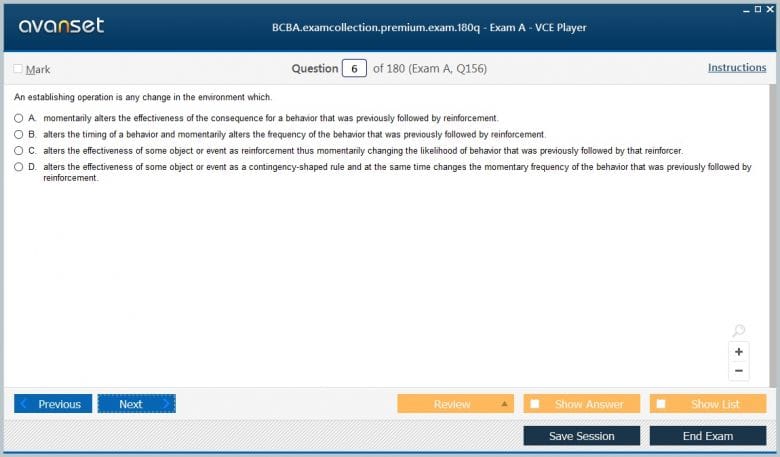
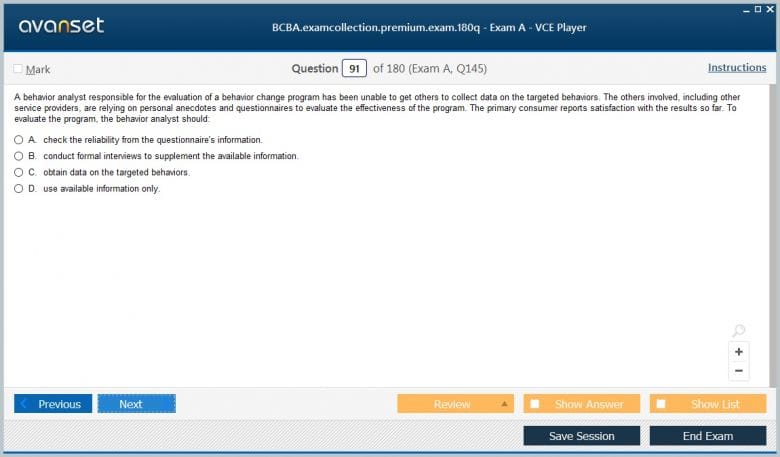
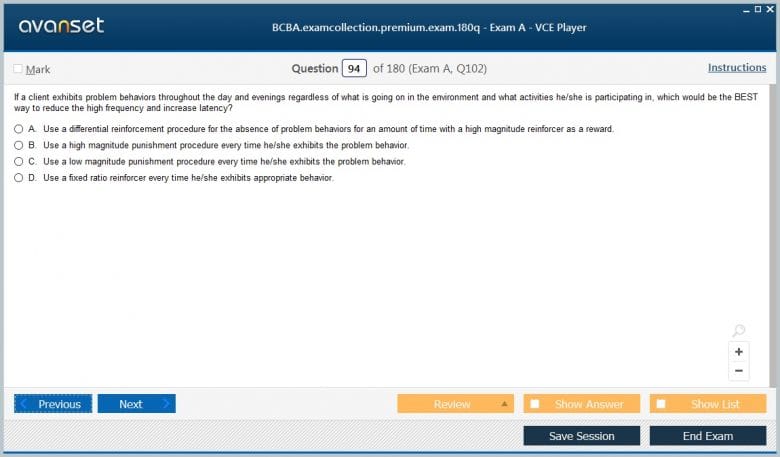
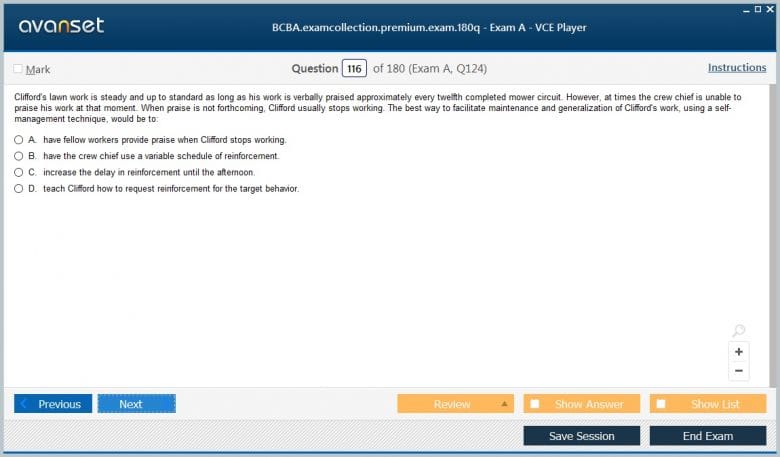
BACB BCBA Practice Test Questions in VCE Format
| File | Votes | Size | Date |
|---|---|---|---|
File BACB.test-king.BCBA.v2026-07-27.by.lucas.99q.vce |
Votes 1 |
Size 113.18 KB |
Date Jul 26, 2026 |
File BACB.Passguide.BCBA.v2019-03-05.by.Monika.108q.vce |
Votes 4 |
Size 124.72 KB |
Date Mar 10, 2019 |
BACB BCBA Practice Test Questions, Exam Dumps
BACB BCBA (Board Certified Behavior Analyst) exam dumps vce, practice test questions, study guide & video training course to study and pass quickly and easily. BACB BCBA Board Certified Behavior Analyst exam dumps & practice test questions and answers. You need avanset vce exam simulator in order to study the BACB BCBA certification exam dumps & BACB BCBA practice test questions in vce format.
The Board Certified Behavior Analyst credential is BACB’s graduate-level certification for independent behavior-analytic practitioners. BCBA work can include assessment, intervention design, data-based decision-making, staff and caregiver training, supervision, and systems-level performance improvement. The exam reflects that breadth: success requires more than recognizing technical terms because candidates must apply behavioral principles while respecting ethics, measurement quality, functional relations, and the limits of available evidence.
In 2026, the BCBA examination is delivered in person through Pearson VUE and allows four hours for 185 multiple-choice questions. The current handbook identifies 175 scored questions and 10 unscored questions, organized around the 6th Edition BCBA Test Content Outline. Candidates should verify application and scheduling details directly with BACB because major eligibility and certification changes are scheduled to take effect in 2027.
ExamCollection’s BACB certifications context is useful for distinguishing roles. The BCaBA credential is particularly relevant because BCaBAs practice under BCBA supervision and may appear in exam scenarios involving delegation, oversight, and competency-based supervision. BCBA preparation should therefore connect technical knowledge to independent professional accountability.
Behavior analysts describe how behavior changes as a function of environmental events. Candidates should be fluent with reinforcement, punishment, extinction, stimulus control, motivating operations, schedules, respondent and operant processes, verbal behavior, rule-governed behavior, generalization, maintenance, and related concepts. The exam becomes difficult when several terms could superficially describe the same event, so precision about antecedents, responses, consequences, and changes in future behavior matters.
A useful study method is to convert every definition into an original scenario, then alter one feature and decide whether the concept changes. If an event follows behavior, that alone does not make it reinforcement; the future probability of the response must increase. If a stimulus precedes behavior, that alone does not make it a discriminative stimulus. This kind of contrastive practice builds the reasoning needed for applied questions.
Independent practitioners are responsible for selecting measurement systems that fit both the behavior and the decision to be made. Frequency, rate, duration, latency, interresponse time, trials-to-criterion, and percentage measures answer different questions. Continuous observation may be ideal but impractical, while discontinuous systems can introduce predictable biases. BCBA candidates should understand those tradeoffs rather than treating all data as equally informative.
Measurement also includes operational definition, observer training, interobserver agreement, procedural fidelity, and graph construction. A precise graph cannot rescue poorly defined behavior or inconsistent data collection. When data appear surprising, a BCBA should ask whether the behavior changed, the measurement changed, implementation changed, or contextual variables changed before redesigning treatment.
The BCBA outline expects understanding of single-case experimental logic: repeated measurement, prediction, verification, replication, and systematic manipulation. Reversal, multiple-baseline, multielement, and changing-criterion designs each provide different forms of experimental control. Candidates should know what conclusions a design supports and which threats remain when the arrangement is weak or incompletely implemented.
Design selection is inseparable from ethics and feasibility. Withdrawing a successful intervention can be inappropriate when the target is dangerous or the treatment produces durable learning. Multiple baselines avoid some withdrawal concerns but require independent tiers and sufficient opportunities to stagger implementation. Multielement designs allow rapid comparison but can suffer from interaction between conditions. Strong exam reasoning weighs demonstration of effect against client welfare and practical constraints.
Assessment can include record review, interviews, rating tools, preference assessment, direct descriptive observation, skill assessment, and functional analysis. Each method answers a different question. Descriptive patterns can guide hypotheses, but they do not prove function; experimental analysis can provide stronger evidence but may be unnecessary, impractical, or unsafe in some circumstances. The BCBA must know when the available evidence is sufficient for the decision at hand.
Functional reasoning also prevents topography-based treatment. Aggression, noncompliance, self-injury, task avoidance, or repetitive behavior can occur for different reasons across individuals and contexts. Intervention selection should be linked to the relevant contingencies and skill deficits, not to the name of the behavior alone. When medical, psychiatric, educational, or environmental factors fall outside behavior-analytic scope, interdisciplinary collaboration becomes part of competent assessment.
Behavior-change procedures include antecedent interventions, differential reinforcement, extinction, skill teaching, shaping, chaining, prompting, fading, token economies, contingency contracting, self-management, and many other arrangements. Independent practice requires knowing how those procedures work, what implementation conditions they require, and what adverse or collateral effects should be monitored.
Treatment should also target outcomes that matter to the client. Social validity, preference, assent, cultural responsiveness, stakeholder priorities, feasibility, generalization, maintenance, and quality of life all influence whether an intervention is defensible. The most technically elegant plan is not necessarily the best plan if it is burdensome, unacceptable, unsafe, or impossible to implement consistently in the natural environment.
A treatment plan should specify what will be measured, how frequently data will be reviewed, what pattern would count as improvement, and when modification is warranted. Visual analysis considers level, trend, variability, immediacy of effect, overlap, and consistency across similar phases. Candidates should practice interpreting graphs without inventing certainty that the data do not support.
Clinical judgment is strongest when decision rules are explicit enough to reduce reactive changes. One poor session may reflect noise rather than treatment failure, while a persistent flat trend may justify reassessment. Before increasing intervention intensity, verify treatment integrity and measurement quality. This sequence protects clients from unnecessary changes and helps the team distinguish a weak procedure from weak implementation.
BCBAs make decisions that can affect autonomy, education, health, family routines, employment, and access to services. Ethical practice includes informed consent, confidentiality, accurate records, truthful representation of credentials, appropriate billing and documentation, protection from exploitation, competence, and management of multiple relationships. Candidates should study ethics as a decision framework rather than a list of forbidden acts.
When values conflict, identify the client, stakeholders, relevant obligations, risks, available evidence, and scope of authority. Document consultation and the rationale for action. A BCBA should not allow employer pressure, caregiver preference, or productivity targets to override client welfare or professional standards. Equally, ethics does not mean avoiding difficult decisions; it means making them transparently, competently, and with appropriate safeguards.
BCBAs may supervise RBTs, BCaBAs, trainees, and other staff. Effective supervision is competency based: establish expectations, assess baseline performance, teach through instruction and modeling, provide rehearsal, observe implementation, deliver specific feedback, reinforce improvement, and collect performance data. Signing forms or holding meetings without observing behavior is not equivalent to meaningful supervision.
Personnel problems should also be analyzed functionally. Inconsistent implementation may result from unclear task definitions, missing resources, weak prompts, delayed feedback, competing contingencies, or lack of skill. A supervisor who assumes poor motivation can miss the environmental cause. Exam scenarios often reward a systematic performance-analysis approach because it mirrors behavior analysis applied to organizations.
BACB has announced substantial BCBA and BCaBA certification requirement changes effective January 1, 2027. Candidates pursuing review under the current 2022 requirements need to pay close attention to the Board’s application deadlines and completeness rules. Course sequences and experience records assembled from older guidance should be checked against the current handbook before an application is submitted.
For preparation, use the 6th Edition Test Content Outline as the organizing document. Build domain-specific error logs, practice data interpretation, rehearse ethical reasoning, and explain why wrong answers fail. That last step is important because the BCBA exam often distinguishes between an answer that is technically possible and one that is best supported by function, data, ethics, or scope.
BCBA certification marks readiness for independent behavior-analytic responsibility, not the end of professional development. New practice areas require new competence, supervision responsibilities require ongoing skill, and client populations differ in ways that demand learning beyond the examination outline. The credential is strongest when the practitioner maintains the same evidence-seeking habits used to prepare for the exam.
Candidates coming from BCaBA, RBT, education, psychology, healthcare, or organizational roles may enter with different strengths. A disciplined preparation plan identifies those asymmetries early. Someone comfortable with intervention procedures may need deeper experimental design; someone strong in coursework may need more practice translating graphs and ethics standards into applied decisions. Balanced competence is the goal because independent practice exposes weaknesses that memorization can hide.
Independent practice also requires careful documentation. Session notes, assessment records, treatment plans, consent records, supervision documentation, data systems, and communications should be accurate enough to support continuity of care and professional review. Documentation is not a substitute for clinical judgment, but weak records make it difficult to reconstruct why a decision was made, whether procedures were authorized, or whether treatment changed when the data justified it.
BCBAs should be prepared to manage risk without abandoning behavior-analytic principles. Severe behavior may require crisis planning, environmental safeguards, medical coordination, staff competency checks, and rapid escalation. The presence of risk does not justify using the most restrictive procedure by default; it increases the need for function-based assessment, proportional safeguards, monitoring, consent, and consultation with other qualified professionals when the problem crosses disciplinary boundaries.
Communication is another independent-practice skill that appears behind many technical decisions. A BCBA may need to explain a graph to a caregiver, teach a procedure to staff, discuss uncertainty with a physician or school team, or document why an intervention is being changed. Accurate language should remain understandable to the audience. Jargon that hides assumptions can make technically sound work harder to implement and easier to misinterpret.
Go to testing centre with ease on our mind when you use BACB BCBA vce exam dumps, practice test questions and answers. BACB BCBA Board Certified Behavior Analyst certification practice test questions and answers, study guide, exam dumps and video training course in vce format to help you study with ease. Prepare with confidence and study using BACB BCBA exam dumps & practice test questions and answers vce from ExamCollection.
Purchase Individually

Site Search:

SPECIAL OFFER: GET 10% OFF

Pass your Exam with ExamCollection's PREMIUM files!
SPECIAL OFFER: GET 10% OFF
Use Discount Code:
MIN10OFF
A confirmation link was sent to your e-mail.
Please check your mailbox for a message from support@examcollection.com and follow the directions.

Download Free Demo of VCE Exam Simulator
Experience Avanset VCE Exam Simulator for yourself.
Simply submit your e-mail address below to get started with our interactive software demo of your free trial.
Is the premium file still good for 2022.
@hassan, braindumps for BCBA exam offered here are essential tools when it comes to the test preparation. i passed the exam using them. they feature the questions which are frequently tested in the actual exam plus their respective answers. when you supplement what you’ve learned in the course with their content, you’re assured of getting a passing score.
hey? i am about to take the exam and i want to use bcba braindumps as part of my revision. will they help me pass the exam???
@wilson_101, BCBA questions and answers are great!! they helped me understand the course content better and even idealized me on how to handle the different types of questions which i may encounter in the BCBA exam. in general, these files are helpful since i have scored 85% in the exam using them! use them during your revision and it will be easy for you to answer the exam questions. good luck!
i am so happy for passing the exam in my first attempt!!! my advice to the candidates waiting to sit for this tough exam is to prepare adequately using the relevant study resources especially these BCBA practice tests offered by examcollection. if you answer all the questions contained in these available files appropriately before the actual exam, you’ll have a high chance of succeeding.
hi guys? tell me whether the practice questions and answers for BCBA exam provided in this platform can help me clear the test successfully???
wow! i've passed the exam using bcba vce files... even though i had limited time to prepare for the test, these files have helped me to score a high grade. i can assure you that they’re helpful!!
these BCBA exam dumps are really helpful. i utilized them in my revision for the test and i was surprised to find most of the questions in my certification exam. i answered the questions easily and passed with flying colors. use them so that you may perform well too!