


Premium File
272 Q&A
$76.99$69.99
BACB BCABA Exam Questions & Answers, Accurate & Verified By IT Experts
Instant Download, Free Fast Updates, 99.6% Pass Rate
272 Questions & Answers
Last Update: Sep 27, 2026
$69.99
BACB BCABA Exam Screenshots
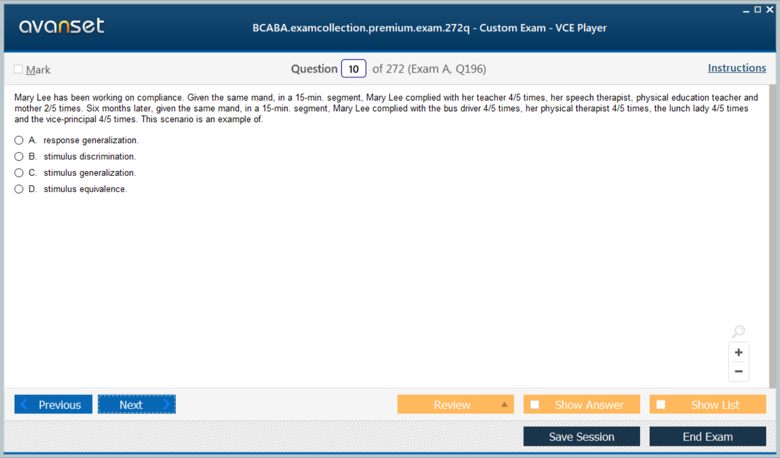
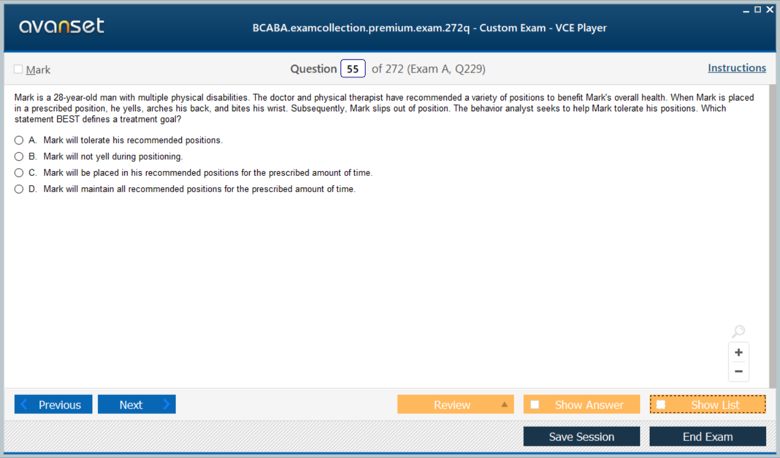
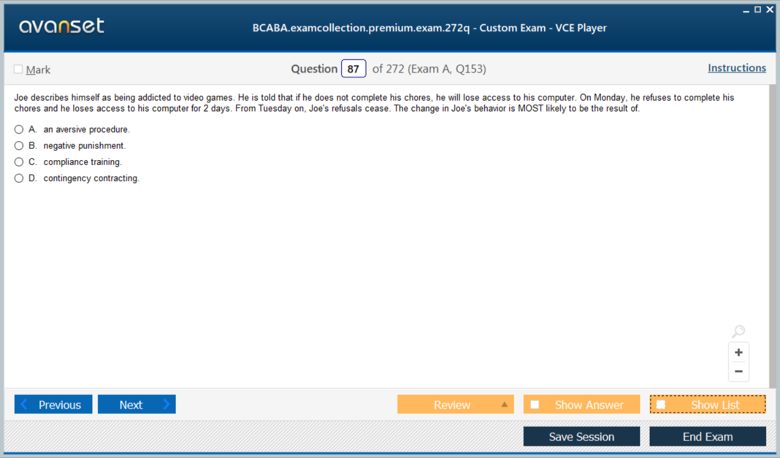
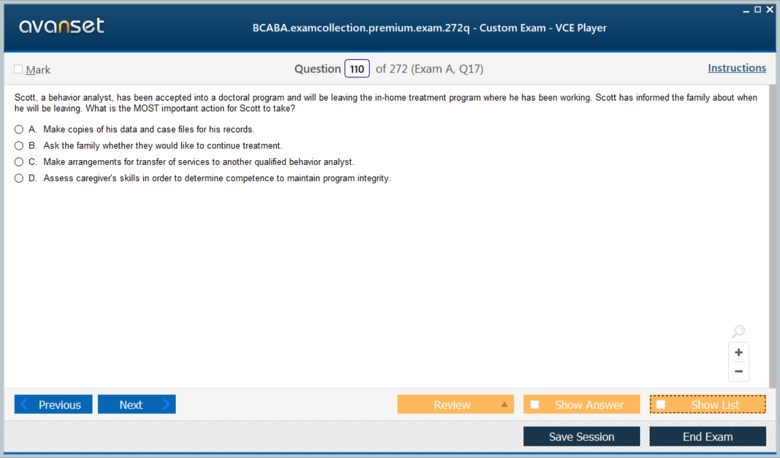
BACB BCABA Practice Test Questions in VCE Format
| File | Votes | Size | Date |
|---|---|---|---|
File BACB.onlinetest.BCABA.v2026-08-24.by.wangjuan.150q.vce |
Votes 1 |
Size 175.94 KB |
Date Aug 23, 2026 |
BACB BCABA Practice Test Questions, Exam Dumps
BACB BCABA (Board Certified Assistant Behavior Analyst) exam dumps vce, practice test questions, study guide & video training course to study and pass quickly and easily. BACB BCABA Board Certified Assistant Behavior Analyst exam dumps & practice test questions and answers. You need avanset vce exam simulator in order to study the BACB BCABA certification exam dumps & BACB BCABA practice test questions in vce format.
The Board Certified Assistant Behavior Analyst credential is BACB’s undergraduate-level certification for practitioners who apply behavior-analytic services under required supervision. It sits between the Registered Behavior Technician role and independent BCBA practice: a BCaBA can perform meaningful assessment, measurement, intervention, and case-support work within the scope of training, but the credential does not remove the obligation to work under a qualified BCBA supervisor. That distinction should shape both exam preparation and career planning.
As of 2026, the BCaBA examination is a four-hour, in-person Pearson VUE exam with 175 multiple-choice questions. The current handbook identifies 150 scored questions and 25 unscored questions, and the exam follows the 6th Edition BCaBA Test Content Outline. Candidates should use current BACB documents rather than older study plans because the Board has announced substantial certification requirement changes for 2027.
Within ExamCollection, BACB certifications provide the broader credential context, while BCBA certification matters directly because BCaBA practice is supervised and many assistants eventually consider graduate-level independent certification. The strongest study plan therefore connects exam domains to the supervised professional decisions a BCaBA is expected to make.
Candidates need fluent definitions, but the harder work is selecting the right concept when several terms sound plausible. Reinforcement, punishment, motivating operations, stimulus control, extinction, schedules, generalization, and derived relations become useful only when the learner can recognize the environmental relation described in a scenario. Studying examples and nonexamples is more effective than memorizing isolated one-line definitions because the exam frequently asks what a practitioner should infer or do from observable information.
Behaviorism and philosophical assumptions provide the frame for those decisions. A BCaBA should understand why behavior analysts emphasize observable relations, functional variables, prediction and influence, and parsimonious explanations. These ideas are not abstract decoration: they affect how practitioners describe a problem, separate data from interpretation, and avoid attributing behavior to labels that do not explain the controlling conditions.
Measurement is strongest when the recording system captures the feature of behavior that matters. Frequency and rate describe occurrence, duration captures how long behavior lasts, latency measures delay from an event to a response, and interresponse time describes spacing between responses. Discontinuous systems can be practical when continuous observation is not feasible, but they introduce sampling effects that must be understood before conclusions are drawn.
Candidates should be able to move from raw data to interpretable displays and then judge whether measurement is trustworthy. That includes operational definitions, data collection integrity, interobserver agreement, and the limits of a graph. A rising line does not establish why behavior changed. Good exam reasoning asks whether the data answer the original question, whether the measurement system could bias the result, and whether more evidence is needed before altering an intervention.
Behavior analysis relies on repeated measurement and systematic manipulation to test functional relations. BCaBA preparation should therefore cover baseline logic, prediction, verification, replication, and the purposes of common single-case designs. Reversal, multiple-baseline, changing-criterion, and multielement arrangements differ in what they demonstrate and in when their use is practical or ethical.
The important skill is design selection rather than diagram recognition. A reversal may provide a clear demonstration when behavior can safely return toward baseline, but it may be unsuitable when treatment effects are irreversible or withdrawing an effective intervention would be risky. A multiple-baseline design can avoid withdrawal but requires sufficiently independent tiers and staggered change. Exam scenarios reward candidates who match the design to the behavior, setting, ethics, and available control.
Behavior assessment should move from clear definitions and relevant records toward direct observation and functional reasoning. Preference and reinforcer assessments answer different questions from functional behavior assessment. Descriptive information can suggest patterns, but correlation between an antecedent, behavior, and consequence does not by itself prove function. Candidates should know what each assessment method can establish and where its limits are.
When function is uncertain, the professional response is not to guess based on the behavior’s appearance. Similar topographies can serve different functions across clients or contexts. The BCaBA role requires gathering accurate information, recognizing when additional assessment is needed, and working within the supervising BCBA’s clinical direction. That disciplined approach keeps treatment connected to evidence rather than to assumptions.
The intervention domain covers reinforcement-based procedures, differential reinforcement, extinction, prompting and fading, shaping, chaining, token systems, contingency arrangements, stimulus-control procedures, and strategies for teaching new skills. Candidates should be able to identify the operative contingency and predict likely side effects. For example, differential reinforcement is not simply “rewarding good behavior”; it requires defining which response class earns reinforcement and what happens to competing responses.
Implementation integrity matters because a theoretically sound plan can fail when staff apply it inconsistently. A BCaBA should monitor whether antecedent supports, prompts, reinforcers, schedules, and consequence procedures are delivered as designed. If outcomes are poor, the next step is to examine data and treatment integrity before declaring the underlying behavioral principle ineffective.
Intervention planning is not complete when a procedure can reduce a target behavior in controlled conditions. The plan must also fit the person, environment, resources, risks, and goals. Social validity asks whether the goals, procedures, and outcomes are acceptable and meaningful. Generalization and maintenance should be planned rather than treated as fortunate aftereffects.
Exam scenarios may present several technically possible options. The strongest answer usually respects function, current data, least-restrictive effective practice, stakeholder needs, and the practitioner’s authorized scope. A complicated intervention that staff cannot implement reliably may produce worse outcomes than a simpler evidence-based plan with strong treatment integrity. BCaBA-level judgment means recognizing those practical dependencies and consulting the supervisor when decisions exceed delegated responsibility.
BCaBAs work with clients whose care may involve significant risk, privacy concerns, family dynamics, school systems, medical issues, and multiple service providers. Ethical practice therefore includes competence, informed consent and assent where applicable, confidentiality, accurate documentation, responsible public statements, and avoidance or management of conflicts of interest. Knowing a procedure is not the same as being qualified to use it independently.
Scope and supervision are especially important for this credential. A BCaBA must not present supervised practice as independent BCBA practice. When a case involves unfamiliar assessment, severe risk, a new population, or a procedure outside current competence, the correct professional action is to seek guidance, training, or referral. The exam tests ethics most effectively when candidates reason from the client’s welfare and the credential’s actual authority rather than from convenience.
Unlike a BCBA, a BCaBA does not practice independently. Supervision should include observation, performance feedback, review of data and documentation, skill development, and clear delegation. The assistant should arrive prepared with accurate records and specific questions so supervision can focus on clinical reasoning rather than reconstruction of what happened during the week.
BCaBAs may also supervise RBTs when requirements are met, which makes performance management an important exam area. Effective supervision uses clear expectations, modeling, rehearsal, feedback, reinforcement, and objective performance data. Correcting staff behavior through vague criticism or occasional reminders is weaker than analyzing the performance problem and arranging supports that make correct implementation more likely.
BACB has announced significant BCBA and BCaBA certification changes effective January 1, 2027. Candidates who want their application reviewed under the current 2022 eligibility requirements need to follow the Board’s stated transition deadlines and submit a complete application on time. That makes current official handbooks essential: an old course outline may teach durable behavior-analytic principles while still being wrong about eligibility, documentation, or application timing.
For exam study, organize the 6th Edition Test Content Outline into a weekly cycle: review concepts, solve scenario questions, explain why alternatives are weaker, and practice interpreting data. Track errors by domain rather than only by total score. A candidate who repeatedly misses experimental-control questions needs a different repair plan from one who misses ethics scenarios or function-based intervention questions.
The BCaBA credential is most valuable when exam knowledge is translated into careful supervised practice. Strong candidates can measure behavior accurately, reason about function, recognize design limits, implement procedures with fidelity, and communicate clearly with the supervising BCBA and other stakeholders. Those habits support both examination performance and safer professional work.
Candidates considering eventual independent practice should view the BCaBA as a substantive professional credential rather than a shortened BCBA. It builds experience with the same scientific and ethical foundations while preserving a different level of responsibility. The natural progression to BCBA requires graduate-level preparation and separate eligibility, so the next step should be planned from current BACB requirements rather than assumed from job experience alone.
BCaBA candidates should also practice translating broad goals into observable, measurable targets. “Improve communication” or “reduce problem behavior” is not enough for reliable treatment. The practitioner needs a definition that different observers can apply, a measurement system sensitive to meaningful change, and a clear relationship between the target and the client’s priorities. This discipline improves both data quality and supervision because the BCBA can evaluate exactly what is being implemented and measured.
Generalization deserves explicit planning. Skills may need to occur with different people, materials, instructions, settings, or naturally occurring reinforcers, and treatment effects can weaken when prompts or intensive schedules are removed. A BCaBA who notices that performance is strong only during teaching sessions should bring that pattern to supervision and help test programmed generalization and maintenance strategies rather than assuming mastery automatically transfers.
Go to testing centre with ease on our mind when you use BACB BCABA vce exam dumps, practice test questions and answers. BACB BCABA Board Certified Assistant Behavior Analyst certification practice test questions and answers, study guide, exam dumps and video training course in vce format to help you study with ease. Prepare with confidence and study using BACB BCABA exam dumps & practice test questions and answers vce from ExamCollection.
Purchase Individually
Top BACB Certification Exams
Site Search:

SPECIAL OFFER: GET 10% OFF

Pass your Exam with ExamCollection's PREMIUM files!
SPECIAL OFFER: GET 10% OFF
Use Discount Code:
MIN10OFF
A confirmation link was sent to your e-mail.
Please check your mailbox for a message from support@examcollection.com and follow the directions.

Download Free Demo of VCE Exam Simulator
Experience Avanset VCE Exam Simulator for yourself.
Simply submit your e-mail address below to get started with our interactive software demo of your free trial.
Hello All, Do you have the BCABA Exam in Spanish? thank you