



Premium File
65 Q&A
$76.99$69.99
ISTQB ATTA Exam Questions & Answers, Accurate & Verified By IT Experts
Instant Download, Free Fast Updates, 99.6% Pass Rate
65 Questions & Answers
Last Update: Oct 21, 2026
$69.99
ISTQB ATTA Exam Screenshots
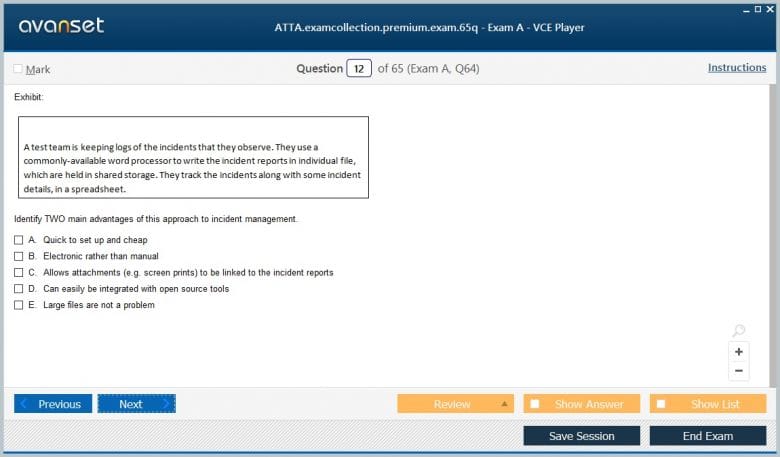
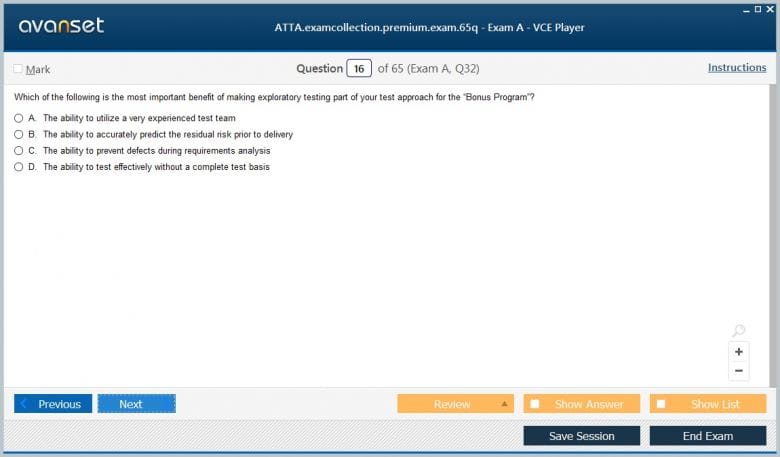
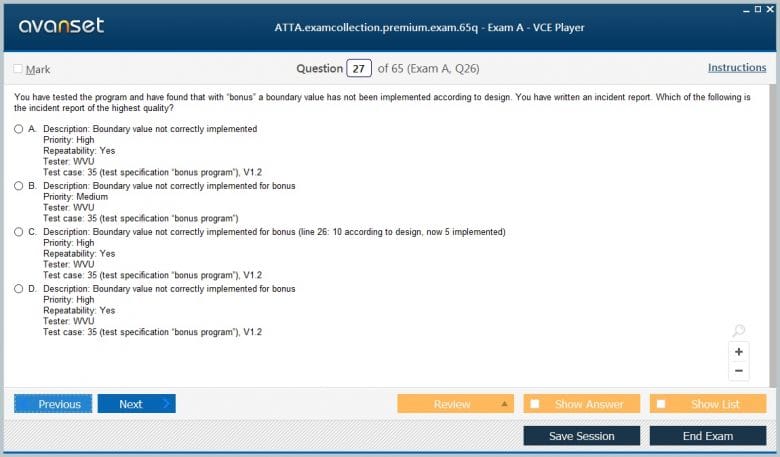
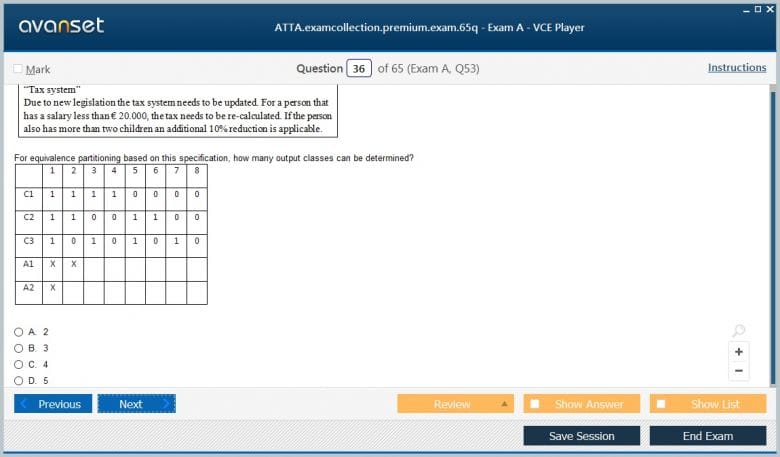
ISTQB ATTA Practice Test Questions in VCE Format
| File | Votes | Size | Date |
|---|---|---|---|
File ISTQB.Test-inside.ATTA.v2026-08-08.by.Anna.41q.vce |
Votes 3 |
Size 263.88 KB |
Date Aug 11, 2026 |
ISTQB ATTA Practice Test Questions, Exam Dumps
ISTQB ATTA (Advanced Technical Test Analyst) exam dumps vce, practice test questions, study guide & video training course to study and pass quickly and easily. ISTQB ATTA Advanced Technical Test Analyst exam dumps & practice test questions and answers. You need avanset vce exam simulator in order to study the ISTQB ATTA certification exam dumps & ISTQB ATTA practice test questions in vce format.
ATTA is a legacy abbreviation associated with ISTQB Advanced Technical Test Analyst material. Current candidates should not treat it as a separate modern certification. ISTQB’s active route is Certified Tester Advanced Level Technical Test Analyst v4.0, which covers risk-based technical testing, white-box techniques, static and dynamic analysis, technical quality characteristics, reviews, and test tools and automation.
The version history matters because the Technical Test Analyst syllabus has changed several times. ISTQB identifies the 2012 syllabus as v2.0, the 2019 syllabus as v3.0, and the 2021 syllabus as v4.0. English exams for the 2012 version stopped being valid years ago, while certificates earned under earlier versions remain valid. For preparation in 2026, the current v4.0 material—not an old ATTA outline—should define the scope. The ISTQB certification family also helps place TTA beside Test Analyst, Test Management, automation, and specialist testing paths.
The Technical Test Analyst role is defined by the kinds of risks it tackles. Functional correctness matters, but the role reaches deeper into performance, security, reliability, maintainability, portability, compatibility, architecture, code behavior, interfaces, and tooling. A strong TTA does not simply run technical tools; the analyst connects a product risk to a test objective, chooses an appropriate technique, understands the evidence produced, and explains what confidence that evidence can or cannot provide.
This makes the role highly collaborative. Developers and architects hold implementation knowledge, operations teams understand production behavior, security specialists know threat patterns, and product stakeholders understand impact. The Technical Test Analyst brings testing discipline to those perspectives. Candidates should therefore study technical topics in context rather than as independent definitions.
Technical testing becomes expensive when important quality risks are discovered late. The TTA syllabus expects candidates to participate in risk analysis and use the result to shape technical coverage. A service with strict latency objectives needs a different evidence plan from a batch process whose main risk is data integrity. A safety-relevant component may prioritize reliability and fault handling, while an internet-facing service may emphasize attack surfaces and secure configuration.
Risk affects environments, data, instrumentation, techniques, and sequencing. It can justify early static analysis, architecture reviews, component-level checks, targeted load models, security testing, or specialized tools. The principle is similar to Test Management, but the TTA works closer to the engineering detail. Candidates who understand how risk changes a technical test design will handle scenario questions better than those who only memorize categories.
CTAL-TTA includes statement testing, decision testing, modified condition/decision coverage, multiple-condition testing, and API testing. These techniques help reveal how thoroughly implementation structures have been exercised. They are powerful when internal logic creates risk, but they do not prove that the software meets user expectations or business rules. Structural coverage and behavioral coverage answer different questions.
That distinction is worth making explicit during study. White-box and black-box testing can complement each other: a test suite may achieve high structural coverage while missing an important business scenario, or cover every documented business rule while leaving complex error-handling branches untouched. The TTA must understand what a coverage measure means and avoid turning a percentage into a false claim of quality.
Static analysis examines artifacts without executing the software. Depending on the tool and artifact, it can detect coding-rule violations, suspicious constructs, dependency issues, complexity, control-flow problems, data-flow anomalies, or other maintainability and security concerns. Dynamic analysis observes a running system and can reveal memory behavior, timing characteristics, resource consumption, leaks, concurrency problems, and runtime interactions that static techniques cannot demonstrate directly.
The exam is less about naming tools than choosing a technique that fits the problem. If a team is investigating a latency spike, runtime profiling and measurement may be appropriate. If maintainability risk comes from highly complex code, static analysis may provide an earlier signal. If an API has branching authorization logic, structural techniques can complement behavioral security tests. Candidates should practice matching evidence to a technical question.
The current TTA syllabus includes performance, security, reliability, maintainability, portability, compatibility, and operational-profile considerations. Technical testers therefore need to recognize that non-functional qualities interact. A caching change might improve response time but create stale-data risk. Encryption may add processing overhead. A resilience mechanism can make failure recovery stronger while complicating observability and diagnosis.
Specialist routes can go deeper where a project demands it. CT-PT performance testing focuses on performance risks, metrics, load generation, execution, and reporting, while CT-SEC security testing covers security risk, mechanisms, human factors, lifecycle integration, tools, and standards. The TTA role is broader: it needs enough technical breadth to plan and contribute across several quality characteristics and to know when specialist depth is required.
Technical test design also depends on observability. A system can be difficult to test even when it is functionally correct because the relevant internal state, timing, resource use, or failure information is hidden. Technical Test Analysts can influence logging, metrics, diagnostic interfaces, controllable dependencies, and environment hooks so that later tests produce interpretable evidence. Improving testability is often cheaper than compensating with increasingly complex external tests.
Test oracles deserve similar attention. For some technical qualities there is no single exact expected result. Performance needs thresholds and distributions; reliability may require statistical evidence over time; compatibility depends on supported combinations; security may require evidence that a forbidden behavior cannot be achieved. Candidates should practice defining what would count as a pass, fail, or inconclusive result before selecting a tool.
Technical analysis is strongest when non-functional characteristics are treated as connected constraints rather than isolated test specialties. A response-time problem may originate in inefficient algorithms, excessive database access, contention, or deployment configuration; a reliability concern may surface only after sustained load; a security control can introduce latency or operational complexity. The technical test analyst therefore has to ask which quality characteristic is threatened, what mechanism could cause the failure, what observation would expose it, and what trade-off a proposed fix might introduce elsewhere.
Technical Test Analysts contribute to reviews of requirements, architecture, design, code, and technical work products. Their value is not merely finding defects in a meeting. They can identify missing testability, ambiguous interfaces, failure modes that are difficult to observe, unsafe assumptions about capacity, or architecture decisions that create excessive verification cost later.
Review skill depends on context. A checklist can help, but a generic checklist is not a substitute for technical reasoning. A database migration, embedded component, cloud-native service, and desktop application expose different risks. Candidates should understand why a particular defect type matters and what downstream testing difficulty it creates.
Review work is especially valuable for artifacts that determine technical behavior before implementation. Interface contracts, data models, concurrency assumptions, error-handling rules, logging designs, and algorithm descriptions can all reveal test conditions while they are still inexpensive to change. A technically strong reviewer does not simply look for coding mistakes. The reviewer asks whether the design is observable, controllable, diagnosable, and robust under abnormal conditions, and whether the stated architecture provides enough seams for meaningful testing.
The TTA syllabus expects awareness of test automation projects and specific tools, but current ISTQB has a dedicated advanced route for deeper automation engineering. CTAL-TAE v2.0 covers automation architecture, implementation, maintainability, CI/CD integration, reporting, verification, and continuous improvement. That relationship is useful when defining the TTA boundary: a Technical Test Analyst may identify automation opportunities and technical requirements even when another specialist designs the automation solution.
Tool selection should follow the problem. Technical testers need to consider supported technologies, integration points, data and environment needs, observability, false-positive risk, maintainability, and the expertise required to interpret results. A sophisticated tool that produces untrusted output can reduce confidence instead of increasing it.
Test environments are part of that engineering system. Coverage can be misleading when the laboratory differs materially from production in topology, data volume, dependency behavior, or resource limits. Technical analysts should know which environment differences matter to a particular quality risk and which can safely be simulated. Stubs, service virtualization, instrumentation, profilers, and fault-injection mechanisms are useful only when their influence on the result is understood. That reasoning separates a trustworthy technical experiment from a script that merely produces output.
The current CTAL-TTA exam has 45 questions worth 78 points, requires 51 points to pass, and has a 120-minute base duration. Candidates must hold Foundation Level certification and meet the practical-experience expectations of their member board or exam provider. Foundation Level concepts remain important because advanced technical questions assume that basic testing principles, test processes, risks, defects, and techniques are already familiar.
Legacy ATTA material can still be useful for conceptual depth, but it should be filtered against v4.0. Build a current topic map, practice structural techniques by hand, interpret analysis outputs rather than simply recognizing tool names, and connect each technical activity to a product risk. The strongest preparation combines breadth across technical quality characteristics with the discipline to choose evidence that actually answers the engineering question in front of the team.
Go to testing centre with ease on our mind when you use ISTQB ATTA vce exam dumps, practice test questions and answers. ISTQB ATTA Advanced Technical Test Analyst certification practice test questions and answers, study guide, exam dumps and video training course in vce format to help you study with ease. Prepare with confidence and study using ISTQB ATTA exam dumps & practice test questions and answers vce from ExamCollection.
Purchase Individually
Top ISTQB Certifications

Site Search:

SPECIAL OFFER: GET 10% OFF

Pass your Exam with ExamCollection's PREMIUM files!
SPECIAL OFFER: GET 10% OFF
Use Discount Code:
MIN10OFF
A confirmation link was sent to your e-mail.
Please check your mailbox for a message from support@examcollection.com and follow the directions.

Download Free Demo of VCE Exam Simulator
Experience Avanset VCE Exam Simulator for yourself.
Simply submit your e-mail address below to get started with our interactive software demo of your free trial.