



Premium File
40 Q&A
$76.99$69.99
Nuage Networks 4A0-N02 Exam Questions & Answers, Accurate & Verified By IT Experts
Instant Download, Free Fast Updates, 99.6% Pass Rate
40 Questions & Answers
Last Update: Oct 30, 2026
$69.99
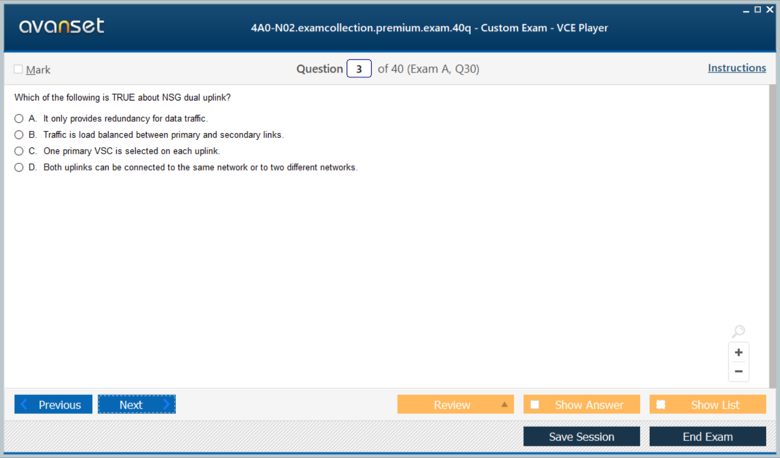
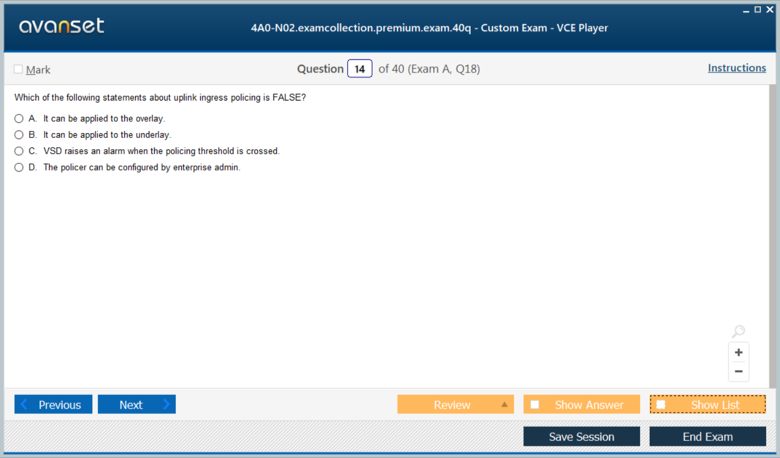
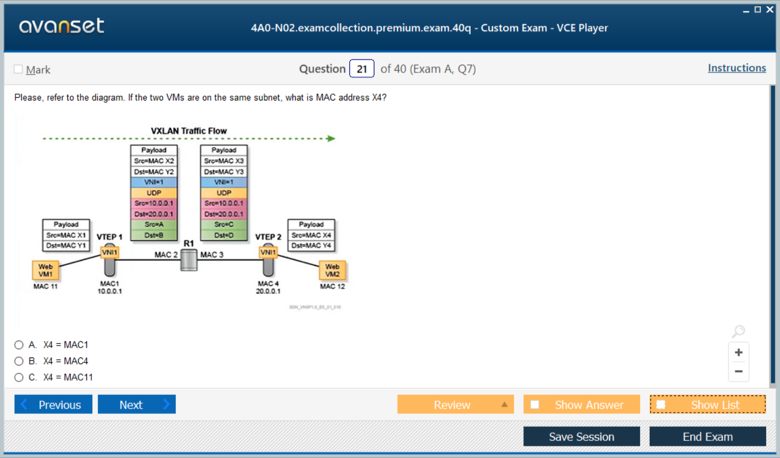
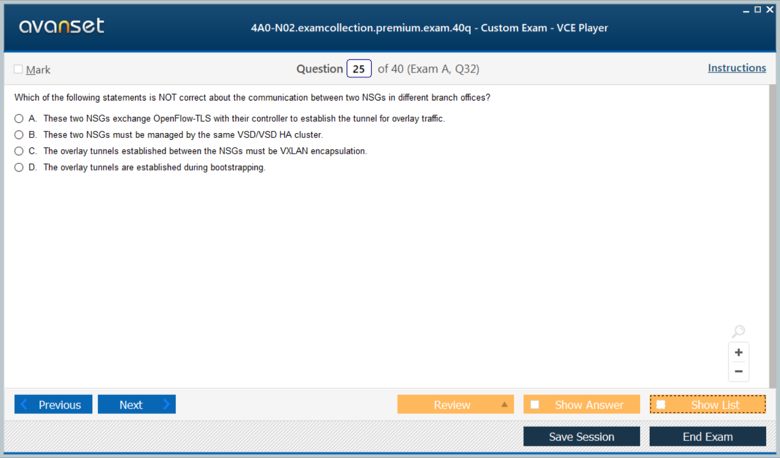
Nuage Networks 4A0-N02 Exam Screenshots
Nuage Networks 4A0-N02 Practice Test Questions in VCE Format
| File | Votes | Size | Date |
|---|---|---|---|
File Nuage Networks.questionpaper.4A0-N02.v2026-08-15.by.abdullah.15q.vce |
Votes 1 |
Size 114.44 KB |
Date Aug 14, 2026 |
File Nuage Networks.Actualtests.4A0-N02.v2019-08-09.by.Evelyn.18q.vce |
Votes 5 |
Size 118.64 KB |
Date Aug 12, 2019 |
Nuage Networks 4A0-N02 Practice Test Questions, Exam Dumps
Nuage Networks 4A0-N02 (Nuage Networks Virtualized Network Services (VNS) Fundamentals) exam dumps vce, practice test questions, study guide & video training course to study and pass quickly and easily. Nuage Networks 4A0-N02 Nuage Networks Virtualized Network Services (VNS) Fundamentals exam dumps & practice test questions and answers. You need avanset vce exam simulator in order to study the Nuage Networks 4A0-N02 certification exam dumps & Nuage Networks 4A0-N02 practice test questions in vce format.
The historical 4A0-N02 exam was identified by Nokia as Nuage Networks Virtualized Network Services Fundamentals. It belongs to an earlier certification catalog, so current scheduling should not be inferred from the continued existence of the exam page. The subject, however, remains recognizable because Nokia still describes Nuage Virtualized Network Services (VNS) as an SD-WAN solution for automating branch connectivity and applying policy across enterprise networks.
VNS takes the software-defined principles used in the datacenter and applies them to the wide area network. The goal is not simply to replace an expensive circuit with internet access. It is to define application-aware policy centrally, automate branch onboarding, use multiple transports intelligently, maintain security controls, and connect sites consistently to datacenters and clouds.
The best way to study the old exam is to think like an operator responsible for hundreds of branches. Every design choice should answer an operational question: how does a new site come online, how are paths selected, how does policy follow applications, what happens when a circuit fails, and how can the team troubleshoot without logging into every device separately?
Traditional WAN rollout often begins with a router configuration built site by site. VNS instead starts with service intent: what applications the branch uses, which networks it should reach, what security policy applies, which transports are available, and what performance objectives matter. A controller and policy system can then turn that intent into repeatable configuration.
This shift is operationally important. A company opening many branches does not want each site to become a custom engineering exercise. Standardized templates, zero-touch or low-touch provisioning, and centralized policy reduce variance. The Nuage Networks model therefore treats automation as part of network architecture, not as an optional scripting layer added later.
An SD-WAN has value when it can make forwarding decisions based on business intent rather than static routes alone. Real-time voice may need low latency and low loss. Bulk backup traffic may prefer the lowest-cost path. A SaaS application may be allowed direct internet breakout, while sensitive enterprise traffic returns through a controlled security path. The policy engine translates those priorities into routing behavior.
Do not reduce path selection to a single metric. A link can be reachable yet unsuitable because of jitter, packet loss, or congestion. A robust policy considers service level, application category, transport cost, and failover behavior. Troubleshooting should therefore compare the selected path with the policy that was supposed to select it and with the measured condition of each transport.
Application identification also needs operational caution. Classification can be based on addresses, ports, signatures, or other telemetry, and the result is only as good as the detection method. Encrypted applications, content-delivery networks, and shared cloud endpoints can make simplistic classification unreliable. A policy should therefore have a sensible default behavior when traffic cannot be identified confidently, rather than pushing unknown flows into a path that violates security or performance expectations.
Quality measurements need time context as well. A single latency sample should not trigger constant path changes. Hysteresis, threshold windows, and hold-down behavior can prevent oscillation when two links are close in quality. The operator should understand how quickly the system reacts to degradation and how it avoids flapping between transports, because an over-sensitive policy can destabilize sessions even when every circuit is technically available.
Branches may use private WAN, broadband, LTE or 5G, and other access types at the same time. Diversity improves resilience only if the system knows how each path should be used. A backup circuit that is never tested can fail at the same moment as the primary. A low-cost path used for the wrong workload can create a performance incident that looks like an application problem.
Design failure behavior before production. Decide which applications fail over immediately, which can tolerate degradation, and whether stateful services need special handling. Then test link loss, recovery, flapping, and asymmetric paths. Automated path steering should make the branch more predictable under failure, not merely more complicated when a carrier problem occurs.
VNS uses centralized intent while forwarding decisions are enforced close to branch traffic. This pattern scales because the central system does not need to process every packet. It distributes policy and control information, while local gateways apply the resulting behavior. Operators gain a single place to define service rules without introducing a single packet-forwarding choke point.
That separation also guides fault isolation. If many sites receive the wrong rule, investigate the shared policy or controller. If one site behaves differently, inspect local state, connectivity, software, or hardware. If traffic follows the expected local rule but performs poorly, move outward to the transport path or destination service. The architecture gives a structured troubleshooting sequence.
SD-WAN policy is incomplete if it optimizes connectivity while ignoring security. Branches increasingly access SaaS services, public clouds, private datacenters, and internet destinations directly. A centralized policy model can define segmentation and permitted communication so that a site is not trusted merely because it is connected to the corporate WAN.
Segmentation should map to business roles and application boundaries. Guest traffic, payment systems, corporate endpoints, operational technology, and administrative access may require different paths and controls. Security policy also needs lifecycle discipline: changes should be reviewed, staged, observed, and rolled back if they create unintended exposure or block critical traffic.
Direct internet access creates another design choice. Sending SaaS traffic straight from the branch can improve latency and reduce backhaul, but it changes where inspection, logging, and policy enforcement occur. The architecture must state which security controls remain local, which are delivered through cloud services, and which traffic must still traverse centralized inspection. Convenience should not silently bypass the organization’s control model.
Identity and device posture can also influence modern access decisions. Although the historical exam centered on VNS fundamentals, current enterprise networking increasingly combines location-independent policy with user, device, and application context. That evolution reinforces the original software-defined idea: security should be expressed as business intent and enforced consistently, rather than being tied permanently to one physical circuit or branch appliance.
Nuage VNS material also reflects the move toward virtualized network functions on universal customer premises equipment. Instead of deploying a dedicated appliance for every service, an operator can host virtual functions and manage their lifecycle through software. This can reduce hardware variety and make it easier to introduce or change services across many locations.
Virtualization does not remove capacity planning. CPU, memory, acceleration requirements, interface throughput, and failure domains still matter. Running several network functions on one platform can simplify logistics but also concentrate risk. An exam scenario that proposes consolidation should be evaluated for performance headroom, service isolation, upgrade coordination, and recovery behavior.
Lifecycle management becomes a first-class task when network functions are software. Images need version control, upgrade sequencing, compatibility checks, and rollback. A new firewall or WAN function may consume additional CPU or change packet ordering. Operators should stage upgrades on a representative branch, compare performance, and confirm that service chaining still follows the intended order before a broad rollout.
The failure domain of uCPE also deserves attention. Consolidating several services onto one device reduces hardware count, but a device failure can affect all of those functions together. High availability may require paired appliances, redundant transports, or rapid replacement procedures. Cost savings should be evaluated alongside the operational consequence of concentrating functions.
The earlier 4A0-N01 VSP foundations focus primarily on datacenter and cloud network virtualization, while VNS extends policy-driven networking toward branches and WAN services. The technologies are related because enterprises need connectivity to remain coherent from remote users and sites through the WAN into applications hosted in private or public clouds.
Understanding the distinction prevents a common conceptual error. VSP is not simply “SD-WAN inside a datacenter,” and VNS is not merely “VSP with routers.” Their operational objects, endpoints, failure modes, and service objectives differ. What they share is abstraction: business policy is expressed centrally and translated into distributed network behavior.
Build a small enterprise with three branches, two transports per branch, one private application, one SaaS service, and one internet-facing workload. Define which traffic uses which path under normal conditions, what happens during loss or congestion, which segments may communicate, and how a new site receives its policy. Then inject failures and ask what evidence would prove whether the problem is policy, overlay control, local gateway state, carrier transport, or the destination.
That exercise captures the lasting value of the historical exam. Product interfaces evolve, but the engineering discipline remains: express intent, automate repeatable deployment, measure path quality, maintain isolation, and keep enough visibility to explain why the network chose a particular behavior. Those are the skills that turn SD-WAN from a marketing label into an operable enterprise service.
Include normal operations as well as failures in the exercise. Add a new branch, change an application policy, rotate a transport, and retire a site. These lifecycle events reveal whether the design is truly automated or only easy to demonstrate at initial deployment. A network that handles outages well but requires manual cleanup for every routine change will still become expensive and inconsistent at scale.
Go to testing centre with ease on our mind when you use Nuage Networks 4A0-N02 vce exam dumps, practice test questions and answers. Nuage Networks 4A0-N02 Nuage Networks Virtualized Network Services (VNS) Fundamentals certification practice test questions and answers, study guide, exam dumps and video training course in vce format to help you study with ease. Prepare with confidence and study using Nuage Networks 4A0-N02 exam dumps & practice test questions and answers vce from ExamCollection.
Purchase Individually
Site Search:

SPECIAL OFFER: GET 10% OFF

Pass your Exam with ExamCollection's PREMIUM files!
SPECIAL OFFER: GET 10% OFF
Use Discount Code:
MIN10OFF
A confirmation link was sent to your e-mail.
Please check your mailbox for a message from support@examcollection.com and follow the directions.

Download Free Demo of VCE Exam Simulator
Experience Avanset VCE Exam Simulator for yourself.
Simply submit your e-mail address below to get started with our interactive software demo of your free trial.