



Premium File
64 Q&A
$76.99$69.99
Nuage Networks 4A0-N01 Exam Questions & Answers, Accurate & Verified By IT Experts
Instant Download, Free Fast Updates, 99.6% Pass Rate
64 Questions & Answers
Last Update: Nov 01, 2026
$69.99
Nuage Networks 4A0-N01 Exam Screenshots
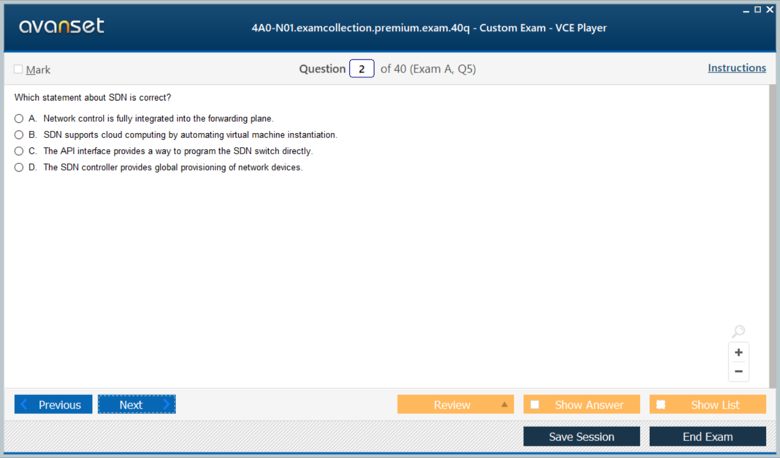
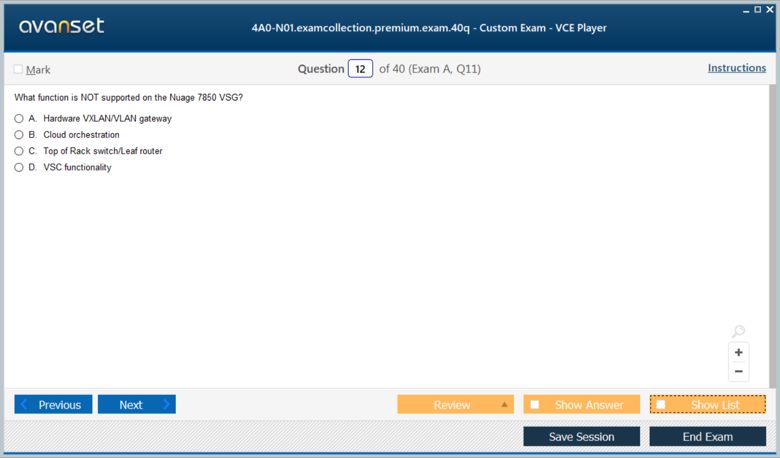
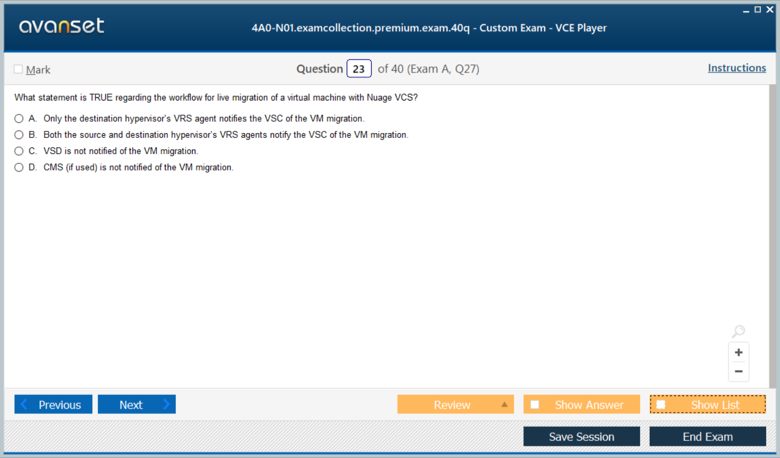
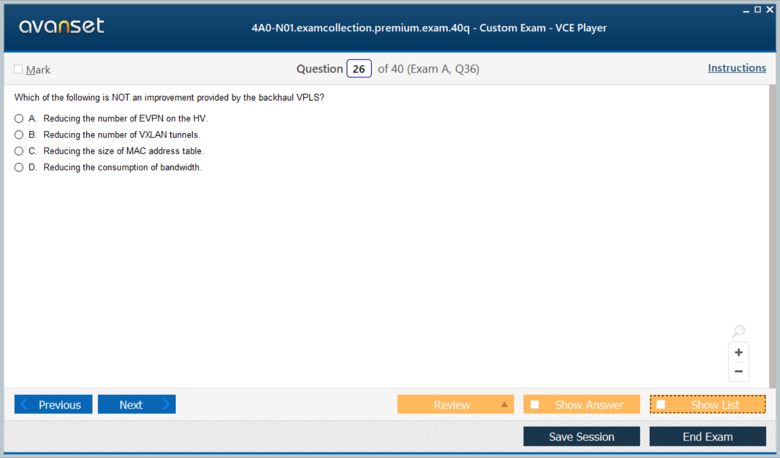
Nuage Networks 4A0-N01 Practice Test Questions in VCE Format
| File | Votes | Size | Date |
|---|---|---|---|
File Nuage Networks.Prep4sure.4A0-N01.v2026-09-30.by.Olivia.18q.vce |
Votes 2 |
Size 107.79 KB |
Date Oct 03, 2026 |
Nuage Networks 4A0-N01 Practice Test Questions, Exam Dumps
Nuage Networks 4A0-N01 (Nuage Networks Virtualized Cloud Services (VCS) Fundamentals) exam dumps vce, practice test questions, study guide & video training course to study and pass quickly and easily. Nuage Networks 4A0-N01 Nuage Networks Virtualized Cloud Services (VCS) Fundamentals exam dumps & practice test questions and answers. You need avanset vce exam simulator in order to study the Nuage Networks 4A0-N01 certification exam dumps & Nuage Networks 4A0-N01 practice test questions in vce format.
The 4A0-N01 exam belongs to an earlier Nuage Networks certification era, when Virtualized Services Platform (VSP) fundamentals were taught as a distinct written exam. Nokia material from that period identifies 4A0-N01 as Nuage Networks Virtualized Services Platform Fundamentals. It should therefore be treated as a historical exam code rather than presented as a currently scheduled credential.
The architecture is not merely a museum piece. Nokia still publishes material for Nuage Networks VSP and describes it as a software-defined networking platform for automating cloud and datacenter connectivity. That makes the old exam useful as a way to understand the design logic behind policy-driven network virtualization: separate application intent from physical topology, create logical networks on demand, and let software keep connectivity aligned with changing workloads.
Preparation is strongest when the reader studies the platform as a system rather than memorizing component names. VSP links policy, control, forwarding, analytics, and cloud orchestration. The important question is how those pieces cooperate when a tenant creates a workload, changes a security rule, migrates a virtual machine, or extends an application across sites.
Traditional datacenter networking often begins with physical constructs: VLANs, switch ports, routing instances, access lists, and device-by-device configuration. VSP reverses the viewpoint. The operator describes logical network requirements for an application or tenant, and the platform translates those requirements into distributed forwarding behavior. This abstraction is the central idea behind the Nuage Networks approach.
That distinction matters because cloud workloads are dynamic. A virtual machine may be created, moved, resized, or deleted without a network engineer touching a physical switch. If the network depends on manual configuration, compute automation quickly outruns network operations. A policy-driven overlay allows connectivity and security state to follow the workload. For exam-style scenarios, identify which requirement belongs to policy and which still depends on the IP underlay carrying the overlay traffic.
The Virtualized Services Directory (VSD) provides the business and policy model. Administrators define tenants, domains, zones, subnets, users, access policies, and related service constructs in a hierarchy that represents how applications should communicate. The value is not the GUI itself; it is the centralized source of intent that can be translated consistently across many workloads and locations.
Think carefully about inheritance and scope. A broad policy at a domain level can affect many endpoints, while a narrower rule may target a specific zone or application tier. Good designs keep reusable policy high enough in the hierarchy to avoid duplication but do not make a rule so broad that unrelated applications inherit it accidentally. Troubleshooting therefore begins by asking which policy object owns the behavior, not by assuming a packet was dropped by a random switch.
Policy design also depends on naming and tenancy discipline. In a large environment, dozens of teams may create domains and subnets that look similar but serve different owners or lifecycle rules. Clear object ownership, predictable naming, and role-based administration reduce the risk that an operator edits the wrong tenant. They also make logs and API output easier to interpret during an incident, when a cryptic identifier can otherwise slow the investigation.
The policy database should be treated as production configuration. Changes deserve review, export or backup where supported, and a clear record of who changed what. A platform that can instantiate networking rapidly can also propagate a mistaken rule rapidly. Operational maturity therefore combines centralized control with stronger change governance rather than using centralization as a reason to relax it.
The Virtualized Services Controller (VSC) represents the control-plane side of the architecture. It distributes reachability and service information so that forwarding elements can build the correct paths without every endpoint having to learn the entire physical network. The broader SDN lesson is separation of concerns: control logic can be centralized or logically centralized while packet forwarding remains distributed close to workloads.
This does not eliminate the need for routing knowledge. The overlay still depends on a healthy IP fabric, and control-plane sessions need reachability, convergence, and resilience. When a logical network fails, determine whether the fault is in policy, overlay control, endpoint attachment, or the underlay. An overlay cannot repair an underlay that drops packets, has MTU problems, or cannot reach the tunnel endpoints.
Virtual Routing and Switching (VRS) functions at the workload edge, where virtual interfaces connect to the virtual network. That location is important because distributed forwarding and security can be enforced close to the source instead of hairpinning every flow through a centralized appliance. The result can improve scale and reduce unnecessary traffic movement inside a large datacenter.
For study purposes, follow a single packet. Start with a workload attached to a logical subnet, identify the local policy that permits or denies the flow, determine how the destination is resolved in the overlay, and then distinguish the encapsulated underlay path from the tenant-visible address space. This packet walk exposes misunderstandings much faster than memorizing acronyms.
An overlay creates tenant and application networks independently of the physical fabric. That independence supports overlapping address spaces, mobility, multi-tenancy, and rapid provisioning. The underlay remains responsible for moving encapsulated packets between tunnel endpoints with adequate bandwidth, latency, MTU, and availability. Treating the two layers as interchangeable is one of the easiest ways to misdiagnose a failure.
Operational teams need observability in both layers. A tenant may report that two application tiers cannot communicate even though the physical fabric is healthy. Conversely, policy can be correct while an underlay routing flap causes intermittent loss. Mature troubleshooting correlates logical topology, policy state, tunnel state, and physical path metrics instead of relying on one dashboard.
MTU is a practical example of the boundary between overlay and underlay. Encapsulation adds headers, so an underlay that cannot carry the resulting frame size may produce fragmentation or dropped packets that appear only for certain applications. Small pings can succeed while larger application flows fail. A useful troubleshooting sequence checks the effective packet size, tunnel path, and interface counters instead of concluding that policy is wrong because connectivity is inconsistent.
Resilience should be tested in both layers as well. Redundant physical paths are valuable only if routing converges correctly, while redundant controllers are useful only if forwarding state remains available during control-plane disruption. A design review should ask which failures the overlay can mask, which require underlay recovery, and what the operator will see when each event occurs.
Cloud networking is not only about creating networks quickly. Different tenants, business units, or application environments may reuse address space and still require strong isolation. VSP uses logical domains and policy to keep those environments separate while sharing the same physical infrastructure. The design goal is predictable boundaries without rebuilding the physical network for every new consumer.
Security policy should express application relationships rather than broad assumptions about location. A web tier may communicate with an application tier on defined services, while direct access to a database tier is restricted. When workloads move, the rule should continue to describe the relationship. This is one reason policy-driven virtualization is more durable than security based only on switch ports or static addresses.
VSP was designed to integrate with cloud and virtualization systems so that network changes can be triggered by workload lifecycle events. When a cloud platform creates a compute instance, the network can allocate the appropriate logical connectivity automatically. When the instance disappears, stale state can be removed. The network becomes part of the provisioning workflow instead of a separate ticket queue.
Automation also raises the cost of a bad policy. A manual mistake might affect one device, while an incorrect template or global rule can be propagated at scale. Administrators therefore need change control, versioned intent, staged testing, and rollback procedures. The fastest automation is not the safest automation unless the policy model is observable and recoverable.
Integration points also create dependency risk. If the cloud management platform can create compute resources while the network integration is degraded, workloads may exist without usable connectivity. Conversely, stale lifecycle events can leave unused policy objects or address assignments behind. Monitoring should therefore include orchestration health and reconciliation, not only packet forwarding. The desired state in the cloud platform and the realized state in VSP should periodically be compared.
API-driven workflows benefit from idempotent behavior. Repeating a request should not create duplicate networks or conflicting policy objects. Where the platform or surrounding automation cannot guarantee that property, the workflow should query current state first and make the smallest necessary change. This is the difference between automation that merely works in a demo and automation that remains safe during retries, partial failures, and large-scale operations.
The related 4A0-N02 material shifts the emphasis from datacenter VSP foundations toward Virtualized Network Services and branch connectivity. The relationship is logical: both rely on centralized policy and software-defined control, but they apply those ideas to different operational domains.
For a modern review of 4A0-N01, build a simple architecture diagram with VSD, VSC, VRS, the IP underlay, two tenants, and a cloud orchestrator. Then walk through workload creation, east-west communication, a denied flow, a VM move, and an underlay failure. If you can explain which component owns each decision and which evidence would confirm it, you have captured the durable engineering value of the historical exam.
Go to testing centre with ease on our mind when you use Nuage Networks 4A0-N01 vce exam dumps, practice test questions and answers. Nuage Networks 4A0-N01 Nuage Networks Virtualized Cloud Services (VCS) Fundamentals certification practice test questions and answers, study guide, exam dumps and video training course in vce format to help you study with ease. Prepare with confidence and study using Nuage Networks 4A0-N01 exam dumps & practice test questions and answers vce from ExamCollection.
Purchase Individually
Site Search:

SPECIAL OFFER: GET 10% OFF

Pass your Exam with ExamCollection's PREMIUM files!
SPECIAL OFFER: GET 10% OFF
Use Discount Code:
MIN10OFF
A confirmation link was sent to your e-mail.
Please check your mailbox for a message from support@examcollection.com and follow the directions.

Download Free Demo of VCE Exam Simulator
Experience Avanset VCE Exam Simulator for yourself.
Simply submit your e-mail address below to get started with our interactive software demo of your free trial.