



Premium File
300 Q&A
$76.99$69.99
Symantec 250-513 Exam Questions & Answers, Accurate & Verified By IT Experts
Instant Download, Free Fast Updates, 99.6% Pass Rate
300 Questions & Answers
Last Update: Sep 21, 2026
$69.99
Symantec 250-513 Exam Screenshots
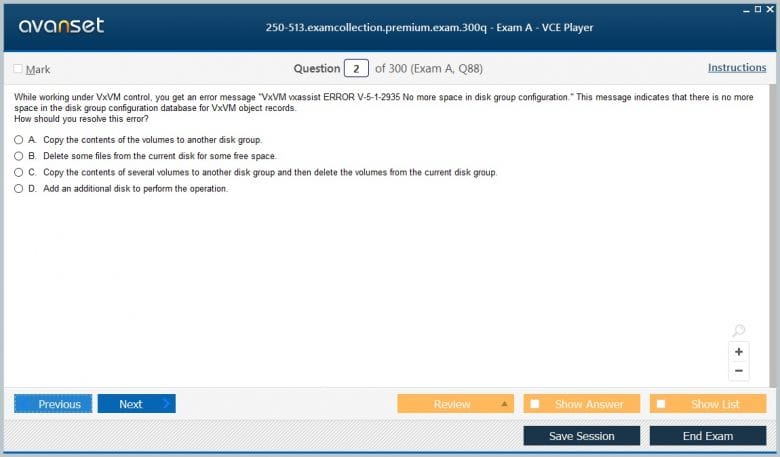
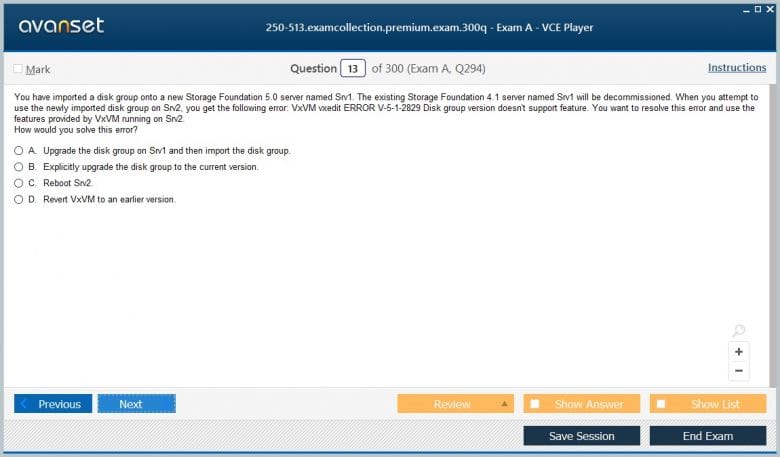
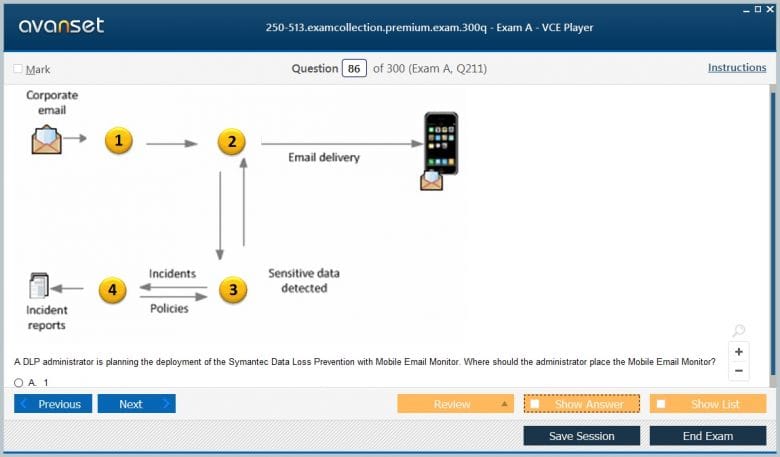
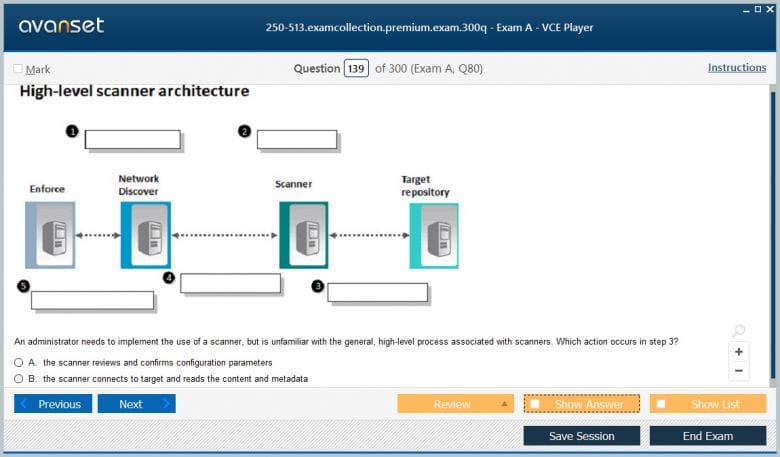
Symantec 250-513 Practice Test Questions in VCE Format
| File | Votes | Size | Date |
|---|---|---|---|
File Veritas.Passit4sure.250-513.v2024-09-04.by.Roma.300q.vce |
Votes 10 |
Size 653.79 KB |
Date Sep 04, 2024 |
Symantec 250-513 Practice Test Questions, Exam Dumps
Symantec 250-513 (Administration of Symantec Data Loss Prevention 12 (Broadcom)) exam dumps vce, practice test questions, study guide & video training course to study and pass quickly and easily. Symantec 250-513 Administration of Symantec Data Loss Prevention 12 (Broadcom) exam dumps & practice test questions and answers. You need avanset vce exam simulator in order to study the Symantec 250-513 certification exam dumps & Symantec 250-513 practice test questions in vce format.
250-513 belongs to an earlier generation of Symantec Data Loss Prevention certification, centered on administration of DLP 12. It is no longer part of Broadcom’s current certification catalog, which now lists 250-587 for Symantec Data Loss Prevention 16.x Administration. That makes 250-513 a legacy exam rather than a current registration target, but the architecture and operating ideas behind it remain useful for understanding how enterprise DLP programs are assembled.
The 250-513 material is best approached as a historical product-administration study rather than as a current exam bulletin. DLP 12 established many of the concepts that still define the product family: an Enforce management tier, detection servers positioned around different data channels, endpoint agents, content inspection methods, policy conditions, incident workflows, and reporting. The surrounding Symantec exam family shows how those older product certifications fit into a broader security portfolio that has since moved under Broadcom.
For a modern reader, the value is not memorizing obsolete screen labels. It is understanding why data protection systems need accurate classification, channel-aware detection, identity context, policy governance, and disciplined incident handling. Those ideas also connect naturally to current data loss prevention techniques, where technical controls are strongest when they are tied to real business data and well-defined response processes.
An enterprise DLP deployment cannot watch only one network boundary. Sensitive information may move through email, web uploads, endpoints, removable media, file shares, databases, or collaboration workflows. DLP 12 therefore used a distributed architecture in which the Enforce platform coordinated policies and incidents while specialized detection components inspected data at different control points. Understanding which component sees which traffic is more important than memorizing server names in isolation.
Administrators also had to think about placement. A detection server positioned incorrectly could miss the traffic it was meant to inspect or create unnecessary network complexity. Endpoint monitoring introduced different constraints from network inspection, and stored-data discovery introduced another operating model again. The architectural lesson is durable: start with the data flow, identify where inspection is practical, and then place controls where they can observe the event without undermining availability or user experience.
DLP policies become useful only when their detection logic matches the organization’s information. Simple keyword rules can catch obvious patterns, but enterprise environments need more precise techniques for structured records, confidential documents, source-code fragments, regulated identifiers, and contextual combinations. DLP 12 exposed multiple detection approaches so an administrator could balance accuracy, coverage, and performance according to the data being protected.
That is why good preparation should compare methods rather than learn them as vocabulary. Exact Data Matching is appropriate when protected values can be drawn from structured records. Indexed Document Matching is aimed at documents or document-like content. Described Content Matching and pattern-based rules handle other forms of identifiable information. The broader lesson, reinforced by advanced DLP strategy, is that detection must be engineered to reduce both missed events and noisy false positives.
Network controls can observe traffic, but endpoint agents add visibility into actions that may never cross a monitored gateway. Copying data to removable media, printing, moving files into local applications, or transferring information through endpoint channels can all matter to a DLP program. Administrators therefore need to understand agent deployment, communication with the management environment, policy updates, and what happens when an endpoint is temporarily disconnected.
Endpoint policy should also reflect operational reality. A rule that blocks every suspicious action may look strong but can disrupt legitimate work and generate resistance. In practice, administrators often combine monitoring, user notification, justification workflows, and blocking according to risk. That same balance appears in modern endpoint governance: the control should be strong enough to protect the asset while still producing an incident record that analysts can interpret and business owners can act on.
DLP 12 deployments could inspect several network-oriented channels, but administrators needed to distinguish monitoring from prevention. Monitoring components identify policy violations and create incidents, while prevention components sit where they can interrupt or redirect a transaction. Email and web traffic behave differently, and the placement of a prevention component affects how it integrates with mail systems, proxies, or other security infrastructure.
This is a good place to connect DLP administration with broader security architecture. A proxy, mail gateway, and DLP detection tier may all see the same transaction for different reasons. The administrator should know which control is authoritative, where encrypted traffic becomes visible, and which component owns the response. Confused responsibility leads to duplicate alerts, bypass paths, or failures that are difficult to trace during an incident.
Data at rest often presents a different risk from data in motion. A file share may contain years of accumulated documents, duplicate exports, abandoned project folders, or records that no longer belong in broad-access locations. Discover-style scanning allows a DLP program to identify those concentrations of sensitive information and create remediation work that is not tied to a live user transaction.
The challenge is scope. Scanning everything at maximum depth can produce excessive load and huge incident queues. Administrators need to define repositories, credentials, schedules, inclusion and exclusion rules, and remediation ownership carefully. The same discipline appears in information-protection programs outside Symantec; for example, information protection and compliance administration also depends on knowing where sensitive content lives before controls can be applied consistently.
A DLP product can detect thousands of events, but the security value comes from how those events are triaged, assigned, investigated, and closed. DLP 12 administrators needed to understand incident attributes, status, severity, policy matches, user context, and evidence. The goal was not simply to prove that a rule fired. It was to help an analyst determine whether the event represented routine behavior, a policy mistake, user error, or a genuine data-loss risk.
Workflow design matters because analysts need enough context to act without exposing sensitive content unnecessarily. Role-based access, data-owner participation, escalation paths, and remediation notes all support a defensible process. A mature DLP program therefore resembles an incident-management system as much as a detection engine. Incident response discipline is useful context because DLP incidents need ownership, evidence, decision criteria, and closure just like other security events.
An alert becomes more useful when the system knows who performed the action and who owns the information involved. Directory integration, user groups, business-unit context, and data-owner exception logic can reduce noise and route incidents more intelligently. An administrator should understand how identity information enters the DLP environment and what happens when that information is stale, incomplete, or inconsistent across systems.
The practical lesson is to treat directory data as part of the control plane. A policy that assumes perfect group membership may fail when identities change or service accounts are used unexpectedly. Testing should include ordinary users, privileged users, shared accounts, and exceptional business workflows. This emphasis on identity also connects to modern adaptive access control, where context improves the quality of security decisions.
DLP administration is not finished when policies are created. The platform contains databases, services, detection components, certificates, endpoint packages, and configuration dependencies that need routine maintenance. Administrators should understand health monitoring, service state, log review, backup expectations, version compatibility, and the order in which major changes are introduced. A rushed upgrade can be more damaging than a poorly tuned policy because it can remove visibility across the whole environment.
Change control is equally important for policy logic. A small rule modification can multiply the number of incidents or block a business process. Mature teams test changes in a controlled scope, document expected behavior, review results, and then expand deployment. This operational mindset is one of the strongest reasons to study a legacy administration exam: product interfaces change, but disciplined security administration remains a transferable skill.
Because 250-513 is a legacy DLP 12 exam, candidates should not interpret old objectives as current product guidance. Broadcom’s live certification catalog now uses 250-587 for DLP 16.x Administration. Version changes bring new deployment requirements, features, and integrations, so current administrators should use current documentation and training rather than relying on historical procedures.
The conceptual bridge is still valuable. Architecture, policy construction, data identification, endpoint and network channels, incident workflow, identity context, and operational maintenance remain central to enterprise DLP. A sensible study method is to learn those durable ideas from the older track, then deliberately compare them with the current product. That approach preserves the historical value of 250-513 without confusing a retired exam with today’s certification path.
Legacy DLP study is especially useful for learning how policy tuning becomes a continuous feedback loop. A rule begins with a hypothesis about sensitive information, but production incidents reveal edge cases: formatting differences, authorized transfers, recurring business processes, and new data sources. Administrators should capture those findings and refine thresholds or conditions deliberately. That habit prevents policy sets from becoming either permanently noisy or progressively weakened by ad hoc exceptions.
It is also worth practicing architecture diagrams from memory. Draw the management tier, database, endpoint agents, network detection points, mail or web integrations, and repository scans, then trace one incident from user action to analyst review. If that path cannot be explained clearly, the product is being learned as a list of features instead of as a system.
Go to testing centre with ease on our mind when you use Symantec 250-513 vce exam dumps, practice test questions and answers. Symantec 250-513 Administration of Symantec Data Loss Prevention 12 (Broadcom) certification practice test questions and answers, study guide, exam dumps and video training course in vce format to help you study with ease. Prepare with confidence and study using Symantec 250-513 exam dumps & practice test questions and answers vce from ExamCollection.
Purchase Individually
Top Symantec Certification Exams
Site Search:

SPECIAL OFFER: GET 10% OFF

Pass your Exam with ExamCollection's PREMIUM files!
SPECIAL OFFER: GET 10% OFF
Use Discount Code:
MIN10OFF
A confirmation link was sent to your e-mail.
Please check your mailbox for a message from support@examcollection.com and follow the directions.

Download Free Demo of VCE Exam Simulator
Experience Avanset VCE Exam Simulator for yourself.
Simply submit your e-mail address below to get started with our interactive software demo of your free trial.