



Premium File
87 Q&A
$76.99$69.99
Zend 200-710 Exam Questions & Answers, Accurate & Verified By IT Experts
Instant Download, Free Fast Updates, 99.6% Pass Rate
87 Questions & Answers
Last Update: Sep 06, 2026
$69.99
Zend 200-710 Exam Screenshots
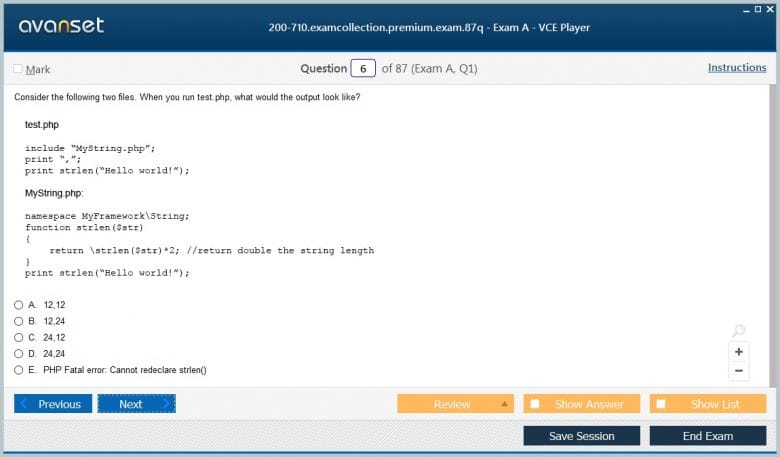
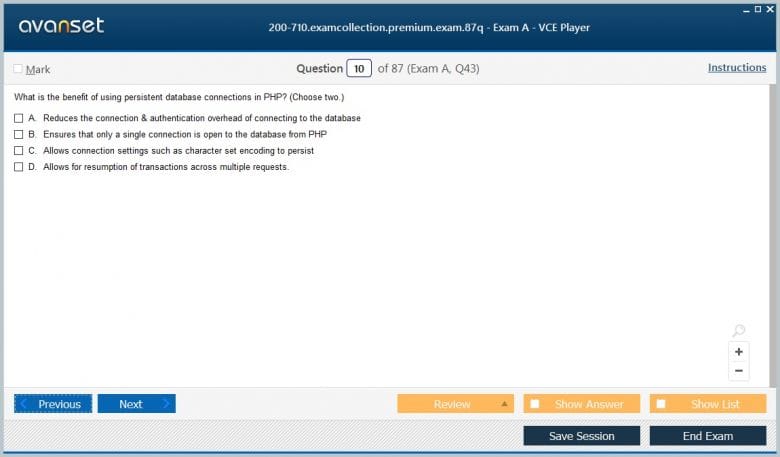
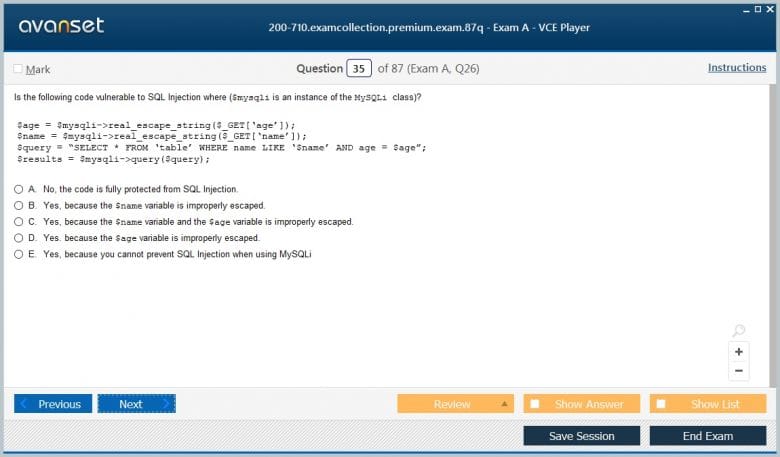
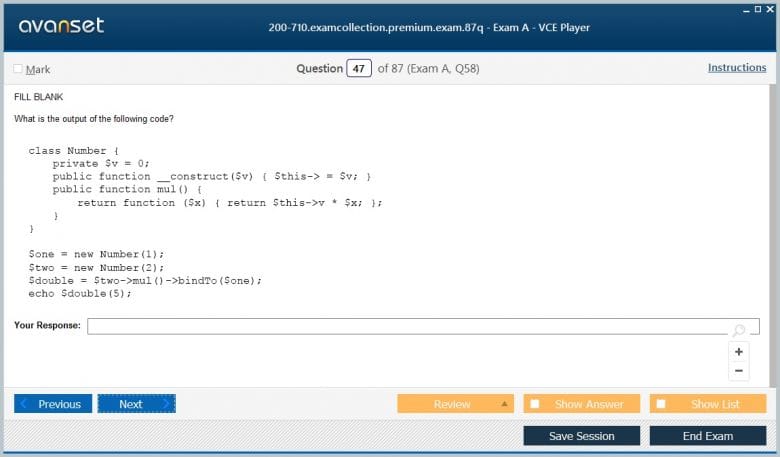
Zend 200-710 Practice Test Questions in VCE Format
| File | Votes | Size | Date |
|---|---|---|---|
File Zend.examquestions.200-710.v2026-08-14.by.liming.52q.vce |
Votes 1 |
Size 242.3 KB |
Date Aug 14, 2026 |
File Zend.testking.200-710.v2020-07-24.by.teddy.51q.vce |
Votes 2 |
Size 254.35 KB |
Date Jul 24, 2020 |
Zend 200-710 Practice Test Questions, Exam Dumps
Zend 200-710 (Zend Certified Engineer) exam dumps vce, practice test questions, study guide & video training course to study and pass quickly and easily. Zend 200-710 Zend Certified Engineer exam dumps & practice test questions and answers. You need avanset vce exam simulator in order to study the Zend 200-710 certification exam dumps & Zend 200-710 practice test questions in vce format.
The Zend 200-710 Zend Certified Engineer exam is associated with the earlier Zend PHP certification program. Zend paused that program in 2023 and later reintroduced the Zend PHP Certified Engineer certification with refreshed content covering PHP through version 8.4. Zend’s current public certification page promotes the modern exam but does not present 200-710 as the current code. In 2026, the safest editorial treatment is therefore to regard 200-710 as a legacy code whose technical domains can still inform study, not as a current exam identifier.
The enduring topics are recognizable to any serious PHP developer: language basics, functions, data types, web features, object-oriented programming, security, input/output, strings and regular expressions, databases and SQL, arrays, and error handling. The challenge is to update the examples and runtime assumptions so that historical study material does not teach obsolete behavior.
PHP has permissive syntax and dynamic typing, which makes small details important. Operators, type juggling, comparison rules, variable scope, references, constants, and control flow can produce surprising results when developers rely on intuition rather than explicit behavior. A certification-style question often compresses those interactions into a short code sample.
Prepare by running small experiments on a current PHP 8.4 environment. Predict output first, then execute the code and explain any difference. This is more useful than memorizing isolated facts because it builds a mental model of how the language evaluates expressions and handles edge cases.
Older PHP certification material predates many improvements in the type system. Current PHP supports richer scalar and return declarations, union and intersection types, attributes, named arguments, and other language features that affect API design. Historical questions about functions can still teach scope, references, defaults, and variable arguments, but they should be supplemented with current syntax and compatibility rules.
When reviewing code, ask what the function promises, which inputs are valid, how errors are represented, and whether side effects are obvious. Modern PHP applications benefit when function contracts are explicit enough for developers and static-analysis tools to reason about them.
Classes, interfaces, traits, inheritance, visibility, constructors, static members, magic methods, and namespaces are core language features. The deeper skill is knowing how to choose among them. Inheritance can model an is-a relationship, interfaces can define capabilities, composition can reduce coupling, and traits can share implementation without creating a class hierarchy.
Use small design exercises rather than only syntax drills. Refactor a class with too many responsibilities, replace a global dependency with constructor injection, or define an interface around an external service. This makes certification study reinforce maintainable application design.
HTTP requests expose query parameters, form fields, cookies, headers, files, and server variables. All of them can carry unexpected values. Security depends on validating according to business rules, encoding output for the target context, managing sessions safely, and using framework or platform controls correctly.
Do not reduce security to one sanitization function. SQL injection, cross-site scripting, cross-site request forgery, file-upload abuse, insecure session handling, and command execution are different problems with different mitigations. Current Zend material still includes security as a major certification domain, so historical 200-710 preparation should be updated with modern secure-development practice.
PHP string handling includes quoting rules, interpolation, byte-oriented operations, multibyte concerns, formatting, and pattern matching. Regular expressions are powerful but can become difficult to maintain or inefficient when used without discipline. Certification questions may test whether a pattern actually matches the intended input and how captures or replacements behave.
Practice by writing tests around edge cases: empty strings, Unicode data, unexpected delimiters, very long input, and invalid formats. Prefer simpler string operations where they express the requirement clearly. A regex should solve a specific parsing or validation problem, not demonstrate cleverness.
Zend historically emphasized standard SQL concepts rather than one database vendor. That remains good preparation. Understand joins, grouping, transactions, indexes, constraints, normalization, and the difference between SQL logic and PHP application logic. Use parameterized queries or appropriate abstraction layers rather than concatenating untrusted input into SQL.
Performance issues can arise from query design as much as PHP code. Inspect execution plans where needed, avoid N+1 query patterns, and keep transactions scoped to the work that must be atomic. A developer who can reason about both application and database behavior is better prepared for production troubleshooting.
Modern PHP applications should distinguish expected business conditions from programming failures and infrastructure problems. Exceptions can carry context across layers, while logging captures information needed to diagnose incidents. Error handling should avoid both silent failure and uncontrolled disclosure of stack traces or sensitive data to users.
Runtime observability matters as applications scale. PHP-FPM slow logging can expose requests that hang or exceed latency thresholds, while application logs and metrics help identify database, network, or business-layer causes. Certification study becomes more valuable when linked to real diagnostic workflows.
PHP performance depends on far more than micro-optimizing syntax. Opcode caching, autoloading, database access, serialization, remote calls, caching strategy, and algorithmic choices can dominate response time. PHP OPcache is one concrete example: avoiding repeated compilation can improve runtime efficiency, but it cannot fix an application that performs excessive queries or expensive external calls.
Profile first, optimize second. Capture a representative workload, identify the dominant cost, make one controlled change, and measure again. This approach is as important for exam preparation as it is for production because it replaces folklore with evidence.
The broader Zend certifications inventory includes older code pages such as 200-710 and 200-550 Zend Framework 2. Zend’s current certification material, however, describes a relaunched PHP exam that covers PHP through 8.4. Candidates should use that current scope for new certification plans and use legacy code pages only for historical context or older records.
To prepare intelligently, take the durable 200-710 domains and revalidate each one against PHP 8.4 behavior. Run examples, read current language documentation, and build a small application that exercises input handling, classes, database access, error handling, and security. The result is a study plan that respects the history without freezing your knowledge in the past.
Compatibility deserves explicit attention because PHP has removed or changed behaviors across major versions. Code that was valid under older runtimes may now raise warnings, throw exceptions, or fail entirely. When using historical practice material, verify every behavior you rely on against a current runtime instead of assuming the old answer still applies.
The 200-710 code remains useful as a marker in Zend certification history, but the professional skill being measured has moved forward. A modern Zend PHP candidate should be comfortable reading legacy PHP while writing secure, typed, observable, and maintainable code on the current platform.
Modern PHP preparation should include compatibility reasoning across language versions. Read a short program and identify assumptions about types, error handling, deprecated behavior, extensions, or standard-library functions that may change when the runtime is upgraded. Then use automated tests and static analysis to separate actual behavioral changes from warnings or style preferences. The goal is not to memorize every historical incompatibility; it is to develop a repeatable way to evaluate how a PHP application will behave on a newer supported runtime.
Dependency management is part of that reasoning. Application behavior often depends as much on Composer packages and extension versions as on the PHP interpreter itself. Practice reviewing version constraints, transitive dependencies, abandoned packages, and extension requirements before an upgrade. A green application test on one developer workstation is not enough if production uses a different extension set or platform configuration. Reproducible dependency resolution and environment visibility are therefore core professional skills around modern PHP.
Security questions should be approached by trust boundary. For every external value—request parameters, cookies, headers, uploaded files, database content, API responses—decide what validation is required, where encoding belongs, and which API should perform sensitive operations such as database queries or password verification. This prevents the common mistake of treating one generic sanitization function as a universal defense. Secure PHP code uses context-appropriate controls at the point where untrusted data crosses into a privileged operation.
PHP engineers should also rehearse serialization and data-boundary decisions. Native serialization, JSON, database hydration, and API payloads all turn data into executable application state in different ways. Practice deciding which formats are safe for untrusted input, how types and nullability are validated after decoding, and where object construction should be controlled. These choices matter because data that looks syntactically valid can still violate application invariants or create security problems when restored without validation.
Concurrency and request-lifecycle assumptions deserve explicit review even in traditionally synchronous PHP applications. Shared caches, sessions, queues, database transactions, and background workers can create race conditions that are invisible in a single-request example. Build a small scenario in which two requests update the same logical record and decide where locking, transaction isolation, idempotency, or conflict detection belongs. This moves preparation beyond syntax and toward the behavior of real production systems.
A modern study plan should end with a small application that crosses multiple objective areas at once: typed domain code, HTTP input, authentication, parameterized persistence, exception handling, tests, Composer dependencies, and deployment configuration. Debugging that application under a current PHP runtime reveals far more about practical readiness than memorizing isolated functions, while still exercising the language fundamentals represented by the historical 200-710 code.
Go to testing centre with ease on our mind when you use Zend 200-710 vce exam dumps, practice test questions and answers. Zend 200-710 Zend Certified Engineer certification practice test questions and answers, study guide, exam dumps and video training course in vce format to help you study with ease. Prepare with confidence and study using Zend 200-710 exam dumps & practice test questions and answers vce from ExamCollection.
Purchase Individually
Site Search:

SPECIAL OFFER: GET 10% OFF

Pass your Exam with ExamCollection's PREMIUM files!
SPECIAL OFFER: GET 10% OFF
Use Discount Code:
MIN10OFF
A confirmation link was sent to your e-mail.
Please check your mailbox for a message from support@examcollection.com and follow the directions.

Download Free Demo of VCE Exam Simulator
Experience Avanset VCE Exam Simulator for yourself.
Simply submit your e-mail address below to get started with our interactive software demo of your free trial.