



Premium File
223 Q&A
$76.99$69.99
Zend 200-550 Exam Questions & Answers, Accurate & Verified By IT Experts
Instant Download, Free Fast Updates, 99.6% Pass Rate
223 Questions & Answers
Last Update: Oct 21, 2026
$69.99
Zend 200-550 Exam Screenshots
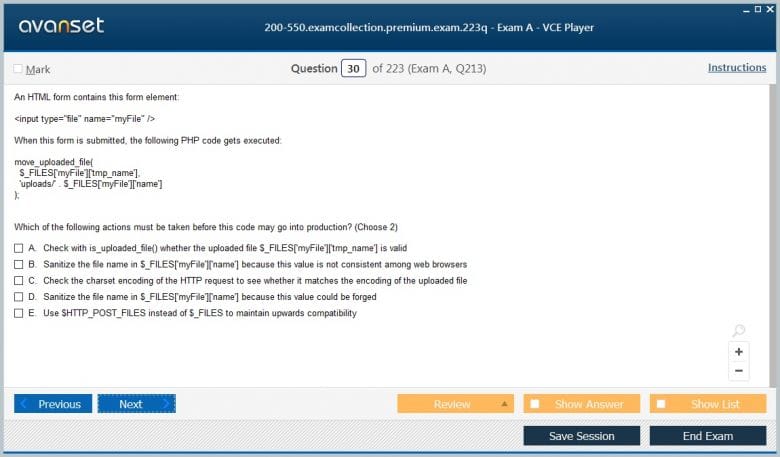
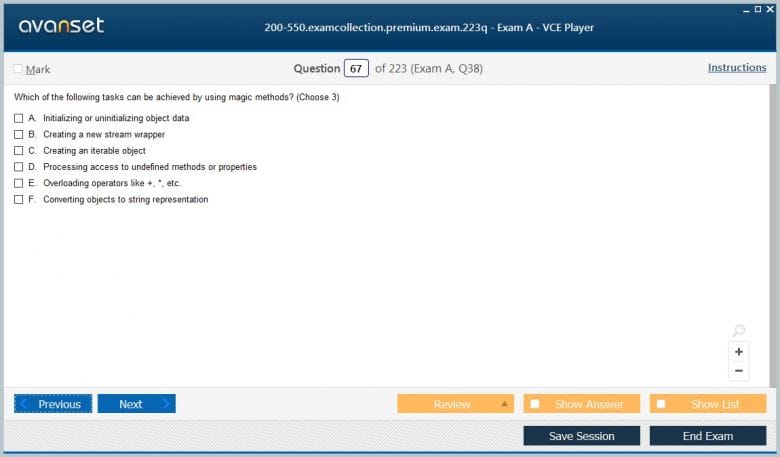
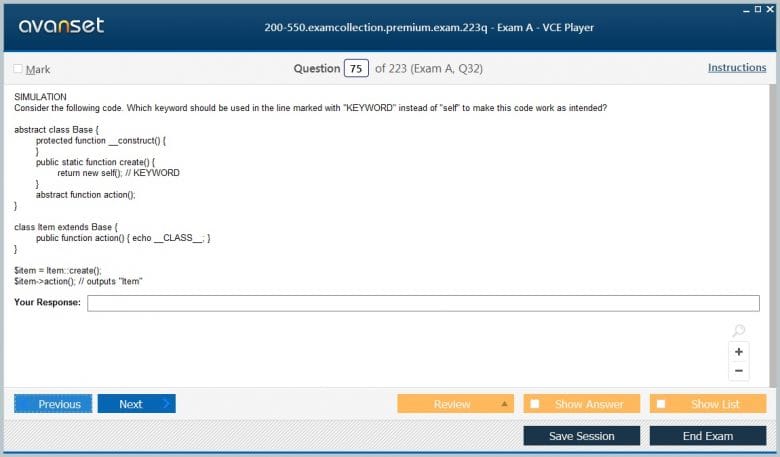
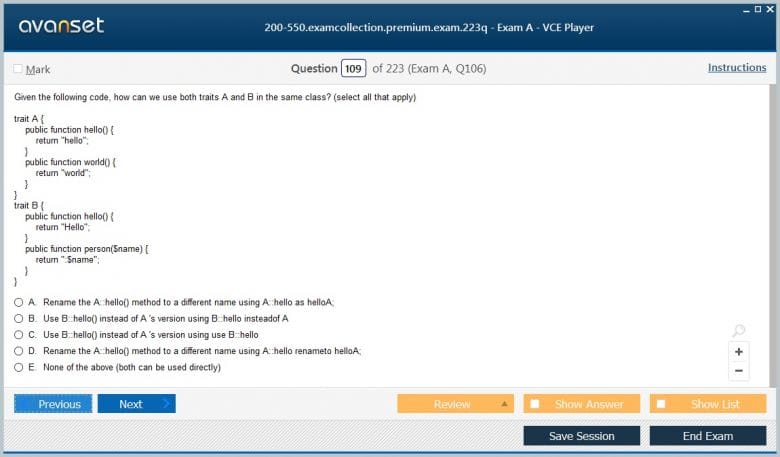
Zend 200-550 Practice Test Questions in VCE Format
| File | Votes | Size | Date |
|---|---|---|---|
File Zend.examanswers.200-550.v2026-07-25.by.jaxon.123q.vce |
Votes 1 |
Size 122.04 KB |
Date Jul 24, 2026 |
File Zend.Actualtests.200-550.v2019-03-14.by.Calista.125q.vce |
Votes 3 |
Size 126.91 KB |
Date Mar 18, 2019 |
File Zend.Testkings.200-550.v2015-03-16.by.Isidore.200q.vce |
Votes 5 |
Size 196.08 KB |
Date Mar 16, 2015 |
Zend 200-550 Practice Test Questions, Exam Dumps
Zend 200-550 (Zend Framework 2) exam dumps vce, practice test questions, study guide & video training course to study and pass quickly and easily. Zend 200-550 Zend Framework 2 exam dumps & practice test questions and answers. You need avanset vce exam simulator in order to study the Zend 200-550 certification exam dumps & Zend 200-550 practice test questions in vce format.
The Zend 200-550 Zend Framework 2 exam belongs to an older generation of Zend certification. Zend paused its previous certification process in 2023, and its current training site has since reintroduced the Zend PHP Certified Engineer exam around modern PHP through version 8.4. The old 200-550 code is therefore best understood as a historical framework certification target rather than a current 2026 exam code. That status does not make the technical ideas useless, but it changes how candidates should use the material.
Zend Framework 2 was built around modular, object-oriented PHP application design with components for MVC, services, validation, authentication, forms, databases, and other web-development concerns. Its architectural patterns influenced later Laminas projects and many enterprise PHP applications. Studying the exam today is most valuable when the goal is maintaining or modernizing an existing codebase and understanding the design choices behind it.
ZF2 applications were commonly organized around modules that packaged configuration, controllers, services, views, and related code. This encouraged teams to define boundaries instead of allowing one application namespace to become an undifferentiated collection of classes. Module configuration also made application composition flexible, but it introduced an important operational concern: configuration from multiple modules can interact in ways that are not obvious from one file.
When maintaining a legacy application, start by mapping modules and responsibilities. Identify which modules own routes, services, database access, authentication, and cross-cutting configuration. This reveals coupling and helps determine whether a change can remain local or will affect shared application behavior.
The Model-View-Controller pattern separated request handling, domain or application logic, and presentation. In practice, poor applications often moved too much logic into controllers because that was the most visible entry point. The healthier pattern keeps controllers thin: accept the request, coordinate services, select a response, and leave business behavior to components that can be tested independently.
Use legacy exam material to inspect real code. If a controller contains SQL, validation rules, and business calculations, identify how those responsibilities could be separated. This exercise remains relevant in modern PHP frameworks because maintainability still depends on clear boundaries even when the framework APIs have changed.
ZF2’s service-management approach encouraged applications to obtain dependencies through configured factories and services rather than creating everything directly inside business code. Dependency injection improves testability and allows implementations to be changed without rewriting consumers, but only if service definitions remain understandable.
When debugging a service-resolution problem, trace the requested service name, alias, factory, constructor dependencies, and configuration. Circular dependencies or hidden service-locator calls can make the application difficult to reason about. The general lesson is current: dependency wiring should make object relationships more explicit, not hide them behind global access.
Routes map incoming HTTP requests to application behavior. A legacy ZF2 application may include literal, segment, hostname, method, or child routes with parameters and constraints. Security and correctness depend on understanding which requests can reach which controller actions and how user input enters the application.
Review routes as part of threat modeling. Confirm that sensitive operations require appropriate methods and authentication, validate route parameters, and avoid assumptions that a URL pattern itself provides authorization. Modern frameworks may express routes differently, but the security principle remains the same: routing controls reachability, while authorization controls permission.
Zend Framework provided structured approaches to forms, input filtering, and validation. The important distinction is that validation asks whether data satisfies a rule, while filtering transforms or normalizes input. Both need to be applied with a clear understanding of where data came from and where it will be used.
Legacy applications should be reviewed for assumptions that were acceptable under older PHP or browser behavior. Input handling, encoding, file uploads, database parameters, and output escaping deserve fresh scrutiny. The historical exam can provide a map of framework capabilities, but current security practice should guide modernization decisions.
Authentication establishes identity; authorization determines what that identity may do. Combining them conceptually is a common design mistake. A user can be successfully authenticated and still lack permission to view a record or perform an action. ZF2 applications often integrated these concerns through framework components and application-specific services.
When reviewing an old application, locate both layers. Determine where sessions or credentials establish identity and where roles, ACLs, ownership rules, or policy checks restrict access. Security tests should include authenticated users attempting actions outside their permissions, not only anonymous access.
Zend Framework 2 supported database abstraction and other infrastructure components appropriate to its era. A long-lived application may now run on newer database versions, PHP runtimes, or deployment environments than those originally tested. Review connection handling, transactions, prepared statements, schema assumptions, and caching behavior rather than assuming compatibility is automatic.
Performance work should also be measured. Modern PHP deployments can use PHP OPcache to avoid repeated script compilation, but application-level bottlenecks may still live in database queries, remote calls, or poor caching strategy. Profile before optimizing.
The broader Zend certifications context has changed. Zend’s current public material promotes a relaunched Zend PHP Certified Engineer exam covering PHP through 8.4. That is distinct from the historical Framework 2 target represented by 200-550. Candidates should not assume that purchasing old 200-550 material prepares them for the current PHP certification.
The neighboring 200-710 Zend PHP exam is itself an older code associated with the prior program. Both pages are useful as historical reference, but current exam planning should begin from Zend’s current certification information rather than from legacy code numbers.
If your practical goal is maintaining a ZF2 application, turn the exam domains into an architecture review. Map modules, routing, controllers, services, authentication, authorization, input validation, database access, logging, caching, and deployment dependencies. For each area, identify technical debt, unsupported components, security risk, and test coverage.
Then choose one request path and trace it end to end from route match through service calls, persistence, and response rendering. Repeat with an error case and an unauthorized case. That exercise provides more durable value than memorizing historical API details, because it teaches you to understand the system you may need to migrate or support.
Logging is particularly useful in legacy modernization because failures may occur across old framework code, newer PHP runtimes, and external services. Application logs should preserve enough context to reconstruct the request without exposing secrets. At the PHP runtime level, PHP-FPM slow logging can also help distinguish framework behavior from runtime or infrastructure bottlenecks.
The right conclusion is not that Zend Framework 2 knowledge has become irrelevant. It is that the certification code belongs to an earlier period. Use 200-550 to understand legacy architecture and modernization risk, while using current Zend and Laminas documentation for present-day implementation decisions.
Legacy framework study becomes especially valuable when it is tied to an upgrade decision. Take a small Zend Framework 2 module and inventory its routes, controllers, services, forms, persistence layer, authentication dependencies, and third-party packages. Mark which components depend directly on framework APIs and which express portable domain logic. This creates a migration map: portable logic can usually move with limited change, while tightly coupled infrastructure requires deliberate replacement or adaptation. The exercise also reveals where the old application violated separation of concerns long before modernization began.
Security review should be part of that migration map. Older applications may carry assumptions about password handling, session configuration, input filtering, escaping, dependency versions, or transport security that were reasonable at the time but no longer satisfy modern expectations. Do not assume that a successful runtime upgrade proves the application is secure. Review trust boundaries explicitly, update unsupported dependencies, and retest authentication and authorization paths with current threat models.
Testing strategy determines how safely a legacy codebase can evolve. Characterization tests can capture existing behavior before refactoring, while unit and integration tests protect the service layer, routing, database access, and form validation as components are replaced. Even if the historical exam emphasized framework configuration, modern maintenance requires evidence that behavior remains correct through change. That makes testing one of the most practical ways to convert 200-550 knowledge into present-day engineering value.
Dependency injection is another legacy lesson that transfers well beyond Zend Framework 2. Review a controller that constructs database adapters, mailers, caches, and domain services directly, then refactor the responsibilities behind interfaces and inject them through a service layer. The result is easier to test, easier to replace during migration, and less dependent on framework-specific factories. This exercise shows why the historical service-manager emphasis still matters even when the original container APIs are no longer the target platform.
Routing and middleware boundaries should be tested with failure cases as well as successful requests. Try missing parameters, malformed identifiers, unauthenticated requests, authorization failures, invalid form submissions, and downstream service errors. Decide which layer should reject each condition and what response should be exposed to the client. A legacy framework application becomes far easier to modernize when request handling has clear ownership instead of allowing every controller to invent its own error behavior.
For maintainers, modernization planning should end with a staged sequence rather than a single rewrite decision. Stabilize the application with tests, update the runtime and dependencies that can move safely, isolate obsolete framework coupling, replace components incrementally, and measure production behavior after each step. That approach reduces the risk of combining a language upgrade, framework migration, architecture rewrite, and feature change into one untestable release.
Go to testing centre with ease on our mind when you use Zend 200-550 vce exam dumps, practice test questions and answers. Zend 200-550 Zend Framework 2 certification practice test questions and answers, study guide, exam dumps and video training course in vce format to help you study with ease. Prepare with confidence and study using Zend 200-550 exam dumps & practice test questions and answers vce from ExamCollection.
Purchase Individually
Site Search:

SPECIAL OFFER: GET 10% OFF

Pass your Exam with ExamCollection's PREMIUM files!
SPECIAL OFFER: GET 10% OFF
Use Discount Code:
MIN10OFF
A confirmation link was sent to your e-mail.
Please check your mailbox for a message from support@examcollection.com and follow the directions.

Download Free Demo of VCE Exam Simulator
Experience Avanset VCE Exam Simulator for yourself.
Simply submit your e-mail address below to get started with our interactive software demo of your free trial.