


Premium File
81 Q&A
$76.99$69.99
Veritas VCS-325 Exam Questions & Answers, Accurate & Verified By IT Experts
Instant Download, Free Fast Updates, 99.6% Pass Rate
81 Questions & Answers
Last Update: Sep 06, 2026
$69.99
Veritas VCS-325 Exam Screenshots
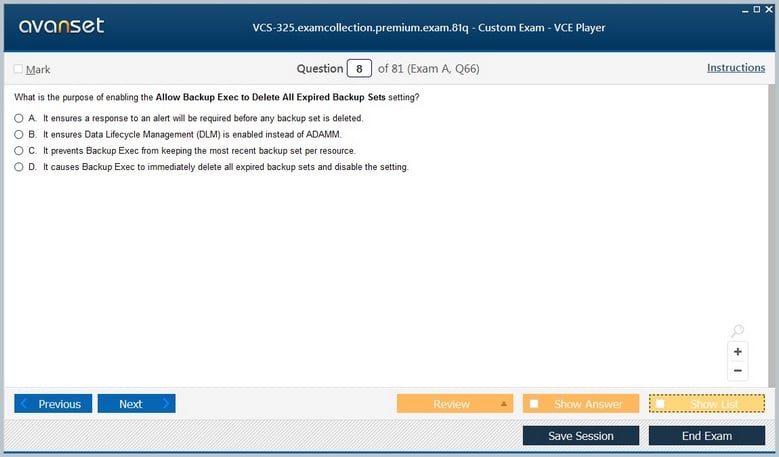
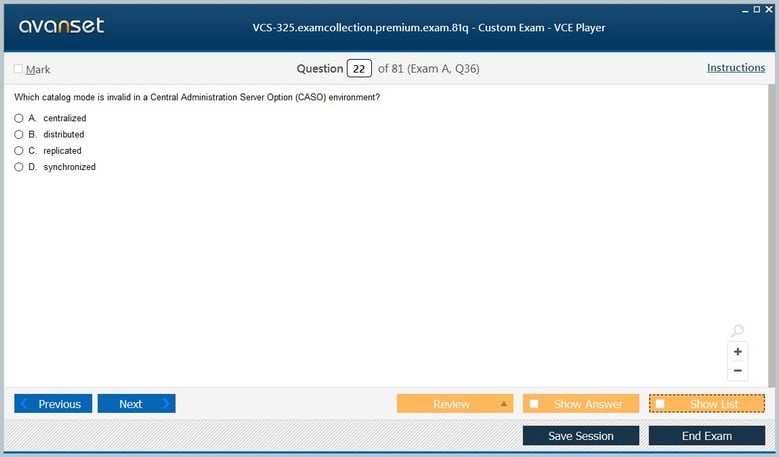
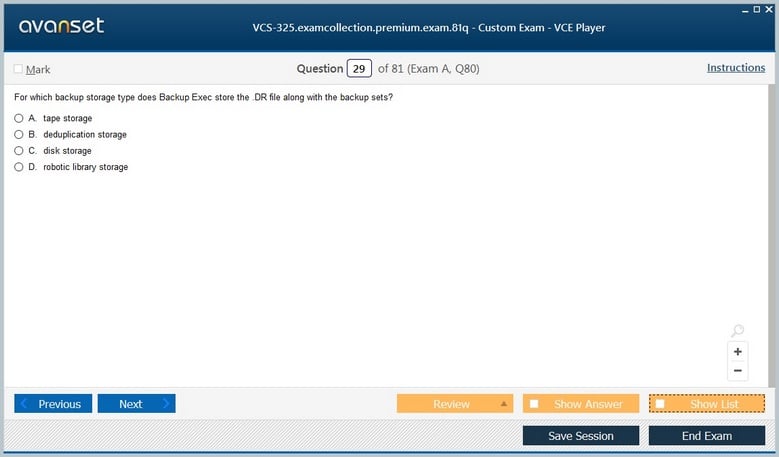
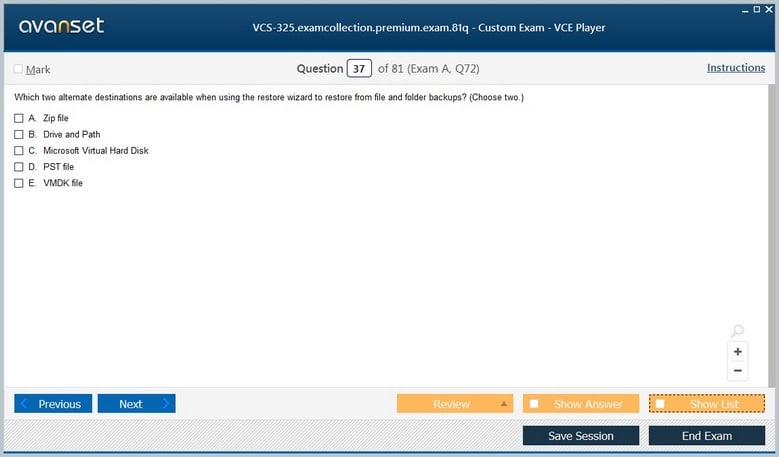
Veritas VCS-325 Practice Test Questions in VCE Format
| File | Votes | Size | Date |
|---|---|---|---|
File Veritas.Testking.VCS-325.v2026-09-13.by.Porter.39q.vce |
Votes 3 |
Size 85.68 KB |
Date Sep 16, 2026 |
Veritas VCS-325 Practice Test Questions, Exam Dumps
Veritas VCS-325 (Administration of Veritas Backup Exec 20.1) exam dumps vce, practice test questions, study guide & video training course to study and pass quickly and easily. Veritas VCS-325 Administration of Veritas Backup Exec 20.1 exam dumps & practice test questions and answers. You need avanset vce exam simulator in order to study the Veritas VCS-325 certification exam dumps & Veritas VCS-325 practice test questions in vce format.
VCS-325 is the Veritas Certified Specialist exam for Administration of Veritas Backup Exec 20.1. Arctera’s current education catalog still lists the exam, but it also lists the newer VCS-326 for Backup Exec 21, while the current course portfolio includes Backup Exec 22 administration. VCS-325 is therefore still a live certification listing, yet it represents an older product generation and should be prepared for with careful version discipline.
The exam’s core skills remain practical: install and configure Backup Exec, create and monitor backup jobs, configure storage, manage remote protected systems, perform restores, use agents and options, maintain the environment, apply updates, interpret job logs, and troubleshoot common failures. The product version changes, but these responsibilities still define the work of a small-to-midsize data-protection administrator.
Backup Exec is now part of Arctera’s data-protection portfolio rather than the NetBackup business that moved to Cohesity. That corporate split matters because candidates may encounter older Veritas branding throughout documentation and exam material while newer training and support experiences use Arctera. The Veritas certifications remain useful for mapping the approved ExamCollection destinations, but current product administration should be checked against Arctera resources.
A successful backup job depends on more than a schedule. The media server, storage target, protected resource, credentials, agent support, network path, and available capacity all have to work together. Administrators should inventory what must be protected and confirm that the required components are available before building policy. This avoids creating jobs that are syntactically valid but operationally impossible.
A useful preparation method is to draw the environment first: Backup Exec server, storage devices, protected Windows or application servers, virtual infrastructure, cloud or disk targets, and any remote agents. Then map each backup and restore path. When a job fails, that diagram provides a shortlist of components to test instead of encouraging random configuration changes.
A protection job inherits the reliability limits of every resource it depends on. The Backup Exec server needs stable access to storage, protected hosts, application agents, name resolution, credentials, and the network path between them. Before troubleshooting a schedule, establish whether those dependencies are healthy and whether the service account can still reach what the job expects. This sounds basic, but it prevents a common failure mode in which administrators repeatedly edit a backup selection while the underlying problem is authentication, connectivity, or target availability.
Resource discovery should also be kept separate from protection intent. Seeing a server in the console does not mean every dataset on that server needs the same retention or recovery method. Build selections around business recovery requirements, then verify that newly added volumes, databases, virtual machines, or application components do not silently fall outside the expected scope. Good backup administration is partly the discipline of reconciling what exists with what policy says should be protected.
Backup Exec can work with different storage targets, and each has capacity, performance, retention, and operational characteristics. Disk storage may provide fast restores, removable media can support separation, cloud targets can extend off-site retention, and staged or duplicated copies can satisfy different recovery requirements. Administrators need to understand how the chosen storage behaves during both backup and restore.
Capacity planning should include growth, retention, duplicate copies, maintenance operations, and the possibility that failed jobs need to rerun. A target that looks sufficient on day one can become unstable when retention expands or data growth accelerates. Monitoring free space and job throughput is therefore part of routine administration, not an occasional housekeeping task.
Business applications often require more than copying open files. Databases, directory services, virtual machines, and other workloads may need application-aware processing, specialized agents, transaction handling, or granular recovery capabilities. Administrators should know which option protects which workload and what prerequisites must be satisfied before the feature can operate reliably.
This is also where restore testing becomes essential. A job can complete successfully while application recovery remains unproven. Test the recovery method that the business actually expects, whether that is a whole server, a virtual machine, a database, or a granular item. Recovery confidence should be based on evidence, not on the presence of a successful backup status.
Application-aware protection has to coordinate with the application’s own consistency model. A database may need transactions handled correctly; a messaging or directory service may require supported recovery semantics; a virtualized application may have dependencies that are invisible at the guest-file level. The administrator should know what the agent is doing, which credentials it uses, how to recognize a quiescing or snapshot failure, and what validation proves that the restored application is usable rather than merely present on disk.
This is also why recovery documentation should be written per application instead of as one generic “restore procedure.” The backup operator may be able to recover files or a database object, while an application owner must validate service-level behavior afterward. Defining that handoff before an incident reduces confusion about when the restore is technically complete and when the business service is actually ready for users.
Users do not always need an entire machine restored. They may need one mailbox item, one application object, one file, or another small unit of data. Granular Recovery Technology allows certain workloads to be recovered at finer levels without requiring a full-system restore first. Candidates should understand when granular recovery is supported and what dependencies it introduces.
The principle extends beyond Backup Exec: recovery should match the scope of the incident. Restoring too much wastes time and can overwrite healthy data, while restoring too little may not repair the service. Strong administrators classify the failure, choose the smallest reliable recovery method, and validate the restored item in the application context.
Virtualization allows administrators to protect workloads at the hypervisor layer, but virtual machines still contain applications, filesystems, and credentials that may require additional processing. Backup design should account for snapshots, quiescence, changed-block tracking where applicable, storage performance, and the difference between restoring a full VM and recovering data inside it.
A common operational mistake is to assume that because a virtual machine image exists, every application recovery objective is satisfied. A better design maps VM-level protection to application-level expectations and tests both when required. This layered recovery mindset remains relevant as organizations mix virtual, physical, cloud, and SaaS workloads.
VCS-325 includes installing Backup Exec updates and applying updates to remote agents. Version consistency matters because mismatched components can create unsupported or unstable protection paths. At the same time, upgrades can affect production systems, so maintenance needs scheduling, compatibility review, rollback planning, and post-update validation.
Treat the backup platform like any other critical service. Maintain an inventory of component versions, review release notes, test significant changes, and confirm that representative backup and restore operations still succeed afterward. A data-protection platform that is never patched accumulates risk; one that is patched without control can create its own outage.
Backup Exec provides job logs, Windows event information, service status, configuration tasks, and other diagnostic evidence. Administrators should use those sources to identify the first failing dependency rather than repeatedly rerunning a job. Network access, credentials, agent health, storage availability, service state, and application conditions can all produce similar high-level symptoms.
A repeatable workflow helps: confirm the protected resource is reachable, verify credentials and agent state, inspect storage, review the job log at the first error, check operating-system events, and then reproduce the smallest failing action. This approach makes troubleshooting faster and creates documentation that can be reused when the issue returns.
Logs establish sequence and error context, but diagnosis should correlate them with operating-system events, application logs, storage status, network behavior, and recent changes. A timeout can originate in a slow target, name resolution, authentication, overloaded virtualization infrastructure, or an application snapshot that never became ready. The goal is to isolate the first failing dependency rather than to react to the last error shown in a job summary.
Trend analysis helps before a hard failure appears. Backup duration that increases every week, growing exception counts, shrinking free capacity, repeated agent-update warnings, or steadily lengthening verification work can reveal risk while jobs still finish successfully. Administrators who only react to red status are managing incidents; administrators who track deterioration are managing the protection service. That distinction remains relevant regardless of whether the environment is on the 20.1 generation represented by VCS-325 or a newer Backup Exec release.
Arctera currently lists both VCS-325 for Backup Exec 20.1 and VCS-326 for Backup Exec 21, while its course schedule includes Backup Exec 22 administration. Candidates taking VCS-325 should stay faithful to the 20.1 objectives for the exam, but administrators working on a newer release should not force old procedures onto a modern environment.
This two-layer approach avoids a common certification problem. Exam preparation is version-specific; professional competence is current-version-specific. The two overlap in architecture, storage, jobs, agents, restores, monitoring, maintenance, and troubleshooting, but details can change. Keep separate notes for “what VCS-325 tests” and “how our current Backup Exec environment works.”
A useful capstone is to protect a small mixed environment, configure at least two storage or copy behaviors, back up a representative application-aware workload, then recover at multiple levels. Include one failure such as a stopped agent, unavailable target, expired credential, or low-capacity condition and document how the issue appears in the job log.
Pair that lab with broader backup-and-recovery reasoning: identify recovery objectives, choose copies that satisfy them, and verify that the process works under realistic constraints. VCS-325 may be tied to Backup Exec 20.1, but the professional lesson is current—backups are useful only when administrators can explain, monitor, troubleshoot, and restore them with confidence.
A complete drill should define a recovery objective before starting and measure the result afterward. Restore one granular item, one complete application or system, and one workload to alternate infrastructure if the lab allows it. Record how long media discovery, data transfer, startup, and validation each take. The timings reveal where the true RTO is spent and whether the organization has been assuming that “backup completed” and “service can be restored quickly” mean the same thing.
Repeat at least one drill after deliberately removing a normal dependency—for example, use alternate storage, a different target path, or a replacement credential. Real incidents rarely occur under ideal conditions, and a recovery process that only works while the original server, account, and network are intact is fragile. VCS-325 preparation becomes much more valuable when it produces that kind of tested operational confidence instead of a list of console procedures.
Go to testing centre with ease on our mind when you use Veritas VCS-325 vce exam dumps, practice test questions and answers. Veritas VCS-325 Administration of Veritas Backup Exec 20.1 certification practice test questions and answers, study guide, exam dumps and video training course in vce format to help you study with ease. Prepare with confidence and study using Veritas VCS-325 exam dumps & practice test questions and answers vce from ExamCollection.
Purchase Individually
Top Veritas Certification Exams
Site Search:

SPECIAL OFFER: GET 10% OFF

Pass your Exam with ExamCollection's PREMIUM files!
SPECIAL OFFER: GET 10% OFF
Use Discount Code:
MIN10OFF
A confirmation link was sent to your e-mail.
Please check your mailbox for a message from support@examcollection.com and follow the directions.

Download Free Demo of VCE Exam Simulator
Experience Avanset VCE Exam Simulator for yourself.
Simply submit your e-mail address below to get started with our interactive software demo of your free trial.