


Premium File
144 Q&A
$76.99$69.99
WorldatWork T1-GR1 Exam Questions & Answers, Accurate & Verified By IT Experts
Instant Download, Free Fast Updates, 99.6% Pass Rate
144 Questions & Answers
Last Update: Sep 27, 2026
$69.99
WorldatWork T1-GR1 Exam Screenshots
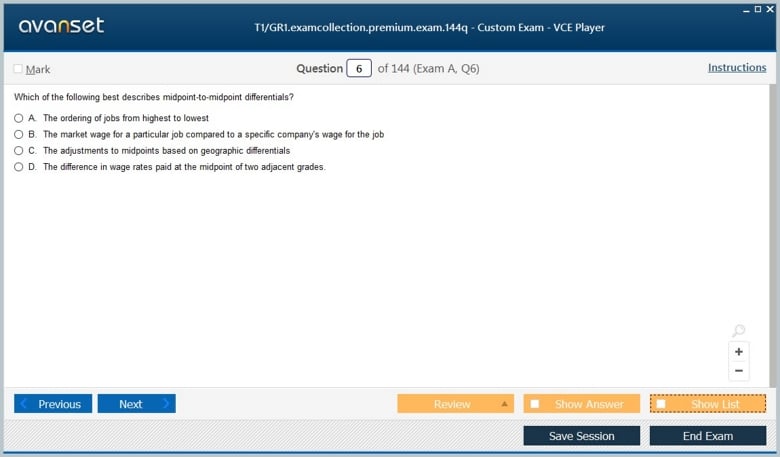
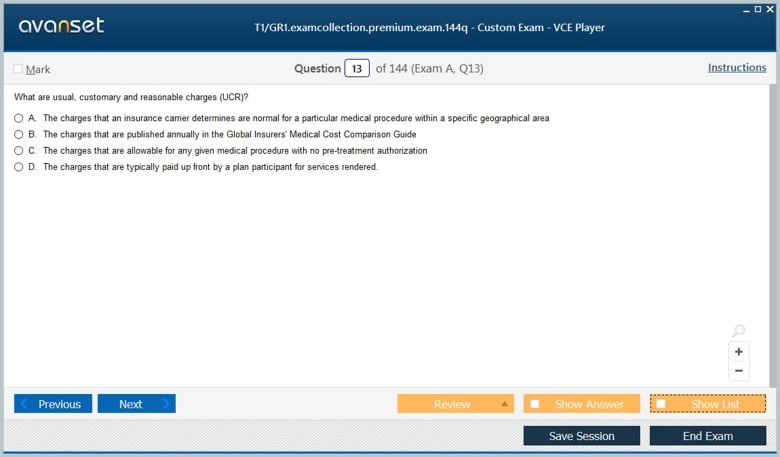
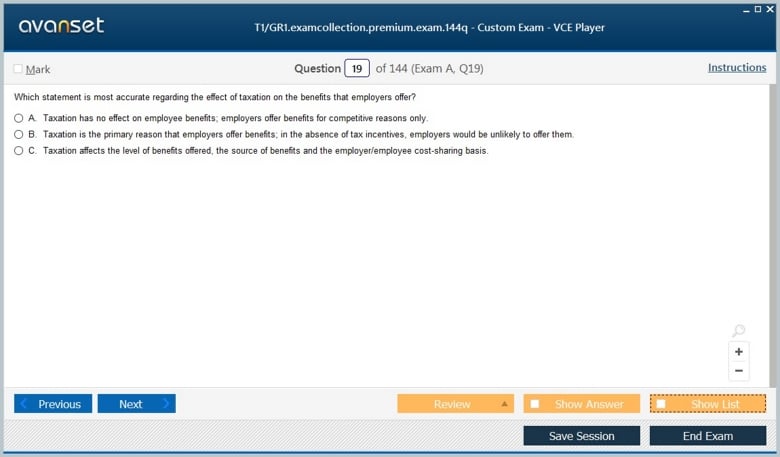
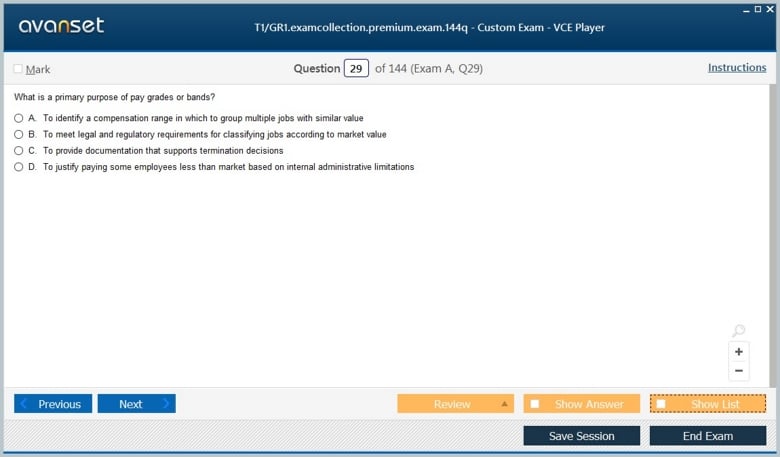
WorldatWork T1-GR1 Practice Test Questions in VCE Format
| File | Votes | Size | Date |
|---|---|---|---|
File WorldatWork.passit4sure.T1-GR1.v2026-09-19.by.limin.86q.vce |
Votes 1 |
Size 89.63 KB |
Date Sep 19, 2026 |
File WorldatWork.Prep4sure.T1-GR1.v2019-09-26.by.Luke.71q.vce |
Votes 4 |
Size 72.37 KB |
Date Sep 27, 2019 |
WorldatWork T1-GR1 Practice Test Questions, Exam Dumps
WorldatWork T1-GR1 (Total Rewards Management Exam) exam dumps vce, practice test questions, study guide & video training course to study and pass quickly and easily. WorldatWork T1-GR1 Total Rewards Management Exam exam dumps & practice test questions and answers. You need avanset vce exam simulator in order to study the WorldatWork T1-GR1 certification exam dumps & WorldatWork T1-GR1 practice test questions in vce format.
The WorldatWork T1/GR1 Total Rewards Management exam is a legacy code from the earlier CCP and GRP certification structure. WorldatWork’s official 2025 equivalency tables map Total Rewards Management (T1/GR1) to the redesigned Creating Impact Through Total Rewards course and exam. The organization also revised its certification status pages in January 2025 to show the new structure. In 2026, candidates should therefore treat T1/GR1 as historical curriculum context rather than as the name of the current CCP or GRP requirement.
The underlying ideas remain foundational: total rewards connects compensation, benefits, well-being, careers, and recognition to organizational strategy and employee needs. The modern program has refreshed the framing, but anyone reviewing T1/GR1 material can still use it to understand why individual reward programs should be managed as one coordinated system.
An organization may offer salary, incentives, health benefits, retirement plans, recognition, development, and flexible work. The total rewards perspective asks how those elements work together. Adding one program can change the perceived value of another, and the same investment can have different effects across employee groups. The objective is not to maximize every component but to create a coherent package that supports workforce and business priorities.
Practice by mapping a real organization’s rewards offering across the five broad elements. Identify where the design is intentionally strong, where employees may not perceive value, and where programs overlap or contradict one another. A generous development program, for example, may not improve retention if employees see no path to internal advancement.
Total rewards strategy begins with the organization’s direction. A company competing through innovation may place more emphasis on scarce technical skills, rapid career growth, and long-term incentives. A cost-focused operation may prioritize workforce stability, predictable labor cost, and efficient benefits. A public or nonprofit organization may face funding constraints while relying heavily on mission and career meaning.
The reward strategy should state which workforce outcomes matter and how investment choices support them. Avoid generic objectives such as “attract and retain talent” unless they are translated into specific populations and behaviors. Strong strategy clarifies what the organization is willing to pay for and which tradeoffs it accepts.
Employees do not value every reward equally. Career stage, location, job family, family situation, income level, and personal preference can change how a program is perceived. Segmentation can improve relevance, but excessive customization increases complexity and can create fairness concerns. The practitioner needs to balance choice with operational simplicity and clear principles.
Use data rather than stereotypes. Survey results, benefit utilization, turnover patterns, engagement feedback, and workforce demographics can reveal where programs are valued or misunderstood. When segmentation is proposed, define the business rationale and ensure that differences are defensible, compliant, and consistent with the organization’s employee experience.
Organizations compete in labor markets, so market pay and benefits matter. However, blindly matching every external practice can produce a rewards package that lacks identity and exceeds the budget. Market data should inform decisions alongside business strategy, internal equity, affordability, and talent risk.
Benchmark selectively. Determine which peer groups are relevant for each workforce segment and which percentiles or practices support the organization’s talent strategy. A company may intentionally lead the market in one critical area while matching or lagging elsewhere. Total rewards management is the process of making those choices explicit.
A program has limited impact if employees do not understand it. Total rewards communication should explain not only what is offered but also how employees can use it and why the organization designed it that way. Annual statements can help, but ongoing manager communication and clear digital information are often more important than one polished document.
Test communication with actual employee questions. Can a manager explain how incentive opportunity works? Can a new hire find retirement information? Do employees understand which development resources are available? If not, the organization may be funding rewards that are effectively invisible. Communication is therefore part of program design, not an activity added after launch.
Total rewards programs are often owned by different teams, which creates a risk that compensation, benefits, recognition, and career programs evolve independently. Governance establishes decision rights, review cycles, shared principles, and measures. It also defines who can approve exceptions, because uncontrolled exceptions can undermine both cost management and fairness.
Create a review calendar that examines program effectiveness, market conditions, compliance changes, cost, employee response, and strategic fit. Some programs may need annual review, while others change only when legislation or workforce strategy shifts. The important point is that continuation should be an active decision, not the default result of organizational inertia.
The current WorldatWork certifications are organized differently from the older program reflected by T1/GR1. WorldatWork’s CCP and GRP equivalency documents explicitly map this legacy exam to Creating Impact Through Total Rewards. Legacy work still counts in transition rules, but the current credential structure should be used when planning new certification activity.
The legacy C8 Business Acumen and T7 IFRS for Compensation Professionals codes also map into updated courses. Together they illustrate how WorldatWork consolidated and refreshed the older curriculum rather than simply renaming individual exams one-for-one in every case.
Take an organization and write a concise total rewards diagnosis. Start with business and workforce strategy, map current programs, estimate major costs, identify employee segments, review market position, and highlight inconsistencies. Then recommend two or three priorities rather than proposing a long list of unrelated enhancements.
For each recommendation, state the intended workforce behavior, expected business value, cost, implementation risk, and measure of success. This turns total rewards from a descriptive framework into a decision tool. It also builds the integrated thinking that made T1/GR1 foundational and that remains central to the redesigned Creating Impact Through Total Rewards requirement.
One useful exercise is to remove a program from the rewards package and predict the consequences. If tuition support disappeared, would recruiting, internal mobility, or retention change? If incentive opportunity increased but base-pay competitiveness declined, which roles would be affected? Counterfactual thinking reveals whether a program has a clear strategic purpose or survives mainly because it has always existed.
T1/GR1 should therefore be remembered as a historical exam code with current conceptual value. Candidates planning certification in 2026 should use WorldatWork’s redesigned requirements, while professionals reviewing older material can still use the total rewards framework to make better integrated decisions.
A mature total-rewards analysis should also separate stated program value from experienced value. An employer may spend heavily on benefits or development while employees assign little value because eligibility is unclear, access is difficult, or communication is poor. Build a simple inventory of reward elements, the cost of each program, the employees who can use it, and the behavior or outcome it is intended to influence. Then identify where cost and perceived value diverge. This converts the total-rewards concept into a practical portfolio-management problem.
Global reward design adds another layer because consistency and local relevance can conflict. Headquarters may want common principles while local markets differ in pay practices, statutory benefits, taxation, labor expectations, and talent scarcity. Practice defining which elements should be globally governed, which can vary by market, and what approval process applies to exceptions. That exercise fits both the historical T1/GR1 foundation and the current WorldatWork emphasis on creating organizational impact through an integrated total-rewards strategy.
Measure the portfolio as a system after implementation. Track not only compensation cost but also participation, uptake, turnover, recruiting outcomes, internal movement, employee understanding, and manager behavior. If a program is expensive but unused, the issue may be design, access, or communication. If a low-cost program strongly supports a critical population, its strategic value may exceed its accounting cost. The point is to make reward decisions from evidence rather than from tradition.
Total rewards architecture should also make trade-offs visible across employee segments. A single program may be highly valued by one population and almost irrelevant to another. Build a matrix that compares strategic importance, attraction needs, retention risk, affordability, statutory constraints, and employee preferences for several workforce groups. Then decide which rewards should remain common and where differentiated design is justified. This prevents the phrase 'total rewards' from becoming a promise that every employee receives the same mix regardless of business context.
Communication should be treated as part of program design, not a launch-day activity. A benefit or incentive that employees cannot understand may fail even when its economics are sound. Practice translating a complex reward element into plain language that explains eligibility, employee action, timing, and value without overselling uncertain outcomes. Then identify which details belong in policy, manager guidance, employee communication, and individualized statements. Clear communication protects both perceived value and governance.
A final useful exercise is to evaluate a reward program at renewal. Compare the original objective with participation, workforce outcomes, cost, employee feedback, and operational burden. Decide whether to continue, redesign, narrow, or retire the program, and document the decision criteria. That closes the loop between strategy and measurement and reflects the modern expectation that total rewards operates as a managed portfolio rather than a permanent collection of inherited programs.
Go to testing centre with ease on our mind when you use WorldatWork T1-GR1 vce exam dumps, practice test questions and answers. WorldatWork T1-GR1 Total Rewards Management Exam certification practice test questions and answers, study guide, exam dumps and video training course in vce format to help you study with ease. Prepare with confidence and study using WorldatWork T1-GR1 exam dumps & practice test questions and answers vce from ExamCollection.
Purchase Individually
Site Search:

SPECIAL OFFER: GET 10% OFF

Pass your Exam with ExamCollection's PREMIUM files!
SPECIAL OFFER: GET 10% OFF
Use Discount Code:
MIN10OFF
A confirmation link was sent to your e-mail.
Please check your mailbox for a message from support@examcollection.com and follow the directions.

Download Free Demo of VCE Exam Simulator
Experience Avanset VCE Exam Simulator for yourself.
Simply submit your e-mail address below to get started with our interactive software demo of your free trial.