



Premium File
70 Q&A
$76.99$69.99
Apple SVC-19A Exam Questions & Answers, Accurate & Verified By IT Experts
Instant Download, Free Fast Updates, 99.6% Pass Rate
70 Questions & Answers
Last Update: Sep 11, 2026
$69.99
Apple SVC-19A Exam Screenshots
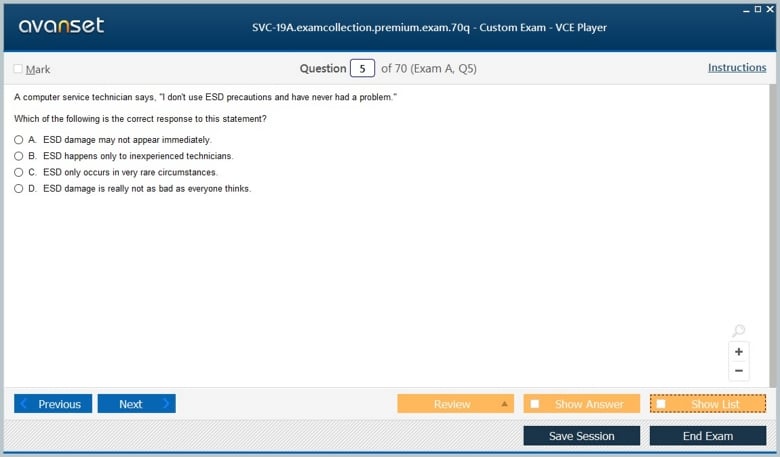
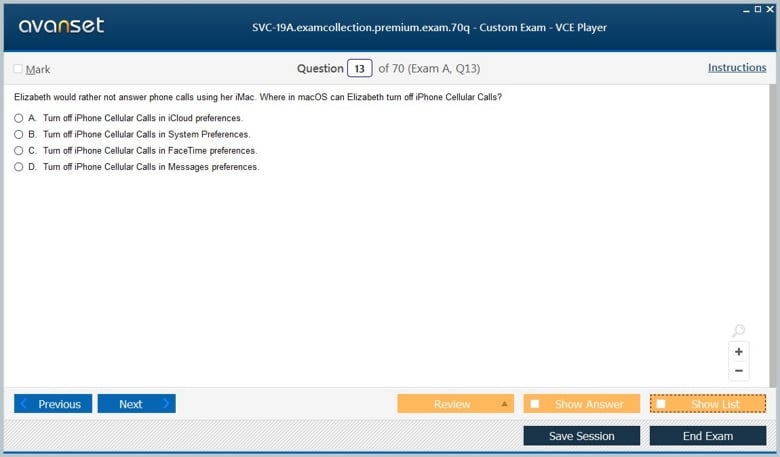
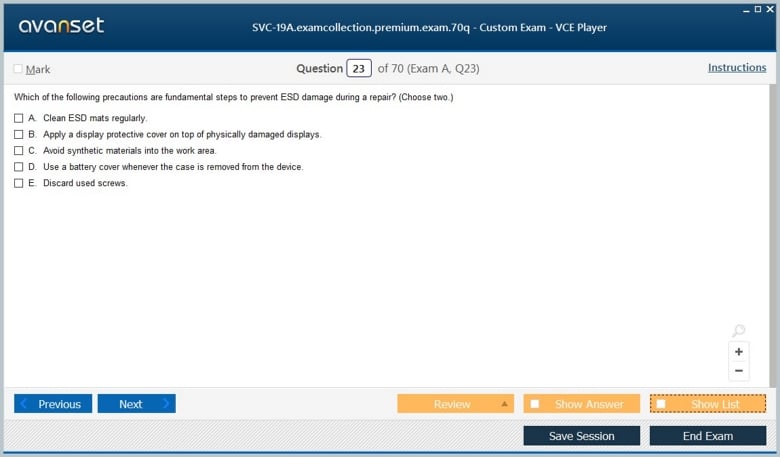
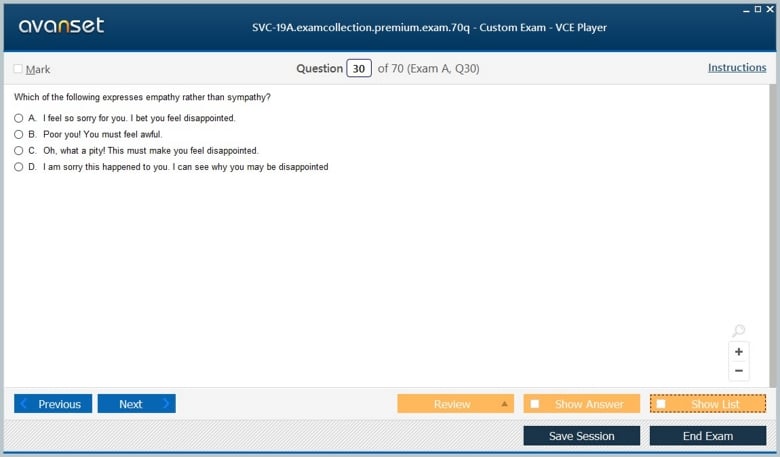
Apple SVC-19A Practice Test Questions in VCE Format
| File | Votes | Size | Date |
|---|---|---|---|
File Apple.certkey.SVC-19A.v2026-08-29.by.santiago.35q.vce |
Votes 3 |
Size 75.81 KB |
Date Aug 29, 2026 |
Apple SVC-19A Practice Test Questions, Exam Dumps
Apple SVC-19A (Apple Service Fundamentals Exam) exam dumps vce, practice test questions, study guide & video training course to study and pass quickly and easily. Apple SVC-19A Apple Service Fundamentals Exam exam dumps & practice test questions and answers. You need avanset vce exam simulator in order to study the Apple SVC-19A certification exam dumps & Apple SVC-19A practice test questions in vce format.
Apple SVC-19A belongs to a very different part of Apple training than its code might suggest to a modern reader. It was the Apple Service Fundamentals examination used in the 2019 service-certification cycle, not a Swift development credential. That distinction matters because the knowledge being tested centered on technician behavior, safety, electrostatic-discharge controls, troubleshooting discipline, customer interaction, and service-product knowledge. Anyone researching this old code needs to begin with that historical context rather than treating an archived exam page as evidence of a current Apple certification.
The exam sat inside Apple's technician certification model of the period. SVC-19A supplied the shared fundamentals component for 2019 service credentials, while product-specific examinations completed the relevant path. This makes the exam useful today mainly as a record of how Apple expected technicians to reason and work, not as a current badge to pursue. Across Apple certifications, older service exams and newer IT-support credentials belong to different generations, so version labels must be read carefully.
For candidates working through historical material, the most useful question is not simply "what facts were on SVC-19A?" The stronger question is how Apple combined safety, service workflow, diagnostic judgment, and customer-facing discipline into a common foundation before technicians moved into device-specific repair knowledge. That structure explains why the exam placed unusual weight on process and risk control rather than only hardware memorization.
Historical Apple service documentation identifies SVC-19A as a prerequisite component used for the 2019 Apple Certified iOS Technician and Apple Certified Mac Technician paths. It was paired with the corresponding product-specific examination rather than operating as a complete certification by itself. A technician therefore had to demonstrate both common service fundamentals and the knowledge required for the product family being serviced.
That arrangement followed the logic of earlier cycles. The SVC-16A service-fundamentals exam served the 2016 program, and SVC-17A served the 2017 cycle. SVC-19A continued the same broad model for 2019. The succession is important because study material carrying an older SVC code may contain sound service principles while still being wrong about the exact product procedures, policies, or exam version.
Historical preparation material describes SVC-19A as an open-resource, computer-based knowledge examination delivered through Pearson VUE. It used 70 items over a two-hour appointment and required an 80 percent overall score, with separate must-pass requirements for the electrostatic-discharge and safety sections. Those section gates reveal something important about the design: a candidate could not compensate for unsafe practice by scoring extremely well on less critical material.
Service work creates risks that ordinary end-user support does not. A technician may open devices, disconnect power, handle batteries, work around sharp edges, use specialized fixtures, and touch components that can be damaged by static electricity without any visible sign of failure. The fundamentals exam therefore treated safe working behavior as part of technical competence rather than as an administrative preface.
Electrostatic discharge is a good example. A device can appear to survive an uncontrolled static event and still suffer latent damage that shows up later. Proper grounding, approved work surfaces, careful component handling, and awareness of high-risk environments reduce that possibility. The exam's separate ESD threshold encouraged candidates to understand why controls exist and when to apply them, not merely to recognize the words "ESD strap" in a question.
Safety scenarios also require judgment about when to stop. A swollen or damaged battery, liquid exposure, heat, unusual odor, compromised enclosure, or unsafe power condition changes the correct service response. The disciplined technician first controls risk, protects the customer and workspace, and follows the applicable service procedure. Trying to complete a repair at all costs is not evidence of competence when the safer action is containment, escalation, or replacement through the approved channel.
Apple's service-fundamentals approach connected technical work to the way a repair is received, documented, and returned. A correct repair can still become a poor service outcome if the technician fails to set expectations, records the wrong symptom, overlooks data or privacy implications, or cannot explain what was done. Customer communication therefore belongs in the troubleshooting process from the first conversation.
A strong intake begins by translating the customer's description into observable symptoms. "It keeps dying" could refer to unexpected shutdowns, rapid battery discharge, charging interruption, thermal protection, an application crash, or a device that will not wake. The technician asks focused questions about when the behavior occurs, what changed beforehand, whether accessories are involved, and whether the problem can be reproduced. That information shapes the diagnostic path and prevents unnecessary part replacement.
Clear documentation serves the same purpose. Notes should distinguish reported behavior from verified findings, record relevant diagnostic results, and make the next action understandable to another technician. Clear records improve continuity when a repair changes hands and reduce ambiguity if the device returns. SVC-19A therefore rewarded a service mindset in which communication and technical reasoning reinforce each other.
A service exam can tempt candidates to memorize symptom-to-part associations, but professional troubleshooting works by reducing uncertainty. The technician confirms the symptom, identifies the conditions under which it appears, checks the simplest plausible causes, isolates variables, uses diagnostics where appropriate, and only then chooses a corrective action. That sequence matters because many symptoms can be produced by software, settings, accessories, environmental conditions, or user workflow as well as failed hardware.
Good isolation also protects against confirmation bias. If a customer reports a charging problem, for example, it is easy to assume the battery is at fault. A disciplined process checks the power source, cable or adapter, port condition, relevant software state, thermal conditions, and diagnostic evidence before reaching that conclusion. The exact steps depend on the product and service documentation, but the reasoning pattern is portable.
The exam's fundamentals emphasis makes troubleshooting method more important than memorizing one device generation. Historical questions may reference products that are no longer serviced in the same way, yet the habit of verifying a symptom and changing one variable at a time remains useful. What must not be carried forward uncritically are old repair-authority rules, part-replacement procedures, or current-product safety instructions; those always depend on the active Apple documentation.
Technicians still needed to recognize product families, service terminology, common features, and the boundaries between customer-facing troubleshooting and authorized repair. Product knowledge helps a technician ask better questions and understand what a diagnostic result means. It also helps identify when an apparent fault is expected behavior, a configuration issue, or a feature interaction rather than a failed component.
The danger in studying a historical product-knowledge section is treating old facts as timeless. Port layouts, batteries, storage architectures, security features, startup behavior, and serviceability have changed substantially across Apple generations. The useful study habit is to separate foundational reasoning from version-bound details. Learn why a technician checks a particular condition, then verify the current procedure for the actual device being serviced.
This is also why SVC-19A should not be presented as a shortcut into today's Apple support credentials. The modern Apple Device Support exam addresses support across current Apple platforms and leads to the Apple Certified Support Professional badge. Apple's current IT training also includes Apple Deployment and Management for large-scale administration. Those are different programs with different objectives and should be studied from their live preparation material.
Having an open resource available did not make the historical examination trivial. Reference access helps only when a candidate can recognize the issue, locate the right information quickly, and distinguish an authoritative procedure from a vaguely related page. Two hours for 70 items leaves limited time for aimless searching, especially when safety and ESD questions must be answered reliably enough to clear their individual thresholds.
Preparation therefore benefited from knowing the structure of Apple's service resources and from understanding common concepts before test day. Candidates who already knew the purpose of ESD controls, the logic of symptom isolation, the role of documentation, and the limits of technician authorization could use references to confirm details. Candidates who depended on searching every question from scratch were likely to lose time and miss the reasoning behind scenario questions.
A useful historical study method is to rehearse decisions rather than memorize answer fragments. Given a scenario, identify the immediate risk, the missing information, the next diagnostic action, and the condition that would require escalation. That approach mirrors real service work and remains more durable than memorizing isolated statements from an old question bank.
SVC-19A is valuable for understanding Apple's 2019 technician model, but it should not be treated as a live certification target in 2026. Apple has moved its public professional training toward device support and enterprise deployment/management. Service-provider technicians may also work under current service programs and procedures that are not represented by a 2019 exam code.
The most common research error is to see a still-indexed exam page and assume the credential remains active. Historical certification pages often persist long after a vendor changes delivery partners, exam names, or program structure. For SVC-19A, the year embedded in the code and the documented 2019 pairing are strong signals that the material must be dated explicitly.
For that reason, old practice material should be used as a concept archive, not as the final authority for present-day procedures. Safety rules, battery handling, data-protection steps, diagnostic tools, and service eligibility can change. A technician preparing for current work should always defer to the current Apple training and service documentation available to the role.
A sensible SVC-19A review begins with four connected capabilities: safe handling, disciplined troubleshooting, accurate communication, and product-aware decision making. These capabilities explain the shape of the exam more clearly than a long list of old product facts. They also make it easier to understand why Apple imposed separate safety and ESD passing requirements.
Scenario practice should ask what the technician knows, what still needs to be verified, and what action creates the least risk while moving the repair forward. That turns study into a sequence of service decisions. It also exposes weak areas quickly: a learner who repeatedly jumps to component replacement probably needs more work on isolation, while one who ignores documentation needs to think more carefully about service continuity and customer expectations.
SVC-19A ultimately represents a historical checkpoint in Apple's technician-certification lineage. Its enduring lesson is that service competence is broader than repair technique. A technician must protect people and devices, gather reliable evidence, communicate clearly, and work inside defined procedures. Those principles remain useful even though the 2019 exam itself belongs to an earlier certification model.
Go to testing centre with ease on our mind when you use Apple SVC-19A vce exam dumps, practice test questions and answers. Apple SVC-19A Apple Service Fundamentals Exam certification practice test questions and answers, study guide, exam dumps and video training course in vce format to help you study with ease. Prepare with confidence and study using Apple SVC-19A exam dumps & practice test questions and answers vce from ExamCollection.
Purchase Individually
Site Search:

SPECIAL OFFER: GET 10% OFF

Pass your Exam with ExamCollection's PREMIUM files!
SPECIAL OFFER: GET 10% OFF
Use Discount Code:
MIN10OFF
A confirmation link was sent to your e-mail.
Please check your mailbox for a message from support@examcollection.com and follow the directions.

Download Free Demo of VCE Exam Simulator
Experience Avanset VCE Exam Simulator for yourself.
Simply submit your e-mail address below to get started with our interactive software demo of your free trial.