



Premium File
65 Q&A
$76.99$69.99
SNIA S10-110 Exam Questions & Answers, Accurate & Verified By IT Experts
Instant Download, Free Fast Updates, 99.6% Pass Rate
65 Questions & Answers
Last Update: Sep 12, 2026
$69.99
SNIA S10-110 Exam Screenshots
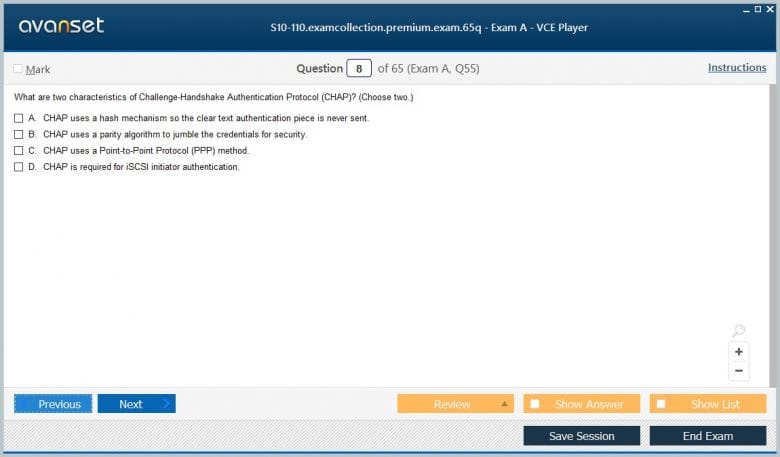
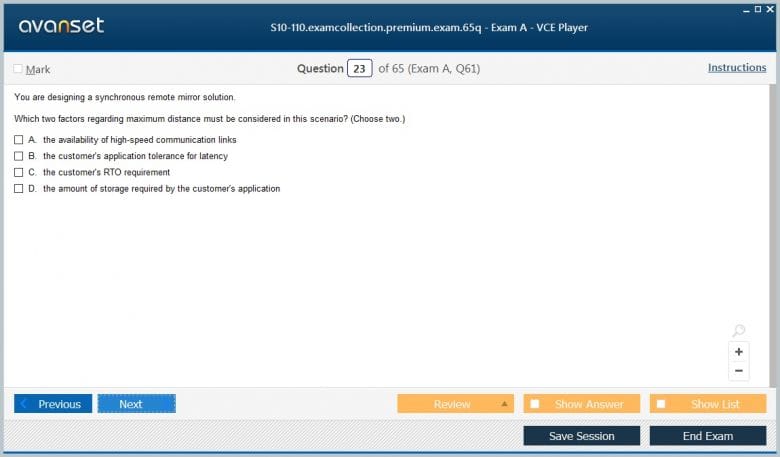
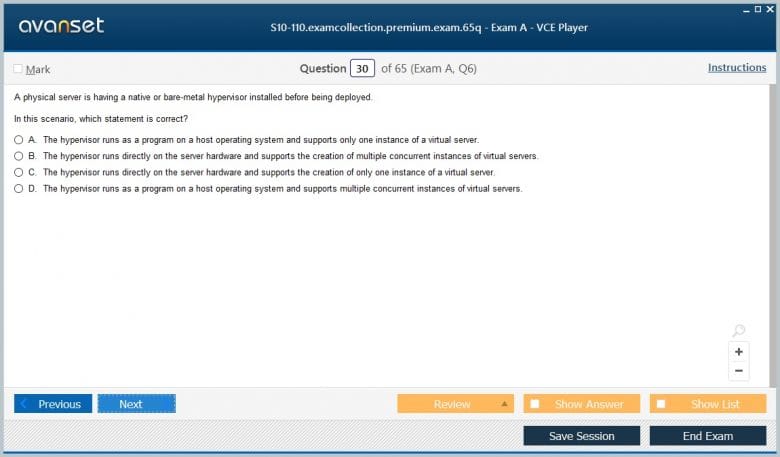
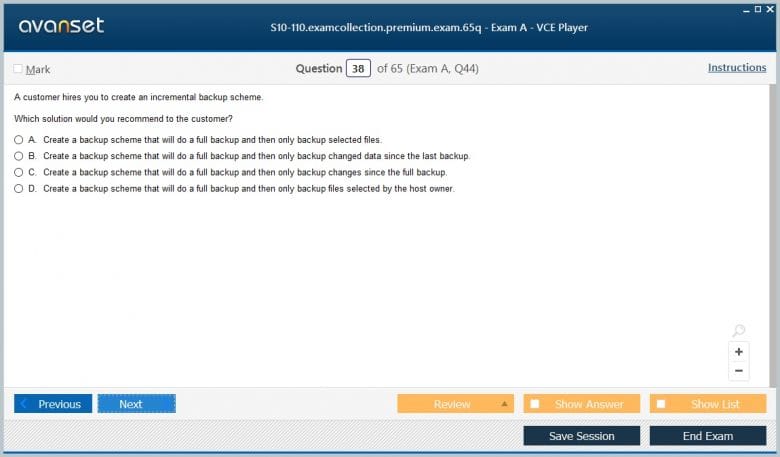
SNIA S10-110 Practice Test Questions in VCE Format
| File | Votes | Size | Date |
|---|---|---|---|
File SNIA.Actualtests.S10-110.v2026-08-30.by.William.38q.vce |
Votes 3 |
Size 45.78 KB |
Date Sep 02, 2026 |
SNIA S10-110 Practice Test Questions, Exam Dumps
SNIA S10-110 (Storage Networking Foundations) exam dumps vce, practice test questions, study guide & video training course to study and pass quickly and easily. SNIA S10-110 Storage Networking Foundations exam dumps & practice test questions and answers. You need avanset vce exam simulator in order to study the SNIA S10-110 certification exam dumps & SNIA S10-110 practice test questions in vce format.
SNIA Storage Networking Foundations S10-110 is the foundation-level exam associated with the SNIA Certified Storage Professional body of knowledge. SNIA’s published exam description centers on vendor-neutral storage concepts: host and storage elements, networking and transport, storage functions, data protection, disaster recovery, security, management, and the operational language used across heterogeneous environments. That breadth is precisely why the material remains useful even as specific products and certification pathways evolve.
The public SNIA exam inventory contains several older exam codes, so candidates should separate the technical value of the S10-110 blueprint from assumptions about registration availability. SNIA still references S10-110 in its advanced storage certification material, but many public pages date from earlier program cycles. Anyone planning to pay for an exam should therefore confirm the current registration path directly with SNIA rather than infer availability from an archived description.
For study purposes, the exam is best treated as a map of storage architecture rather than a vocabulary test. The candidate should be able to follow data from an application through a host interface and transport, into a storage system, through protection mechanisms, and back again during recovery. Once that end-to-end flow is clear, terms such as SAN, NAS, block, file, object, replication, snapshot, RPO, RTO, multipathing, and tiering become connected decisions instead of isolated definitions.
Storage architecture starts with how applications address data. Block storage exposes addressable units that a host can organize into filesystems or database structures. File storage presents a shared namespace and file-oriented operations. Object storage combines data with metadata and uses an object-oriented access model that scales well for large unstructured datasets. These are not simply competing products; they solve different access, scale, consistency, and management requirements.
Exam scenarios may describe an application rather than name the storage type. A transactional database with strict latency needs points toward block-oriented design. Shared departmental documents often fit file access. Massive repositories of media, backups, or cloud-native content may favor object semantics. The useful skill is recognizing the access pattern and operational requirement before selecting technology.
A storage request passes through layers: application, operating system or hypervisor, filesystem or volume manager, host bus or network interface, transport fabric, target interface, storage controller, cache, media, and protection mechanisms. Different architectures collapse or redistribute those layers, but the fundamental troubleshooting question remains the same: where can latency, failure, or misconfiguration enter the path?
Fibre Channel, iSCSI, Ethernet-based transports, and newer NVMe-related technologies make more sense when studied as ways to carry storage commands and data between initiators and targets. Candidates should know the role of addressing, zoning or segmentation, discovery, path redundancy, and congestion. The objective is not to become a vendor CLI specialist. It is to understand why a storage network needs deterministic connectivity, fault isolation, and predictable performance.
Storage systems are built around redundancy because a single failed cable, switch, controller, power supply, or path should not automatically stop an application. Multipathing, redundant fabrics, dual controllers, RAID or erasure protection, clustered services, and replicated copies all address different failure domains. The exam rewards candidates who can identify which component is actually protected by a given mechanism.
Redundancy is not the same as backup. Mirroring can preserve availability when a disk fails, but it can also replicate accidental deletion or corruption. A second controller can keep I/O moving, but it does not provide a historical copy. Keep availability, recoverability, and retention as separate design goals. The architecture becomes much clearer once each control is tied to a specific failure scenario.
Recovery point objective describes how much data loss a business can tolerate; recovery time objective describes how long service can remain unavailable. Those two measures shape replication frequency, backup schedules, snapshot design, off-site copies, automation, and testing. A zero or near-zero RPO can require continuous replication, while a longer tolerance may allow periodic backups or asynchronous methods with lower cost and complexity.
The broader logic appears in modern backup and recovery strategy. Although cloud implementations use different products, the design questions remain familiar: what failure are we protecting against, how much state can be lost, how quickly must service return, and what dependencies must be restored in the correct order?
A storage system can have enough capacity and still perform poorly. Capacity planning asks how much usable space is available after protection overhead, growth, snapshots, metadata, and reserved space. Performance analysis asks about latency, throughput, IOPS, queue depth, workload mix, cache behavior, and contention. One workload may need high sequential throughput; another may be limited by small random I/O latency.
Candidates should be cautious about single-number comparisons. More IOPS does not automatically mean a better system if latency rises under realistic concurrency. Compression or deduplication can improve effective capacity while consuming compute resources. Thin provisioning increases flexibility but requires monitoring so physical capacity does not run out unexpectedly. Storage design is a balancing exercise, not a benchmark contest.
Snapshots often create point-in-time views efficiently, especially when implemented with redirect-on-write or copy-on-write techniques. Clones can provide writable copies for testing or development. Replication maintains another copy locally or remotely. Traditional backup creates independently managed recovery copies with retention policies. These tools overlap, but their failure isolation and operational purposes are not identical.
A snapshot stored on the same system can be fast for accidental-file recovery yet useless if the array is lost. Synchronous replication can minimize data loss but adds distance and latency constraints. Backup can provide long retention and separation but may restore more slowly. Scenario questions become easier when you identify the required recovery point, recovery time, independence, and retention before choosing the mechanism.
Storage security includes access control, authentication, encryption, key management, network segmentation, secure administration, media handling, auditability, and disposal. A useful companion topic is data storage security, because the risks are broader than encryption at rest. Unauthorized management access, exposed snapshots, weak administrative accounts, and improperly sanitized media can compromise data even when the storage protocol itself is functioning correctly.
Think about security at every point in the data lifecycle: creation, transport, persistence, copying, backup, sharing, recovery, and retirement. Encryption keys need protection independent from the encrypted data. Administrative networks deserve different controls from client data paths. Logs should support accountability. Decommissioned media must be sanitized according to policy. The exam’s vendor-neutral perspective makes these principles transferable across products.
A storage environment must be observable. Administrators need information about health, capacity, performance, failures, paths, replication status, and backup success. Thresholds should be meaningful enough to trigger action before users experience an outage. Alert storms are not evidence of good monitoring; they often show that signals have not been prioritized around business impact.
The candidate should connect a symptom to the layer most likely responsible. High application response time could come from the host, network, controller, media, queueing, or an unrelated application dependency. Storage metrics help narrow the possibilities, but diagnosis requires correlation across the path. That systems view is one of the most valuable outcomes of S10-110 study.
Historically, S10-110 sat beneath more advanced SNIA exams such as S10-210 and architecture-focused paths. Those higher-level codes have changed over time, but the progression idea remains useful: first understand storage components and failure modes, then move into operations, design, and optimization. Do not let an old certification diagram replace current program research, especially when archived pages remain searchable.
A strong preparation routine combines the published blueprint with hands-on observation. Inspect a host’s disks and filesystems, trace network paths, compare a snapshot with a backup, calculate usable capacity under a protection scheme, and write an RPO/RTO recovery plan for a small workload. The goal is to be able to explain why a storage design behaves the way it does. That knowledge remains useful even when exam names, vendors, and delivery platforms change.
Study storage media as part of a hierarchy rather than as isolated device trivia. Hard disks, flash, persistent memory, and cloud storage services differ in latency, endurance, cost, failure behavior, and management model. Caching can hide slower media for hot data, while tiering can move colder information to cheaper capacity. The candidate should understand that a workload's perceived storage performance comes from the entire architecture, including cache, controllers, networks, and access patterns, not simply the nominal speed of the underlying device.
Virtualization adds another abstraction layer. A virtual machine may see a virtual disk that maps through a hypervisor to a datastore, LUN, file share, or software-defined storage pool. Containers may use persistent-volume abstractions backed by block or file services. When troubleshooting, identify which layer owns the namespace, path, protection, and performance policy. The foundation exam's vendor-neutral approach is useful precisely because those layers can be implemented by very different products while exposing similar architectural responsibilities.
Cloud storage should be interpreted through the same fundamentals rather than treated as a separate universe. Managed block volumes, file services, and object stores still embody choices about access semantics, durability, availability zones, encryption, snapshots, replication, and cost. The provider hides much of the physical infrastructure, but architects and administrators remain responsible for selecting the right service and configuring recovery and access correctly. Learning the concepts first makes it easier to evaluate both on-premises arrays and cloud services without relying on brand-specific memorization.
Go to testing centre with ease on our mind when you use SNIA S10-110 vce exam dumps, practice test questions and answers. SNIA S10-110 Storage Networking Foundations certification practice test questions and answers, study guide, exam dumps and video training course in vce format to help you study with ease. Prepare with confidence and study using SNIA S10-110 exam dumps & practice test questions and answers vce from ExamCollection.
Purchase Individually
Site Search:

SPECIAL OFFER: GET 10% OFF

Pass your Exam with ExamCollection's PREMIUM files!
SPECIAL OFFER: GET 10% OFF
Use Discount Code:
MIN10OFF
A confirmation link was sent to your e-mail.
Please check your mailbox for a message from support@examcollection.com and follow the directions.

Download Free Demo of VCE Exam Simulator
Experience Avanset VCE Exam Simulator for yourself.
Simply submit your e-mail address below to get started with our interactive software demo of your free trial.
The dump is valid?