



Premium File
70 Q&A
$76.99$69.99
QlikView QV-Developer-01 Exam Questions & Answers, Accurate & Verified By IT Experts
Instant Download, Free Fast Updates, 99.6% Pass Rate
70 Questions & Answers
Last Update: Nov 11, 2026
$69.99
QlikView QV-Developer-01 Exam Screenshots
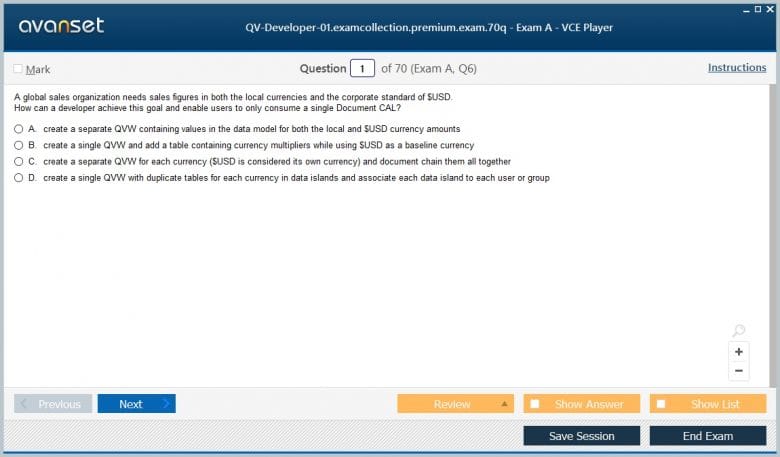
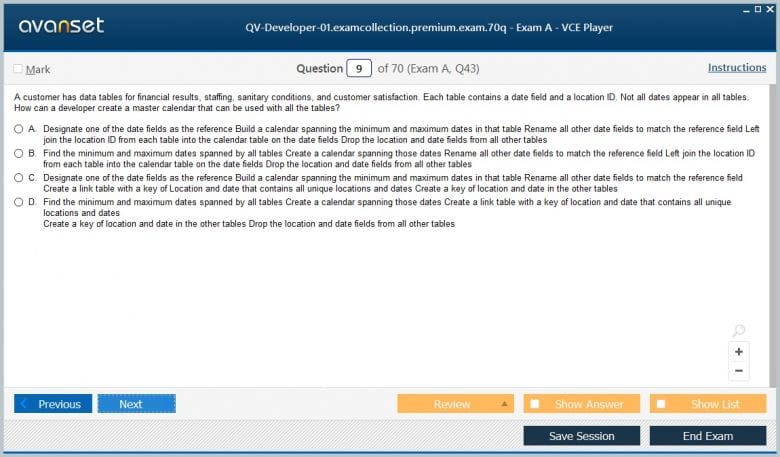
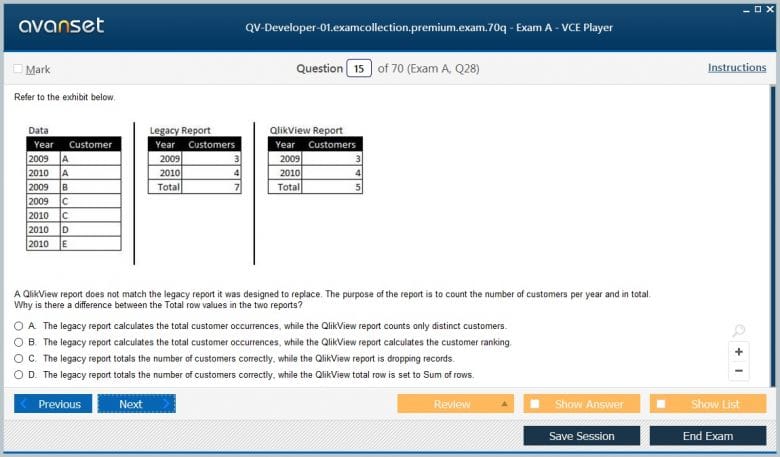
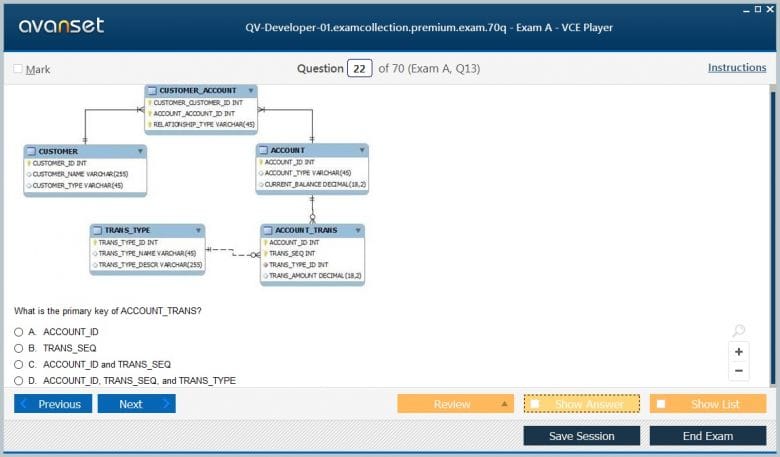
QlikView QV-Developer-01 Practice Test Questions in VCE Format
| File | Votes | Size | Date |
|---|---|---|---|
File QlikView.Test-king.QV-Developer-01.v2026-08-05.by.Matty.44q.vce |
Votes 3 |
Size 1006.08 KB |
Date Aug 06, 2026 |
QlikView QV-Developer-01 Practice Test Questions, Exam Dumps
QlikView QV-Developer-01 (QlikView 11 Developer Certification Examination (qv_developer_01)) exam dumps vce, practice test questions, study guide & video training course to study and pass quickly and easily. QlikView QV-Developer-01 QlikView 11 Developer Certification Examination (qv_developer_01) exam dumps & practice test questions and answers. You need avanset vce exam simulator in order to study the QlikView QV-Developer-01 certification exam dumps & QlikView QV-Developer-01 practice test questions in vce format.
The QV-Developer-01 exam comes from the older QlikView Developer naming used for technical application development. Qlik’s current learning catalog uses the title QlikView Data Architect for the certification that covers data modeling, scripting, design, deployment, and support of QlikView applications. That naming shift is more than cosmetic: it emphasizes that the technical developer’s central responsibility is the analytical data architecture behind the interface.
Qlik currently lists the QlikView Data Architect exam as 50 questions over 120 minutes with a 65 percent passing score. Its objectives cover requirements, source analysis, associative modeling, application interface work, and delivery. Historical QlikView Developer material used a different exam structure and, in older generations, passing Developer could also confer the Designer credential. Candidates should therefore avoid mixing mechanics from different eras.
The enduring skill set belongs to the broader Qlik certification family: turn source data into a maintainable associative model, create reliable expressions and visual objects, and deliver an application that behaves correctly for users.
QlikView development starts with the same question as any analytical system: what decision must the application support? Technical developers need to identify KPIs, dimensions, measures, data sources, refresh expectations, security constraints, and the level of detail users require. Those choices determine the model before a script is written.
A request for profitability analysis, for example, may require transaction facts, product cost history, currency conversion, customer hierarchy, and fiscal calendar rules. If those requirements are discovered late, the developer ends up patching expressions and adding ad hoc tables. Good QlikView architecture pulls those rules forward into the model design.
Before loading a table, inspect keys, nulls, cardinality, duplicate behavior, data types, and the grain represented by each record. QlikView will happily load structurally inconsistent data, but the associative model will expose those inconsistencies as wrong selections or incorrect totals later.
Technical developers should also identify source ownership and refresh constraints. A large production database may require staged extraction, while a spreadsheet may contain unstable column names and manual corrections. The architecture should acknowledge those realities instead of assuming every source is clean, complete, and permanently available.
QlikView associates tables by common field names, which creates powerful exploration without writing joins for every query. The same behavior makes accidental associations dangerous. A field named Status in two unrelated tables can connect data that should remain independent, while inconsistent customer identifiers can prevent a relationship that users expect.
Candidates should be comfortable diagnosing synthetic keys, circular references, and ambiguous models. The goal is not to eliminate every synthetic key by reflex, but to understand why it appeared and whether the model expresses the intended business relationship. Concatenated facts, link tables, composite keys, and mapping can each be valid tools when chosen for a clear reason.
Load scripts can perform joins, concatenation, mapping, aggregation, date derivation, variable logic, conditional loading, and many other transformations. A technically clever script can still be a maintenance problem if its purpose is difficult to follow. Production scripts should make the flow from source to final model visible.
Use names that communicate table roles, keep transformation stages organized, and comment business rules that would not be obvious to another developer. When a reload fails or a metric changes unexpectedly, readable scripts reduce the time required to isolate the cause. Maintainability is part of technical correctness.
Native QVD files are a major part of mature QlikView deployments. They can cache extracted data, support layered transformation, improve load performance, and let several applications reuse the same curated data. This can reduce repeated pressure on transactional systems and create a clearer boundary between extraction and presentation.
The architecture still needs discipline. QVD files require naming, ownership, refresh order, retention, and error handling. Incremental loading should be validated for updates and deletes, not just new rows. These concerns connect QlikView development with broader data integration principles such as consistency, recoverability, and controlled transformation.
The current QlikView Data Architect outline still includes a substantial interface-development domain. Developers may need to choose object types, understand complex expressions, tune object performance, and implement actions or triggers. That reflects QlikView’s history as a product where technical and presentation responsibilities often overlapped.
The related QV12BA Business Analyst exam concentrates more heavily on interface design, but technical developers still need enough visualization judgment to test whether the model works in a real application. A model that is elegant in the table viewer but forces unusable expressions into every chart is not finished.
QlikView performance is shaped by data volume, field cardinality, model structure, reload design, expression complexity, and the number of objects users cause to recalculate. Reducing unnecessary fields and rows can have a larger effect than micro-optimizing an individual expression.
Technical developers should profile reload times and interactive behavior separately. A fast reload does not guarantee responsive sheets, and a responsive sheet does not guarantee an operationally acceptable nightly load. Performance work is strongest when measurements identify which stage is actually limiting the user experience.
QlikView applications eventually run in a governed environment with server and publisher components, client types, scheduled reloads, access controls, and operational dependencies. Developers do not need to own all of those systems, but their design choices affect how well an application can be published and supported.
That means avoiding local file dependencies that will not exist on the server, documenting data connections, understanding section access, and coordinating refresh timing. A development environment can hide assumptions that fail immediately after deployment; production-minded developers test those assumptions before handoff.
Qlik’s current catalog lists QlikView Data Architect and QlikView Business Analyst certifications. The older Developer label remains useful for historical searches and older training material, but current preparation should follow the live Data Architect objectives rather than assuming the old code and exam mechanics remain unchanged.
The migration from QlikView toward Qlik Sense also gives historical context. Modern Qlik Sense technical certification is represented by the QSDA2024 Data Architect exam. The products differ, but both roles reward the same architectural habits: understand grain, control associations, transform data deliberately, validate results, and design for production operation.
QlikView section access can restrict data based on user identity, but mistakes can lock out administrators or expose more data than intended. Developers should test with representative accounts and understand how reductions interact with field names, case, and the application data model. Security behavior should be verified after reload and in the server context, not only inside a developer desktop session.
A secure design also documents who owns the mapping between identities and entitlements. Hard-coding temporary usernames into an application may work during development but becomes brittle in production. Treat access data as governed input with the same care given to other business-critical source data.
QV-Developer-01 is best understood as a legacy doorway into a skill set Qlik now frames more explicitly as data architecture. The durable competencies are source analysis, associative modeling, script design, QVD strategy, performance, validation, and technical delivery.
Candidates working with current QlikView should anchor preparation in the live QlikView Data Architect objectives while using older Developer material selectively. Version-specific details age; the ability to explain how raw data becomes a reliable QlikView application remains the real technical standard.
Technical handoff should include enough context for another developer to maintain the application: source dependencies, reload order, QVD lineage, section access rules, variables, non-obvious expressions, and known performance constraints. A QlikView file that only its original author can safely modify is not a mature production deliverable.
Data lineage is especially important in older QlikView estates where applications may have accumulated years of script changes. A developer should be able to trace a chart measure back through variables, resident loads, QVDs, and source tables. Without that lineage, a simple business-rule change can trigger risky edits across several layers whose dependencies are not obvious.
Legacy extensions, macros, and external dependencies should also be inventoried before modernization. They may have been reasonable when the application was built but can complicate server upgrades or migration to newer Qlik platforms. Technical developers add value by distinguishing essential business behavior from implementation choices that can be replaced.
When a QlikView application is stable but strategically important, refactoring should be incremental. Establish reconciled totals and key user journeys first, then simplify one layer at a time and retest. This preserves trust while improving maintainability and provides a safer path than redesigning the model and interface simultaneously without a behavioral baseline.
A useful maintenance exercise is to open the application with no prior knowledge and identify every external dependency it requires to reload and render correctly. Record file paths, database connections, variables, extensions, section access sources, and server assumptions. Anything that cannot be rediscovered from the application or its documentation is a future operational risk, especially during migration or staff turnover.
For QlikView development, regression testing should include a small set of trusted totals and user journeys. After changing a script or data model, confirm that those measures still reconcile and that common selections still produce the expected records. This protects against technically successful reloads that subtly change analytical behavior.
It is also worth measuring reload duration and document size before and after structural changes. A refactor that simplifies code but doubles memory consumption may not be an improvement. Technical developers should evaluate maintainability, correctness, and operational performance together rather than optimizing one dimension in isolation.
Go to testing centre with ease on our mind when you use QlikView QV-Developer-01 vce exam dumps, practice test questions and answers. QlikView QV-Developer-01 QlikView 11 Developer Certification Examination (qv_developer_01) certification practice test questions and answers, study guide, exam dumps and video training course in vce format to help you study with ease. Prepare with confidence and study using QlikView QV-Developer-01 exam dumps & practice test questions and answers vce from ExamCollection.
Purchase Individually
Top QlikView Certification Exams
Site Search:

SPECIAL OFFER: GET 10% OFF

Pass your Exam with ExamCollection's PREMIUM files!
SPECIAL OFFER: GET 10% OFF
Use Discount Code:
MIN10OFF
A confirmation link was sent to your e-mail.
Please check your mailbox for a message from support@examcollection.com and follow the directions.

Download Free Demo of VCE Exam Simulator
Experience Avanset VCE Exam Simulator for yourself.
Simply submit your e-mail address below to get started with our interactive software demo of your free trial.