



Premium File
50 Q&A
$76.99$69.99
QlikView QSDA2018 Exam Questions & Answers, Accurate & Verified By IT Experts
Instant Download, Free Fast Updates, 99.6% Pass Rate

QSDA2018 Premium File: 50 Questions & Answers
Last Update: Sep 15, 2026
QSDA2018 Training Course: 90 Video Lectures
$74.99
QlikView QSDA2018 Exam Screenshots
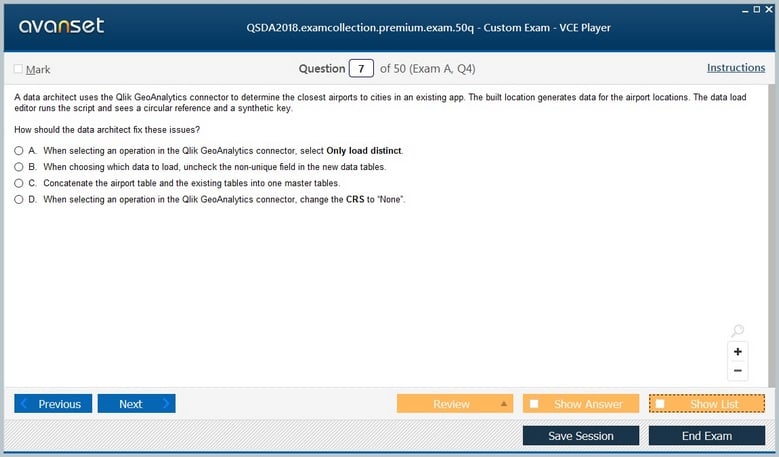
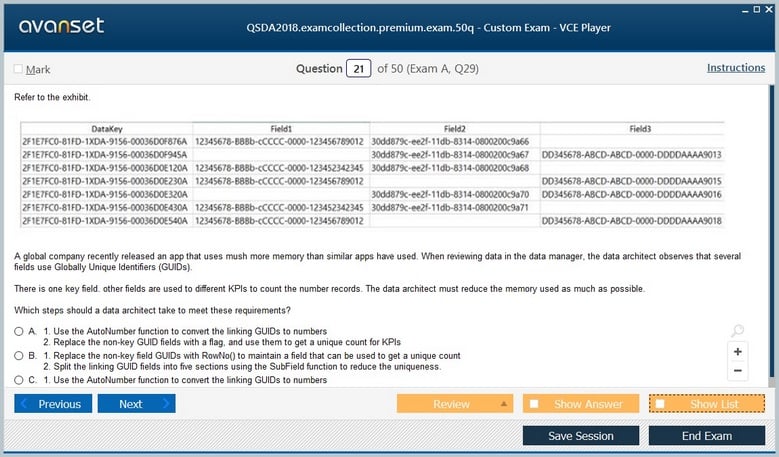
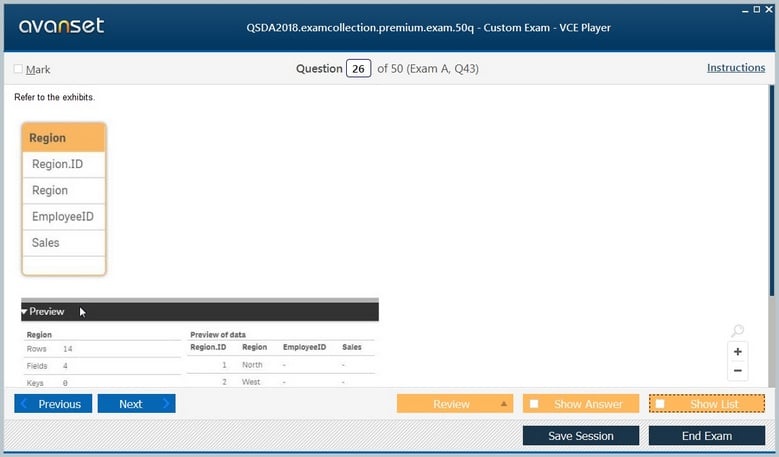
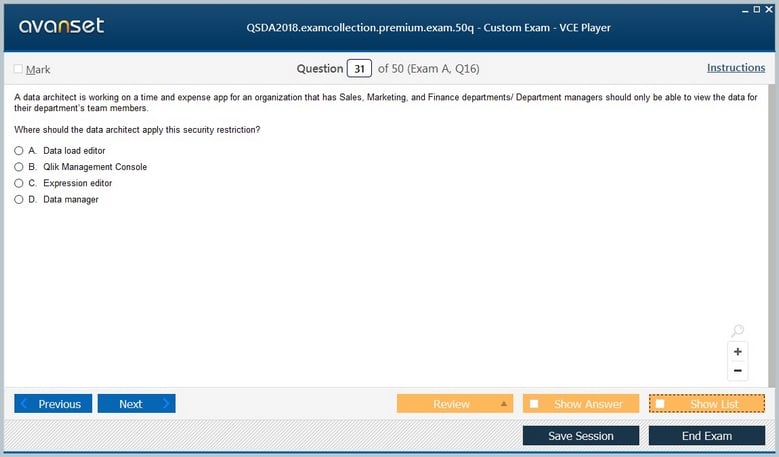
QlikView QSDA2018 Practice Test Questions in VCE Format
| File | Votes | Size | Date |
|---|---|---|---|
File QlikView.passcertification.QSDA2018.v2026-09-28.by.maisie.25q.vce |
Votes 1 |
Size 2.72 MB |
Date Sep 28, 2026 |
File QlikView.Braindumps.QSDA2018.v2019-04-06.by.Monika.23q.vce |
Votes 5 |
Size 2.28 MB |
Date Apr 07, 2019 |
QlikView QSDA2018 Practice Test Questions, Exam Dumps
QlikView QSDA2018 (Qlik Sense Data Architect Certification Exam) exam dumps vce, practice test questions, study guide & video training course to study and pass quickly and easily. QlikView QSDA2018 Qlik Sense Data Architect Certification Exam exam dumps & practice test questions and answers. You need avanset vce exam simulator in order to study the QlikView QSDA2018 certification exam dumps & QlikView QSDA2018 practice test questions in vce format.
The QSDA2018 Qlik Sense Data Architect exam was the June 2018 release of Qlik’s Data Architect certification. Qlik introduced it alongside Business Analyst and System Administrator exams tied to the same software release, and later certification versions replaced it. Historical Qlik material described a 50-question, two-hour operational exam after the 2018 beta period, so candidates should treat QSDA2018 as a versioned legacy blueprint rather than a current exam registration target.
The underlying role remains highly relevant. A Qlik data architect is responsible for turning raw source structures into an associative model that supports reliable analysis. That means understanding requirements, source systems, load scripts, transformations, keys, table relationships, QVD layers, validation, and performance. The value of the 2018 exam is that it exposes how these responsibilities fit together.
Within the Qlik certification ecosystem, data architecture is the technical layer between raw data and analytical applications. It differs from Business Analyst work because the architect owns deeper modeling and script decisions, and it differs from administration because the primary concern is the data model rather than the server estate.
Qlik’s 2018 certification announcement made the release relationship explicit: Business Analyst, Data Architect, and System Administrator exams were based on the June 2018 release, and older versions were retired. That historical model encouraged candidates to know details of the product as it existed at a specific point in time.
Modern Qlik certifications are less tightly branded around a release year. The current Data Architect exam is described as platform-neutral for client-managed Qlik Sense and Qlik Cloud. When using 2018 material, candidates should separate enduring modeling principles from exact editor behavior, connector screens, or features that may have changed since that release.
Before writing a load script, the architect needs to know what one row represents in each source and what level of detail the business expects to analyze. Orders, order lines, customers, products, inventory snapshots, and payments all have different grains. Joining them without understanding those grains can duplicate facts and inflate measures.
Good modeling therefore starts with a map of facts, dimensions, keys, and time relationships. The architect should be able to explain how a business question travels through the model. If the model cannot answer that explanation cleanly, the issue should be solved in design rather than hidden later in chart expressions.
Qlik automatically associates tables that share field names. This creates the platform’s flexible associative experience, but automatic association is not the same as correct association. Fields with the same label can represent different business concepts, while keys that should match can arrive with incompatible values, types, or formatting.
Architects need to manage key names deliberately and recognize symptoms such as synthetic keys, circular references, unexpected record multiplication, or selections that propagate through the wrong relationship. The strongest model is not the one with the fewest tables; it is the one whose associations accurately express the business relationships users expect to explore.
Qlik’s data load editor allows the architect to transform structure while data enters the application. Resident loads, preceding loads, mapping, joins, concatenation, aggregation, variables, loops, and conditional statements can all reshape the source into an analytical model. Each technique has consequences for readability, performance, and the risk of changing grain.
Candidates should learn to read a script as a sequence of data-shaping decisions. For every step, ask what rows are created, removed, combined, or renamed and which keys exist afterward. Script syntax is easier to retain when it is attached to a modeling purpose such as standardizing a code, building a calendar, resolving many-to-many relationships, or creating a reusable extract layer.
QVD files are central to many Qlik architectures because they provide a native storage layer that can be loaded efficiently. An organization may extract source data into QVDs, transform it in a separate layer, and let applications consume curated outputs. That structure can reduce repeated source queries and make reload pipelines easier to manage.
The trade-off is operational discipline. More layers mean more dependencies, naming conventions, storage management, and reload sequencing. A QVD strategy should have a reason: reuse, performance, source protection, incremental loading, or controlled transformation. Creating extra files without an architecture simply moves complexity out of the app without eliminating it.
Large datasets often make full reloads impractical. Incremental loading can process only new or changed records, but the architect must know how changes are identified and how updates or deletes are reconciled. A timestamp, transaction ID, or source change table can work only if its semantics are trustworthy.
This connects Qlik application modeling with broader data-integration design. Latency, source impact, recoverability, and consistency all matter. An incremental load that is fast but silently misses late updates is not a successful optimization. Candidates should practice reasoning about restart behavior and how they would validate that the target model still matches the intended source state.
Time analysis creates recurring modeling problems: fiscal periods, multiple date fields, rolling windows, snapshots, slowly changing dimensions, and comparisons between transaction dates and fulfillment dates. A master calendar can simplify many cases, but not every model has one obvious date relationship.
Architects should understand why a canonical date or link-table pattern may be used and what it does to selections. The goal is to let users compare meaningful time perspectives without introducing ambiguous associations. Date handling should also be validated for locale, timestamp granularity, nulls, and boundaries such as fiscal year-end.
A Qlik model should be reconciled against source totals and known business cases before visualizations are trusted. Validation can include row counts, distinct-key counts, sums at known grains, null analysis, duplicate detection, and comparisons with existing reports. Differences are not always errors, but every difference should have an explanation.
Good validation also tests selections. Choose a customer, product, or period with known behavior and follow the associations. If the expected records remain possible and excluded values make sense, the model is expressing the relationship correctly. This kind of testing catches structural problems that can be invisible in aggregate totals.
The current QSDA2024 reflects a platform-neutral certification that still emphasizes requirements, connectivity, model design, transformation, and validation. That continuity is useful: the tools evolved, but architects are still judged on how they shape data into something analytically reliable.
For historical study, compare QSDA2018 with the current outline and keep what remains conceptually stable. Source analysis, association design, transformation logic, validation, and performance are enduring. Exact release-specific behaviors should be verified in the version of Qlik Sense you actually use rather than assumed from an archived study guide.
High-cardinality fields, unnecessary columns, duplicated facts, and complicated association structures consume memory and can make reloads or selections slower. Architects should measure model size and reload behavior while the design is still flexible. Removing unused fields or correcting grain often improves performance more safely than compensating later with complex expression tricks.
Optimization should preserve semantics. Joining tables simply to reduce object count can duplicate measures; concatenating facts without a type discriminator can blur meaning; dropping a field to save memory can remove a required analysis path. The best performance change is one whose effect on both resource use and analytical behavior can be explained.
QSDA2018 captures a period when Qlik certification was explicitly versioned around a product release, but the core challenge it represented has not disappeared. Data architects still have to decide what the model means, not simply how to make a script run.
The most useful preparation is to build models that can be explained from source to selection. If you can justify the grain, keys, transformations, QVD layers, incremental strategy, calendar design, and validation method, you are practicing the durable skills behind both the historical QSDA2018 exam and today’s Qlik data-architecture work.
A useful architecture review ends with documentation another developer can follow. Record source systems, key fields, table grain, transformation purpose, QVD dependencies, incremental rules, security assumptions, and validation checks. Documentation is not a substitute for a clean model, but it makes the intent visible when the original author is no longer available.
Field naming is another architectural decision with user-facing consequences. Technical source names may be compact or cryptic, while analytical applications need stable business terminology. Renaming fields during the load can improve usability, but the mapping should be documented so that developers can trace a visible dimension back to its source and understand whether any semantic transformation occurred.
Architects should also plan for source schema change. A new column may be harmless, while a renamed key, changed data type, or altered grain can silently break associations or incremental logic. Monitoring reload failures is not enough; validation should detect cases where the script still runs but the meaning of the data has shifted.
For QSDA2018-era models, a useful final exercise is to trace one metric from the source record through every transformation until it appears in a chart. Note where field names change, where records are filtered, and where associations are created. That lineage check exposes hidden assumptions and makes it easier to distinguish a modeling defect from an expression defect.
Legacy models should also be opened with warnings and table relationships visible. Synthetic keys, unexpected circularity, and unusually large tables deserve deliberate review even when the application appears to work. Historical success is not proof that the structure remains appropriate after years of source and requirement changes.
Go to testing centre with ease on our mind when you use QlikView QSDA2018 vce exam dumps, practice test questions and answers. QlikView QSDA2018 Qlik Sense Data Architect Certification Exam certification practice test questions and answers, study guide, exam dumps and video training course in vce format to help you study with ease. Prepare with confidence and study using QlikView QSDA2018 exam dumps & practice test questions and answers vce from ExamCollection.
Purchase Individually

QlikView QSDA2018 Video Course

Top QlikView Certification Exams
Site Search:

SPECIAL OFFER: GET 10% OFF

Pass your Exam with ExamCollection's PREMIUM files!
SPECIAL OFFER: GET 10% OFF
Use Discount Code:
MIN10OFF
A confirmation link was sent to your e-mail.
Please check your mailbox for a message from support@examcollection.com and follow the directions.

Download Free Demo of VCE Exam Simulator
Experience Avanset VCE Exam Simulator for yourself.
Simply submit your e-mail address below to get started with our interactive software demo of your free trial.