
Pass Your Scrum PSM I Certification Easy!
Scrum PSM I Certification Exams Questions & Answers, Accurate & Verified By IT Experts
Instant Download, Free Fast Updates, 99.6% Pass Rate.
Scrum PSM I Certification Exams Screenshots
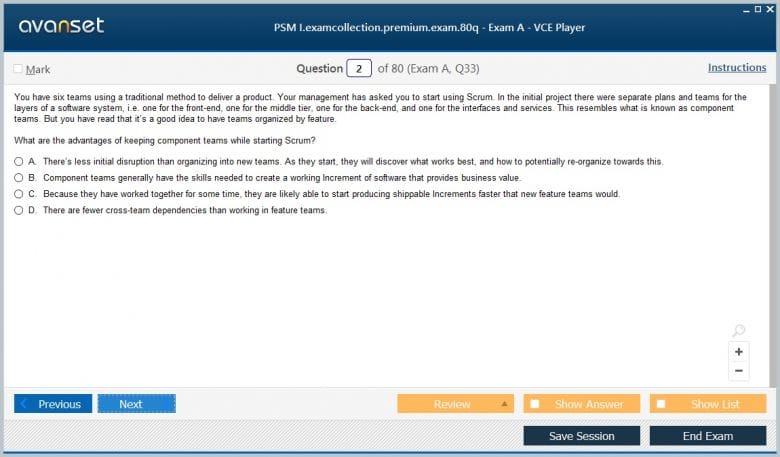
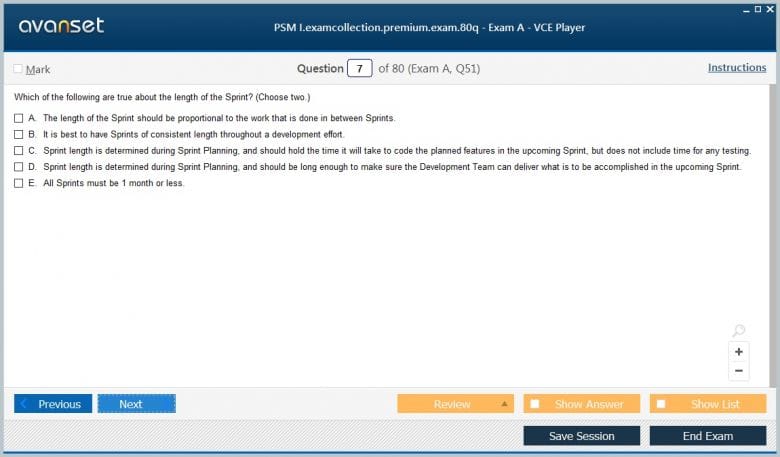
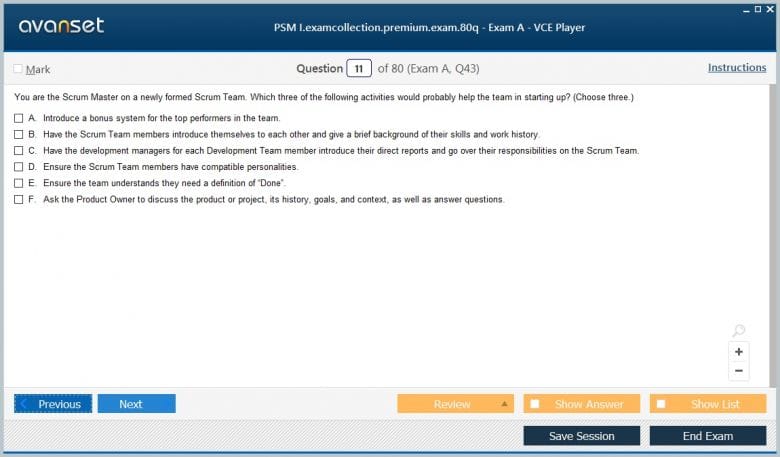
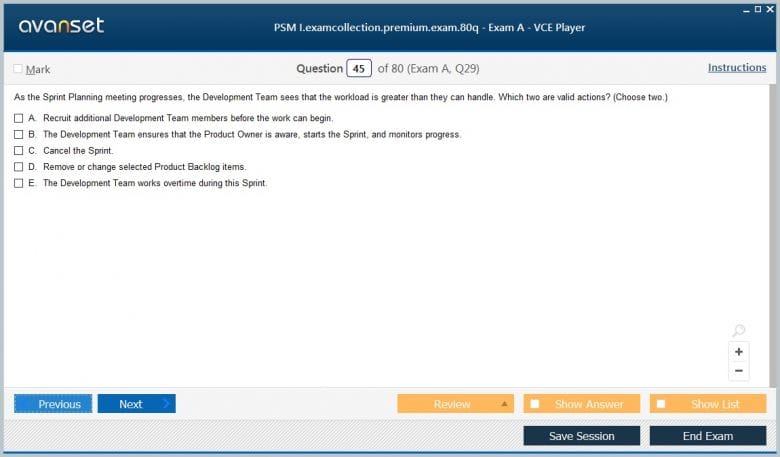
PSM I Product Reviews
Download Free PSM I Practice Test Questions VCE Files
| Exam | Title | Files |
|---|---|---|
Exam PSM I |
Title Professional Scrum Master I |
Files 6 |
Scrum PSM I Certification Exam Dumps & Practice Test Questions
Prepare with top-notch Scrum PSM I certification practice test questions and answers, vce exam dumps, study guide, video training course from ExamCollection. All Scrum PSM I certification exam dumps & practice test questions and answers are uploaded by users who have passed the exam themselves and formatted them into vce file format.
PSM I: Proving Practical Scrum Mastery, Not Memorizing the Scrum Guide
Professional Scrum Master I is Scrum.org’s foundational Scrum Master certification and remains current in 2026. The PSM I assessment contains 80 questions, allows 60 minutes, and requires an 85% passing score. Scrum.org describes the credential as evidence that a candidate understands the Scrum framework, the Scrum Master accountabilities, and how Scrum is applied within Scrum Teams. That wording matters: the test is not intended to reward vocabulary alone.
PSM I is based on Scrum as defined in the Scrum Guide, but many difficult questions present situations where several actions sound reasonable. Candidates need to reason from empiricism, Scrum values, accountabilities, events, artifacts, commitments, and self-management. The question is usually not “what would a generic manager do?” but “what action best supports Scrum’s purpose without adding a rule that the framework does not contain?”
Preparation should combine close reading with scenario practice. Read the Scrum Guide until the relationships are clear, then analyze common team situations: incomplete work at the end of a Sprint, pressure to change the Sprint Goal, stakeholders bypassing the Product Owner, a Daily Scrum turning into a status meeting, or a Scrum Master becoming the team’s task coordinator. Each scenario exposes whether you understand the framework as a system.
Empiricism is the reason the framework is structured the way it is
Scrum is built around transparency, inspection, and adaptation. Those ideas are easy to recite but more useful when applied to decisions. Transparency makes the current situation visible enough to inspect; inspection looks for meaningful differences between expectation and reality; adaptation changes the plan or process when those differences matter. Events and artifacts support that feedback loop rather than existing as ceremony.
When evaluating an exam scenario, ask what information is visible, who needs to inspect it, and what adaptation is possible. This often clarifies choices that otherwise look like competing meeting techniques. Scrum’s structure is designed to shorten the distance between reality and informed action.
The Scrum Master is accountable for effectiveness, not for commanding the team
A Scrum Master helps the Scrum Team and organization understand and use Scrum effectively. That can include coaching, facilitation, removing impediments, helping the Product Owner, and addressing organizational barriers. It does not make the Scrum Master the team’s manager, work assigner, meeting secretary, or substitute Product Owner.
Practice rewriting command-and-control behaviors into coaching behaviors. Instead of assigning tasks, help Developers improve self-management. Instead of deciding priority, help the Product Owner make Product Backlog ordering clear. Instead of owning every impediment personally, help the team and organization develop the ability to remove recurring causes.
That accountability also extends beyond the Developers. A Scrum Master may need to help managers, stakeholders, and surrounding teams understand why frequent interruption, hidden work, or delayed feedback harms empiricism. The intervention is not to become an escalation manager who solves every organizational problem personally. It is to make impediments visible, coach people toward better interactions, and help the organization create conditions in which the Scrum Team can deliver value and learn. PSM I scenarios often become clearer when you ask whether an action builds the system’s capability or merely centralizes more authority in the Scrum Master.
The Product Goal and Sprint Goal create different planning horizons
The Product Goal describes a future state that provides a longer-term objective for the Scrum Team. The Sprint Goal explains why the current Sprint is valuable. Candidates should understand how Product Backlog items can change as learning occurs while these goals provide coherence. Treating the Sprint Backlog as a frozen contract is inconsistent with adaptation, but treating the Sprint Goal as optional removes the purpose that lets Developers negotiate scope intelligently.
Use scenario drills where new information appears mid-Sprint. Ask whether the Sprint Goal is still valid, what Developers can renegotiate with the Product Owner, and whether cancellation is justified. The answer should preserve focus without pretending that learning stops when Sprint Planning ends.
Events have purposes; timeboxes are not the purpose
Sprint Planning, Daily Scrum, Sprint Review, and Sprint Retrospective each create a specific inspection and adaptation opportunity. Teams can keep the calendar perfectly and still miss Scrum if the events become status reporting, approval gates, presentations, or routine meetings with no meaningful adaptation.
For every event, practice explaining what is inspected, who participates, and what can change as a result. The Daily Scrum helps Developers inspect progress toward the Sprint Goal and adapt their plan. The Sprint Review inspects the outcome with stakeholders and can adapt the Product Backlog. The Retrospective focuses on increasing quality and effectiveness.
The Sprint itself is also an event and contains the others. Its fixed length creates a regular cadence for inspection, adaptation, and delivery of a valuable Increment. Shorter Sprints create more learning cycles but also more frequent planning and review; longer Sprints allow more elapsed time before those formal opportunities. Scrum does not prescribe a universally correct length within the one-month maximum. Teams should choose a duration that supports useful forecasting and risk control, then avoid changing it casually from Sprint to Sprint because the cadence itself helps create transparency.
Artifacts become useful through their commitments
The Product Backlog, Sprint Backlog, and Increment each have a commitment: Product Goal, Sprint Goal, and Definition of Done. These commitments improve transparency by making purpose and quality expectations explicit. Candidates should understand the relationship rather than memorizing three pairs.
The Definition of Done is especially important because it creates a shared quality threshold for an Increment. Work that does not meet it is not part of the Increment. This prevents teams from using ambiguous labels such as “almost done” to create false transparency about what is actually usable.
Self-management changes how planning and accountability work
Developers decide how to turn selected Product Backlog items into an Increment. They are accountable for creating the Sprint Backlog, adapting their plan daily, instilling quality through the Definition of Done, and holding each other accountable as professionals. A Scrum Master who assigns individual tasks may create short-term order while weakening the self-management Scrum depends on.
Study scenarios that tempt you to centralize control: missed commitments, uneven workload, conflict, or a new team member. Ask how the Scrum Master can improve clarity, coaching, and team capability without taking over the Developers’ accountability.
The Product Owner is one person accountable for maximizing product value
Stakeholders can provide input, but the Product Owner is accountable for effective Product Backlog management and maximizing product value. Committees can inform decisions, and work can be delegated, but accountability is not distributed across a voting group. This distinction appears often in PSM I scenarios because organizations naturally try to map existing governance structures onto Scrum.
A Scrum Master should help stakeholders work effectively with the Product Owner rather than bypassing the role. If priorities are unclear, the remedy is better product management and transparency, not allowing every stakeholder to inject work directly into the Sprint.
PSM I should be answered from Scrum, not from local company habit
Candidates with project-management experience sometimes bring useful instincts that are not part of Scrum. Status reports, phase gates, resource managers, detailed upfront plans, and role hierarchies may exist in an organization, but the assessment asks whether you understand Scrum. Do not add requirements to the framework because they are common in another method.
The broader Scrum certifications can help place PSM I among related credentials, but keep the exam lens disciplined. Where another framework uses different roles or ceremonies, do not blend them unconsciously into your answer.
Use the assessment format to shape final practice
Eighty questions in sixty minutes leaves limited time for research during the attempt. Open-book access is not a substitute for fluency. Practice reading carefully, identifying the Scrum concept being tested, eliminating answers that add unsupported rules, and moving on when a question is taking too long. Use the Scrum Open assessment as feedback, but do not mistake familiarity with repeated questions for mastery.
After PSM I, PSM II is a natural progression for Scrum Masters who want deeper application and coaching scenarios. Move up when you can explain not only what Scrum says but why a particular intervention improves transparency, self-management, value, or organizational effectiveness.
PSM I is difficult for a useful reason: it compresses a small framework into many judgment calls. Candidates who merely memorize terms often struggle when a scenario includes organizational pressure, conflicting priorities, or tempting management habits. Candidates who understand the purpose behind Scrum’s accountabilities, events, artifacts, and commitments can reason through those situations more consistently.
Read the Scrum Guide precisely, practice realistic scenarios, and keep returning to empiricism and self-management. If your answers help the Scrum Team see reality sooner, make better adaptations, and preserve the accountabilities of the framework, you are moving beyond memorization toward the practical mastery PSM I is intended to represent.
Final practice should include questions where several answers are partially true. Read qualifiers such as “best,” “first,” “accountable,” and “required,” then separate what Scrum explicitly defines from actions that might merely be helpful in one organization. Multiple-answer questions deserve the same discipline: do not select an additional statement just because it sounds supportive. After each practice session, classify misses by concept—accountability, event purpose, artifact commitment, self-management, or empiricism—so review targets the reasoning gap rather than the wording of a single question.
ExamCollection provides the complete prep materials in vce files format which include Scrum PSM I certification exam dumps, practice test questions and answers, video training course and study guide which help the exam candidates to pass the exams quickly. Fast updates to Scrum PSM I certification exam dumps, practice test questions and accurate answers vce verified by industry experts are taken from the latest pool of questions.


Scrum PSM I Video Courses

Top Scrum Certifications
Site Search:



