



Premium File
70 Q&A
$76.99$69.99
Informatica PR000007 Exam Questions & Answers, Accurate & Verified By IT Experts
Instant Download, Free Fast Updates, 99.6% Pass Rate
70 Questions & Answers
Last Update: Oct 30, 2026
$69.99
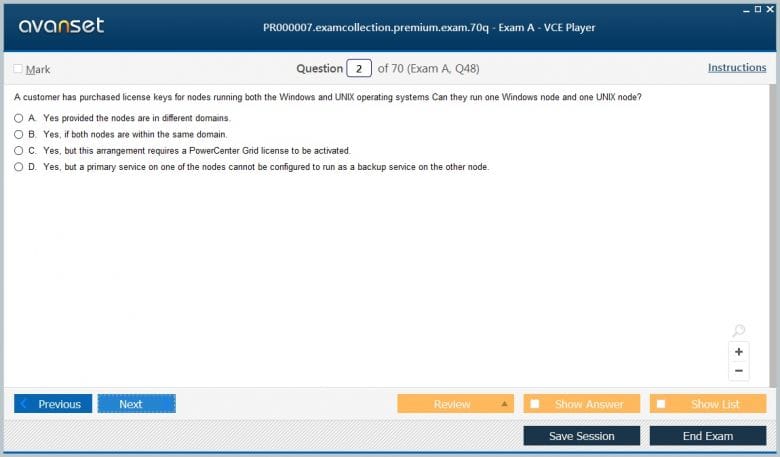
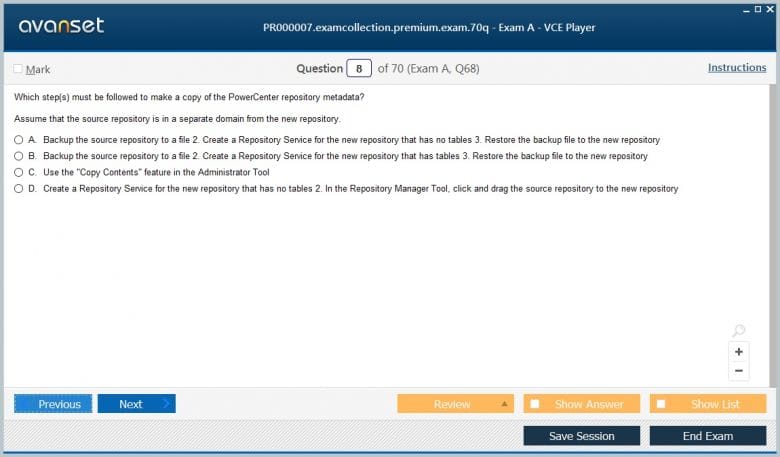
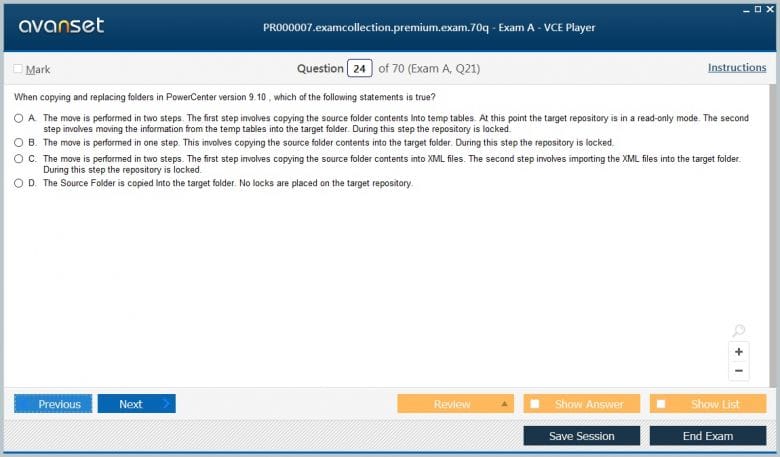
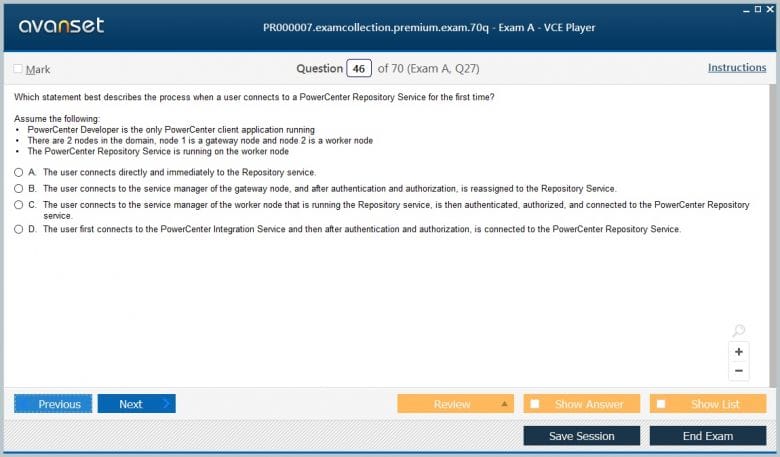
Informatica PR000007 Exam Screenshots
Informatica PR000007 Practice Test Questions in VCE Format
| File | Votes | Size | Date |
|---|---|---|---|
File Informatica.braindumps.PR000007.v2026-09-16.by.orla.30q.vce |
Votes 1 |
Size 47.4 KB |
Date Sep 16, 2026 |
Informatica PR000007 Practice Test Questions, Exam Dumps
Informatica PR000007 (PowerCenter Data Integration 9.x Administrator Specialist) exam dumps vce, practice test questions, study guide & video training course to study and pass quickly and easily. Informatica PR000007 PowerCenter Data Integration 9.x Administrator Specialist exam dumps & practice test questions and answers. You need avanset vce exam simulator in order to study the Informatica PR000007 certification exam dumps & Informatica PR000007 practice test questions in vce format.
PR000007 is the historical Informatica PowerCenter Data Integration 9.x Administrator Specialist exam. It should be treated as a legacy-version resource, not as the current Informatica administrator certification. Informatica University now publishes a PowerCenter Data Integration 10 Administrator professional certification covering installation and configuration, architecture, server maintenance, security, deployment, repository management, web services, command-line utilities, and implementation practices. That current catalog makes the version transition explicit even though many administrative concepts from 9.x remain recognizable.
The useful way to study an older administrator track is to separate enduring platform ideas from version-specific screens, commands, compatibility rules, and defaults. PowerCenter administration still revolves around domains, nodes, application services, repositories, integration services, security, deployment, monitoring, resilience, and operational control. Candidates using historical PR000007 material should learn those relationships while checking modern product documentation before assuming that an old configuration option, supported platform, or recovery procedure still behaves identically.
A PowerCenter environment is not merely a collection of desktop tools. Administrative control begins with the Informatica domain, which provides the framework in which nodes and services operate. Administrators need to understand how the domain configuration repository, service manager, nodes, gateway responsibilities, and application services fit together. When a service is unavailable, the useful question is not only “is it running?” but also which layer owns the failure, what dependency it relies on, and where the relevant configuration and logs live.
Historical 9.x questions often test architecture through operational scenarios. A node may be available while an application service is misconfigured; a repository service may be healthy while an integration service cannot reach a required database; or a gateway problem may affect domain-level administration differently from a worker-node issue. Mapping each symptom to the architecture prevents random troubleshooting and is still a durable skill in newer PowerCenter environments.
Capacity planning is another architectural responsibility. A domain may remain technically available while sessions queue, repository response degrades, or operating-system limits constrain throughput. Administrators should correlate workload patterns with CPU, memory, disk, network, database response, and service settings before increasing resources. A bottleneck can move after one component is improved, so tuning should be iterative and measured rather than based on a single utilization snapshot.
High availability also requires clarity about what is actually redundant. Multiple nodes do not automatically protect every service, database, file path, or external dependency. Administrators need to understand which components can fail over, what configuration enables recovery, how clients reconnect, and whether shared infrastructure introduces a hidden single point of failure. Planned failover tests are more informative than diagrams that have never been exercised.
The PowerCenter Repository Service manages the metadata used by development and runtime components. That metadata describes mappings, sessions, workflows, connections, folders, permissions, and other objects that make integration work repeatable. An administrator therefore treats repository availability, database connectivity, backup, restore, and maintenance as production concerns rather than back-office tasks. A repository failure can interrupt design work, scheduling, deployment, or runtime execution even when source and target systems themselves are healthy.
Good administration includes knowing where authoritative metadata lives and avoiding unsupported shortcuts. Direct manipulation of repository tables can bypass application logic and create corruption or inconsistent metadata. Supported export, backup, repository, and command-line mechanisms exist because metadata has relationships that are not obvious from individual rows in a database. The broader lesson is that platform metadata requires the same change discipline as application code.
The Integration Service executes sessions and workflows, which means administrative settings directly affect how developer-built mappings run. Process configuration, code pages, operating-system resources, connection behavior, partitioning, recovery options, and service availability can all change runtime outcomes. An administrator does not need to redesign every mapping, but does need enough understanding of execution to distinguish an infrastructure problem from a mapping or data problem.
This relationship is why PR000041, the legacy 9.x developer track, is a useful adjacent reference. Developers define transformations and workflows; administrators provide the services, permissions, connectivity, runtime capacity, and operational controls that allow those objects to execute reliably. The roles overlap at troubleshooting boundaries, but they are not interchangeable.
Administrative security is broader than creating users. PowerCenter environments can involve domain roles, repository permissions, service privileges, database credentials, operating-system accounts, network paths, encryption settings, and access to files or shared directories. A secure design follows least privilege and keeps administrative authority separate from routine development or operations wherever practical. It also records who can change services, deploy objects, manage credentials, or inspect sensitive runtime information.
Credential handling deserves special attention because integration platforms often connect to many high-value systems. Reusing powerful database accounts, embedding passwords in scripts, or granting broad service-account privileges can turn an integration server into a concentration point for risk. Historical exam questions may frame security as a product configuration topic, but the professional objective is consistent: limit authority, protect secrets, and make administrative changes traceable.
A mature access model separates platform administration, repository development, operations, and ordinary consumption. This reduces the chance that one compromised account can alter mappings, change runtime services, and access sensitive source systems at the same time. Periodic entitlement reviews should verify that privileges still match job responsibilities, especially after project changes, contractor departures, or emergency access.
Auditability depends on more than authentication. Administrative actions should leave records that can be connected to a person, time, object, and reason for change. If teams rely on shared administrator IDs or undocumented command-line scripts, incident investigation becomes harder and change control loses credibility. Privileged activity should therefore be both limited and attributable.
PowerCenter objects commonly move from development to test and then to production. The same logical workflow may need different connection strings, parameter files, schedules, directories, and service settings in each environment. Administrators should understand how deployment groups, exports, imports, folders, labels, permissions, and environment-specific configuration reduce the chance that a migration silently points at the wrong system or uses the wrong runtime assumptions.
A controlled promotion process also makes rollback possible. If a change introduces failures, the team needs to know exactly which metadata, configuration, parameter, or connection changed and how to restore a known-good state. That operational discipline matters more than memorizing the location of a particular 9.x menu. Modern delivery practices may automate more of the path, but traceable deployment remains essential.
PowerCenter produces information at several layers: domain and node logs, application-service logs, workflow and session logs, operating-system metrics, and database or network evidence. Efficient troubleshooting starts by identifying the failing layer and then following the dependency chain. Searching every log for the same timestamp is less useful if the administrator has not first determined whether the failure concerns authentication, repository access, source connectivity, service startup, resource exhaustion, or mapping logic.
Operational monitoring should also distinguish one-time failures from emerging patterns. Repeated session retries, increasing repository latency, disk growth, memory pressure, long queue times, or unstable connections can signal capacity or configuration problems before they create an outage. Administrators add value when they turn raw logs into service-level understanding rather than responding only after users report failed workflows.
Administrators also need service-level indicators that reflect business impact. A green process can still be unhealthy if jobs finish hours later than normal, workflow backlogs grow, or a repository response-time trend threatens batch windows. Baselines for normal duration, throughput, error frequency, and resource use help distinguish expected variation from a developing incident.
When incidents cross team boundaries, a concise evidence package speeds resolution. Relevant log excerpts, timestamps, affected workflow names, recent changes, service state, connection tests, and reproduction details are more useful than a generic message that “PowerCenter is down.” Operational maturity is visible in how quickly the team can move from symptom to bounded cause.
An integration platform is recoverable only when the organization can restore the metadata, configuration, credentials, files, and dependent databases required to resume controlled execution. Repository backups are central, but they are not the entire plan. Administrators need to understand domain configuration, service dependencies, shared directories, parameter files, external schedulers, and the sequence in which components should be validated after restoration.
Recovery planning should define acceptable data loss and downtime and then test whether the technical procedure can meet those objectives. A backup that has never been restored is an assumption, not evidence. Historical 9.x environments may use older tooling, but the discipline of testing restores, documenting dependencies, and recording recovery responsibilities remains current.
The approved Informatica exams inventory contains older codes alongside newer resources, so version context matters. Informatica University currently lists PowerCenter Data Integration 10 Administrator and Developer professional certifications. A candidate whose work still uses 9.x may gain practical value from PR000007 topics, but someone seeking a current credential should verify the live Informatica catalog rather than assuming a historical code remains bookable.
The broader discipline of data integration also helps place administration in context. PowerCenter exists to move and transform business data reliably. The administrator’s job is therefore not simply to keep services green; it is to operate the integration platform so that governed data flows remain available, secure, observable, and recoverable.
Go to testing centre with ease on our mind when you use Informatica PR000007 vce exam dumps, practice test questions and answers. Informatica PR000007 PowerCenter Data Integration 9.x Administrator Specialist certification practice test questions and answers, study guide, exam dumps and video training course in vce format to help you study with ease. Prepare with confidence and study using Informatica PR000007 exam dumps & practice test questions and answers vce from ExamCollection.
Purchase Individually
Site Search:

SPECIAL OFFER: GET 10% OFF

Pass your Exam with ExamCollection's PREMIUM files!
SPECIAL OFFER: GET 10% OFF
Use Discount Code:
MIN10OFF
A confirmation link was sent to your e-mail.
Please check your mailbox for a message from support@examcollection.com and follow the directions.

Download Free Demo of VCE Exam Simulator
Experience Avanset VCE Exam Simulator for yourself.
Simply submit your e-mail address below to get started with our interactive software demo of your free trial.