



Premium File
60 Q&A
$76.99$69.99
Pegasystems PEGAPCDC80V1 Exam Questions & Answers, Accurate & Verified By IT Experts
Instant Download, Free Fast Updates, 99.6% Pass Rate
60 Questions & Answers
Last Update: Sep 21, 2026
$69.99
Pegasystems PEGAPCDC80V1 Exam Screenshots
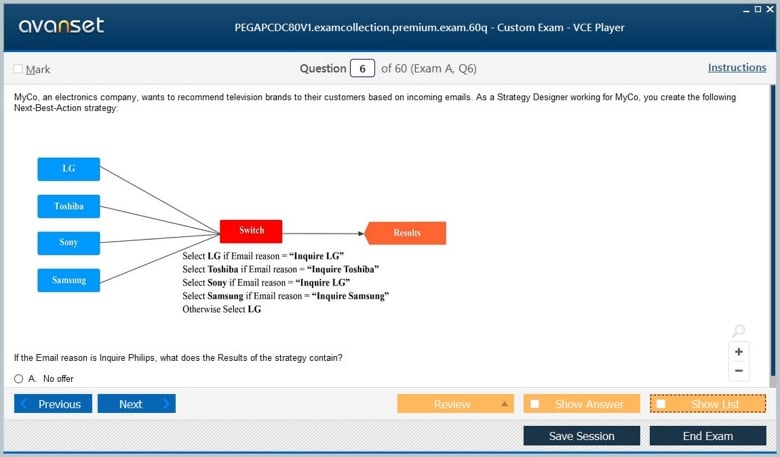
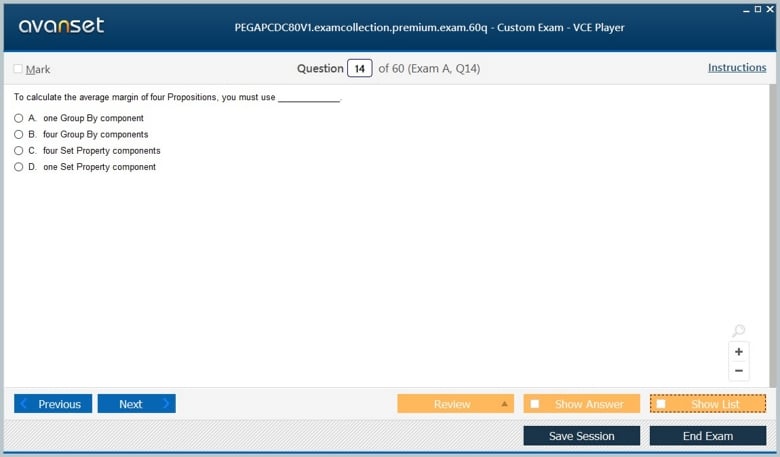
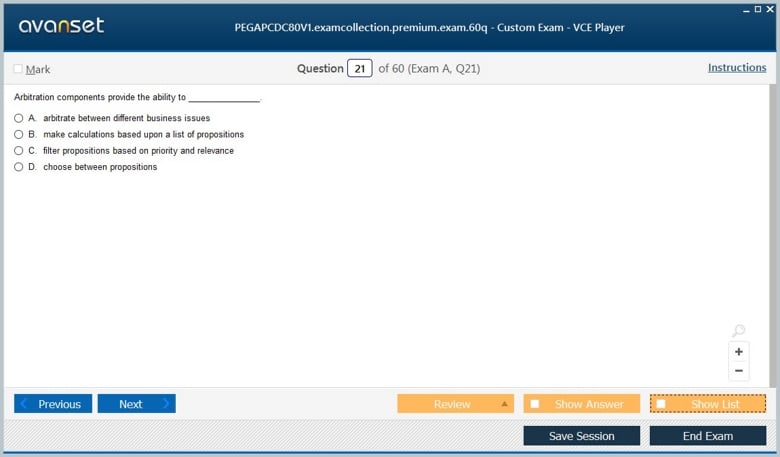
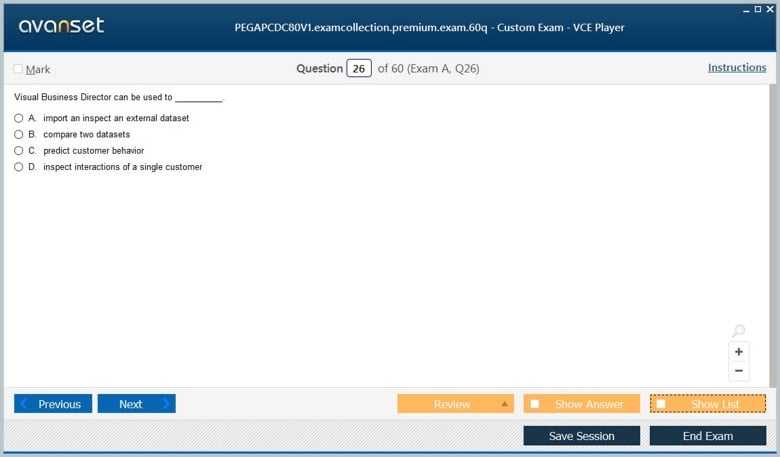
Pegasystems PEGAPCDC80V1 Practice Test Questions in VCE Format
| File | Votes | Size | Date |
|---|---|---|---|
File Pegasystems.Testking.PEGAPCDC80V1.v2026-08-03.by.Martin.28q.vce |
Votes 3 |
Size 174.24 KB |
Date Aug 04, 2026 |
Pegasystems PEGAPCDC80V1 Practice Test Questions, Exam Dumps
Pegasystems PEGAPCDC80V1 (Pega Certified Decisioning Consultant) exam dumps vce, practice test questions, study guide & video training course to study and pass quickly and easily. Pegasystems PEGAPCDC80V1 Pega Certified Decisioning Consultant exam dumps & practice test questions and answers. You need avanset vce exam simulator in order to study the Pegasystems PEGAPCDC80V1 certification exam dumps & Pegasystems PEGAPCDC80V1 practice test questions in vce format.
The PEGAPCDC80V1 exam represents an earlier Pega Certified Decisioning Consultant version from the 8.0 era. Pega’s current Academy does not surface this exact historical code with the same prominence as later decisioning exams, so old question counts, retirement dates, and blueprint percentages should not be inferred from newer pages. The durable subject is how customer data, business policy, predictive insight, arbitration, and channel context combine into a defensible next-best-action decision.
Decisioning work differs from ordinary workflow design because the output is often a choice among competing actions rather than a fixed next step. A consultant needs to understand not only whether an action is eligible, but why it should outrank another action for this customer, in this channel, at this moment, under the organization’s contact and risk policies.
The broader Pegasystems certifications include later Customer Decision Hub exams, which helps place this 8.0 code in the evolution toward more recent next-best-action and decisioning practice.
A customer may technically qualify for many offers, service messages, retention treatments, or educational actions. Decisioning becomes useful when the system narrows those possibilities according to business rules and customer context before attempting to rank them.
Eligibility answers whether an action can be considered. Applicability asks whether it fits the current situation. Suitability can exclude actions that would be inappropriate even if they are otherwise allowed. These distinctions matter because a high model score should not override policy that says an action should not be presented.
For study, take one proposed action and write down the conditions that make it eligible, the circumstances that make it inappropriate, and the evidence that would increase or decrease its priority. That exercise reveals whether a decision is being driven by policy, prediction, or both.
An action describes what the business wants to do: present an offer, recommend a service, request a renewal, or provide a message. A treatment describes how that action is expressed in a channel. The same underlying action may require different content and interaction patterns in web, mobile, email, or assisted service.
Keeping those layers separate supports consistency. Business eligibility should not be re-created independently inside every channel treatment. Otherwise a customer can receive contradictory experiences because each channel has encoded a slightly different version of the policy.
Treatments also need channel context. A short mobile message, a call-center script, and a detailed web presentation can represent the same business action without being identical artifacts.
Good decisioning does not simply maximize response probability. Organizations also need policies that prevent inappropriate contact, respect consent, apply exclusions, and recognize when an action conflicts with the customer’s circumstances. Engagement policy is the mechanism for keeping those constraints explicit.
These rules should be explainable to business owners. If an action is suppressed, the reason should be traceable to a policy condition rather than an unexplained score. That improves governance and makes policy changes safer because teams can see which customer populations will be affected.
A useful design habit is to test both sides of each policy boundary. If an offer is limited to customers above a threshold, test values immediately below, at, and above the boundary, along with missing or stale data.
After invalid actions are removed, several legitimate candidates may remain. Arbitration provides a way to compare them using factors such as business value, propensity, context, and strategic priority. The exact formula or weighting can vary, but the architectural idea is stable: competing actions need one comparable basis for selection.
The danger is allowing a single factor to dominate without understanding the consequence. A very high business value can overwhelm customer relevance; a predictive score can favor actions that conflict with strategic commitments; a manually boosted priority can persist long after the reason for it has expired.
Decisioning consultants should therefore treat arbitration settings as business policy with measurable effects. Changes should be tested against representative customer populations, not only checked for technical validity.
A recommendation can be individually relevant and still be wrong in sequence. Customers notice frequency, repetition, and timing. Contact policy helps control how often an action or group of actions may be presented and how prior responses affect future eligibility.
Suppression needs enough context to avoid blunt rules. A customer who declined one optional product may still need an important service notification. Conversely, repeatedly presenting the same promotion through several channels can damage trust even if each channel decision looks reasonable in isolation.
This is where decision history becomes valuable. The system should be able to consider what was shown, through which channel, when it occurred, and how the customer responded.
Strategies combine data, filters, models, calculations, business rules, and arbitration into an executable decision flow. The visual nature of a strategy can make complex logic easier to discuss, but only if the structure remains purposeful. A strategy filled with duplicated components and unexplained branches can become as opaque as poorly structured code.
Reusable sub-strategies should represent stable decision capabilities. Examples include calculating a common customer value measure, applying a shared exclusion, or selecting a product family before individual offers are ranked. Clear boundaries make testing and governance easier.
The later PEGACPDC88V1 exam is a useful comparison because its official blueprint explicitly emphasizes decision strategies alongside actions, engagement policy, contact policy, arbitration, channels, and business agility.
A propensity model can estimate the likelihood of a response, churn, or another outcome, but the model does not know every business constraint. Decisioning consultants need enough data-science literacy to understand what a score represents, how it was produced, and when it may be unreliable.
Model performance can degrade as customer behavior, products, or channels change. A score should therefore be monitored in production, and teams should know what decision behavior occurs when a model is unavailable or has insufficient evidence.
The PEGACPDS25V1 Data Scientist exam represents a deeper specialization in predictive and analytical work. The Decisioning Consultant role consumes that capability while combining it with business policy and operational next-best-action design.
Decisioning environments are expected to change frequently. Products launch, offers expire, regulations change, budgets tighten, and new customer signals become available. A design that requires a developer to rebuild a large strategy for every business adjustment will become a bottleneck.
Where appropriate, business-owned rules and action configuration should be separated from stable strategy structure. Governance still matters: giving business users change capability should come with approval, testing, effective dates, and the ability to understand the impact of a change.
The older PEGACPDC74V1 exam shows that decisioning had an earlier certification lineage, while newer Customer Decision Hub versions formalize more mature next-best-action operating patterns.
For a legacy 8.0 implementation, the priority is to understand how its strategies, actions, models, and customer data were designed at the time. Replacing old configuration without understanding its policy intent can silently change who receives an action and why.
For current skills, compare the older concepts with later exams such as PEGACPDC24V1. The vocabulary and tooling evolve, but the central questions remain: what actions are possible, which are permissible, which is best now, how often should it be shown, and how will the organization know whether the policy is working?
Hands-on preparation should use a small action set with competing priorities. Add an eligibility rule, a suitability exclusion, a propensity signal, a business-value factor, and a contact restriction. Then vary customer data and explain why the winning action changes. If the decision cannot be explained, the strategy is not ready.
PEGAPCDC80V1 is best treated as legacy decisioning material with enduring architectural lessons. It should not be used to infer the details of today’s Pega decisioning exam, but it remains useful for understanding how next-best-action systems combine policy, analytics, history, and business value.
The strongest consultants can move between technical strategy logic and a business explanation of the decision. They can say not only which action won, but which candidates were excluded, which policy applied, which evidence influenced the ranking, and how contact history affected the result. That explainability is what turns a decision engine from a black box into a governable business capability.
Decision quality also depends on the quality and timeliness of the customer context. A perfectly designed strategy can make a poor choice if the profile is stale, consent is missing, or a recent interaction has not reached the decisioning system. Consultants should therefore treat data freshness and identity resolution as part of decision design rather than as somebody else’s upstream problem.
Testing should evaluate populations, not only individual examples. A change that improves outcomes for one sample customer may unintentionally suppress too many actions for another segment or over-concentrate volume on a single offer. Before deployment, compare distributions of eligibility, winning actions, suppression reasons, and expected value across representative groups.
After deployment, the feedback loop matters. Response data, outcomes, and operational constraints should inform future models and policy. Governance should make it possible to distinguish a model-driven performance change from a business-rule change, so teams know which component to adjust instead of treating the entire decision strategy as one opaque system.
Explainability also matters when a business stakeholder challenges a result. A consultant should be able to reconstruct the candidate set, exclusions, arbitration inputs, and contact history that produced the recommendation.
Go to testing centre with ease on our mind when you use Pegasystems PEGAPCDC80V1 vce exam dumps, practice test questions and answers. Pegasystems PEGAPCDC80V1 Pega Certified Decisioning Consultant certification practice test questions and answers, study guide, exam dumps and video training course in vce format to help you study with ease. Prepare with confidence and study using Pegasystems PEGAPCDC80V1 exam dumps & practice test questions and answers vce from ExamCollection.
Purchase Individually
Top Pegasystems Certification Exams
Site Search:

SPECIAL OFFER: GET 10% OFF

Pass your Exam with ExamCollection's PREMIUM files!
SPECIAL OFFER: GET 10% OFF
Use Discount Code:
MIN10OFF
A confirmation link was sent to your e-mail.
Please check your mailbox for a message from support@examcollection.com and follow the directions.

Download Free Demo of VCE Exam Simulator
Experience Avanset VCE Exam Simulator for yourself.
Simply submit your e-mail address below to get started with our interactive software demo of your free trial.