



Premium File
60 Q&A
$76.99$69.99
Pegasystems PEGACRSA80V1 Exam Questions & Answers, Accurate & Verified By IT Experts
Instant Download, Free Fast Updates, 99.6% Pass Rate
60 Questions & Answers
Last Update: Nov 02, 2026
$69.99
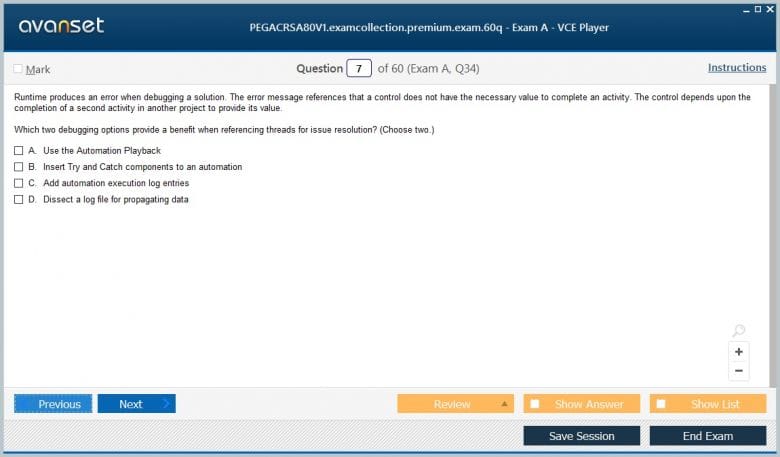
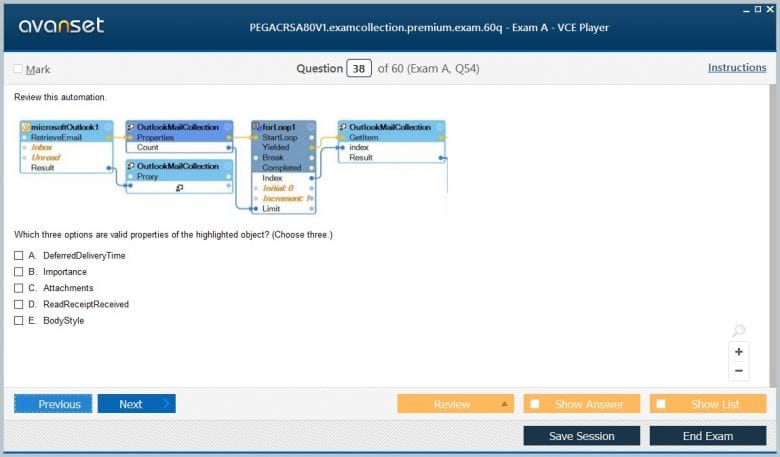
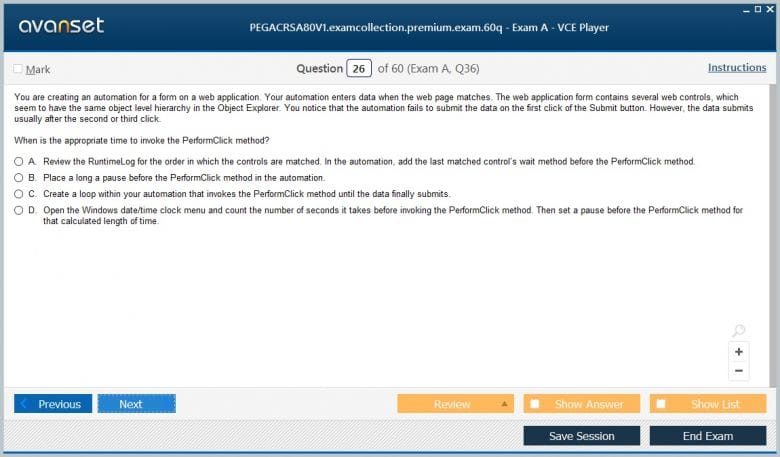
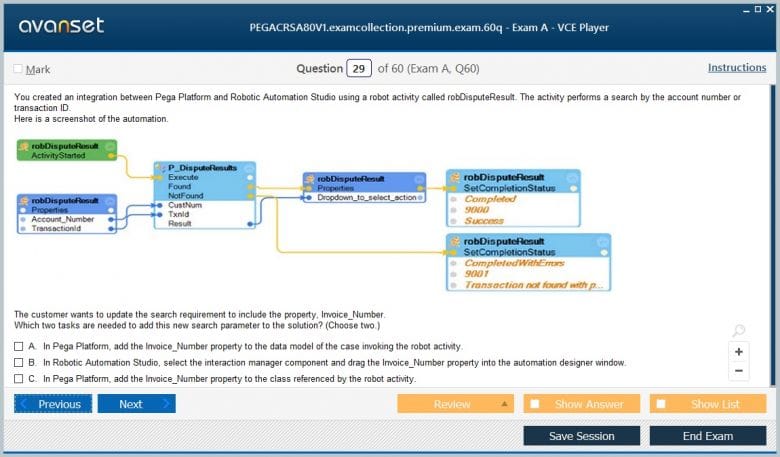
Pegasystems PEGACRSA80V1 Exam Screenshots
Pegasystems PEGACRSA80V1 Practice Test Questions in VCE Format
| File | Votes | Size | Date |
|---|---|---|---|
File Pegasystems.Test-king.PEGACRSA80V1.v2026-10-24.by.Olivia.31q.vce |
Votes 3 |
Size 688.51 KB |
Date Oct 24, 2026 |
Pegasystems PEGACRSA80V1 Practice Test Questions, Exam Dumps
Pegasystems PEGACRSA80V1 (Certified Robotics System Architect (CRSA) 80V1) exam dumps vce, practice test questions, study guide & video training course to study and pass quickly and easily. Pegasystems PEGACRSA80V1 Certified Robotics System Architect (CRSA) 80V1 exam dumps & practice test questions and answers. You need avanset vce exam simulator in order to study the Pegasystems PEGACRSA80V1 certification exam dumps & Pegasystems PEGACRSA80V1 practice test questions in vce format.
The PEGACRSA80V1 exam belongs to an earlier generation of Pega robotics certification, when desktop automation was commonly framed around identifying application controls, coordinating automations, and deploying robotic solutions into user or unattended workflows. The code should therefore be treated as version-specific legacy material rather than as a description of Pega’s current robotics certification blueprint.
That status does not make its technical ideas irrelevant. Older Pega robotics implementations still depend on durable automation principles: select work that is stable enough to automate, identify applications reliably, move data deliberately, synchronize with real application state, handle exceptions, and make failures observable. Those are the concepts worth retaining when studying an older exam code.
The wider Pegasystems certifications also contains later robotics exam versions, which helps place PEGACRSA80V1 in a longer certification lineage instead of treating it as a current standalone credential.
A robotic automation is only as strong as the process selected for it. Repetitive keystrokes are not automatically good candidates. The work should have reasonably stable inputs, understandable decision rules, predictable applications, and an exception path that a human or support process can own. If a process changes every week or depends on judgment that is not captured in data, automating the visible clicks can simply make the underlying instability harder to see.
For exam preparation, it is useful to analyze a manual process before thinking about tools. Identify the trigger, the applications touched, data read or written, points where the user waits, branches in the workflow, and conditions that should stop the automation. This separates process design from implementation details and makes later debugging far easier.
A good candidate also has measurable value. Saving a few seconds on a rare task may not justify deployment and support overhead, while reducing errors in a high-volume data-entry process can be worthwhile even if the time saving per transaction is modest.
Desktop automation depends on identifying the correct application elements at runtime. A human can recognize a button even when a window moves or another record is open; an automation needs explicit rules that distinguish the intended target from similar controls. Early Pega robotics work therefore placed strong practical emphasis on interrogation, control matching, adapters, and the structure exposed by target applications.
Candidates should understand why a brittle identifier causes failures. If an element is matched only by coordinates or a value that changes every session, the automation may work during development and fail in production. Reliable matching uses attributes that express the identity of the target while avoiding unnecessary constraints that make the match too narrow.
Recognition also affects maintainability. When several automations depend on the same application, a thoughtful integration model allows shared controls and behavior to be reused. Duplicating recognition logic across projects increases the number of places that must be repaired after an application update.
Many desktop automation failures are really synchronization failures. A screen may appear before its data is loaded, a control may exist before it is enabled, or a remote application may respond more slowly under production load than it did during testing. Fixed delays can hide the problem for a while, but they either waste time when the application is fast or still fail when it is slower than expected.
Robust design waits for meaningful state: a window is created, an element becomes available, a process completes, or a value reaches the expected condition. The automation should also define a timeout and an exception path instead of waiting forever.
This is an important exam mindset because synchronization connects several topics at once. Recognition tells the automation what object matters; events and waits tell it when the object is ready; exception handling defines what happens when the expected state never arrives.
A long chain of steps can look straightforward on a design surface while still being difficult to support. Strong automations divide work into understandable units, pass only the necessary data between them, and make the current transaction state visible. If a workflow fails after updating one system but before updating another, support staff need to know which steps completed and whether it is safe to retry.
Data should also be validated near the point where assumptions are made. If an account number must have a particular format, checking it before launching several downstream actions prevents a bad input from becoming a confusing application error later.
Recovery is not limited to catching technical exceptions. Business exceptions—such as a record that requires manual review—should be distinguished from automation defects. That distinction improves reporting and prevents ordinary business variation from being treated as a platform failure.
An attended automation assists a person who is already working in the desktop environment. The user can supply context, resolve ambiguity, and see when the automation needs intervention. Unattended work has no such safety net. It therefore requires stronger scheduling, credential handling, transaction isolation, logging, and recovery.
The design should reflect that difference. An attended assistant can ask the user to select a record or confirm a sensitive action. An unattended process must obtain every required input from trusted sources and must stop safely when those inputs are incomplete.
Security also changes with the operating model. Credentials should not be embedded in automation logic simply because a robot needs to sign in. The solution should use an appropriate credential mechanism, minimize privileges, and make it clear which identity performed each action.
Robotic automations cross application boundaries, so a failure can originate in recognition, timing, data mapping, application state, environment differences, permissions, or the automation logic itself. Effective debugging starts by narrowing the failure to a reproducible state instead of changing several components at once.
Breakpoints, logs, variable inspection, and controlled test data help answer specific questions: Did the expected control match? Was the value populated? Did the application event occur? Did the branch take the intended path? The goal is evidence, not guesswork.
Teams should also preserve enough diagnostic information in production to investigate failures without exposing sensitive data. A useful log identifies the transaction, the stage that failed, and the relevant error while avoiding passwords or unnecessary personal information.
Automation teams quickly discover that the same application actions appear in many processes: sign in, search for a customer, open a record, save a change, or capture a status. Implementing each action independently creates inconsistent behavior and multiplies maintenance after an application change.
Reusable components work best when their contracts are clear. A shared search routine should define the inputs it requires, what it returns, and how it reports no result or a technical failure. Hidden dependencies make reuse fragile because callers cannot predict what the component will do.
Reuse should not become over-abstraction. A tiny step that is unique to one process may be clearer inline. The useful boundary is usually a stable business or application capability that appears repeatedly and can be tested independently.
An automation that runs on a developer workstation is not finished. Production introduces different screen resolutions, application versions, user profiles, network latency, security policies, credentials, and support expectations. Deployment planning should therefore be part of design rather than an afterthought.
Configuration values that differ by environment should be externalized where appropriate. Release packages should be versioned, and teams should know how to roll back a defective change. Monitoring should reveal both hard failures and silent degradation, such as an increasing number of transactions being routed to manual handling.
Operational ownership matters as much as packaging. Someone must know which business process the robot supports, when it may run, which team owns the target application, and how incidents are escalated. Without that context, even a technically sound automation can become difficult to maintain.
The later PEGAPCRSA80V1-2019 exam reflects a subsequent Pega Robotics System Architect version and is a more useful bridge from the early CRSA naming into Pega’s later robotics certification lineage. Pega Academy now publishes a newer Robotics System Architect exam for its current robotics release, so candidates pursuing certification today should confirm the live blueprint rather than assuming the older 8.0 code still defines the credential.
For legacy support, however, studying the older material can still be productive if the goal is understanding the architecture already deployed. Focus on the reasons behind interrogation, matching, synchronization, modular automation, debugging, and deployment. Those principles travel better across versions than memorizing interface labels.
The best preparation is to build a small but realistic automation and deliberately break it. Change a target property, delay an application response, return an unexpected value, and simulate a failed sign-in. Then observe whether the solution fails safely and whether the logs make the cause clear. That exercise turns a legacy exam outline into practical engineering knowledge.
PEGACRSA80V1 is most useful when read historically: it represents an earlier stage of Pega desktop automation rather than today’s certification blueprint. Its enduring value lies in the operational problems it forces an architect to solve. Automation must recognize the right application state, move data without corrupting it, recover from predictable failure, protect credentials, and remain supportable after deployment.
That distinction protects candidates from two common mistakes. One is treating an old exam code as current simply because a study page still exists. The other is dismissing all older material even when maintaining the systems built with it. Version awareness allows both kinds of work to be done correctly: use current Pega Academy material for current certification decisions, and use legacy objectives to understand the design assumptions of legacy robotic solutions.
Go to testing centre with ease on our mind when you use Pegasystems PEGACRSA80V1 vce exam dumps, practice test questions and answers. Pegasystems PEGACRSA80V1 Certified Robotics System Architect (CRSA) 80V1 certification practice test questions and answers, study guide, exam dumps and video training course in vce format to help you study with ease. Prepare with confidence and study using Pegasystems PEGACRSA80V1 exam dumps & practice test questions and answers vce from ExamCollection.
Purchase Individually
Top Pegasystems Certification Exams
Site Search:

SPECIAL OFFER: GET 10% OFF

Pass your Exam with ExamCollection's PREMIUM files!
SPECIAL OFFER: GET 10% OFF
Use Discount Code:
MIN10OFF
A confirmation link was sent to your e-mail.
Please check your mailbox for a message from support@examcollection.com and follow the directions.

Download Free Demo of VCE Exam Simulator
Experience Avanset VCE Exam Simulator for yourself.
Simply submit your e-mail address below to get started with our interactive software demo of your free trial.