



Premium File
88 Q&A
$76.99$69.99
GIAC GCED Exam Questions & Answers, Accurate & Verified By IT Experts
Instant Download, Free Fast Updates, 99.6% Pass Rate
88 Questions & Answers
Last Update: Sep 21, 2026
$69.99
GIAC GCED Exam Screenshots
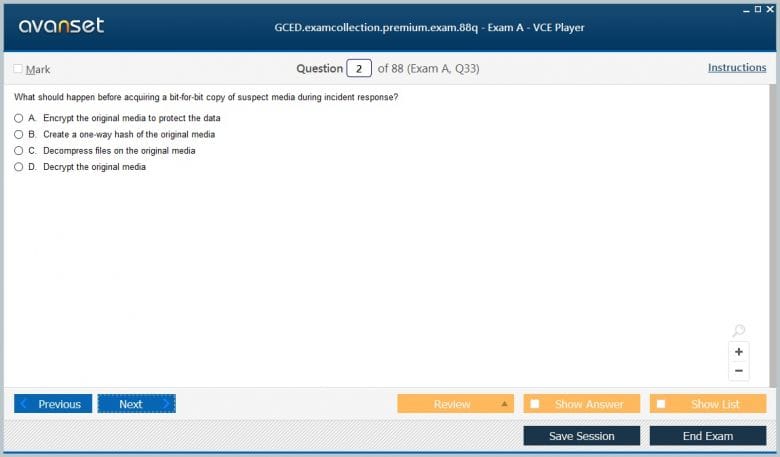
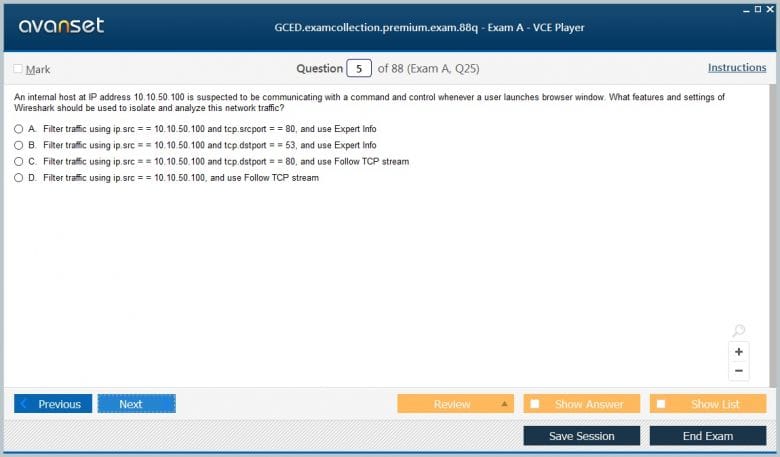
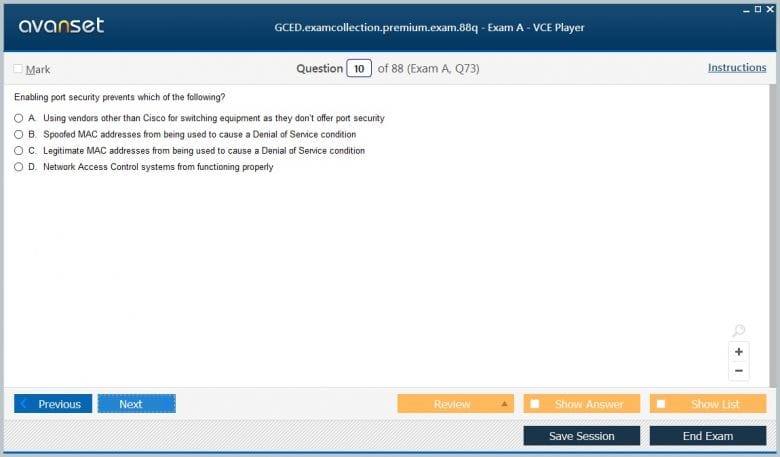
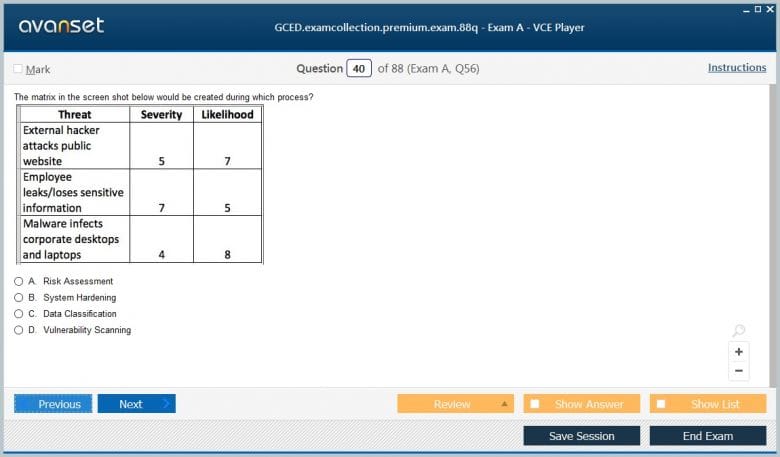
GIAC GCED Practice Test Questions in VCE Format
| File | Votes | Size | Date |
|---|---|---|---|
File GIAC.pass4sures.GCED.v2026-07-22.by.gabriel.52q.vce |
Votes 1 |
Size 675.95 KB |
Date Jul 22, 2026 |
File GIAC.selftestengine.GCED.v2021-04-28.by.wangping.48q.vce |
Votes 1 |
Size 173.7 KB |
Date Apr 28, 2021 |
File GIAC.Certkiller.GCED.v2019-04-16.by.Gordy.49q.vce |
Votes 3 |
Size 424.77 KB |
Date Apr 17, 2019 |
GIAC GCED Practice Test Questions, Exam Dumps
GIAC GCED (GIAC Certified Enterprise Defender) exam dumps vce, practice test questions, study guide & video training course to study and pass quickly and easily. GIAC GCED GIAC Certified Enterprise Defender exam dumps & practice test questions and answers. You need avanset vce exam simulator in order to study the GIAC GCED certification exam dumps & GIAC GCED practice test questions in vce format.
GCED, the GIAC Certified Enterprise Defender, is a current practitioner certification for defenders who need breadth across infrastructure hardening, network analysis, security operations, incident response, malware, logging, and attack-surface management. GIAC explicitly positions it as building on the security skills measured by GSEC. That makes GCED less about mastering one security product and more about connecting defensive controls into an enterprise system that can prevent, detect, investigate, contain, and recover from attacks.
The credential belongs inside the wider GIAC certifications ecosystem. Candidates who need a foundation can compare it with GSEC, while deeper incident handling and traffic analysis connect naturally to GCIH and GCIA. GCED’s value is the ability to understand how those disciplines meet inside a real enterprise.
An enterprise attack surface includes more than internet-facing hosts. Identities, remote-management paths, cloud control planes, software dependencies, exposed services, unmanaged assets, and trust relationships can all create routes into the environment. Prioritization should therefore combine vulnerability information with asset value, reachability, exploitability, and the controls already in place. This is why a vulnerability list is not the same thing as a defensive plan: the defender needs to know which weakness changes realistic attacker options and which remediation materially reduces exposure.
Enterprise defense is stronger when teams identify exposures before adversaries turn them into incidents. GCED’s current objectives include attack-surface management, vulnerability management, reconnaissance awareness, and frameworks such as MITRE ATT&CK and D3FEND. The practical skill is prioritization. An organization can have thousands of findings, but defenders need to know which exposures create credible attack paths to important assets.
Good prioritization combines technical severity with reachability, asset value, identity privilege, exploitability, and compensating controls. A scanner score alone cannot describe business risk. The broader explanation of vulnerability assessment is useful context because assessment becomes operationally valuable only when findings lead to targeted remediation and verification.
Baselines are most useful when deviations can be detected and explained. A secure configuration that exists only at build time gradually loses value as emergency changes, package updates, new accounts, and operational exceptions accumulate. Automation can compare systems with an approved state, but the organization still needs a process for legitimate exceptions and for returning temporary changes to the baseline. The defensive objective is not absolute uniformity; it is controlled, visible change so that an attacker-created modification does not hide among undocumented operational drift.
Secure baselines are temporary unless the organization can detect and correct drift. GCED includes configuration management and automation workflows because modern estates change constantly through patching, cloud deployment, infrastructure-as-code pipelines, administrator actions, and application releases. A defender needs to know what “known good” means and how deviations are identified.
Automation can harden systems repeatedly, but it can also reproduce mistakes at scale. Candidates should think about approval, testing, rollback, and evidence. A configuration change should be traceable to a requirement, deployed through a controlled mechanism, and measurable afterward. Security automation is most useful when it reduces inconsistency without removing human judgment from high-impact changes.
Compromise becomes much more damaging when an attacker can move freely. GCED therefore covers identity and infrastructure hardening, including enterprise identity systems and network controls. Defenders should understand how privilege, segmentation, authentication, administrative protocols, and directory infrastructure create or block movement paths.
Logs from technologies such as Active Directory, RADIUS, and TACACS+ also become investigative evidence. A failed login is not automatically malicious, and a successful login is not automatically legitimate. Analysts need to correlate identity events with source systems, network locations, expected behavior, and other telemetry to decide whether an account is being used normally or as part of an attack.
Telemetry design should begin with detection questions. If defenders need to identify suspicious authentication, process execution, lateral movement, or outbound connections, the relevant sources must be enabled, retained, normalized, and time-synchronized before an incident occurs. Collecting everything without a use case can create cost and noise, while collecting too little leaves investigators reconstructing events from gaps. A mature logging strategy maps important behaviors to evidence sources and then tests whether analysts can actually query those sources during an exercise.
Security operations cannot analyze data that was never collected. GCED emphasizes telemetry and evidence quality because logging strategy determines what an incident team can later prove. Useful telemetry should capture the activities that matter, preserve reliable timestamps, include identifiers that support correlation, and arrive at the analysis platform without silent loss or destructive normalization.
More logs are not automatically better. Collection must be designed around detection questions. Endpoint events, authentication records, DNS, proxy, firewall, cloud control-plane logs, and network telemetry each answer different questions. The discussion of raw-log analysis in a SIEM is a stronger supporting reference here because useful monitoring depends on understanding which records answer the investigative question and how those records can be correlated.
Network evidence is especially valuable for relationships between systems. Endpoint logs can show that a process ran, while flow or packet data can show where it communicated, how often, and whether similar behavior occurred elsewhere. DNS, proxy, firewall, IDS, and packet sources each answer different questions and have different retention limits. Defenders should know which source is authoritative for an observation and how address translation or load balancing changes what an analyst sees. Correlating network evidence with host telemetry turns a suspicious connection into a richer account of the activity around it.
GCED includes packet analysis, intrusion analysis, network monitoring, and forensics. Network data can reveal scanning, command-and-control patterns, protocol misuse, unusual destinations, and lateral movement even when endpoint logs are incomplete. Analysts should understand packet, flow, and log-level evidence and choose the right source for the question.
Intrusion detection systems add another layer by applying signatures, protocol understanding, and behavioral logic. Tuning matters because a noisy IDS can train analysts to ignore alerts, while an overly narrow ruleset misses important activity. Candidates should understand how a detection is produced and what evidence should be collected to confirm or reject it rather than treating an alert as a verdict.
Containment decisions are rarely binary. Disconnecting a host can stop attacker activity but can also destroy a live observation opportunity, interrupt a critical service, or trigger an adversary to change tactics. The responder weighs business impact, evidence needs, attacker access, and the risk of continued operation. Recovery has similar dependencies: restoring a system is not enough if the compromised credential, persistence mechanism, or exposed service remains. Good response connects technical actions to an explicit objective and verifies that the objective was achieved.
Detection is only the beginning. GCED objectives cover investigation, containment, eradication, recovery, and the obstacles that can complicate those stages. Responders need to preserve evidence while acting quickly enough to reduce harm. The right containment action depends on business impact, adversary access, persistence, and whether isolation could destroy visibility into a larger intrusion.
A mature process assigns decision authority before the incident. The incident-response lifecycle is useful supporting context because technical actions need escalation, communication, and recovery criteria. After containment, the team should verify that the attacker’s access path and persistence are gone rather than simply restoring a service and closing the ticket.
The most valuable malware findings are translated into controls the rest of the environment can use. A domain, mutex, process tree, registry modification, or command pattern can become a hunt query, detection rule, block condition, or hardening requirement. Analysts should distinguish durable behaviors from brittle indicators because hashes and infrastructure can change quickly. Feeding behavioral knowledge back into prevention and detection turns one investigation into broader defensive improvement, which is exactly the enterprise perspective that separates response work from one-host cleanup.
GCED includes malware identification, triage, and analysis because defenders need to translate suspicious code into indicators and protective action. Static techniques can reveal metadata, strings, imports, and structure; dynamic techniques can show process, file, registry, and network behavior. The objective is to learn enough about the malware to contain the current incident and improve defenses against recurrence.
Analysis findings should become detections, blocks, hunts, or hardening actions. A command-and-control domain may become a network indicator, a persistence mechanism may become an endpoint hunt, and an exploited configuration may become a baseline fix. Malware work has the greatest enterprise value when it closes the loop between investigation and control improvement.
Practice should also include explaining priorities to another defender. A candidate who can identify a hardening control, detection source, containment action, and recovery check for the same attack path is demonstrating connected understanding rather than isolated recall. That habit mirrors enterprise defense work, where improvements are strongest when prevention, visibility, response, and validation reinforce one another.
GIAC currently lists GCED as a 115-question, three-hour proctored exam with a 69 percent passing score. The objective set is broad, so isolated memorization is risky. Practice by following a realistic scenario from exposure discovery through hardening, telemetry, alerting, investigation, network analysis, malware triage, containment, and recovery. Ask what evidence and decision belongs at each stage.
This integrated method also prevents over-specialization. A network analyst should be able to explain how identity data changes an investigation; an incident responder should understand how configuration drift created the opening; a vulnerability analyst should know which telemetry will show exploitation. GCED represents enterprise defense precisely because it expects the candidate to connect controls, evidence, and response across organizational boundaries.
Go to testing centre with ease on our mind when you use GIAC GCED vce exam dumps, practice test questions and answers. GIAC GCED GIAC Certified Enterprise Defender certification practice test questions and answers, study guide, exam dumps and video training course in vce format to help you study with ease. Prepare with confidence and study using GIAC GCED exam dumps & practice test questions and answers vce from ExamCollection.
Purchase Individually
Site Search:

SPECIAL OFFER: GET 10% OFF

Pass your Exam with ExamCollection's PREMIUM files!
SPECIAL OFFER: GET 10% OFF
Use Discount Code:
MIN10OFF
A confirmation link was sent to your e-mail.
Please check your mailbox for a message from support@examcollection.com and follow the directions.

Download Free Demo of VCE Exam Simulator
Experience Avanset VCE Exam Simulator for yourself.
Simply submit your e-mail address below to get started with our interactive software demo of your free trial.
please get the latest version