



Premium File
75 Q&A
$76.99$69.99
WatchGuard Essentials Exam Questions & Answers, Accurate & Verified By IT Experts
Instant Download, Free Fast Updates, 99.6% Pass Rate
75 Questions & Answers
Last Update: Sep 08, 2026
$69.99
WatchGuard Essentials Exam Screenshots
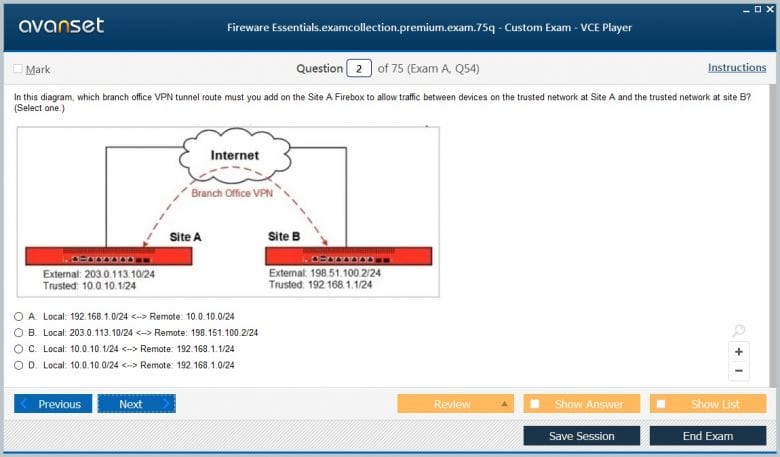
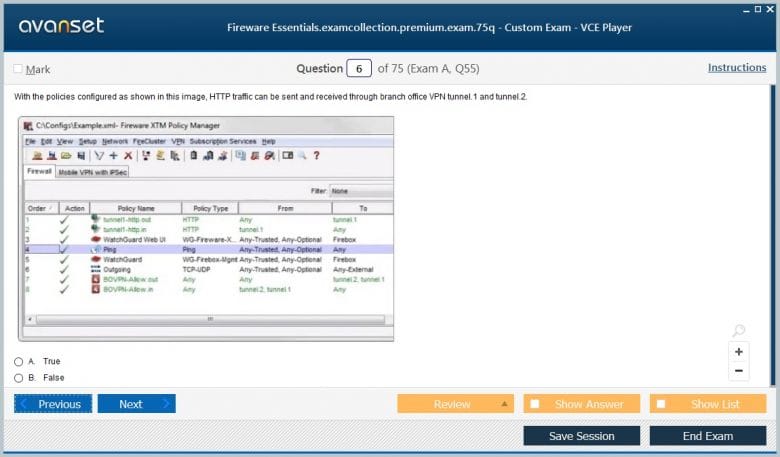
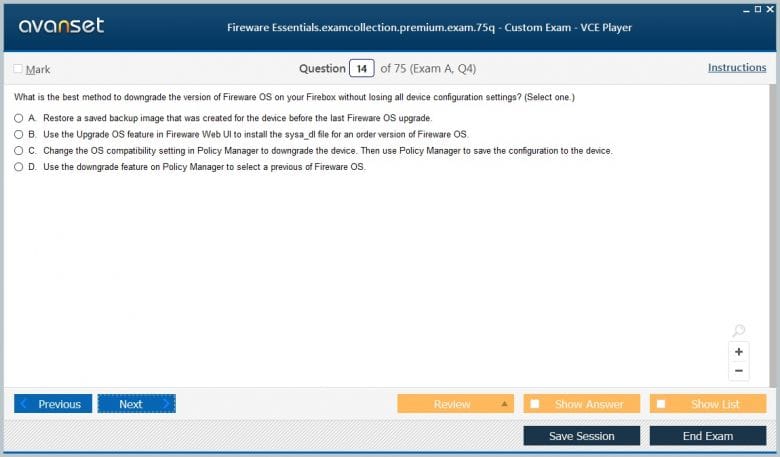
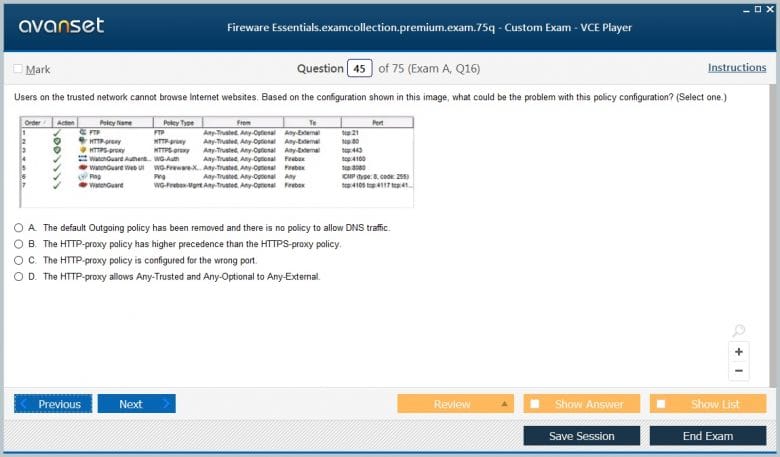
WatchGuard Essentials Practice Test Questions in VCE Format
| File | Votes | Size | Date |
|---|---|---|---|
File WatchGuard.testkings.Essentials.v2026-08-25.by.iwei.38q.vce |
Votes 1 |
Size 227.29 KB |
Date Aug 25, 2026 |
File WatchGuard.Examskey.Essentials.v2019-05-08.by.Martin.49q.vce |
Votes 10 |
Size 702.67 KB |
Date May 11, 2019 |
File WatchGuard.ActualTests.Essentials.v2016-03-30.by.Tacoloco.54q.vce |
Votes 7 |
Size 1.99 MB |
Date Mar 30, 2016 |
File WatchGuard.ActualTests.Essentials.v2015-11-26.by.Bird.50q.vce |
Votes 15 |
Size 920.63 KB |
Date Nov 26, 2015 |
WatchGuard Essentials Practice Test Questions, Exam Dumps
WatchGuard Essentials (Essentials) exam dumps vce, practice test questions, study guide & video training course to study and pass quickly and easily. WatchGuard Essentials Essentials exam dumps & practice test questions and answers. You need avanset vce exam simulator in order to study the WatchGuard Essentials certification exam dumps & WatchGuard Essentials practice test questions in vce format.
The WatchGuard Fireware Essentials exam is a legacy WatchGuard exam code that predates the company’s current Network Security certification structure. Older materials refer to the code simply as “Essentials” and focus on administering Firebox appliances running Fireware. In 2026, WatchGuard’s public certification program is active, but the current network-security path is expressed through newer Essentials exams for locally managed and cloud-managed Fireboxes rather than the old Fireware Essentials code.
That makes this page useful as a historical foundation, not as proof that the old exam is still the right registration target. The underlying skills remain recognizable: interface configuration, firewall policies, proxy behavior, NAT, subscription services, authentication, VPNs, logging, monitoring, backup, restore, and routine troubleshooting. Candidates working with older study material should preserve those durable concepts while checking every current procedure against today’s Learning Center and Fireware documentation.
Fireware Essentials was never just a generic networking test. It expected candidates to understand how a Firebox is deployed and managed: which interfaces are trusted, optional, or external; how addresses and routes are configured; how management access is controlled; and how traffic encounters policy. Those tasks force the administrator to translate a network diagram into an appliance configuration that is secure and supportable.
The broader WatchGuard certifications program still follows that practical philosophy. WatchGuard describes its technical certifications as hands-on validation of real-world service and troubleshooting skills. When revisiting the old exam, therefore, do not memorize screenshots from an obsolete version of Fireware. Reconstruct the traffic flow and ask what the firewall must know to make the correct forwarding and security decision.
A Firebox evaluates traffic through policy, and the quality of the policy set determines much of the security posture. Candidates should understand source and destination matching, services and ports, schedules, users and groups, and the difference between allowing a connection and applying deeper inspection. Policy order, aliases, and default behavior matter because a rule can be technically valid while still permitting more traffic than intended.
The conceptual background in stateful and stateless firewalls is useful here. A stateful firewall tracks connection context, so return traffic is handled as part of an established session instead of as an unrelated packet. Fireware adds product-specific policy and inspection on top of that basic idea. Study both levels: what the firewall is doing as a network security device and what WatchGuard configuration objects tell it to do.
Older Fireware training emphasized the difference between simple packet filtering and proxy-based inspection. The point is not that one is universally good and the other bad. Deeper application-aware inspection can provide stronger control but may introduce additional processing, compatibility considerations, and configuration choices. Administrators need to choose the right level of inspection for the traffic and the security outcome required.
Subscription services extend the decision beyond ports and addresses. Web filtering, intrusion prevention, malware scanning, application control, reputation services, and other protections can evaluate content or behavior that a basic allow/deny rule cannot. For exam scenarios, identify whether the requirement is connectivity, identity, content inspection, threat prevention, or reporting. That usually narrows the relevant feature much faster than memorizing a menu hierarchy.
Many Firebox problems that appear to be firewall-policy failures are really routing or NAT problems. A candidate should be able to trace a connection from source to destination, decide whether source or destination translation occurs, determine which route is used, and predict the return path. Static NAT, dynamic NAT, policy-based NAT behavior, and branch connectivity make sense only when mapped onto an actual packet flow.
Troubleshoot in layers. Confirm addressing and subnet membership, then routing, then NAT, then policy, then higher-level inspection. If the return path is wrong, changing a proxy rule will not fix it. If the destination translation is missing, the correct inbound policy may never see the traffic you think it sees. Drawing the pre-NAT and post-NAT addresses on paper is often more useful than memorizing a configuration screenshot.
Fireware administration also requires understanding who is allowed to use a service and how remote or site-to-site connectivity is established. User authentication can affect policy decisions, while Mobile VPN and Branch Office VPN configurations create encrypted paths with their own authentication, routing, and policy implications. A tunnel can be up and still fail the business requirement if the protected networks, routes, DNS behavior, or firewall rules are wrong.
A useful conceptual companion is the material on VPN architecture and tunneling. Apply those principles to Firebox-specific workflows: peer identity, tunnel negotiation, protected resources, routing, and policy. In troubleshooting questions, distinguish tunnel establishment from application reachability. That separation prevents the common mistake of treating every failed connection as an encryption problem.
A firewall administrator needs to prove what the device did. Traffic Monitor, status information, logs, and reports provide evidence for that task. Learn to read a log entry as a structured explanation: source, destination, protocol, policy, action, translation, inspection result, and any service-specific disposition. A denied connection may reveal the exact policy gap, while an allowed connection with a later proxy or security-service rejection tells a different story.
This is why network security logging matters operationally. Logs are not just compliance records; they are the fastest way to test a traffic-flow hypothesis. Good exam preparation includes looking at normal and failed sessions and learning which fields confirm each stage of processing.
The clearest bridge from old Fireware Essentials material is the current Network Security Essentials for Locally-Managed Fireboxes exam. WatchGuard’s 2026 training schedule actively lists that course, and the company’s current technical-certification page describes network-security exams as part of its live program. The newer exam keeps much of the locally managed Firebox foundation while reflecting current Fireware versions, current services, and current operational practices.
Do not assume that every old option name or workflow survives unchanged. Product interfaces, licensing, cloud integration, logging destinations, and security services evolve. Use the old Essentials blueprint to organize the concepts, then verify the implementation against current training. That approach protects you from two opposite errors: discarding useful fundamentals because the exam code is old, or treating an old screenshot as if it were a current configuration standard.
A productive lab starts with a simple Firebox topology: one external network, at least one trusted network, a published service, a remote-access requirement, and a branch VPN. Build the configuration, then break one thing at a time. Remove a route, change a policy source, alter a NAT rule, misconfigure a VPN network, or disable logging. Predict the symptom before checking the device. This turns historical exam topics into durable diagnostic skill.
For each scenario, record the evidence that proves the root cause. If the traffic never reaches the policy, what shows that? If it reaches the policy but inspection blocks it, what field changes? If a VPN establishes but a subnet is unreachable, which routes and protected networks should be compared? By studying Fireware Essentials this way, the old exam becomes a disciplined model of firewall administration rather than a collection of obsolete facts.
Older Fireware environments also teach an important lesson about configuration backup and recovery. Before major changes, administrators should know how to preserve a known-good configuration and how firmware or configuration compatibility affects restoration. A backup is useful only if the team knows what it contains, when it was taken, and how to restore it safely. In an exam scenario, recovery planning is usually preferable to making high-risk changes with no rollback path.
Multi-WAN behavior adds another layer to the legacy blueprint. Two external interfaces do not automatically create useful resiliency; the device needs a method for deciding when a path is available, which traffic should prefer it, and what happens to existing sessions when conditions change. Study failover as a traffic-flow problem. Ask which connections can move, whether NAT changes when egress changes, and how external DNS or published services are affected if the public address changes.
Proxy actions and exceptions should also be reviewed as policy objects with scope. If HTTPS or web-proxy inspection causes an application problem, the safest response is not to disable inspection for all users. Identify the destination or traffic characteristic, confirm why inspection conflicts, and create the smallest exception that meets the business need. This same least-privilege principle appears throughout firewall administration: broad fixes are fast, but they often create hidden exposure that lasts far longer than the original incident.
Treat the old Essentials material as a map for evidence-driven operations. For every major feature—policy, NAT, authentication, VPN, subscription service, logging—write one healthy example and one failure example. Record the expected symptom, the first diagnostic view you would open, and the evidence that would confirm the cause. This makes the legacy syllabus useful even when product screens have changed, because the underlying troubleshooting sequence remains recognizable on modern locally managed Fireboxes.
Certificate and time dependencies can also explain failures that look like policy problems. VPN authentication, HTTPS inspection, management access, and some security services rely on trusted certificates and accurate system time. When a feature suddenly fails across otherwise healthy routing, check whether a certificate expired, a clock is wrong, or a trust chain changed before rewriting firewall rules.
When upgrading an old Fireware environment, separate compatibility planning from exam nostalgia. Inventory appliance models, supported firmware, VPN peers, management tools, and any external services that depend on the firewall. Then stage the change and validate traffic by business service. This keeps the useful operational discipline of Fireware Essentials while acknowledging that current products and supported upgrade paths have moved beyond the old exam version.
Go to testing centre with ease on our mind when you use WatchGuard Essentials vce exam dumps, practice test questions and answers. WatchGuard Essentials Essentials certification practice test questions and answers, study guide, exam dumps and video training course in vce format to help you study with ease. Prepare with confidence and study using WatchGuard Essentials exam dumps & practice test questions and answers vce from ExamCollection.
Purchase Individually
Top WatchGuard Certification Exams
Site Search:

SPECIAL OFFER: GET 10% OFF

Pass your Exam with ExamCollection's PREMIUM files!
SPECIAL OFFER: GET 10% OFF
Use Discount Code:
MIN10OFF
A confirmation link was sent to your e-mail.
Please check your mailbox for a message from support@examcollection.com and follow the directions.

Download Free Demo of VCE Exam Simulator
Experience Avanset VCE Exam Simulator for yourself.
Simply submit your e-mail address below to get started with our interactive software demo of your free trial.