



Premium File
128 Q&A
$76.99$69.99
Exin EX0-105 Exam Questions & Answers, Accurate & Verified By IT Experts
Instant Download, Free Fast Updates, 99.6% Pass Rate
128 Questions & Answers
Last Update: Sep 24, 2026
$69.99
Exin EX0-105 Exam Screenshots
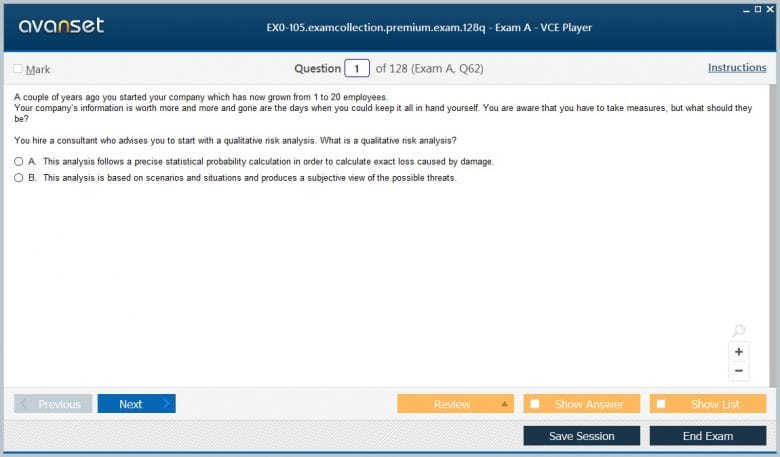
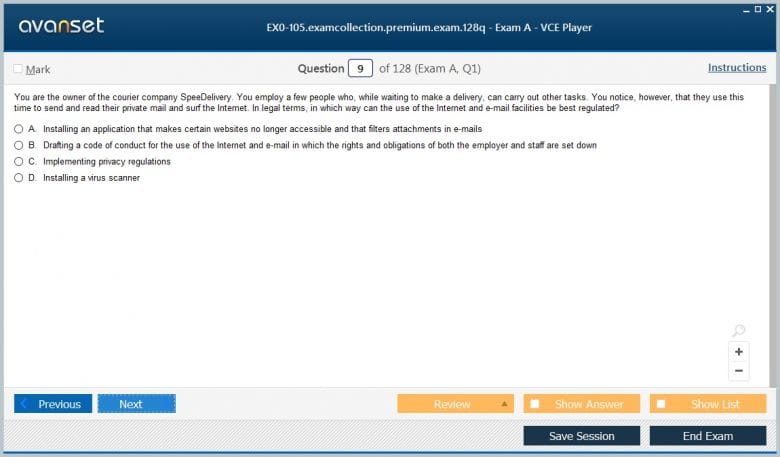
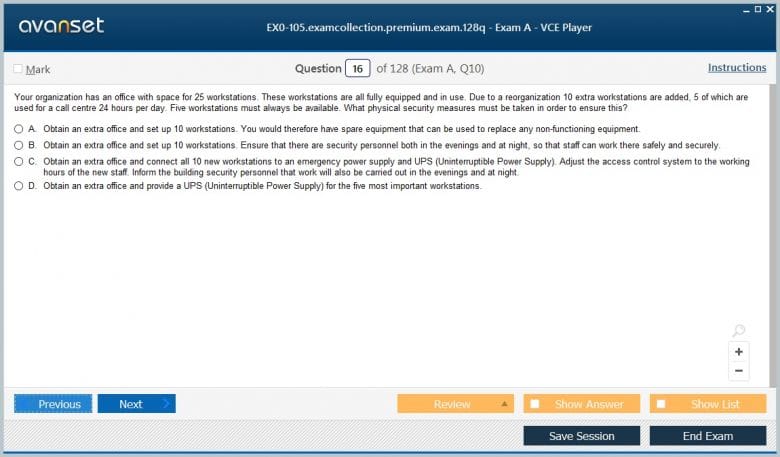
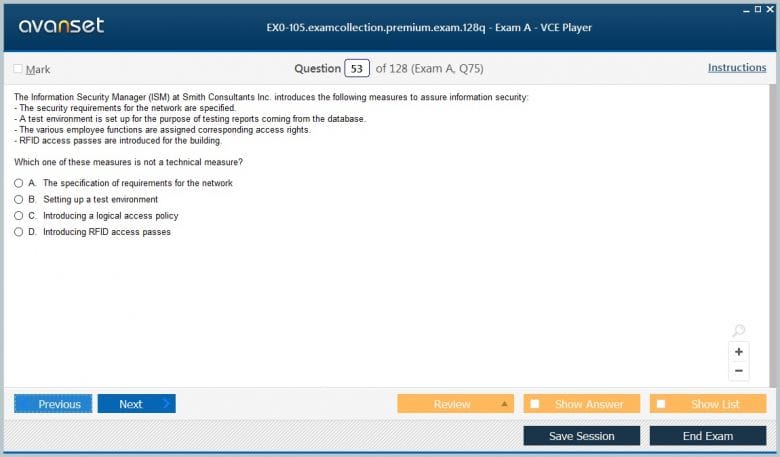
Exin EX0-105 Practice Test Questions in VCE Format
| File | Votes | Size | Date |
|---|---|---|---|
File Exin.Pass4sureexam.EX0-105.v2026-10-02.by.Emily.74q.vce |
Votes 4 |
Size 90.56 KB |
Date Oct 05, 2026 |
File Exin.Actualtests.EX0-105.v2014-12-16.by.Shepherd.128q.vce |
Votes 3 |
Size 191.09 KB |
Date Dec 16, 2014 |
File Exin.Exactquestions.EX0-105.v2014-08-18.by.LAURA.128q.vce |
Votes 28 |
Size 172.2 KB |
Date Aug 18, 2014 |
File EXIN.Testking.EX0-105.v2013-09-17.by.Naz.79q.vce |
Votes 8 |
Size 83.73 KB |
Date Sep 18, 2013 |
File EXIN.ActualTests.EX0-105.v2012-09-15.by.getitcert.79q.vce |
Votes 1 |
Size 62.11 KB |
Date Sep 17, 2012 |
File EXIN.Braindump.EX0-105.v3.0.by.ISO1V5.360q.vce |
Votes 1 |
Size 362.34 KB |
Date Mar 16, 2010 |
Archived VCE files
| File | Votes | Size | Date |
|---|---|---|---|
File EXIN.ActualTests.EX0-105.v2011-12-29.by.Guru.79q.vce |
Votes 3 |
Size 134.84 KB |
Date Dec 29, 2011 |
File EXIN.TestInside.EX0-105.v2011-11-09.by.Merin.89q.vce |
Votes 1 |
Size 56.61 KB |
Date Nov 09, 2011 |
File Exin.SelfTestEngine.EX0-105.v2011-04-15.by.meline.85q.vce |
Votes 1 |
Size 53.27 KB |
Date Apr 17, 2011 |
File EXIN.ActualTests.EX0-105.v2010-07-02.by.jiovalon.79q.vce |
Votes 2 |
Size 64.73 KB |
Date Aug 15, 2010 |
Exin EX0-105 Practice Test Questions, Exam Dumps
Exin EX0-105 (Information Security Foundation based on ISO/IEC 27002) exam dumps vce, practice test questions, study guide & video training course to study and pass quickly and easily. Exin EX0-105 Information Security Foundation based on ISO/IEC 27002 exam dumps & practice test questions and answers. You need avanset vce exam simulator in order to study the Exin EX0-105 certification exam dumps & Exin EX0-105 practice test questions in vce format.
EX0-105 is a legacy EXIN code for Information Security Foundation based on ISO/IEC 27002. The historical title reflects an earlier edition of EXIN’s security program. EXIN’s current foundation credential is Information Security Foundation based on ISO/IEC 27001, and its official materials have been updated to the current ISO/IEC 27001 framework while still drawing on ISO/IEC 27002 for control guidance. Candidates should not assume the old code represents the current live examination.
The durable subject is broader than any one standard revision: organizations need to protect valuable information against inappropriate disclosure, unauthorized or accidental alteration, and loss of availability. A foundation candidate should be able to recognize assets, threats, vulnerabilities, risks, controls, legal obligations, and organizational responsibilities, then explain how they fit together in a management system. That conceptual structure makes old EX0-105 material understandable without freezing security practice in the year the code was issued.
Information security begins by identifying what information supports business processes, decisions, customer relationships, legal duties, intellectual property, and operational continuity. Information can exist in databases, documents, email, source code, backups, conversations, paper records, cloud platforms, removable media, and the knowledge held by employees. Protecting only servers misses the real asset because the same information moves through multiple people, devices, systems, and suppliers.
Classification helps match protection to business value and sensitivity. A public marketing document does not need the same controls as payroll data, authentication secrets, merger plans, or patient information. Classification should therefore influence access, encryption, handling, retention, transmission, backup, and destruction. The goal is proportionality: enough protection to address real risk without making normal work so difficult that users create unsafe workarounds.
Confidentiality limits information to authorized access, integrity protects accuracy and completeness, and availability ensures information and services are accessible when required. The three properties are often taught as the CIA triad, but real decisions require trade-offs. Strong confidentiality controls can reduce usability; extreme availability may be expensive; integrity checks can add latency. Security management sets requirements according to the consequences of failure rather than maximizing every property equally.
Authenticity, accountability, privacy, and non-repudiation can also matter depending on the process. A financial transaction may need evidence of who approved it, while a customer portal needs assurance that users and servers are genuine. Foundation study should connect these properties to business scenarios. That approach is more useful than memorizing definitions because it shows why different information assets require different combinations of controls.
A threat is a potential cause of an unwanted incident; a vulnerability is a weakness that can be exploited or exposed; risk describes the effect of uncertainty on objectives. Malware, fraud, fire, human error, supplier failure, theft, flooding, misconfiguration, and unauthorized access are different threat sources, but the organization’s risk depends on what is exposed, how likely an event is, and what the consequences would be.
Risk assessment is therefore contextual. An unpatched service isolated in a test network may present a different risk from the same service exposed to the internet and processing regulated data. Mature assessments consider assets, threat capability, vulnerability, existing controls, likelihood, and impact. They also record assumptions because uncertainty changes. Security should be revisited when technology, business use, attackers, dependencies, or legal requirements change.
After risk is assessed, management decides how to treat it. Common options include modifying risk through controls, avoiding the risky activity, sharing or transferring part of the exposure, or knowingly retaining risk within agreed criteria. No control is free: technical measures require implementation and maintenance, procedural controls consume staff time, and restrictions can affect customer experience or productivity. The selected treatment should make sense relative to risk appetite and value.
ISO/IEC 27001 formalizes risk-based selection and operation of an information security management system. ISO/IEC 27002 provides detailed control guidance that helps organizations implement appropriate measures. The Information Security Management Professional path extends this management perspective beyond Foundation level. EX0-105 candidates should understand that a control catalog supports judgment; it does not eliminate the need to understand context.
Controls are often grouped as organizational, people-related, physical, and technological measures. Policies establish expectations, training influences behavior, background screening may reduce personnel risk, access controls limit privileges, encryption protects data, logging supports detection and accountability, and physical safeguards protect facilities and equipment. Defense in depth combines layers so one failure does not automatically expose the asset.
Preventive controls aim to reduce the chance of an incident, detective controls reveal events or abnormal behavior, and corrective controls help restore a secure state. A single measure can contribute to several purposes depending on how it is used. Backups, for example, support recovery from accidental deletion and ransomware but only if they are protected, tested, and recoverable. Foundation candidates should evaluate control purpose rather than relying on labels alone.
A security policy explains what the organization expects and why. Supporting standards, procedures, and guidelines add progressively more detail. Effective policies are approved, communicated, reviewed, and connected to accountability; they do not merely exist for auditors. The cybersecurity policy process is useful because it connects risk decisions to operational instructions that staff can actually follow.
Policy also creates a reference point for exceptions. If a business need requires deviation, the organization can assess the resulting risk, define compensating controls, approve the exception at the right level, and review it later. Without a baseline, exceptions become invisible. Foundation-level security management therefore includes governance mechanisms that make intentional decisions distinguishable from unmanaged behavior.
Incident management depends on defined reporting channels, triage criteria, roles, evidence handling, communication plans, escalation paths, and recovery procedures. Employees need to know what suspicious activity looks like and where to report it. Technical teams need logging and monitoring that can reconstruct important events. Management needs thresholds for involving legal, privacy, communications, insurers, regulators, or external specialists.
Recovery should be coordinated with business continuity so that restoring service does not accidentally destroy forensic evidence or reintroduce the same compromise. Lessons learned are equally important. An incident can reveal weak access design, poor supplier controls, missing training, inadequate monitoring, or unrealistic recovery objectives. The purpose of post-incident review is to improve the system rather than simply identify an individual to blame.
Organizations rarely choose security controls in a legal vacuum. Privacy legislation, sector regulations, contracts, intellectual-property rules, records requirements, employment law, and customer obligations can determine how information is collected, processed, retained, transferred, disclosed, and destroyed. A control that is technically effective may still be unsuitable if it violates privacy or evidence rules in a particular jurisdiction.
Foundation study should therefore distinguish risk management from compliance. Compliance establishes obligations that must be met, while risk management considers uncertainty to objectives. The two overlap but are not identical. Passing an audit does not prove that every material risk is controlled, and a risk-based control program still needs to satisfy applicable law. The NIST Cybersecurity Framework objectives provide another example of organizing security outcomes around risk and resilience.
EXIN’s current Information Security Foundation is explicitly aligned with ISO/IEC 27001 and uses updated literature that also references ISO/IEC 27002. That means an EX0-105 archive can help with durable fundamentals, but it should not determine current terminology, control numbering, or exam expectations. Current candidates should use the official preparation guide and current edition of the required reading rather than rely on legacy ISO/IEC 27002-only wording.
The best transition strategy is to keep the conceptual chain intact: identify valuable information, understand threats and vulnerabilities, assess risk, select and operate controls, establish governance, comply with obligations, monitor performance, and improve. Those relationships remain useful even as standards are revised. The EXIN certifications give the provider context, while the current ISFS certification should guide for anyone preparing for a live examination today.
Asset ownership is another foundation concept that prevents security from becoming solely an IT responsibility. The business owner of information is best placed to explain its value, sensitivity, required availability, retention needs, and acceptable use. Technology teams can implement encryption, access control, backup, monitoring, and platform safeguards, but they need business requirements to know what level of protection is appropriate. Clear ownership also gives risk acceptance a legitimate decision maker rather than leaving residual risk with the technician who discovered it.
Access management illustrates the relationship between policy and control. Identification establishes who or what is requesting access, authentication provides evidence of identity, authorization determines permitted actions, and periodic review checks whether those permissions remain justified. Least privilege reduces unnecessary exposure, while segregation of duties can prevent a single person from completing a sensitive transaction without independent control. When employees change roles or leave, timely removal of access is just as important as secure onboarding.
Supplier and cloud relationships add another layer because responsibility can be shared without being transferred completely. Contracts should define security expectations, incident notification, data location, access, continuity, subcontracting, assurance evidence, and exit arrangements where relevant. Organizations still need to understand what the provider secures and what the customer must configure. That principle helps candidates connect ISO-style governance with modern outsourced services: buying a service changes the control environment, but it does not erase accountability for the information being processed.
Go to testing centre with ease on our mind when you use Exin EX0-105 vce exam dumps, practice test questions and answers. Exin EX0-105 Information Security Foundation based on ISO/IEC 27002 certification practice test questions and answers, study guide, exam dumps and video training course in vce format to help you study with ease. Prepare with confidence and study using Exin EX0-105 exam dumps & practice test questions and answers vce from ExamCollection.
Purchase Individually
Site Search:

SPECIAL OFFER: GET 10% OFF

Pass your Exam with ExamCollection's PREMIUM files!
SPECIAL OFFER: GET 10% OFF
Use Discount Code:
MIN10OFF
A confirmation link was sent to your e-mail.
Please check your mailbox for a message from support@examcollection.com and follow the directions.

Download Free Demo of VCE Exam Simulator
Experience Avanset VCE Exam Simulator for yourself.
Simply submit your e-mail address below to get started with our interactive software demo of your free trial.
Any update on ISO 27002 Exam, has anyone taken the exam recently?