


Premium File
179 Q&A
$76.99$69.99
EMC E20-594 Exam Questions & Answers, Accurate & Verified By IT Experts
Instant Download, Free Fast Updates, 99.6% Pass Rate
179 Questions & Answers
Last Update: Sep 24, 2026
$69.99
EMC E20-594 Exam Screenshots
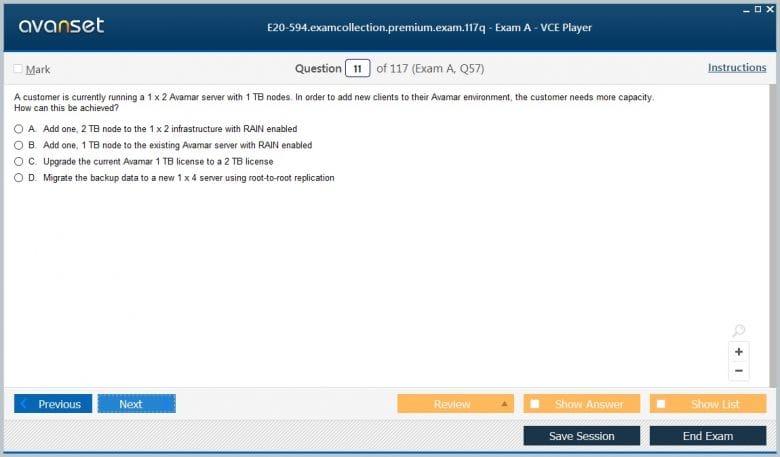
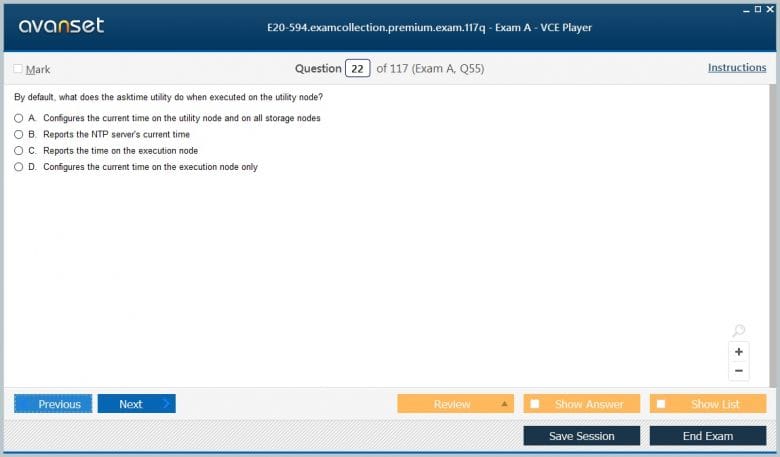
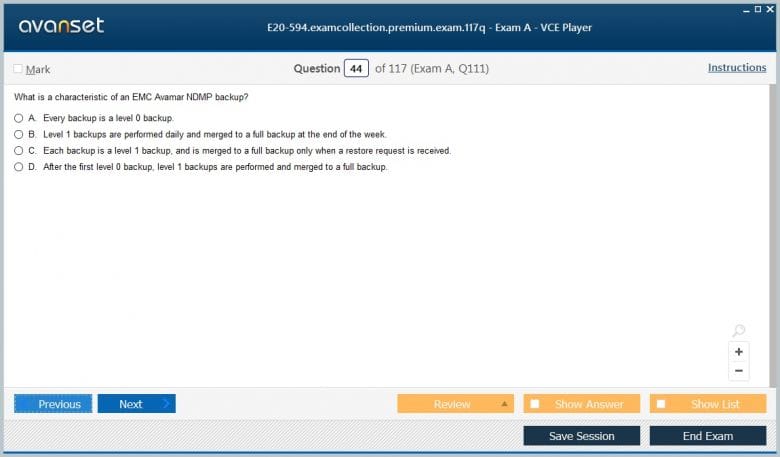
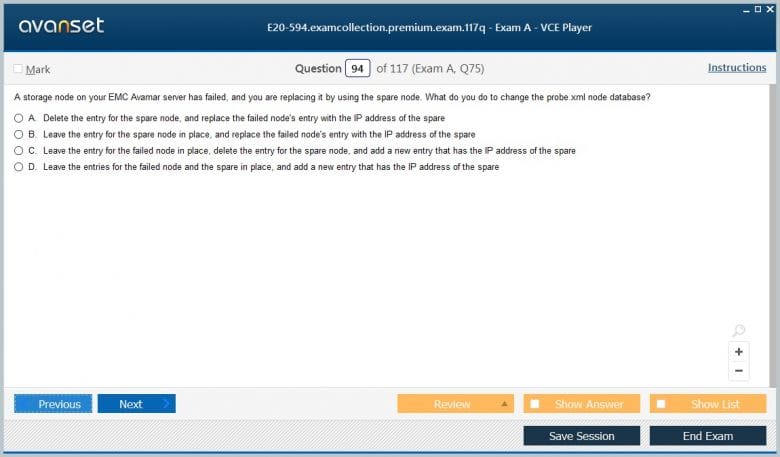
EMC E20-594 Practice Test Questions in VCE Format
| File | Votes | Size | Date |
|---|---|---|---|
File EMC.Selftestengine.E20-594.v2026-07-14.by.Tony.89q.vce |
Votes 2 |
Size 256.25 KB |
Date Jul 16, 2026 |
File EMC.Certexpert.E20-594.v2013-01-28.by.yo.113q.vce |
Votes 8 |
Size 49.97 KB |
Date Jan 28, 2013 |
File EMC.ActualTests.E20-594.v2011-11-24.by.lillbastid.113q.vce |
Votes 3 |
Size 46.95 KB |
Date Nov 27, 2011 |
EMC E20-594 Practice Test Questions, Exam Dumps
EMC E20-594 (Backup and Recovery - Avamar Specialist for Implementation Engineers) exam dumps vce, practice test questions, study guide & video training course to study and pass quickly and easily. EMC E20-594 Backup and Recovery - Avamar Specialist for Implementation Engineers exam dumps & practice test questions and answers. You need avanset vce exam simulator in order to study the EMC E20-594 certification exam dumps & EMC E20-594 practice test questions in vce format.
E20-594 was Dell Technologies’ Specialist - Implementation Engineer, Avamar exam. Dell’s 2022 blueprint described a 90-minute assessment centered on Avamar concepts, implementation, installation and maintenance, and administration across Avamar software, Avamar Virtual Edition, Data Store systems, Data Domain integration, NDMP, replication, Cloud Tier, and operational tooling. It was designed for engineers who had to take an Avamar design from prerequisites through a working, supportable deployment rather than simply operate an already stable system.
Dell retired E20-594 on February 2, 2024 and moved the deployment path to Dell Avamar Deploy 2023, D-AV-DY-23. Dell later retired D-AV-DY-23 on August 28, 2026 and states that no replacement exam is planned. E20-594 is therefore historical, but its subject matter still maps closely to the work of implementation engineers who plan nodes, networks, storage integration, backup targets, replication, and handoff procedures. EMC certifications provide useful context for where this exam sat in the older Proven Professional program.
An Avamar deployment should begin with business requirements rather than an appliance checklist. The implementation engineer needs to know which workloads are protected, how often recovery points are required, how long backups must be retained, where copies must live, and how quickly restores need to complete. Those decisions affect capacity, node count, replication, Data Domain use, network placement, and whether specific application agents or NDMP integrations are needed. A technically successful installation can still be a poor design if it cannot meet the required recovery objectives.
Workload discovery also prevents late surprises. Virtual machines, databases, file systems, NAS devices, remote offices, and large unstructured repositories behave differently. Daily change rate often matters more than raw source capacity because Avamar relies on deduplication and incremental processing. Engineers should document client counts, dataset sizes, peak backup windows, expected growth, and exceptional jobs such as full database maintenance or large ingest events. That baseline turns sizing from guesswork into an explicit design assumption that can be validated after deployment.
Avamar combines client-side deduplication, metadata management, storage nodes or virtual appliances, and optional Data Domain integration. The engineer should understand how clients identify changed data, how unique segments are transferred, how metadata is protected, and how the Avamar server coordinates backup and restore activity. That data path determines which network links become important and where latency, packet loss, firewall rules, DNS, or time synchronization can disrupt operations.
Network design should identify client subnets, management access, replication paths, Data Domain communication, and any isolated backup networks. Redundancy has to be real rather than cosmetic: two logical interfaces that share the same switch or failure domain do not provide the same resilience as genuinely diverse paths. When teams need a broader refresher on recovery architecture, backup and disaster-recovery models help place Avamar inside a larger continuity strategy.
Implementation planning should also distinguish the backup path from the restore path. A design can meet a nightly protection window and still disappoint during a major recovery if the network, target storage, or client concurrency cannot return data at the required rate. For an Avamar implementation, that means estimating restore demand, identifying the systems that would be recovered first, and testing the route from protected data back to production. Recovery performance is a service characteristic, not an accidental by-product of successful backups.
Avamar Virtual Edition brings the appliance into a hypervisor environment, so the implementation plan must include virtual CPU, memory, datastore capacity, network placement, reservation or contention risk, and the operational process for protecting the virtual infrastructure that hosts the backup platform itself. Engineers should confirm that infrastructure administrators understand which resources are critical and which maintenance actions can interrupt backup services.
Avamar Data Store adds dedicated hardware installation and lifecycle considerations. The older E20-594 blueprint explicitly covered Data Store hardware, node addition and replacement, and connection to the customer network. That means implementation skill extended beyond application configuration into rack, power, cabling, hardware health, and node-level maintenance. A clean build record should show physical placement, serials, network addresses, software versions, and any deviations from the approved design.
Avamar can coordinate backups whose data is stored on Data Domain while Avamar retains policy and metadata responsibilities. Engineers therefore need to understand which workloads are appropriate for Data Domain, how connectivity and credentials are configured, and how capacity, retention, and replication responsibilities are divided between the two platforms. Treating the combination as one black box makes troubleshooting harder because an Avamar policy can be healthy while the downstream storage path is constrained or unavailable.
Implementation testing should include both backup and restore. A short successful backup only proves that one direction of the workflow works. Restore tests should verify file recovery, application-aware recovery where applicable, permissions, alternate-location restore, and the performance expected during a real incident. The related E20-598 Avamar administration exam focused more heavily on day-two operation, which is exactly why implementation handoff should include evidence that administrators can recover data without the deployment engineer present.
Replication is not simply a second checkbox copy. The engineer must identify the source and target systems, bandwidth expectations, schedule, authentication, retention behavior, and what happens when the replication link is interrupted. The target should be located in a failure domain that actually improves resilience. Replicating to equipment that shares the same room, power, network edge, or administrative blast radius may provide less protection than the label “off-site” suggests.
Cloud Tier introduces another storage layer and therefore another recovery dependency. Policies should make it clear which backup data can age to cloud storage, how retrieval latency affects recovery expectations, and what credentials or network paths are required. If a business expects a particular recovery time, the engineer should test a restore that follows the same storage path rather than assuming the fastest local restore represents every retained copy.
NAS protection through NDMP has different assumptions from a standard filesystem client. Engineers should confirm supported device behavior, backup interfaces, target storage, catalog or metadata handling, and restore procedures. Large NAS environments also make change rate and directory structure important because millions of small files can behave differently from a smaller number of large objects. Testing should use a representative dataset rather than an empty demonstration share.
Database and application workloads bring their own consistency requirements. A backup may be crash-consistent yet fail an application recovery expectation that requires logs, quiescing, or coordination with native tools. Implementation documentation should therefore describe which protection method is used for each major workload and who owns the application-side steps. Backup teams should not discover during an outage that a “successful” job omitted a required log or recovery sequence.
Dell’s blueprint included monitoring, daily maintenance, capacity management, and the Avamar Fitness Analyzer because a deployment is not complete until the environment can be operated. Engineers should define which dashboards and alerts matter, where notifications are sent, who receives them, and what normal capacity growth looks like. Thresholds should be tied to action so warnings do not become background noise.
Maintenance windows also need ownership. The team should know how Avamar housekeeping, garbage collection, checkpoints, validation, upgrades, and Data Domain maintenance interact with backup schedules. If the platform is consistently busy during its own maintenance window, performance and capacity problems can accumulate slowly. Baseline reports captured immediately after implementation provide a useful reference when behavior changes months later.
Capacity should be discussed in terms of usable operating headroom rather than a single headline number. Deduplication efficiency varies with workload type, change rate, retention, and the amount of common data across protected systems. A design therefore needs assumptions that can be revisited after real backup cycles have accumulated. Trending daily change, protected front-end data, utilization, and maintenance behavior gives administrators an early warning that policy growth is overtaking the original sizing model.
A strong handoff includes architecture diagrams, network and firewall requirements, protected workload inventory, retention and replication policies, capacity assumptions, administrative accounts, monitoring configuration, support contacts, and recovery test results. It should also include known limitations and decisions that were made during implementation. Without that record, day-two administrators inherit a system but not the reasoning behind it.
An acceptance test should be written before installation so success is measurable. Verify client registration, scheduled backups, Data Domain or Cloud Tier paths, replication, alerts, and at least one meaningful recovery for each important workload class. The broader disaster-recovery design principles reinforce the same lesson: recovery capability exists only when the process is tested, owned, and documented.
A strong handoff includes evidence that operators can identify a failed backup, trace the reason, rerun protection safely, locate recovery points, and restore to an alternate location when production recovery would be risky. It should also document dependencies such as DNS, time synchronization, authentication, Data Domain connectivity, and application-specific credentials. These details are easy to overlook during installation, yet they are often the first things that complicate recovery during an outage. Operational documentation is therefore part of the implementation, not paperwork added after it.
Because E20-594 is retired, candidates should not treat old scheduling or exam-version details as current certification advice. The practical value is in the implementation sequence it represented: gather requirements, design architecture, install the platform, integrate storage and applications, configure policies, test recovery, establish monitoring, and hand the service to operations. That sequence remains relevant even as Dell has moved to the Avamar Deploy achievement model.
A useful lab exercise is to build a small Avamar-style deployment plan even when access to full enterprise hardware is limited. Document the protected workloads, expected change rate, network flows, retention, replication target, restore procedure, capacity threshold, and acceptance tests. The quality of that plan reveals whether the engineer understands how the pieces interact. The retired exam was ultimately about turning backup technology into a dependable recovery service, not memorizing product screens.
Go to testing centre with ease on our mind when you use EMC E20-594 vce exam dumps, practice test questions and answers. EMC E20-594 Backup and Recovery - Avamar Specialist for Implementation Engineers certification practice test questions and answers, study guide, exam dumps and video training course in vce format to help you study with ease. Prepare with confidence and study using EMC E20-594 exam dumps & practice test questions and answers vce from ExamCollection.
Purchase Individually
Site Search:

SPECIAL OFFER: GET 10% OFF

Pass your Exam with ExamCollection's PREMIUM files!
SPECIAL OFFER: GET 10% OFF
Use Discount Code:
MIN10OFF
A confirmation link was sent to your e-mail.
Please check your mailbox for a message from support@examcollection.com and follow the directions.

Download Free Demo of VCE Exam Simulator
Experience Avanset VCE Exam Simulator for yourself.
Simply submit your e-mail address below to get started with our interactive software demo of your free trial.