



Premium File
72 Q&A
$76.99$69.99
iSAQB CPSA-F Exam Questions & Answers, Accurate & Verified By IT Experts
Instant Download, Free Fast Updates, 99.6% Pass Rate

CPSA-F Premium File: 72 Questions & Answers
Last Update: Sep 15, 2026
CPSA-F PDF Study Guide: 218 Pages
$74.99
iSAQB CPSA-F Exam Screenshots
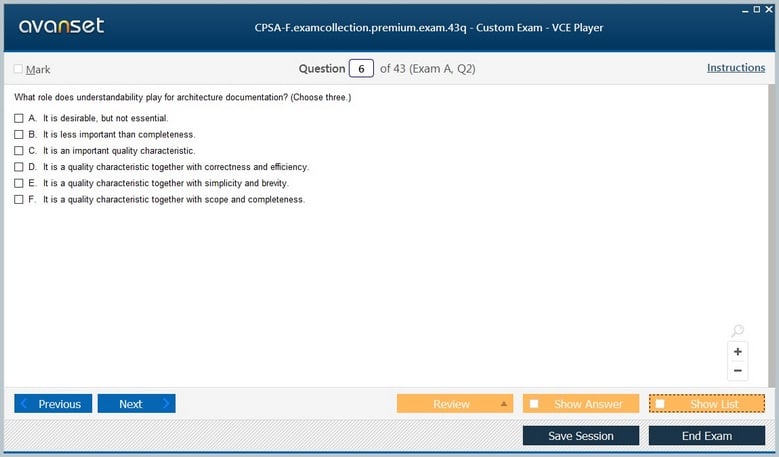
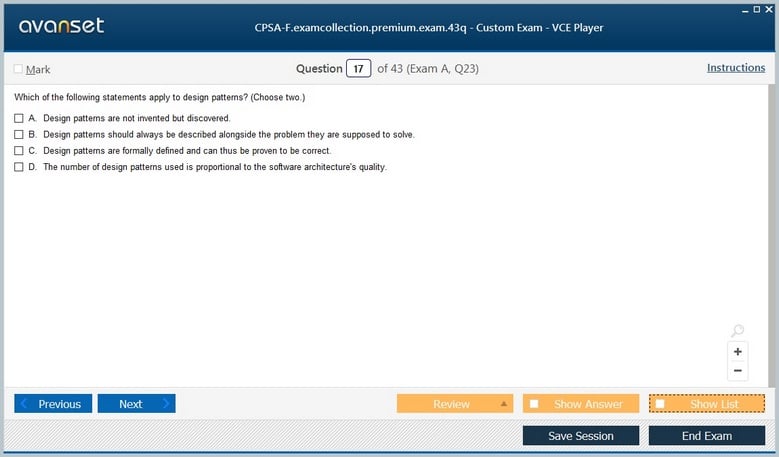
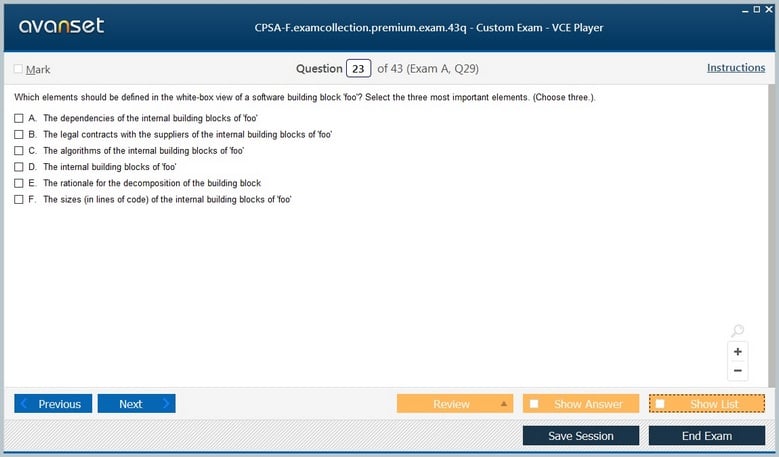
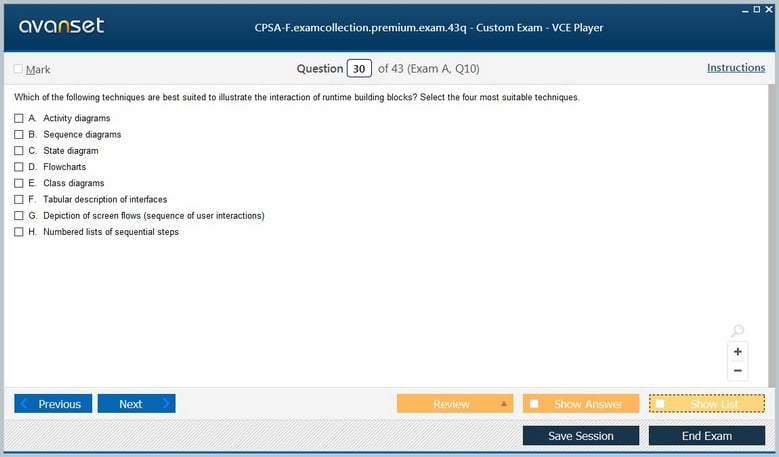
iSAQB CPSA-F Practice Test Questions in VCE Format
| File | Votes | Size | Date |
|---|---|---|---|
File iSAQB.vceplayer.CPSA-F.v2026-09-18.by.elizabeth.23q.vce |
Votes 1 |
Size 35.57 KB |
Date Sep 18, 2026 |
File iSAQB.Test-king.CPSA-F.v2019-12-27.by.Steven.18q.vce |
Votes 3 |
Size 163.56 KB |
Date Jan 01, 2020 |
iSAQB CPSA-F Practice Test Questions, Exam Dumps
iSAQB CPSA-F (Certified Professional for Software Architecture - Foundation Level) exam dumps vce, practice test questions, study guide & video training course to study and pass quickly and easily. iSAQB CPSA-F Certified Professional for Software Architecture - Foundation Level exam dumps & practice test questions and answers. You need avanset vce exam simulator in order to study the iSAQB CPSA-F certification exam dumps & iSAQB CPSA-F practice test questions in vce format.
CPSA-F is the Foundation Level of the iSAQB Certified Professional for Software Architecture program. It is current, and the official curriculum version in force in 2026 is the 2025 curriculum that became mandatory in April 2025. The examination is a multiple-choice assessment administered by independent certification bodies; the official iSAQB material describes roughly 40 questions, about 75 minutes, and a 60% passing threshold, with exact question count varying because questions can carry different point values. Training is recommended but is not a prerequisite for sitting the exam.
The credential is aimed at developers, aspiring architects, system analysts, and other professionals who need a disciplined way to design, document, evaluate, and communicate software architecture. Candidates can also use the broader iSAQB certification inventory to understand how Foundation Level leads toward Advanced Level learning. CPSA-F is valuable because it makes architecture concrete: requirements and constraints shape decisions, structures make those decisions visible, quality attributes create trade-offs, and documentation allows other people to understand why the system was designed as it was.
Software architecture describes the important structures of a system, the elements in those structures, the relationships between them, and the principles that guide design and evolution. The word “important” matters. Architecture is not every class or function. It focuses on decisions that are expensive to change, have broad consequences, or are necessary to understand the system. Examples include deployment boundaries, data ownership, communication patterns, technology constraints, and the way responsibilities are divided across components.
Architectural decisions are contextual rather than universally correct. A small internal application may benefit from a simple modular monolith; a system with independent scaling and deployment needs may justify distributed services. CPSA-F expects candidates to reason from requirements and constraints rather than from fashion. An architecture is good when it supports the relevant goals within the actual environment, not when it contains the newest pattern names.
Architecture decision records are a practical way to preserve why an important choice was made. A useful record identifies the context, the decision, meaningful alternatives, and expected consequences. The value is not administrative completeness; it is helping future developers understand whether a decision still fits when conditions change. Without rationale, teams may preserve an outdated constraint because they assume it was fundamental, or remove a safeguard without understanding what problem it originally solved.
Functional requirements describe what the system must do, while quality requirements describe characteristics such as performance, security, availability, modifiability, usability, and maintainability. Constraints limit the choices available: mandated platforms, budgets, deadlines, regulations, existing systems, staff skills, and organizational standards can all shape architecture. Ignoring a constraint does not make it disappear; it merely produces a design that cannot be implemented or operated as intended.
Quality requirements should be specific enough to evaluate. “The system must be fast” is too vague. A scenario might specify that a customer search returns within a target time under a stated load. Architecture work translates those scenarios into design decisions and later checks whether the result meets them. Candidates should become comfortable asking what stimulus occurs, which part of the system responds, under what environment, and how success will be measured.
Large systems become understandable when responsibilities are separated into modules, components, layers, services, or other building blocks with clear interfaces. Good decomposition seeks high cohesion within a unit and manageable coupling between units. If every component knows internal details of every other component, change becomes risky. If responsibilities are split too finely, coordination overhead can become worse than the original complexity. Architecture is therefore a balancing exercise.
Information hiding is a central principle because it protects the rest of the system from internal change. An interface should expose what consumers need without leaking unnecessary implementation detail. Dependencies should point in directions that make evolution possible. Cycles can make testing, deployment, and reasoning harder. Candidates do not need one universal decomposition recipe; they need to understand why boundaries exist and how those boundaries influence change, ownership, and quality.
Interfaces should also make failure behavior explicit. A component contract that documents only successful calls leaves unanswered questions about timeouts, retries, partial failure, idempotency, and invalid input. Those details can dominate architecture in distributed systems. Candidates should think about how a boundary behaves when dependencies are slow or unavailable, because resilience and coupling are often revealed more clearly by failure paths than by normal operation.
No single diagram explains an entire software system. A building-block view can show static decomposition; a runtime view can show how elements interact during important scenarios; a deployment view can show processes, containers, nodes, networks, and infrastructure. Cross-cutting concepts can document decisions such as persistence, error handling, security, logging, internationalization, and user-interface conventions that apply across many components.
UML can be useful, but CPSA-F is not fundamentally an exercise in memorizing notation. Class, component, package, and sequence diagrams are tools for communicating structure or behavior. The model should be selected for the question the audience needs answered. A developer may need interface and runtime detail; an operations team may need deployment dependencies; a product stakeholder may need a high-level context. Good architecture documentation is audience-aware and intentionally incomplete rather than an enormous model nobody can maintain.
Architecture decisions often improve one quality while creating cost elsewhere. Redundancy can increase availability but also cost and operational complexity. Strong consistency can simplify reasoning while reducing availability or throughput in some distributed scenarios. Additional abstraction can improve changeability but add indirection and performance overhead. Security controls can reduce risk while increasing friction. Architects should make these trade-offs visible so stakeholders choose deliberately rather than discover them after implementation.
Quality scenarios help because they turn broad goals into testable situations. Candidates should practice moving from a desired property to design tactics and then to consequences. Caching can reduce latency but raises consistency questions. Asynchronous messaging can decouple processing but complicates ordering and error handling. Replication can improve resilience but introduces synchronization. The exam tests architectural thinking: what effect does a decision have on the qualities that matter in this particular system?
Architects can use quality scenarios to compare alternatives before committing to implementation. For maintainability, a scenario may ask how much effort is required to add a new payment provider. For availability, it may ask how the system behaves when a database node fails during peak traffic. For security, it may ask how unauthorized access to one component is prevented from exposing unrelated data. Concrete scenarios turn vague quality goals into design questions that teams can test and discuss.
Architecture can be evaluated through reviews, scenario walkthroughs, prototypes, proof-of-concept experiments, performance tests, threat modeling, and other forms of evidence. The technique depends on the uncertainty. If a team is unsure whether a technology can meet latency requirements, a focused prototype is more useful than a long document. If the risk is misunderstanding across teams, a structured review may expose conflicting assumptions. Early evaluation is cheaper than discovering a fundamental problem after deployment.
Risks and technical debt should be documented rather than hidden. A deliberate shortcut can be acceptable when stakeholders understand the consequence and have a plan to revisit it. Undocumented debt becomes dangerous because future teams may mistake a temporary compromise for an intentional long-term design. CPSA-F preparation should therefore include the habit of recording decisions, alternatives, rationale, and known consequences—not merely drawing a final-state diagram.
Architecture reviews are most useful when they focus on a few consequential questions instead of checking whether every document template is complete. Reviewers can ask which quality attribute is hardest to achieve, which dependency is least understood, which decision is most expensive to reverse, and which failure mode has not been tested. Those questions expose architectural risk and encourage evidence before teams invest heavily in one direction.
Software architecture is not finished when development starts. New requirements, incidents, scale, security expectations, team structure, and platform changes can make earlier decisions less suitable. Architecture work includes recognizing when to preserve a stable structure and when to refactor it. Continuous delivery can increase the frequency of change, which makes automated tests, observability, compatibility practices, and clear ownership more important to architectural sustainability.
Candidates should also understand the relationship between architecture and organization. Team boundaries influence communication and often influence system boundaries; unclear ownership can produce unclear interfaces. A design that is theoretically elegant but impossible for the organization to build and operate is not successful architecture. The most useful way to prepare for CPSA-F is to connect each curriculum concept to a system you know, explain the decision in plain language, and identify what evidence would tell you whether that decision is working.
Evolution also depends on managing architectural fitness. Automated dependency checks, performance budgets, contract tests, security policies, and build rules can detect when implementation drifts away from intended structure. Not every architectural rule can be automated, but the more important constraints should have observable evidence where practical. That reduces reliance on periodic diagram reviews and helps teams preserve architecture while delivering frequent change.
Go to testing centre with ease on our mind when you use iSAQB CPSA-F vce exam dumps, practice test questions and answers. iSAQB CPSA-F Certified Professional for Software Architecture - Foundation Level certification practice test questions and answers, study guide, exam dumps and video training course in vce format to help you study with ease. Prepare with confidence and study using iSAQB CPSA-F exam dumps & practice test questions and answers vce from ExamCollection.
Purchase Individually

Top iSAQB Certification Exams
Site Search:

SPECIAL OFFER: GET 10% OFF

Pass your Exam with ExamCollection's PREMIUM files!
SPECIAL OFFER: GET 10% OFF
Use Discount Code:
MIN10OFF
A confirmation link was sent to your e-mail.
Please check your mailbox for a message from support@examcollection.com and follow the directions.

Download Free Demo of VCE Exam Simulator
Experience Avanset VCE Exam Simulator for yourself.
Simply submit your e-mail address below to get started with our interactive software demo of your free trial.