



Premium File
84 Q&A
$76.99$69.99
Blockchain CBBF Exam Questions & Answers, Accurate & Verified By IT Experts
Instant Download, Free Fast Updates, 99.6% Pass Rate
84 Questions & Answers
Last Update: Sep 05, 2026
$69.99
Blockchain CBBF Exam Screenshots
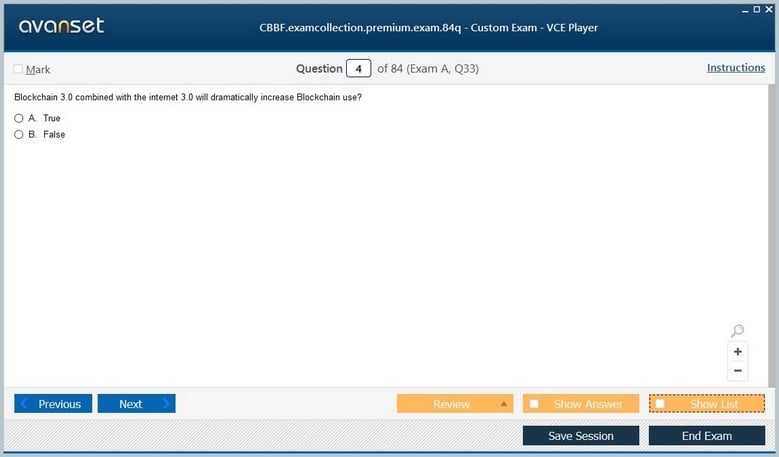
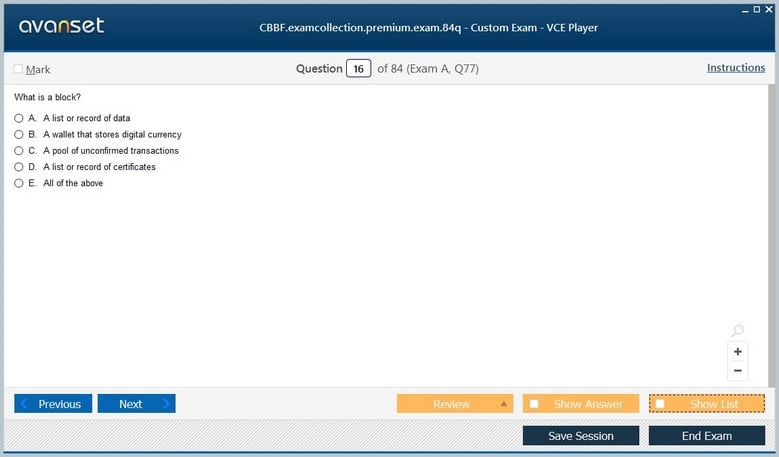
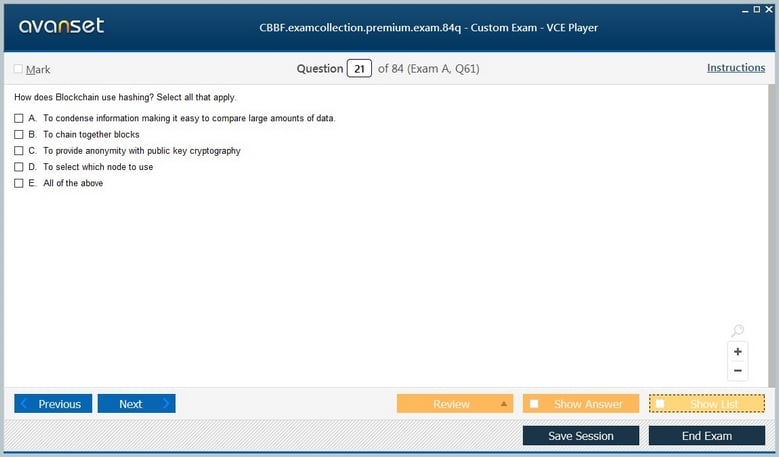
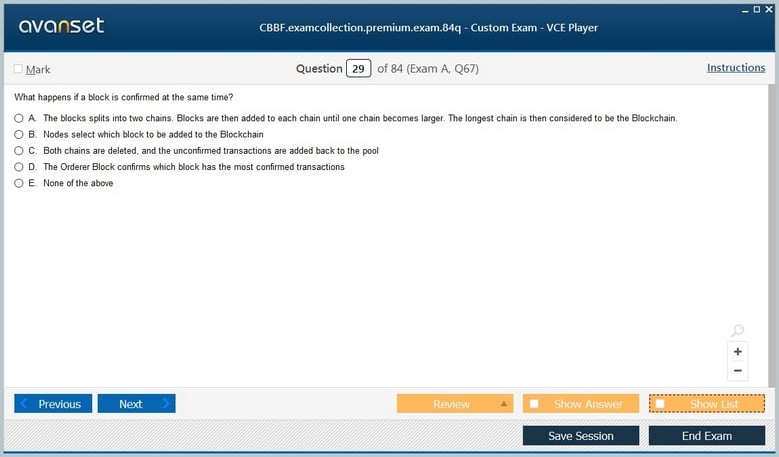
Blockchain CBBF Practice Test Questions in VCE Format
| File | Votes | Size | Date |
|---|---|---|---|
File Blockchain.Actualtests.CBBF.v2026-08-03.by.Andrew.43q.vce |
Votes 5 |
Size 41.95 KB |
Date Aug 05, 2026 |
File Blockchain.Braindumps.CBBF.v2019-07-31.by.Karen.34q.vce |
Votes 5 |
Size 35.22 KB |
Date Jul 31, 2019 |
File Blockchain.Test-king.CBBF.v2019-06-06.by.Elwell.33q.vce |
Votes 2 |
Size 36.31 KB |
Date Jun 09, 2019 |
Blockchain CBBF Practice Test Questions, Exam Dumps
Blockchain CBBF (Certified Blockchain Business Foundations) exam dumps vce, practice test questions, study guide & video training course to study and pass quickly and easily. Blockchain CBBF Certified Blockchain Business Foundations exam dumps & practice test questions and answers. You need avanset vce exam simulator in order to study the Blockchain CBBF certification exam dumps & Blockchain CBBF practice test questions in vce format.
Certified Blockchain Business Foundations (CBBF) is a current Blockchain Training Alliance certification aimed at non-technical business professionals. The provider’s current exam page lists 70 questions, a 70% passing score, 90 minutes, English delivery, and an online format. Its four published sections are General Blockchain Knowledge, Why Use Blockchain, How Blockchain Works, and Using Blockchain for Business.
The broader Blockchain certifications include technical and architecture paths as well. Certified Blockchain Developer - Ethereum (CBDE) moves into application implementation, while Certified Blockchain Solution Architect (CBSA) focuses more directly on solution selection and architecture. For readers comparing pathways, the editorial overview of blockchain technology certifications gives useful context beyond a single exam.
CBBF is not designed to turn a manager into a protocol engineer. Its value is decision literacy: understanding what a blockchain is, why an organization might or might not use one, how trust and consensus differ from a conventional centralized system, and which business requirements justify the additional complexity of distributed state.
A blockchain is a form of distributed ledger in which participants maintain an agreed history of transactions or state changes. The exact architecture varies by platform, but the core idea is that multiple parties can work from a common record without relying on one participant’s private database as the only source of truth. Cryptographic techniques help detect unauthorized modification and bind transactions to identities or keys.
For business professionals, the important point is not that data is “on many computers.” It is that governance and trust are expressed differently. A conventional database can be distributed too, but one organization usually controls the authoritative system. A blockchain becomes interesting when several parties need shared state, have reasons not to delegate full control to one another, and can agree on the rules for validating changes.
Blockchain projects fail when the technology is selected before the problem is defined. A strong candidate asks whether multiple organizations need to write or verify a shared record, whether reconciliation is costly, whether auditability matters, and whether participants have limited mutual trust. If one organization already owns the process and can provide a reliable database, a conventional architecture may be simpler, faster, and cheaper.
The decision should include costs that are easy to ignore during a pilot: integration, governance, identity, key management, privacy, data quality, node operations, upgrades, legal agreements, and exception handling. CBBF’s business orientation is valuable because it encourages managers to weigh those operational costs against the benefit of a shared ledger rather than treating decentralization as automatically superior.
Participants need a way to decide which proposed changes become part of the accepted ledger. Public networks and permissioned enterprise systems can use different consensus mechanisms because their threat models and participant identities differ. The business professional does not need to implement the algorithms, but should understand that consensus affects performance, fault tolerance, energy use, finality, and who can influence the network.
Those tradeoffs influence use-case fit. A network that tolerates anonymous participants may accept different performance characteristics from a consortium where every organization is known and contractually accountable. Asking “Who validates transactions, under what rules, and what happens when validators disagree?” is a better business question than asking whether a platform simply “has consensus.”
Blockchain is often described as immutable, but business decision-makers should use that word carefully. Historical records are designed to be difficult to alter without detection and agreement, yet real systems still have governance, software upgrades, key compromises, invalid data, and legal obligations. A ledger can preserve a bad input just as reliably as a good one if the business process does not validate data before submission.
This creates a critical design principle: blockchain does not eliminate the need for trusted data sources. If a physical asset, identity, shipment, or financial event is represented digitally, the process that connects the real-world fact to the ledger must be trustworthy. The technology can make subsequent history transparent; it cannot magically prove that the original statement was true.
Public blockchains allow broad participation and typically assume that participants do not know or trust one another. Permissioned systems restrict participation and can assign different roles to known organizations. Neither model is universally “more enterprise.” The right choice depends on who needs to read data, who can submit transactions, who validates them, and what governance or privacy requirements apply.
A business consortium may prefer permissioned membership because participants are identifiable and regulatory obligations are strict. A public application may value open access, existing network security, or composability with public assets and services. CBBF candidates should be able to connect network type to business requirements rather than repeating a generic private-versus-public preference.
A smart contract is program logic executed under the rules of a blockchain platform. It can automate state transitions, enforce conditions, or coordinate transfers when defined inputs occur. That can reduce manual reconciliation, but it also turns business rules into software that must be specified, tested, secured, upgraded, and governed. Ambiguous policy does not become clear simply because it is coded.
The relationship to developer certifications is useful here. CBBF learners need to understand what smart contracts mean to a business process, while CBDE goes into writing, testing, deploying, and securing Solidity contracts. That separation helps managers ask better questions of technical teams: which rules are on-chain, which remain off-chain, who can upgrade the contract, and how are exceptions or disputes handled?
Supply chains, asset provenance, multi-party settlement, digital identity, and shared registries are often proposed as blockchain use cases because several organizations need consistent state. The useful analysis is not the industry label but the friction being removed. How much reconciliation happens today? How many parties duplicate the same record? Where do disputes arise? What delays or fraud risks come from inconsistent versions of truth?
A good business case defines baseline metrics before the pilot: reconciliation time, manual touches, error rate, settlement time, dispute volume, audit effort, or capital tied up during delays. The project can then measure whether the blockchain design actually improves those numbers. Without a baseline, “successful pilot” can mean only that a demo ran, which says little about business value.
Blockchain introduces security and governance questions that differ from a conventional application. Private keys can authorize irreversible actions; public ledgers can expose transaction metadata; permissioned networks need membership and certificate governance; smart contracts can encode defects; and replicated data can complicate privacy or deletion requirements. The article on blockchain and information security is useful when considering how security properties and new attack surfaces coexist.
Business leaders should therefore involve legal, compliance, privacy, security, and operations teams early. The goal is not to make every stakeholder a blockchain engineer. It is to identify requirements that architecture must satisfy before investment becomes difficult to reverse. A technology designed to create durable shared records deserves especially careful decisions about what data enters those records in the first place.
The current exam structure is compact, but the published domains are broad. A strong study method moves repeatedly from concept to decision: define a blockchain property, explain why it might matter, describe how the mechanism works at a business level, and apply it to a realistic organizational scenario. That mirrors the provider’s progression from general knowledge through business use.
Candidates should be able to explain both the case for and the case against blockchain in a scenario. That balance is the mark of useful foundation knowledge. The strongest CBBF outcome is not enthusiasm for the technology; it is the ability to recognize when distributed trust, shared state, and auditable history justify blockchain—and when an ordinary system is the more responsible business choice.
Governance is also the mechanism by which a blockchain network changes over time. Participants need rules for onboarding and removing members, upgrading software, changing validation policy, handling compromised credentials, resolving disputes, and deciding which organization pays operational costs. A network can be technically distributed while its governance remains unclear. Business foundations knowledge should therefore include the question “Who is allowed to change the rules, and by what process?”
Interoperability deserves similar attention. A blockchain rarely replaces every existing system. It must exchange data with ERP, identity, payment, analytics, document, or regulatory systems, and those integrations can become the new points of centralization or failure. A well-designed business case accounts for the systems of record that remain off-chain and the controls that verify data moving between them.
Finally, adoption depends on incentives. Multiple organizations may agree that a shared ledger is technically attractive but still disagree about funding, data ownership, liability, competitive visibility, or who benefits most. A viable network gives each required participant a reason to join and remain. CBBF-level understanding is strongest when technical properties are connected to these organizational realities rather than discussed as if technology alone can create cooperation.
Exam preparation benefits from comparing several use cases that look similar on the surface but differ in trust structure. A single-company audit log, a multi-bank settlement network, and a public digital asset can all involve durable records, yet the appropriate architecture may be completely different. Practicing that comparison helps candidates avoid treating “needs an audit trail” as sufficient reason to use blockchain.
Go to testing centre with ease on our mind when you use Blockchain CBBF vce exam dumps, practice test questions and answers. Blockchain CBBF Certified Blockchain Business Foundations certification practice test questions and answers, study guide, exam dumps and video training course in vce format to help you study with ease. Prepare with confidence and study using Blockchain CBBF exam dumps & practice test questions and answers vce from ExamCollection.
Purchase Individually
Top Blockchain Certification Exams
Site Search:

SPECIAL OFFER: GET 10% OFF

Pass your Exam with ExamCollection's PREMIUM files!
SPECIAL OFFER: GET 10% OFF
Use Discount Code:
MIN10OFF
A confirmation link was sent to your e-mail.
Please check your mailbox for a message from support@examcollection.com and follow the directions.

Download Free Demo of VCE Exam Simulator
Experience Avanset VCE Exam Simulator for yourself.
Simply submit your e-mail address below to get started with our interactive software demo of your free trial.