



Premium File
128 Q&A
$76.99$69.99
IBM C9510-418 Exam Questions & Answers, Accurate & Verified By IT Experts
Instant Download, Free Fast Updates, 99.6% Pass Rate
128 Questions & Answers
Last Update: Sep 27, 2026
$69.99
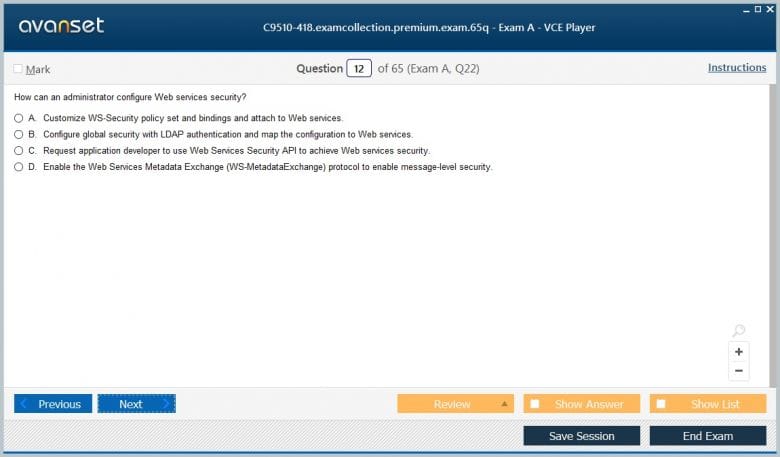
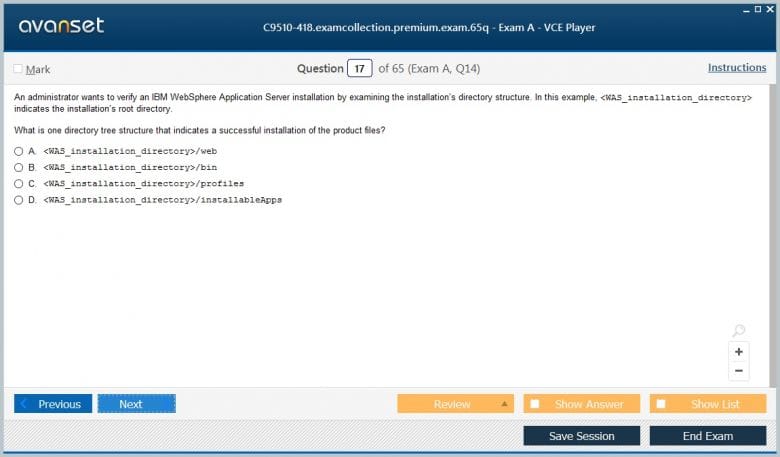
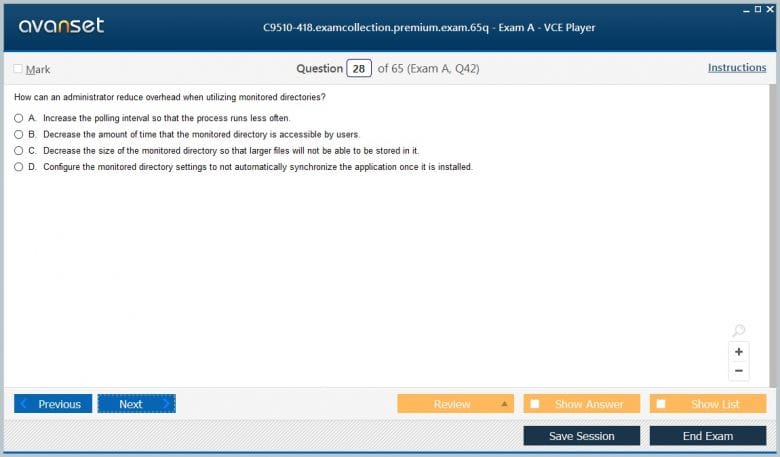
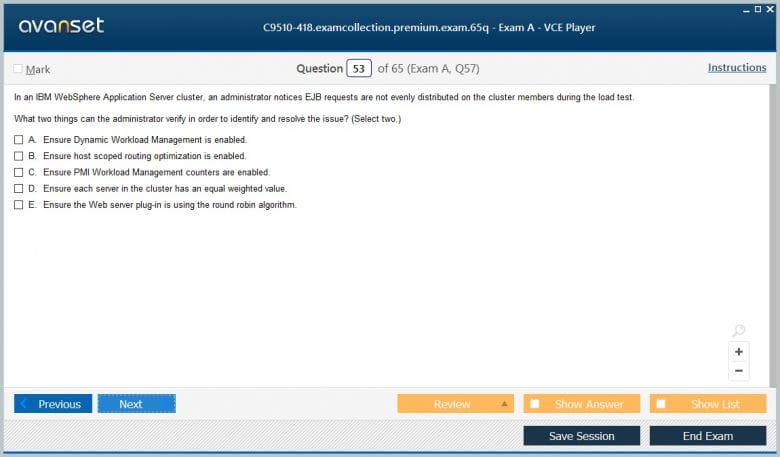
IBM C9510-418 Exam Screenshots
IBM C9510-418 Practice Test Questions in VCE Format
| File | Votes | Size | Date |
|---|---|---|---|
File IBM.actualtests.C9510-418.v2026-09-16.by.theo.77q.vce |
Votes 1 |
Size 237.92 KB |
Date Sep 16, 2026 |
File IBM.Prep4sure.C9510-418.v2020-01-24.by.Leon.65q.vce |
Votes 3 |
Size 171.97 KB |
Date Jan 28, 2020 |
IBM C9510-418 Practice Test Questions, Exam Dumps
IBM C9510-418 (IBM WebSphere Application Server Network Deployment V9.0 Core Administration) exam dumps vce, practice test questions, study guide & video training course to study and pass quickly and easily. IBM C9510-418 IBM WebSphere Application Server Network Deployment V9.0 Core Administration exam dumps & practice test questions and answers. You need avanset vce exam simulator in order to study the IBM C9510-418 certification exam dumps & IBM C9510-418 practice test questions in vce format.
C9510-418, IBM WebSphere Application Server Network Deployment V9.0 Core Administration, belongs to an older V9 certification code generation. IBM continues to support and update WebSphere Application Server V9.0.5, while the current administrator certification path uses C1000-174. This distinction matters: the platform family remains relevant, but candidates should not treat C9510-418 itself as the present exam route.
The core administrative problem has not changed. Network Deployment coordinates distributed Java application servers through cells, nodes, deployment managers, clusters, web server routing, configuration repositories, security, resources, and automation. Administrators need a reliable model of how configuration becomes runtime behavior. When users report “WebSphere is down,” the real cause can live anywhere from DNS and TLS to plug-in routing, JVM health, application dependencies, or a database.
A deployment manager maintains the master configuration for a cell, while managed nodes and node agents participate in distribution and administration. Synchronization is not a background detail. A setting that exists in the master repository may not be active where expected if a node is disconnected or out of sync. Administrators should be able to identify the authoritative configuration and verify whether runtime nodes have received it.
Profiles, nodes, servers, clusters, and resources each have scope. Before changing a JDBC provider, JVM property, security setting, or shared library, ask which workloads should inherit it. Excessively broad scope increases unintended impact; excessively narrow scope creates duplicate configuration. The best topology makes common policy common while preserving deliberate exceptions.
Enterprise applications depend on databases, messaging providers, mail, URLs, authentication repositories, and remote services. WebSphere represents many of these through configurable resources and JNDI names. An administrator needs to understand connection pools, authentication aliases, timeouts, transaction behavior, and how application references map to server-side definitions.
Troubleshooting should separate the resource object from the external service. A data source can be configured correctly while the database is unavailable; the database can be healthy while credentials are wrong; both can be healthy while the application looks up the wrong JNDI name. Test at each layer and keep secrets out of scripts and logs. Dependencies should be documented so an application release does not discover them for the first time in production.
A cluster distributes applications across members and can support horizontal or vertical scaling. But redundancy is only useful if traffic reaches healthy members and application state can survive the expected failures. Understand how the web server plug-in routes requests, how member weights and health influence distribution, and whether session persistence, replication, or stateless design is required.
Capacity planning should include downstream systems. Adding application-server members can increase database connections, message consumers, cache traffic, and calls to external APIs. A cluster may move the bottleneck instead of removing it. The ideas in load balancing are helpful because distribution only improves resilience when health detection and dependency capacity are part of the design.
Deployments can involve EAR files, modules, virtual hosts, resource references, class loaders, shared libraries, security mappings, and context roots. The release process should capture these settings consistently across environments. Manual console memory is not a deployment standard. Use documented steps or automation, preserve application versions, and validate the resulting service rather than relying on an “installation successful” message.
Class loading deserves particular attention because Java applications can bring libraries that overlap with server libraries. Parent-first or parent-last behavior, shared libraries, and isolated class loaders can change which implementation is used. When an application works in one environment but fails in another, compare both the application artifact and the runtime class path before assuming the code is different.
WebSphere can integrate with user registries or federated repositories, enforce Java EE application roles, protect administrative functions, and manage SSL configurations for inbound and outbound trust. Administrators need to distinguish identity problems from authorization problems and transport-trust problems. A TLS handshake failure is not fixed by changing an application role, and a valid certificate does not grant a user permission.
Security changes should be tested with least privilege in mind. Use administrative roles appropriate to job function, protect service identities, and track certificate expiry. If a trust store is changed, identify every outbound or inbound connection that depends on it. The general principles in access control and accountability are useful because middleware administration needs both controlled privilege and a traceable record of changes.
Applications may use JMS or the service integration bus for asynchronous work. Administrators should understand messaging engines, destinations, connection factories, message stores, and transaction boundaries well enough to diagnose stuck or accumulating messages. A consumer outage can appear as healthy producers plus a growing queue, while a transaction rollback can cause a message to be redelivered repeatedly.
Operational dashboards should include queue depth, consumer health, persistent-store status, and error destinations where appropriate. If a message is poison for one consumer, repeated retries can consume capacity without progress. Design procedures for examining and isolating failures without deleting evidence or losing valid business messages.
JVM heap, garbage collection, thread pools, connection pools, CPU, I/O, lock contention, database calls, remote services, and application code can all contribute to latency. Start with a baseline and a reproducible transaction. Performance Monitoring Infrastructure and operating-system metrics help determine whether the JVM is actually the constrained layer. Thread dumps can show blocked or waiting work, while heap analysis can investigate memory growth.
Do not solve every performance issue by raising pool sizes. More threads can create more contention; more database connections can overload the database; a larger heap can make some garbage-collection pauses longer. Tune a resource after evidence identifies it as the bottleneck. Generic monitoring principles apply here: metrics are most useful when they are connected to service behavior and changes over time.
wsadmin scripting lets teams query and modify WebSphere configuration in a repeatable way. Scripts can create resources, deploy applications, change settings, or inspect state across environments. The value is not speed alone. Version-controlled automation makes intended configuration reviewable and reduces differences caused by manual clicks.
Automation needs safeguards. Check current state, validate arguments, stop on errors, protect secrets, and record results. For destructive or high-impact changes, provide rollback or restore procedures. Configuration automation should make the system easier to reason about, not create a hidden layer that only one script author understands.
Backing up WebSphere configuration is important, but restoring an application service may also require application artifacts, certificates, scripts, external database state, messaging state, DNS, web server configuration, and credentials. Define the recovery unit before an outage. A deployment manager restored successfully into an environment with unavailable dependencies is not a recovered business service.
Test loss scenarios at different scopes: one JVM, one node, the deployment manager, a web server, or an entire site. The broader backup and disaster-recovery models discussion helps distinguish local component resilience from site-level continuity. Recovery objectives should be expressed in service terms and validated through exercises.
Change governance protects a shared middleware platform. A Network Deployment cell is shared infrastructure, so changes need an impact model. JVM arguments, security providers, shared libraries, plug-in generation, node settings, and common resources can affect many applications at once. Before a change, identify the scope, dependent applications, validation checks, maintenance window, and rollback. After it, compare the environment with the expected state and retain logs that show what was changed.
Use lower environments to test procedure as well as function. A change that works only because a senior administrator remembers an undocumented manual step is not production-ready. Scripts, configuration-as-code practices where appropriate, and peer review reduce this operational dependency. Middleware governance should make changes easier to repeat and easier to explain, not slower for its own sake.
Lifecycle management should keep product maintenance and application compatibility connected. Fix packs, Java levels, security updates, and operating-system changes can alter a stable environment even when application code is untouched. Maintain a tested patch procedure, representative application checks, and a record of unsupported combinations that must be retired. Middleware becomes easier to operate when teams know not only the current state, but also the next supported state they are moving toward.
The approved inventory contains C1000-174, WebSphere Application Server Network Deployment v9.0.5 Administrator, which is the relevant forward certification relationship for this platform. Use current IBM documentation for exact commands, supported Java levels, fix packs, and certification objectives rather than assuming the C9510-418 blueprint is current.
Viewed within IBM certifications, C9510-418 is an older V9 code rather than the current administrator exam. The lasting administrative standard is simple to state but difficult to practice: understand topology and scope, automate known state, measure before tuning, protect trust boundaries, and restore the complete service rather than one isolated server.
Go to testing centre with ease on our mind when you use IBM C9510-418 vce exam dumps, practice test questions and answers. IBM C9510-418 IBM WebSphere Application Server Network Deployment V9.0 Core Administration certification practice test questions and answers, study guide, exam dumps and video training course in vce format to help you study with ease. Prepare with confidence and study using IBM C9510-418 exam dumps & practice test questions and answers vce from ExamCollection.
Purchase Individually
Site Search:

SPECIAL OFFER: GET 10% OFF

Pass your Exam with ExamCollection's PREMIUM files!
SPECIAL OFFER: GET 10% OFF
Use Discount Code:
MIN10OFF
A confirmation link was sent to your e-mail.
Please check your mailbox for a message from support@examcollection.com and follow the directions.

Download Free Demo of VCE Exam Simulator
Experience Avanset VCE Exam Simulator for yourself.
Simply submit your e-mail address below to get started with our interactive software demo of your free trial.