



Premium File
69 Q&A
$76.99$69.99
IBM C9510-401 Exam Questions & Answers, Accurate & Verified By IT Experts
Instant Download, Free Fast Updates, 99.6% Pass Rate
69 Questions & Answers
Last Update: Sep 24, 2026
$69.99
IBM C9510-401 Exam Screenshots
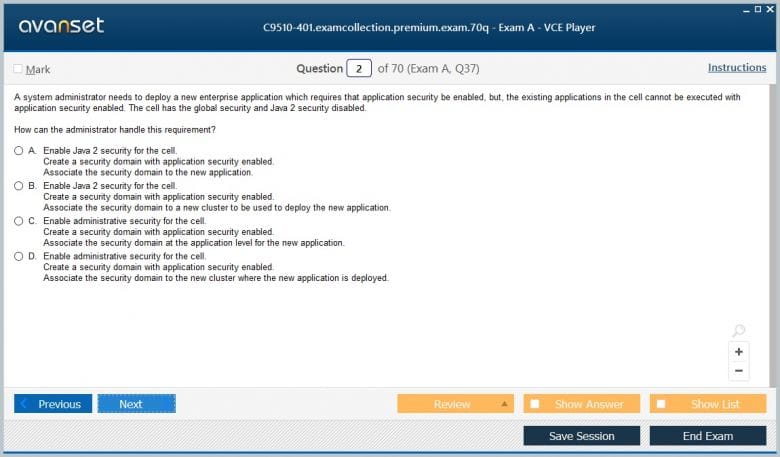
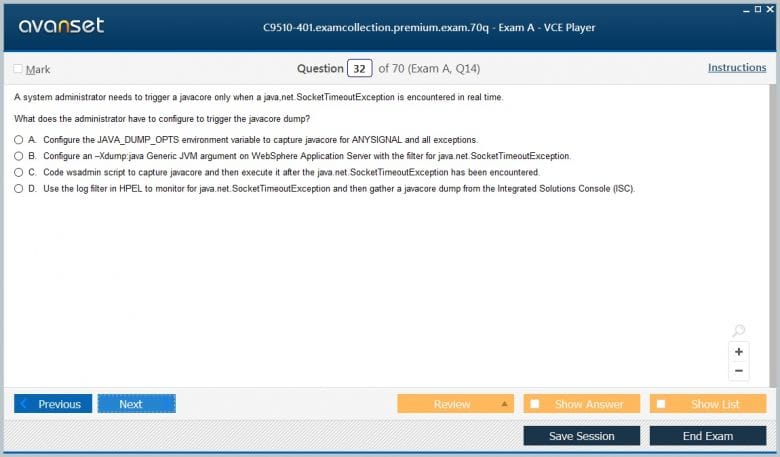
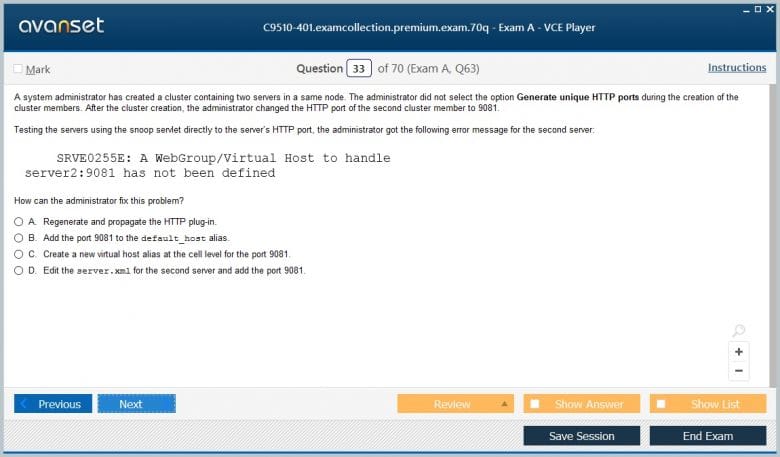
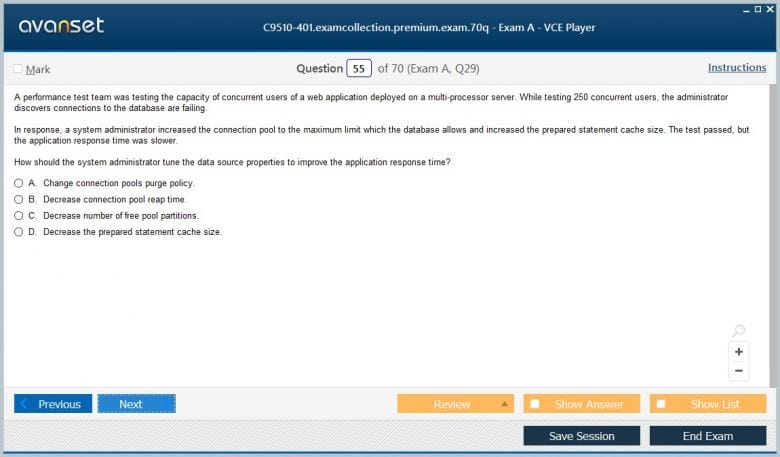
IBM C9510-401 Practice Test Questions in VCE Format
| File | Votes | Size | Date |
|---|---|---|---|
File IBM.certkiller.C9510-401.v2026-10-06.by.giovanni.41q.vce |
Votes 1 |
Size 379.46 KB |
Date Oct 06, 2026 |
File IBM.vceplayer.C9510-401.v2020-06-23.by.ryan.41q.vce |
Votes 2 |
Size 374.36 KB |
Date Jun 23, 2020 |
IBM C9510-401 Practice Test Questions, Exam Dumps
IBM C9510-401 (IBM WebSphere Application Server Network Deployment V8.5.5 and Liberty Profile, System Administration) exam dumps vce, practice test questions, study guide & video training course to study and pass quickly and easily. IBM C9510-401 IBM WebSphere Application Server Network Deployment V8.5.5 and Liberty Profile, System Administration exam dumps & practice test questions and answers. You need avanset vce exam simulator in order to study the IBM C9510-401 certification exam dumps & IBM C9510-401 practice test questions in vce format.
C9510-401, IBM WebSphere Application Server Network Deployment V8.5.5 and Liberty Profile System Administration, is a legacy exam tied to the V8.5.5 administration generation. IBM’s historical training roadmap explicitly connected “Test 401” with WebSphere Application Server Network Deployment V8.5.5 and Liberty Profile, while current IBM training and certification have moved forward to the v9.0.5 administration path. The old blueprint remains valuable because it captures the operational model behind enterprise Java middleware.
WebSphere administration is about coordinating a distributed application platform. Installation Manager, profiles, cells, nodes, deployment managers, application servers, clusters, IBM HTTP Server, plug-ins, security, applications, messaging, logs, performance data, and Liberty all participate. Administrators need to know how configuration flows through that topology and how a request moves from the web tier to an application. When that model is clear, deployment and troubleshooting become much more systematic.
A Network Deployment environment uses a deployment manager to coordinate one or more nodes containing application servers and related resources. Profiles define runtime identities and configuration locations. Node agents synchronize and participate in administration. A cell provides the top-level administrative domain. These concepts are foundational because nearly every operation has a scope: cell, node, server, cluster, application, or resource.
Learn to predict scope before changing a setting. A resource defined at cell scope can be available broadly; a server-scoped definition can intentionally differ. A configuration that is correct in the deployment manager repository may not be active on a node if synchronization is failing. Administrative topology therefore explains both normal operation and failure behavior.
IBM Installation Manager handles product installation, repositories, fixes, and updates for the traditional WebSphere stack. Administrators need to know which packages are installed, where shared resources live, which Java SDK level is active, and how fixes relate to the base product. Maintenance should be treated as a controlled release: verify prerequisites, back up configuration, document current levels, apply the change, and validate the service afterward.
Version consistency matters in clustered or managed environments. Mixed maintenance levels may be supported only in particular conditions and for limited periods. Before rolling maintenance, check compatibility and decide how traffic will be handled as members are stopped and restarted. The goal is to protect service while preserving a supportable configuration, not merely to patch each server independently.
IBM HTTP Server and the WebSphere web server plug-in can route incoming HTTP requests to application servers. Administrators should understand web server definitions, plug-in configuration generation and propagation, virtual hosts, transports, and how clustered members appear to the routing layer. A healthy application server can still be unreachable if the plug-in is stale or the web server points to the wrong endpoints.
Test the route end to end. Resolve the public host, establish TLS, reach the web server, match the application context, route through the plug-in, and confirm that a healthy cluster member handles the request. Load distribution is not only a networking topic; it is part of application availability. The general principles in load balancing are useful context for understanding why health, routing, and capacity need to be considered together.
Deploying an enterprise application involves more than uploading an archive. Module mapping, virtual hosts, class loading, shared libraries, resource references, security roles, startup order, and environment-specific bindings can affect behavior. Administrators should know which settings belong to the application and which belong to the server environment so that releases can move predictably between development, test, and production.
A strong deployment process separates installation success from application health. After a release, test critical URLs or services, check logs for initialization errors, confirm data-source and messaging dependencies, and validate that traffic reaches all intended cluster members. Preserve the prior application version or a rollback procedure. Middleware is most reliable when application deployment is treated as an auditable change rather than an interactive console action.
Clusters allow multiple application-server members to host the same workload. That can improve throughput and availability, but the design must account for session state, persistent data, messaging, caches, and external dependencies. If a user session exists only in one process, losing that member may still disrupt the user even though another server is running.
Study high availability by tracing failure. What happens when one member stops? What if an entire node is unavailable? How does the web plug-in detect health? Is session persistence or replication required? Can the database or messaging layer become the real single point of failure? Disaster-recovery models are broader than WebSphere, but they reinforce the same distinction between local redundancy and complete service recovery.
WebSphere security includes administrative roles, user registries or federated repositories, application authentication and authorization, Java EE security roles, SSL configurations, certificates, and trust relationships. Administrators should know whether a problem occurs before the request reaches the application, during identity establishment, or during application authorization. Broadly disabling security to diagnose a problem is rarely an acceptable production method.
Certificate management deserves its own operational process. Inventory key stores and trust stores, track expiration, understand certificate chains, and test changes in advance. A server that starts correctly can still fail every inbound or outbound secure connection after a certificate or trust change. Access and administrative permissions should likewise follow least privilege and remain attributable.
The wsadmin scripting interface allows administrators to query and change configuration without relying on manual console steps. Scripting is valuable for repeatability, environment consistency, and auditability, but only if scripts include validation and error handling. An automated command can spread a configuration mistake across many servers faster than a human operator could.
Write scripts that inspect state before changing it, log the intended and resulting configuration, stop on unexpected conditions, and support environment-specific parameters without hard-coded secrets. Store them under version control and test them like application code. Automation should make the administrative model clearer, not hide it behind a one-line command.
C9510-401 explicitly included Liberty Profile alongside traditional Network Deployment. Liberty uses a lighter, composable runtime and a configuration model that differs from the classic administrative cell. Candidates should understand that this is not simply a smaller traditional server. Features are enabled as needed, configuration is more file-centered, and deployment practices can be closer to application delivery pipelines.
The operational questions remain familiar: which features are enabled, where configuration comes from, how applications are deployed, how security is established, where logs and metrics go, and how instances are managed at scale. Learning both models in the same exam was valuable because it forced administrators to separate enduring middleware responsibilities from the mechanics of one administration console.
Logs, FFDC data, thread dumps, heap dumps, trace, PMI performance information, web server logs, and operating-system metrics can all contribute to diagnosis. Start with the symptom, time, affected users or servers, and recent changes. Then gather the least invasive evidence that can test a hypothesis. Restarting first can erase useful state and turn a reproducible problem into an intermittent one.
Performance incidents should be decomposed. Is time spent in the web tier, application threads, garbage collection, database calls, remote services, messaging, locks, or network waits? Generic modern monitoring principles apply even though WebSphere has its own tools: measure service health and workload over time so that a spike has a baseline for comparison.
Configuration backup should be part of every significant administrative change. WebSphere provides ways to preserve configuration, but administrators also need copies of scripts, application artifacts, certificates, web-server configuration, and environment-specific documentation. Recovery should be tested at the level of the service that matters. Restoring a deployment manager without the application package or the trust material required by downstream systems may restore configuration while leaving the application unusable.
Operational runbooks should capture start and stop order, health checks, log locations, escalation contacts, and the dependencies that need to be available before traffic returns. These details are mundane until an outage occurs. Then they determine whether recovery is controlled or improvised. The best administrators turn successful incident response into repeatable procedure rather than relying on memory.
Capacity should also be reviewed as applications evolve. A new release can change heap demand, thread use, database connections, message volume, or response size without changing the topology. Trend the platform before and after major releases and keep enough historical data to distinguish slow growth from a sudden regression. Capacity planning is most effective when it is part of release management rather than a reaction to saturation.
IBM still maintains WebSphere V8.5.5 and V9 update streams, but certification has moved beyond C9510-401. The approved inventory contains C1000-174, WebSphere Application Server Network Deployment v9.0.5 Administrator, which is the more relevant current exam relationship. That does not make every V8.5.5 procedure identical in V9; it provides a forward path for the administration role.
The wider IBM certifications landscape helps separate this V8.5.5 exam from the current WebSphere administrator route. The durable skill from C9510-401 is being able to describe the runtime topology, deploy change safely, secure trust boundaries, automate repeatable administration, and diagnose failures from the request path outward.
Go to testing centre with ease on our mind when you use IBM C9510-401 vce exam dumps, practice test questions and answers. IBM C9510-401 IBM WebSphere Application Server Network Deployment V8.5.5 and Liberty Profile, System Administration certification practice test questions and answers, study guide, exam dumps and video training course in vce format to help you study with ease. Prepare with confidence and study using IBM C9510-401 exam dumps & practice test questions and answers vce from ExamCollection.
Purchase Individually
Site Search:

SPECIAL OFFER: GET 10% OFF

Pass your Exam with ExamCollection's PREMIUM files!
SPECIAL OFFER: GET 10% OFF
Use Discount Code:
MIN10OFF
A confirmation link was sent to your e-mail.
Please check your mailbox for a message from support@examcollection.com and follow the directions.

Download Free Demo of VCE Exam Simulator
Experience Avanset VCE Exam Simulator for yourself.
Simply submit your e-mail address below to get started with our interactive software demo of your free trial.