



Premium File
122 Q&A
$76.99$69.99
IBM C2150-609 Exam Questions & Answers, Accurate & Verified By IT Experts
Instant Download, Free Fast Updates, 99.6% Pass Rate
122 Questions & Answers
Last Update: Oct 27, 2026
$69.99
IBM C2150-609 Exam Screenshots
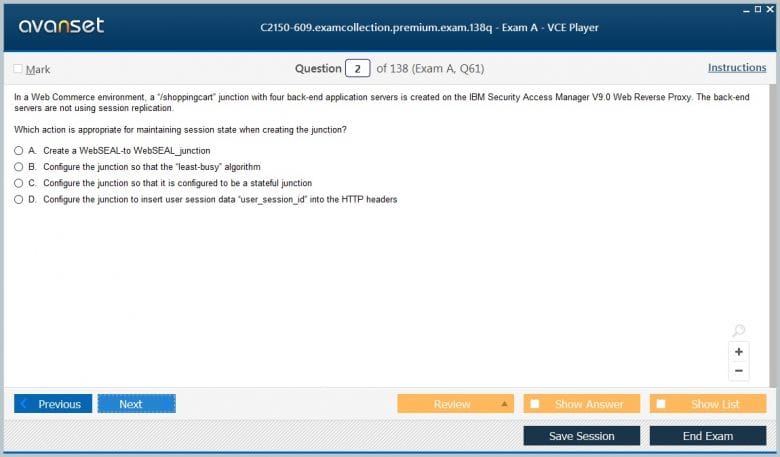
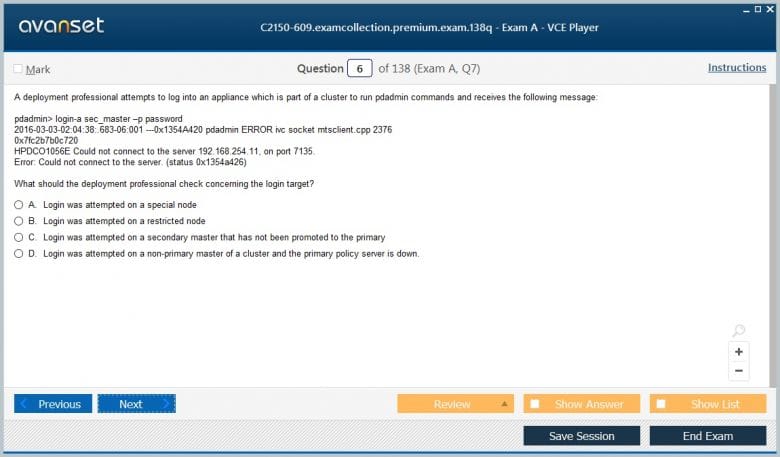
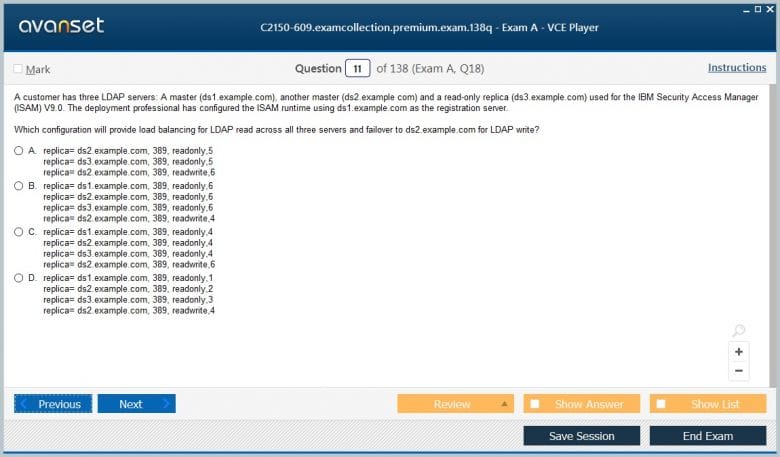
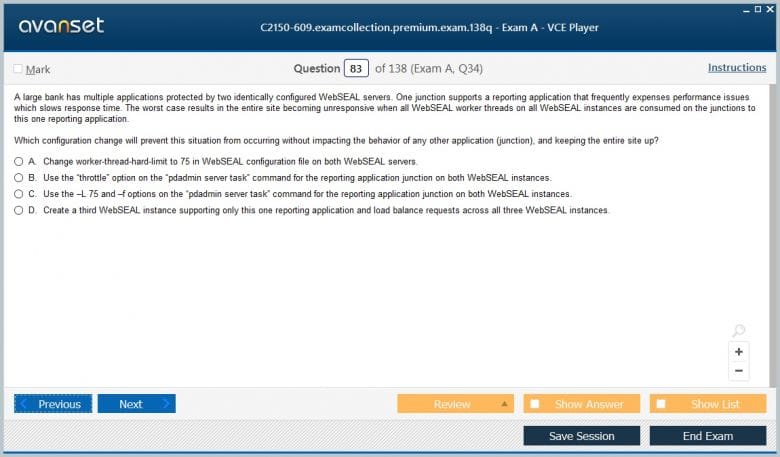
IBM C2150-609 Practice Test Questions in VCE Format
| File | Votes | Size | Date |
|---|---|---|---|
File IBM.passcertification.C2150-609.v2026-08-12.by.charlotte.76q.vce |
Votes 1 |
Size 291.92 KB |
Date Aug 14, 2026 |
File IBM.Test-inside.C2150-609.v2019-03-14.by.Brant.76q.vce |
Votes 3 |
Size 187.96 KB |
Date Mar 18, 2019 |
IBM C2150-609 Practice Test Questions, Exam Dumps
IBM C2150-609 (IBM Security Access Manager V9.0 Deployment) exam dumps vce, practice test questions, study guide & video training course to study and pass quickly and easily. IBM C2150-609 IBM Security Access Manager V9.0 Deployment exam dumps & practice test questions and answers. You need avanset vce exam simulator in order to study the IBM C2150-609 certification exam dumps & IBM C2150-609 practice test questions in vce format.
C2150-609, IBM Security Access Manager V9.0 Deployment, belongs to the IBM Security Access Manager generation that preceded IBM Security Verify Access and today’s IBM Verify Identity Access line. IBM’s own lifecycle material now lists ISAM 9.0 as end of support, while current Verify training focuses on deploying and managing the successor identity-and-access platform. That makes C2150-609 a legacy deployment exam whose architecture is still useful for understanding enterprise access control.
IBM community guidance from the exam period emphasized practical deployment experience, not classroom knowledge alone. That is appropriate because identity platforms fail at integration boundaries: DNS, certificates, directories, reverse proxies, application junctions, federation endpoints, policy, time synchronization, firewalls, and client behavior all have to agree. A deployment professional therefore needs to understand request flow from the user to the protected application, and to know where identity, authentication, authorization, and session state are introduced.
Draw the request path before configuring it. A browser or client reaches the access layer, authentication establishes identity, policy determines what the identity may reach, and the reverse proxy or related component forwards the request to the protected application. Depending on the design, directory services, federation, multi-factor authentication, or application-specific identity propagation can participate. The value of this diagram is diagnostic: when a request fails, it gives the team a sequence of trust decisions to inspect.
Separate authentication from authorization. A user can prove identity successfully and still be denied access by policy. The reverse is more dangerous: a weak authentication path may allow the wrong identity to receive permissions that policy would otherwise enforce correctly. The fundamentals in identification and authentication provide a useful conceptual foundation before adding IBM-specific configuration.
WebSEAL and related reverse-proxy patterns place an enforcement point in front of applications. The proxy terminates or participates in the client connection, applies access policy, and forwards approved traffic to back-end services. Administrators need to understand junctions, host and path mapping, headers, cookies, session handling, and how the application learns the authenticated identity. A routing configuration that works technically can still be insecure if it allows a client to spoof headers that the application trusts.
Plan trust boundaries explicitly. Decide where TLS terminates, which systems can connect directly to the application, whether back-end traffic also needs encryption, and which identity attributes are authoritative. Modern IBM documentation describes Verify Access and the IBM Application Gateway as successors to ISAM-era patterns, but the same question remains: which component is responsible for enforcing access before a protected application receives the request?
Enterprise access management usually depends on an LDAP directory or another authoritative identity source. Deployment work includes connectivity, bind identities, search bases, schema expectations, group resolution, attribute mapping, and availability. Administrators should be able to distinguish a failed directory connection from a valid connection that cannot find the expected user, and from a found user whose group membership does not map to authorization policy.
Directory changes can become security incidents if the access layer caches stale information or if group semantics are misunderstood. Test joiners, movers, and leavers: a new user should receive only intended access, a role change should alter authorization predictably, and a disabled account should lose access within the required time. Identity integration is complete only when lifecycle events behave as designed.
SSO improves usability by allowing one authentication event to support access to multiple applications, but it also expands the consequences of a compromised session. Candidates should understand how session cookies, credential propagation, token or assertion mechanisms, and application trust interact. Ask what proves the user’s identity at each hop and what prevents an attacker from replaying or forging that proof.
The broader principles in single sign-on help organize this reasoning. Session lifetime, reauthentication for sensitive actions, logout behavior, and token validation are security controls, not only user-experience settings. A deployment should also define what happens when the identity provider or directory is unavailable so that fail-open behavior does not appear accidentally.
Federated access can use standards such as SAML, OAuth, or OpenID Connect depending on the application and era. The important deployment skill is not memorizing protocol buzzwords; it is understanding the trust contract. Which party authenticates the user? Which claims or attributes are sent? How are signing and encryption keys managed? What audience and endpoint restrictions are enforced? How are clock differences and certificate rollover handled?
Failures often surface as vague login loops or invalid-token messages. Diagnose them by comparing the assertion or token with the configuration that is supposed to accept it. Check issuer, audience, destination, signature, certificate chain, time validity, subject mapping, and required attributes. A federation integration becomes maintainable when these expectations are documented rather than encoded only in a console.
Policies should answer who may access what under which conditions. Use groups, roles, resource patterns, authentication strength, or contextual requirements in a way that mirrors business entitlement. Avoid rules that are broad because they are easy to configure. A policy architecture becomes hard to audit when exceptions accumulate without ownership or when many users receive direct grants.
Access control and accountability are tightly connected here. Access decisions need traceable inputs, and administrative changes need records. When a user is denied incorrectly, the team should be able to identify the policy, identity attributes, and request resource that produced the decision. When a user is allowed, the same evidence should exist.
Identity platforms rely heavily on cryptographic trust. Web endpoints use server certificates, federation can use signing or encryption keys, and back-end connections may require mutual trust. Deployment professionals should understand certificate chains, trust stores, private-key protection, hostname validation, expiration, and renewal. A certificate that expires at midnight can disable authentication for every application behind the access layer.
Build certificate inventory and renewal ownership into operations. Test changes before expiry, preserve rollback options, and coordinate with external federation partners when shared trust material changes. Cryptography is strongest when the lifecycle is managed. The algorithms may be sound, but an untracked certificate or exposed private key can still break or compromise the service.
When access fails, collect the exact URL, user, time, client, authentication method, and expected policy outcome. Then follow the request path. Did DNS resolve? Did TLS succeed? Did the request reach the proxy? Did authentication complete? Did directory lookup return the expected identity? Did policy allow the resource? Did the back-end application accept propagated identity? This sequence prevents teams from resetting passwords when the actual problem is routing or policy.
Logs and traces should be enabled purposefully. Capture enough detail to correlate a request across components, then return noisy diagnostics to normal settings after investigation. Establish a healthy baseline and synthetic tests for critical applications so the team can detect failures before users open tickets. Practical deployment expertise is largely the ability to turn a broad “login is broken” report into a precise failed control.
Identity infrastructure sits in the login path for many applications, so a deployment error can create a broad outage. Plan changes with staged validation: establish the new component, test it with a limited application or user set, verify authentication and authorization, observe logs, and only then expand traffic. Preserve the prior route or configuration long enough to recover if an unexpected application dependency appears.
Migration also requires behavioral comparison. A successor platform may support the same standards while changing defaults, cipher suites, cookie behavior, session handling, administrative interfaces, or policy representation. Test representative legacy applications, modern federated applications, privileged administration, and failure scenarios. A successful upgrade is not simply a service that starts; it is a set of protected applications that continue to enforce the intended identity controls under normal and abnormal conditions.
Administrative separation also matters during deployment. The people who define policy, maintain directories, manage certificates, operate the access proxy, and own applications may be different teams. Define change ownership and emergency access before an incident. Shared responsibility is safer when every team knows which configuration it can change and which evidence it must preserve for the others.
IBM’s product naming has changed since C2150-609. Current IBM lifecycle information shows ISAM V9 as end of support, followed by IBM Security Verify Access V10 and the newer IBM Verify Identity Access V11 line. The old exam should not be presented as a current route, but its deployment themes remain recognizable in modern identity platforms.
The IBM certifications inventory gives C2150-609 its historical place in the ISAM V9 era. For current implementations, follow IBM Verify documentation and current training. The durable skill is to treat identity as an end-to-end control plane: establish trust, enforce policy at clear boundaries, protect session and cryptographic state, and troubleshoot the request in the order it actually flows.
Go to testing centre with ease on our mind when you use IBM C2150-609 vce exam dumps, practice test questions and answers. IBM C2150-609 IBM Security Access Manager V9.0 Deployment certification practice test questions and answers, study guide, exam dumps and video training course in vce format to help you study with ease. Prepare with confidence and study using IBM C2150-609 exam dumps & practice test questions and answers vce from ExamCollection.
Purchase Individually
Site Search:

SPECIAL OFFER: GET 10% OFF

Pass your Exam with ExamCollection's PREMIUM files!
SPECIAL OFFER: GET 10% OFF
Use Discount Code:
MIN10OFF
A confirmation link was sent to your e-mail.
Please check your mailbox for a message from support@examcollection.com and follow the directions.

Download Free Demo of VCE Exam Simulator
Experience Avanset VCE Exam Simulator for yourself.
Simply submit your e-mail address below to get started with our interactive software demo of your free trial.