


Premium File
55 Q&A
$76.99$69.99
IBM C2150-606 Exam Questions & Answers, Accurate & Verified By IT Experts
Instant Download, Free Fast Updates, 99.6% Pass Rate
55 Questions & Answers
Last Update: Sep 03, 2026
$69.99
IBM C2150-606 Exam Screenshots
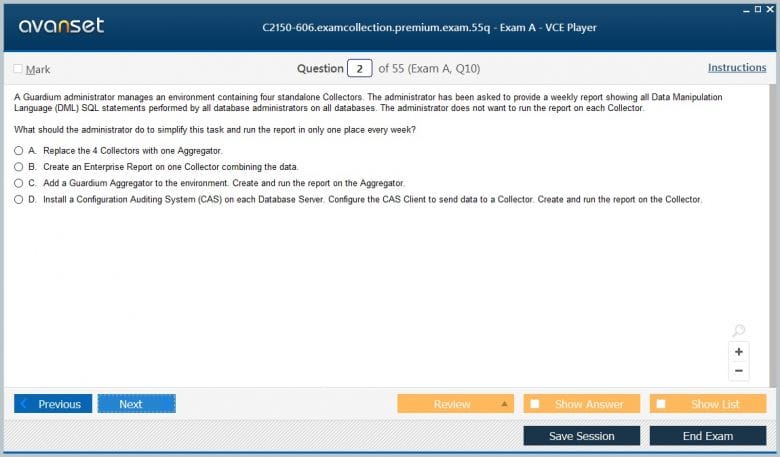
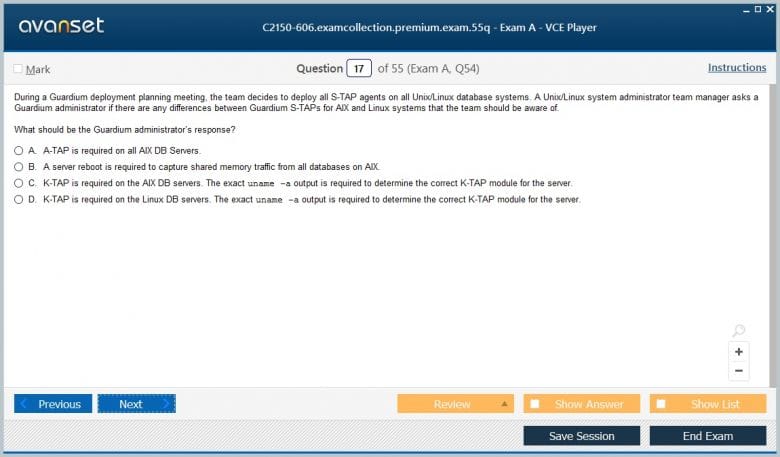
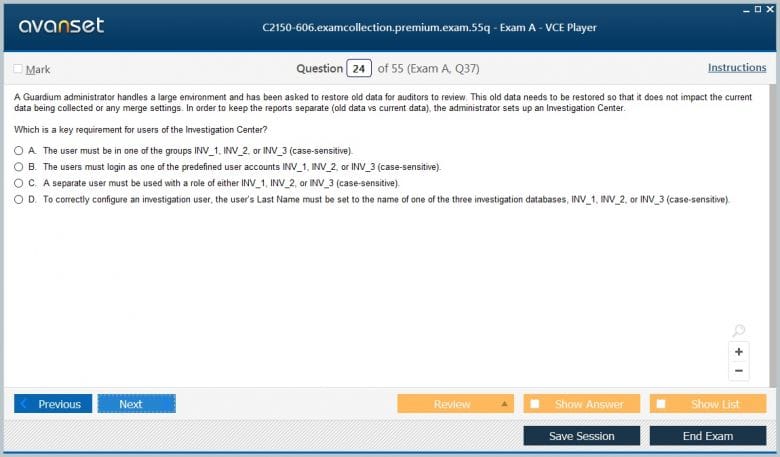
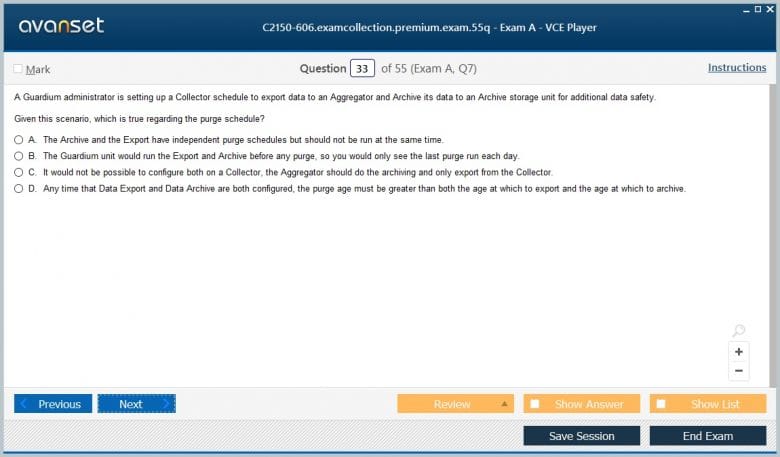
IBM C2150-606 Practice Test Questions in VCE Format
| File | Votes | Size | Date |
|---|---|---|---|
File IBM.pass4sureexam.C2150-606.v2026-06-28.by.james.37q.vce |
Votes 1 |
Size 288.4 KB |
Date Jun 28, 2026 |
File IBM.Certkiller.C2150-606.v2019-03-06.by.Riker.35q.vce |
Votes 3 |
Size 736.87 KB |
Date Mar 10, 2019 |
IBM C2150-606 Practice Test Questions, Exam Dumps
IBM C2150-606 (IBM Security Guardium V10.0 Administration) exam dumps vce, practice test questions, study guide & video training course to study and pass quickly and easily. IBM C2150-606 IBM Security Guardium V10.0 Administration exam dumps & practice test questions and answers. You need avanset vce exam simulator in order to study the IBM C2150-606 certification exam dumps & IBM C2150-606 practice test questions in vce format.
C2150-606, IBM Security Guardium V10.0 Administration, represents an older Guardium certification generation. IBM community material from that period discussed the V10 administrator credential while product training was already moving forward, and IBM’s current certification catalog now highlights Guardium Data Protection v12.x Administrator. The old exam should therefore be treated as a historical administration blueprint, not as proof of a current certification route.
Guardium is most useful when studied as a data-security operating system. It observes activity around protected data stores, applies policy, generates alerts, supports audit and compliance workflows, and depends on collectors, agents or inspection mechanisms, aggregators, central management, storage, and network connectivity. Administrators need to understand how evidence moves through that architecture. A policy cannot protect what is not being observed, and an alert is not meaningful if the organization cannot trace it back to the activity that triggered it.
Guardium deployments can include collectors, aggregators, central managers, S-TAP components, and other integration points. The exact topology depends on scale and database estate. Learn each component by its role in the data path: where activity is captured, where it is evaluated, where information is stored, and where administration is centralized. This is more useful than memorizing appliance names without understanding their dependencies.
Topology decisions affect availability and investigation. If a collector is unavailable, what monitoring is lost? If an agent cannot communicate, how is that detected? If multiple collectors feed an aggregator, which layer should be queried for a specific event? Administrators should be able to draw the environment and annotate network paths, protected servers, management relationships, time sources, and failure domains.
Database activity monitoring depends on collecting the right events from the right systems. For agent-based monitoring, that means installation, configuration, connectivity, and ongoing health of the inspection component. A green appliance dashboard does not prove every database server is being monitored. Inventory coverage should be reconciled against the actual database estate and expected traffic.
Test new or changed databases deliberately. Generate a known activity, verify that it appears in the expected collector, check user and object attribution, and confirm that policy evaluates it. This simple end-to-end validation catches gaps that configuration screenshots can miss. Monitoring controls should be tested like security controls, not assumed to work because the service is running.
A Guardium policy expresses what activity is interesting or prohibited and what response should follow. Effective policies begin with data and business context: privileged access, sensitive tables, unusual commands, access outside expected applications, administrative changes, or other risk conditions. A policy that triggers on everything produces noise; a policy that triggers on nothing creates false confidence.
Build rules around a clear purpose, test them against realistic traffic, and document expected exceptions. Tuning should not simply suppress inconvenient alerts. Ask whether an exception is legitimate, whether the rule is too broad, and whether context such as user, application, source host, time, or object can make it more precise. The general principle of adaptive access control is relevant even though the implementation differs: security becomes more useful when context helps distinguish normal behavior from risky behavior.
Organizations often deploy database monitoring for regulatory or internal control requirements, but raw event collection is not the same as an audit process. Reports need scope, schedules, reviewers, escalation rules, sign-off, and retention. Administrators should know how information reaches the people responsible for reviewing it and what happens when a control exception is found.
Evidence must also be defensible. Time synchronization, protected configuration, access to audit data, and change records all affect trust. The ideas in auditing, accountability, and traceability fit Guardium directly: the platform is valuable when it can reconstruct activity and when its own administrative actions are controlled.
Large environments change constantly. New databases appear, applications move, and sensitive data can be copied into development or reporting systems. Discovery and classification help administrators identify assets and locate data that requires additional monitoring. A security program that protects only the systems listed in last year’s spreadsheet will develop blind spots.
Classification results need review because patterns can create false positives or miss business-specific data. Use them to prioritize investigation, not as unquestioned truth. Connect classifications to policy and reporting so that finding sensitive data leads to an operational response. This turns discovery from an inventory exercise into part of the control lifecycle.
An alert should provide enough context for someone to decide what to do next. Useful context can include database user, application user where available, server, client, object, command, time, policy rule, and related activity. Administrators should understand how to search or report across events so an analyst can move from one alert to a sequence of behavior.
Do not confuse alert volume with security coverage. High volume can indicate a badly tuned policy, duplicated collection, or insufficient filtering. Low volume can indicate a quiet environment or a broken control. Review trend changes against system changes. Generic monitoring guidance such as monitoring and intrusion detection reinforces the same operational lesson: detection is meaningful only when events are actionable and observable over time.
Guardium itself produces data that must be retained, archived, exported, purged, and recovered according to policy. If storage fills, the monitoring system can become unreliable precisely when evidence is needed. Administrators should understand retention periods, archive destinations, aggregation, backups, and the operational impact of moving or deleting stored data.
Recovery planning applies to the security platform as well as the protected databases. Configuration, policies, reports, appliance state, and historical records may all have different recovery requirements. The backup and disaster-recovery models article is broader than Guardium, but it provides a useful way to ask how much service and evidence the organization can afford to lose.
When events disappear, work from source to destination. Is the database active? Is the inspection component healthy? Is network communication available? Does the collector receive traffic? Does policy exclude the event? Is the report querying the expected repository and time range? A stepwise path prevents administrators from changing policy when the actual problem is collection or connectivity.
Performance matters too. Security monitoring should not create unacceptable overhead on protected systems or on the Guardium infrastructure. Establish baselines, understand traffic peaks, size storage and collectors appropriately, and review changes after major database or application releases. If a new application multiplies connection volume, the security platform must be able to absorb that growth without becoming blind or unstable.
A Central Manager can make a large Guardium estate easier to operate by coordinating configuration and managed units, while aggregators can consolidate data for broader reporting. Centralization does not remove the need to understand each collector. Administrators still need to know which systems a unit monitors, whether synchronization is healthy, whether local storage is under pressure, and whether an enterprise report is complete. A single console is useful only when its view can be trusted.
Configuration changes should move through the estate in a controlled way. Record the expected policy or portal state, verify synchronization, and check for units that are unreachable or intentionally different. Security platforms are especially vulnerable to silent drift because a missing rule or agent may not break an application; it simply removes visibility. Regular reconciliation between the intended configuration and the observed configuration is therefore a core administrative control.
Hardening the monitoring platform itself matters as much as monitoring databases. Limit administrative roles, protect management interfaces, keep appliances and agents at supported maintenance levels, secure archive locations, and review changes to policies or user access. A data-protection product with weak administrative controls can become a path to sensitive evidence or a way to suppress detection. Treat Guardium as part of the protected environment, not as an observer that sits outside normal security governance.
Compliance reporting should be mapped to actual control statements rather than generic “security reports.” Identify the regulation or internal policy, the databases and users in scope, the evidence period, the reviewer, and the exception workflow. This makes report design testable. If an auditor asks how privileged database activity is reviewed, the organization should be able to show the collection path, policy, report, review record, and remediation process as one traceable control.
The current IBM catalog lists a Guardium Data Protection v12.x Administrator certification, which confirms that the administration discipline has continued beyond the V10 exam generation. The product capabilities and interfaces have evolved, so present-day candidates should use current IBM materials rather than treating C2150-606 objectives as a v12 syllabus.
Within the older IBM certifications set, C2150-606 belongs to the Guardium V10 generation. The enduring skill is to operate monitoring as a complete control chain: know what should be observed, prove collection is working, tune policy to risk, protect audit evidence, and maintain the platform that makes those controls possible.
Go to testing centre with ease on our mind when you use IBM C2150-606 vce exam dumps, practice test questions and answers. IBM C2150-606 IBM Security Guardium V10.0 Administration certification practice test questions and answers, study guide, exam dumps and video training course in vce format to help you study with ease. Prepare with confidence and study using IBM C2150-606 exam dumps & practice test questions and answers vce from ExamCollection.
Purchase Individually
Site Search:

SPECIAL OFFER: GET 10% OFF

Pass your Exam with ExamCollection's PREMIUM files!
SPECIAL OFFER: GET 10% OFF
Use Discount Code:
MIN10OFF
A confirmation link was sent to your e-mail.
Please check your mailbox for a message from support@examcollection.com and follow the directions.

Download Free Demo of VCE Exam Simulator
Experience Avanset VCE Exam Simulator for yourself.
Simply submit your e-mail address below to get started with our interactive software demo of your free trial.