



Premium File
120 Q&A
$76.99$69.99
IBM C2090-558 Exam Questions & Answers, Accurate & Verified By IT Experts
Instant Download, Free Fast Updates, 99.6% Pass Rate
120 Questions & Answers
Last Update: Sep 24, 2026
$69.99
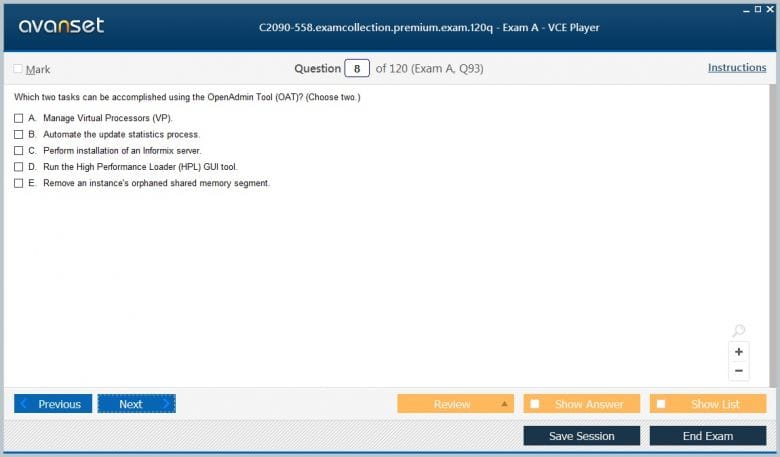
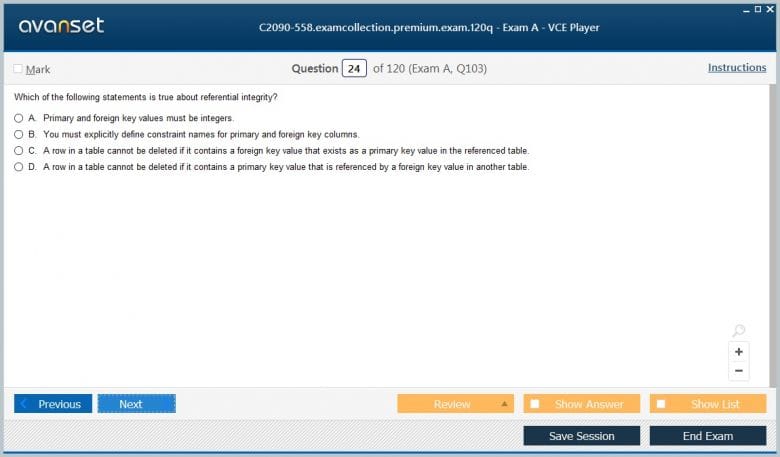
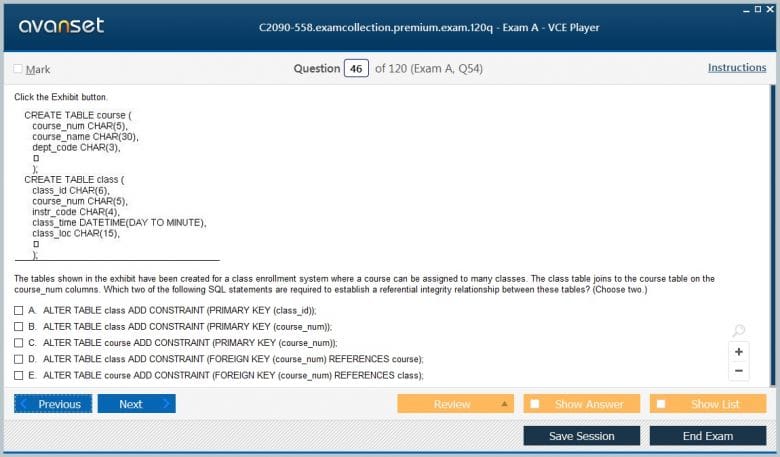
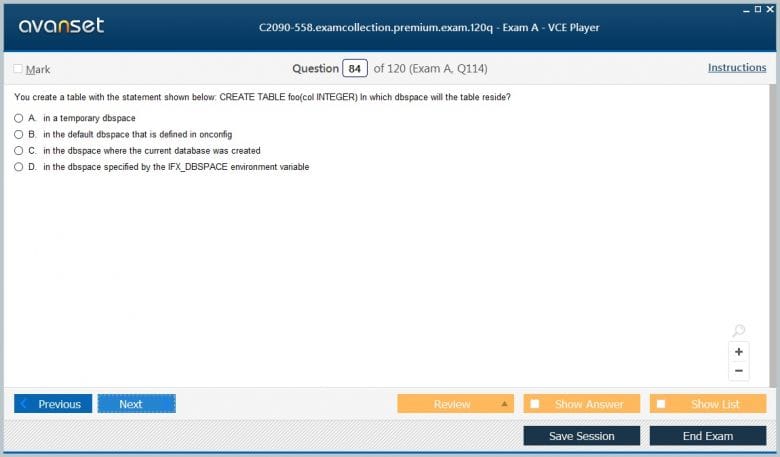
IBM C2090-558 Exam Screenshots
IBM C2090-558 Practice Test Questions in VCE Format
| File | Votes | Size | Date |
|---|---|---|---|
File IBM.Train4sure.C2090-558.v2026-07-23.by.Ava.70q.vce |
Votes 3 |
Size 270.29 KB |
Date Jul 26, 2026 |
IBM C2090-558 Practice Test Questions, Exam Dumps
IBM C2090-558 (Informix 11.70 Fundamentals) exam dumps vce, practice test questions, study guide & video training course to study and pass quickly and easily. IBM C2090-558 Informix 11.70 Fundamentals exam dumps & practice test questions and answers. You need avanset vce exam simulator in order to study the IBM C2090-558 certification exam dumps & IBM C2090-558 practice test questions in vce format.
C2090-558, Informix 11.70 Fundamentals, is a historical IBM certification exam covering installation, instances, storage, SQL, transactions, concurrency, security, backup, recovery, and administrative utilities. Informix has since moved into the HCL product portfolio, where current documentation is for HCL Informix 15.0. That makes the old exam a useful database-administration foundation, but not a current IBM certification claim.
The strongest way to study it is to build a mental model of how an Informix server turns configuration, dbspaces, chunks, databases, tables, logs, locks, buffers, and background activity into a reliable service. Commands such as onstat, onmode, oninit, and ontape become easier to remember when each one answers an operational question. Version-specific options should be validated against current HCL documentation before use.
Informix installation is not simply copying binaries. Administrators need supported operating systems, kernel or system settings where required, appropriate user and group ownership, filesystem and raw-device planning, environment variables, connectivity definitions, and enough disk space for the server, logs, temporary work, backups, and application growth. Machine notes historically mattered because platform-specific requirements could differ from general documentation.
Separate software installation from instance initialization in your mental model. The same installed binaries can support configured server instances, each with its own ONCONFIG, sqlhosts connectivity, dbspaces, logs, and runtime identity. A clean build process records the selected paths and parameters so a server can be recreated without relying on undocumented administrator memory.
ONCONFIG parameters control memory, logging, checkpoints, virtual processors, network behavior, storage, and many other server characteristics. Candidates should understand the purpose of important categories rather than memorizing every setting. Change one parameter only after identifying the workload or failure it is meant to affect, and confirm whether the change requires restart or can be applied dynamically.
Server modes such as online, quiescent, and administration states restrict what work can occur. Mode changes are operational controls: they can prepare for maintenance, limit user access, or support recovery tasks. A production runbook should state who may change mode, what users or sessions are affected, and how normal service will be restored.
Informix organizes physical storage through dbspaces and chunks, with pages and extents used to allocate data. Administrators should know how data and indexes consume space, how temporary dbspaces differ from permanent storage, and how logical and physical logs have distinct roles. Capacity planning must consider growth, free space, fragmentation, backup behavior, and the risk of placing too many critical structures on one failure domain.
Current HCL Informix 15.0 raises many scale limits, but the design principle remains: storage layout should support recoverability and workload. An old 11.70 exam question may use historical limits, so keep version facts separate from the durable architecture. The database recovery planning perspective is useful because storage choices become most visible when something fails.
Space monitoring should look ahead rather than only alert at exhaustion. Track growth rate by dbspace, large-table extent behavior, temporary-space peaks, and log usage during maintenance or bulk load. Reserve enough headroom for recovery and reorganization operations, which may need extra space precisely when the system is already under stress. Capacity planning that targets 100 percent utilization leaves no room for safe maintenance.
Fragmentation can improve manageability and performance when the distribution rule matches workload, but it also adds metadata and operational decisions. A DBA should know whether fragments are balanced, whether pruning is possible for common queries, and whether backup or maintenance can operate on useful subsets. Fragmentation chosen only because a table is large may not solve the actual access problem.
Informix supports relational tables, SQL queries, constraints, indexes, views, procedures, and transactional changes. Fundamentals candidates should understand data types, primary and foreign keys, check constraints, and the behavior of SELECT, INSERT, UPDATE, and DELETE. Application correctness begins with valid schema and transaction design; a DBA cannot tune away inconsistent business rules.
Indexes accelerate appropriate access paths but add maintenance cost. Constraints protect integrity but can expose poor load sequencing. The article on relational database design provides a useful conceptual anchor: structured schema and transactional guarantees are strengths when the application depends on predictable relationships and consistency.
BEGIN WORK, COMMIT WORK, and ROLLBACK WORK define transactional boundaries in logged databases. Isolation settings and locking determine what concurrent sessions can see and how they wait for one another. Candidates should understand why long transactions consume log space and hold locks, why deadlocks can occur, and why an application should commit according to business units of work rather than arbitrary row counts.
Troubleshooting concurrency means identifying the session, locked resource, transaction state, and SQL involved. A timeout is a symptom, not a diagnosis. Changing lock settings globally may hide an application pattern that should instead be fixed by better indexing, shorter units of work, consistent access order, or a different isolation choice.
Logical logs record transactional changes needed for recovery and replication, while checkpoints create synchronization points between memory and disk state. If logs fill because transactions remain open or backups do not clear them according to configuration, the server can become constrained. Administrators need to monitor log usage and understand the consequences of logged versus unlogged database behavior.
Checkpoint frequency also affects runtime and recovery. Very frequent checkpoints can create overhead; very infrequent ones can increase recovery work and dirty-page pressure. Tune from workload evidence rather than from folklore. The goal is a predictable balance among write activity, buffer flushing, log capacity, and restart objectives.
Informix historically provides ontape and ON-Bar approaches for backup and recovery. Administrators should know what is included in level-0 and incremental backups, how logical logs support roll-forward, and what information is required to restore an instance or selected data. A backup job that finishes successfully is only evidence that media was written; it is not proof that recovery will meet the business requirement.
Test restores on a schedule, document media and catalog dependencies, and measure elapsed time. Include scenarios for lost chunks, corrupted data, server loss, and accidental logical changes. The core recovery concepts of recovery point and recovery time help translate technical procedures into expectations that application owners understand.
High-availability and replication configurations increase the importance of logs because secondary systems or replication participants may depend on continuous log flow. Monitor whether downstream consumers are keeping up and understand what happens when a participant is offline longer than the retained log window. A primary server that appears healthy can still be accumulating recovery risk if replication lag is ignored.
Backup catalog and media management deserve operational testing. Administrators should be able to identify which backup set and logical logs are required for a target recovery, where those files are stored, and whether permissions or encryption keys will be available during an outage. Restore tests should include a clean system where possible, because recovering onto the original server can hide dependencies that would be missing after a site-level failure.
Recovery procedures should state when to stop applications, how to validate restored consistency, and how to reconcile transactions that occurred around the failure boundary. Database recovery is complete only when business owners confirm that the recovered service is usable. A technically online instance with missing interfaces, stale replication, or incomplete application data is still an incident.
Tools such as onstat, oncheck, onmode, onspaces, onparams, and other utilities expose server state or perform controlled changes. A fundamentals candidate should know which utility family answers which question. For example, onstat is central to observing sessions, memory, logs, locks, queues, and other runtime structures, while onmode changes selected operating behavior or server mode.
Use tools diagnostically. Collect evidence before making disruptive changes so the original condition is not lost. If performance is poor, capture session and resource state; if a chunk is suspect, verify storage and server messages; if locks are blocking work, identify both holder and waiter. Runbooks should record not only commands but also the expected interpretation of their output.
Monitoring also benefits from baselines. Capture normal buffer use, active sessions, checkpoint behavior, log consumption, I/O activity, and representative query response under expected load. When an incident occurs, compare current state with the baseline instead of guessing which number “looks high.” Informix exposes a great deal of internal state, but evidence only becomes useful when the operator knows what normal looks like for that instance.
Automated health checks should focus on conditions that require action: low free space, blocked sessions, log pressure, failed backups, replication lag, abnormal checkpoint duration, or unavailable listeners. Avoid alerting on every changing metric. A small set of well-owned alarms with clear runbooks produces better reliability than hundreds of thresholds that operators eventually ignore.
Database users need controlled authentication and authorization. Object privileges, role design, administrative groups, file permissions, network listener configuration, and service accounts all contribute to the security boundary. Avoid granting broad database authority merely because an application installation guide once assumed it. Test the minimum privilege set that supports required behavior.
Audit and logs also need protection. Administrative evidence may reveal object names, user activity, SQL, or sensitive errors. Modern HCL Informix 15.0 includes enhanced audit analysis, but the old exam principle remains: security administration should make privileged actions attributable and should prevent application accounts from becoming general-purpose DBA identities.
Use 11.70 as a foundation, then move deliberately to HCL Informix 15.0. HCL Informix 15.0 documentation explicitly supports migration from 11.70, 12.10, and 14.10 under defined conditions, which gives the old exam an unusually clear lineage into a current product. But migration introduces new scale limits, features, platform requirements, and operating procedures. Preserve the conceptual model while revalidating every version-sensitive parameter and utility behavior.
The IBM certifications catalog keeps C2090-558 in its historical certification context, while current product work belongs in HCL documentation. If you understand how an Informix instance is installed, stored, logged, locked, secured, monitored, backed up, and recovered, you have the durable DBA foundation that the 11.70 exam was designed to measure.
Go to testing centre with ease on our mind when you use IBM C2090-558 vce exam dumps, practice test questions and answers. IBM C2090-558 Informix 11.70 Fundamentals certification practice test questions and answers, study guide, exam dumps and video training course in vce format to help you study with ease. Prepare with confidence and study using IBM C2090-558 exam dumps & practice test questions and answers vce from ExamCollection.
Purchase Individually
Site Search:

SPECIAL OFFER: GET 10% OFF

Pass your Exam with ExamCollection's PREMIUM files!
SPECIAL OFFER: GET 10% OFF
Use Discount Code:
MIN10OFF
A confirmation link was sent to your e-mail.
Please check your mailbox for a message from support@examcollection.com and follow the directions.

Download Free Demo of VCE Exam Simulator
Experience Avanset VCE Exam Simulator for yourself.
Simply submit your e-mail address below to get started with our interactive software demo of your free trial.