



Premium File
64 Q&A
$76.99$69.99
IBM C2090-424 Exam Questions & Answers, Accurate & Verified By IT Experts
Instant Download, Free Fast Updates, 99.6% Pass Rate
64 Questions & Answers
Last Update: Sep 06, 2026
$69.99
IBM C2090-424 Exam Screenshots
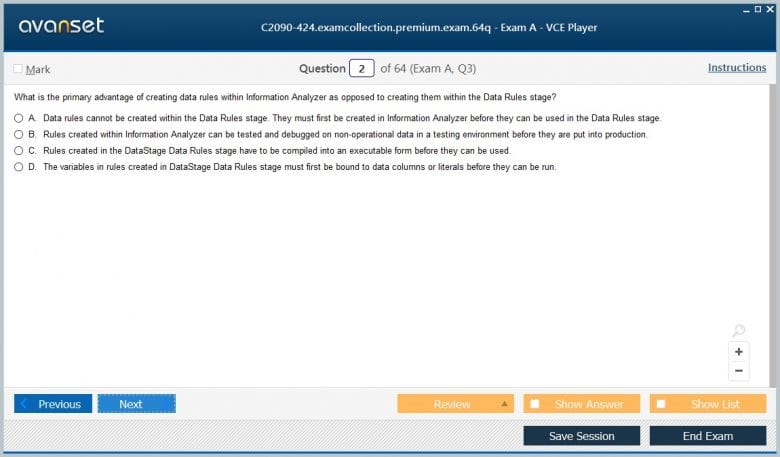

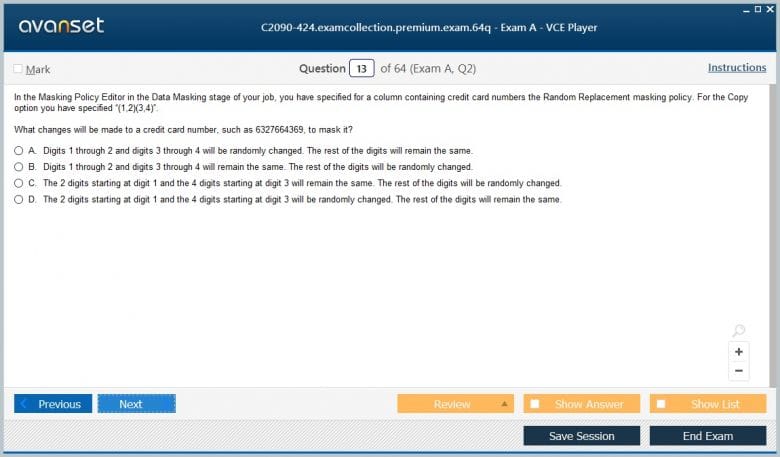

IBM C2090-424 Practice Test Questions in VCE Format
| File | Votes | Size | Date |
|---|---|---|---|
File IBM.questionpaper.C2090-424.v2026-09-14.by.aaron.36q.vce |
Votes 1 |
Size 54.02 KB |
Date Sep 14, 2026 |
File IBM.Testkings.C2090-424.v2019-01-19.by.Andrew.35q.vce |
Votes 2 |
Size 484.56 KB |
Date Jan 24, 2019 |
File IBM.Braindumps.C2090-424.v2017-04-10.by.Holmes.65q.vce |
Votes 6 |
Size 80.54 KB |
Date Apr 18, 2017 |
IBM C2090-424 Practice Test Questions, Exam Dumps
IBM C2090-424 (InfoSphere DataStage v11.3) exam dumps vce, practice test questions, study guide & video training course to study and pass quickly and easily. IBM C2090-424 InfoSphere DataStage v11.3 exam dumps & practice test questions and answers. You need avanset vce exam simulator in order to study the IBM C2090-424 certification exam dumps & IBM C2090-424 practice test questions in vce format.
C2090-424, InfoSphere DataStage v11.3, tested the design, development, operation, and troubleshooting of parallel data-integration jobs. Version 11.3 is historical, while IBM DataStage continues today as a core data-integration service in Cloud Pak for Data and IBM’s broader data platform. That makes the old exam valuable when it is used to understand the parallel-engine mental model rather than as a claim about a current certification route.
DataStage work is fundamentally about moving and transforming data predictably. Sources must be read consistently, partitions must be chosen deliberately, transformations must preserve business meaning, rejects must be visible, and jobs must be restartable when infrastructure or data fails. The old exam covered stages and tools, but the deeper competency is data integration engineering: understand what each stage does to rows, partitions, metadata, ordering, and recoverability.
A job is easier to reason about when input and output schemas are explicit. Define column names, types, lengths, nullability, keys, formats, and business meaning before connecting stages. Runtime column propagation can be useful, but uncontrolled metadata drift can make jobs fragile. A downstream consumer needs to know whether a field is stable, derived, optional, or subject to version change.
Data contracts also include volume and timing. A source delivering ten thousand rows nightly is different from one delivering hundreds of millions under a narrow window. Determine expected row counts, skew, late arrival, duplicate behavior, and source consistency. The broader data-engineering foundation is the same: a pipeline should have a defined input promise and a defined output promise, not just a diagram of connected boxes.
The DataStage parallel engine distributes rows across processing nodes. Partitioning determines which rows reach which player, while collecting or repartitioning may be required for joins, sorts, aggregations, or output. Candidates should understand hash, round-robin, entire, same, and other partitioning choices in the historical context, and especially why an inappropriate choice creates skew or incorrect results.
Preserve partitioning only when the downstream operation can safely use the existing distribution. A developer who preserves it mechanically may avoid one redistribution while producing wrong grouping or join behavior. Conversely, unnecessary repartitioning consumes network and sort resources. Examine the logical requirement first: which rows must meet each other, which ordering is required, and which operations can remain embarrassingly parallel?
DataStage offers multiple ways to combine data. A lookup is effective when reference data is appropriately sized or managed; a join may be better when both inputs are large and partitioned on the key; a merge assumes compatible ordering and key relationships. Sorting can be expensive, so reuse valid ordering where possible and understand when a stage destroys or preserves it.
Do not choose stages only from row-count heuristics. Consider duplicate keys, unmatched rows, nulls, memory, spill behavior, partition skew, and whether the reference changes during the job. A technically fast join that silently drops unmatched business records is a failed design. Correctness rules should be stated before performance tuning begins.
The Transformer stage can derive columns, filter rows, use stage variables, apply functions, and implement conditional logic. Because it is flexible, it can also become a dense block of business rules that nobody can audit. Keep expressions named and organized, isolate reusable logic where appropriate, and test edge cases such as nulls, invalid dates, overflow, unexpected codes, and character-set issues.
Complex logic often benefits from being separated into visible steps even if one giant expression could produce the same result. This makes rejection, lineage, and testing clearer. A DataStage job is operational code. The person supporting it at 2 a.m. should be able to identify which rule rejected a row without reconstructing an entire mapping from nested expressions.
Reusable routines and shared containers should earn their abstraction. Reuse is valuable when the same tested logic truly applies in multiple jobs, but a generic container with many conditional branches can become harder to understand than duplicated simple logic. Define a clear contract for reusable components, version them deliberately, and test every consumer before changing shared behavior.
Stages such as Change Capture and Change Apply can compare before and after datasets when inputs are properly prepared. The key lesson is not the stage name; it is that change detection requires a stable way to identify records and a consistent view of old versus new state. Sort order, partitioning, duplicate keys, and late changes must be handled deliberately.
Incremental processing can dramatically reduce runtime, but it introduces state. Engineers need to know the last successfully processed point, how to replay after partial failure, and how deletes are represented. The same principle appears in modern database migration and change movement: incremental data is trustworthy only when the capture boundary and replay semantics are explicit.
Sequences can control dependencies, conditions, exceptions, notifications, loops, and restart behavior across multiple jobs. They should model business dependencies rather than merely run jobs in a convenient order. If a dimension load must finish before a fact load, encode that requirement. If one noncritical extract can fail without blocking the rest of the batch, make that behavior explicit as well.
Recovery design should identify the smallest safe restart unit. Repeating every upstream extract after one downstream failure wastes time and can produce inconsistent snapshots. But restarting only the failed stage may be unsafe if earlier state changed. Use checkpoints, parameters, staging tables, and idempotent outputs so a sequence can resume without guessing.
External dependencies should be modeled explicitly. If a file is expected from another system, define how arrival is detected, how partial transfers are avoided, and what happens after the cutoff time. If a database maintenance window overlaps the batch, the sequence should wait or fail cleanly rather than repeatedly opening connections. Scheduling is part of data correctness because processing an incomplete source at the wrong time can produce a technically successful but business-invalid dataset.
Notifications should include enough evidence for action: job or sequence name, run identifier, failed stage, error category, input period, and whether an automatic retry occurred. Generic “job failed” messages shift diagnostic work to the operator. Good operations make the first alert useful enough to decide whether the response is rerun, data correction, infrastructure escalation, or waiting for an upstream dependency.
Large jobs should also be tested for data skew. Average rows per partition can look acceptable while one key sends a disproportionate share of work to a single player, making the other players idle. Inspect partition counts and key distributions before adding compute. Remedies may include a different partition key, pre-aggregation, salting, or redesigning the join so one hot value does not determine total elapsed time.
Target systems impose their own limits. A parallel job can generate writes faster than a database, API, or file service can safely consume them. Tune array sizes, commit intervals, partition counts, and connection concurrency with the target owner. Maximizing DataStage throughput in isolation can produce lock storms, log pressure, throttling, or duplicate retry behavior downstream.
DataStage monitoring and job score information help reveal where processes run and how data moves. Candidates should interpret whether the design is CPU-bound, I/O-bound, waiting on a source, spilling during sort, skewed across partitions, or blocked by a slow target. Tuning should be based on observed bottlenecks rather than automatically increasing node count.
More parallelism can make a job slower if it increases redistribution, contention, or target pressure. Likewise, reducing stages may make a graph less readable without changing the expensive operation. Measure rows per second, partition balance, stage elapsed time, source and target capacity, and spill behavior. Optimize the constraint that controls end-to-end completion time.
Test data should exercise failure paths as deliberately as successful paths. Include duplicate keys, malformed values, empty inputs, very large rows, unexpected character sets, and target outages. Verify reject files or tables and confirm operators can replay corrected data without manually editing production datasets. A pipeline that succeeds only with clean inputs is not production-ready.
Projects, parameter sets, environment variables, configuration files, credentials, and runtime paths let the same logical job move between development, test, and production. Hard-coded server names or file paths create fragile deployments. Parameterize what legitimately differs by environment while keeping business logic consistent. Protect secrets through platform mechanisms rather than exposing them in job designs or scripts.
Promotion should be reproducible. Exported assets, version control, deployment procedures, and validation checks should make it possible to identify exactly which job definition is running in production. The article on controlled data migration and synchronization illustrates the broader operational concern: movement between environments needs traceability and clear failure boundaries.
Modern DataStage keeps the integration problem while changing the platform. IBM’s current DataStage service still emphasizes graphical flows, enterprise connectivity, parallel processing, and movement between operational, analytical, cloud, and other systems. Modern runtimes and interfaces differ from v11.3, so legacy commands or deployment assumptions must be revalidated. What survives is the engineering logic around metadata, partitioning, transformation, sequencing, observability, and recoverability.
Use IBM certifications to keep C2090-424 in historical context. When studying, ask what every stage does to data order, partition, schema, error handling, and restartability. If you can answer those questions, you are learning DataStage as an integration platform rather than memorizing a legacy canvas.
Go to testing centre with ease on our mind when you use IBM C2090-424 vce exam dumps, practice test questions and answers. IBM C2090-424 InfoSphere DataStage v11.3 certification practice test questions and answers, study guide, exam dumps and video training course in vce format to help you study with ease. Prepare with confidence and study using IBM C2090-424 exam dumps & practice test questions and answers vce from ExamCollection.
Purchase Individually
Site Search:

SPECIAL OFFER: GET 10% OFF

Pass your Exam with ExamCollection's PREMIUM files!
SPECIAL OFFER: GET 10% OFF
Use Discount Code:
MIN10OFF
A confirmation link was sent to your e-mail.
Please check your mailbox for a message from support@examcollection.com and follow the directions.

Download Free Demo of VCE Exam Simulator
Experience Avanset VCE Exam Simulator for yourself.
Simply submit your e-mail address below to get started with our interactive software demo of your free trial.