



Premium File
123 Q&A
$76.99$69.99
IBM C2090-320 Exam Questions & Answers, Accurate & Verified By IT Experts
Instant Download, Free Fast Updates, 99.6% Pass Rate
123 Questions & Answers
Last Update: Nov 02, 2026
$69.99
IBM C2090-320 Exam Screenshots
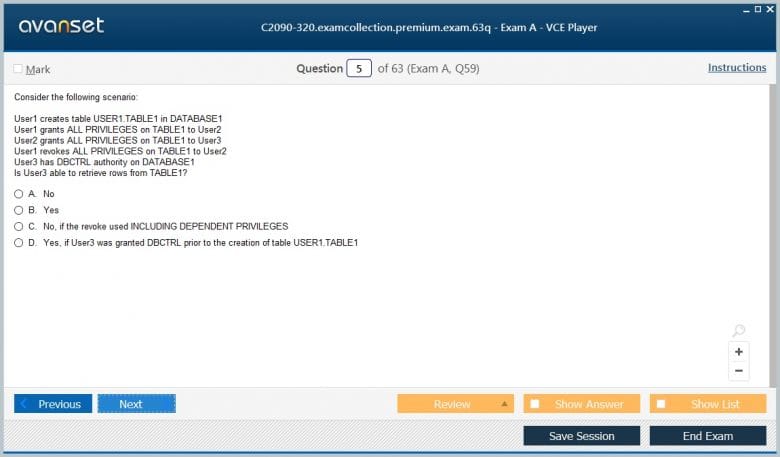
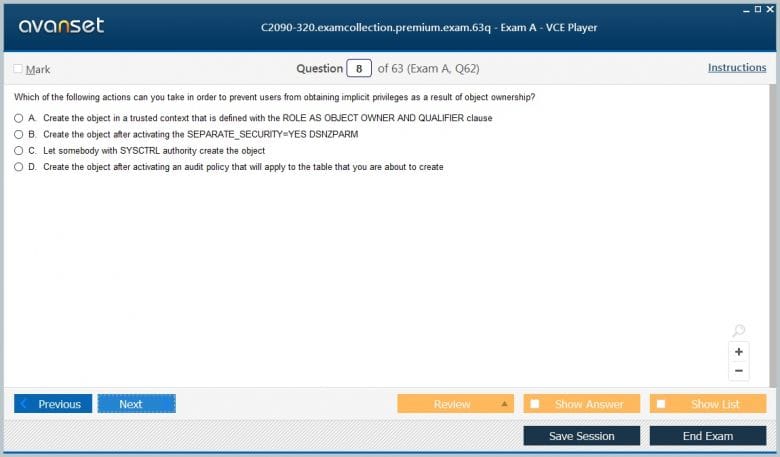
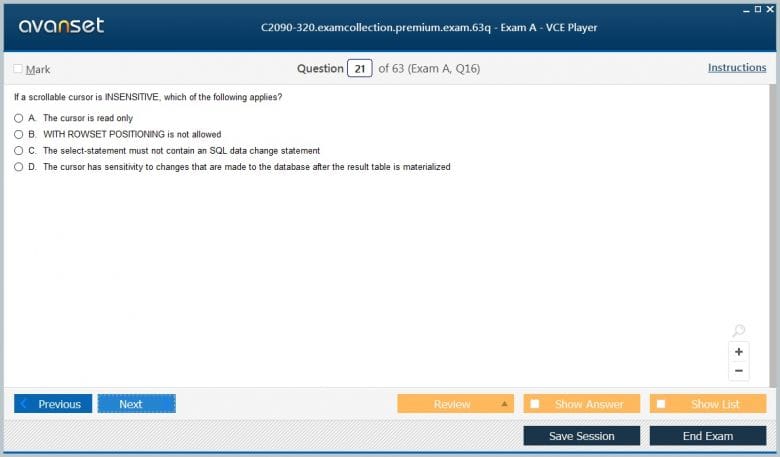
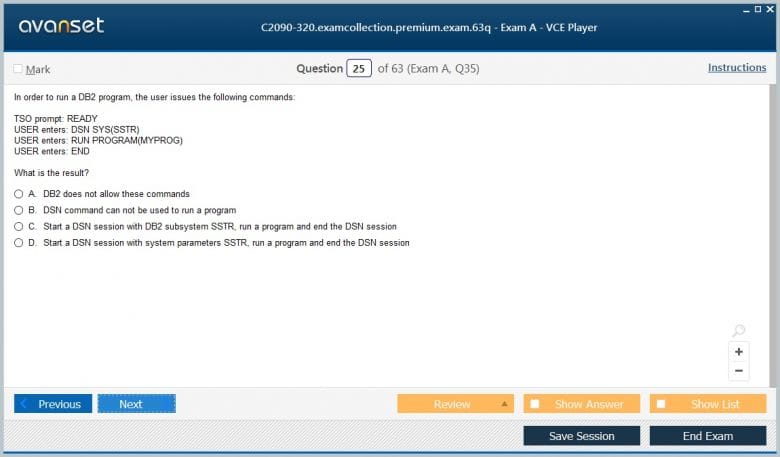
IBM C2090-320 Practice Test Questions in VCE Format
| File | Votes | Size | Date |
|---|---|---|---|
File IBM.Actualtests.C2090-320.v2026-09-14.by.Bat.61q.vce |
Votes 5 |
Size 389.94 KB |
Date Sep 16, 2026 |
IBM C2090-320 Practice Test Questions, Exam Dumps
IBM C2090-320 (DB2 11 Fundamentals for z/OS) exam dumps vce, practice test questions, study guide & video training course to study and pass quickly and easily. IBM C2090-320 DB2 11 Fundamentals for z/OS exam dumps & practice test questions and answers. You need avanset vce exam simulator in order to study the IBM C2090-320 certification exam dumps & IBM C2090-320 practice test questions in vce format.
C2090-320, DB2 11 Fundamentals for z/OS, is an older IBM exam that introduced the database concepts beneath mainframe application and administration work. Db2 11 itself is no longer the current release—IBM’s active documentation is for Db2 13 for z/OS—but the fundamentals remain valuable because relational objects, SQL, transactions, locking, utilities, security, application packages, and recovery still form the conceptual vocabulary of the platform.
The right way to use this exam today is as a structured foundation, not as evidence of a current credential. Learn what each object does, how SQL interacts with it, how Db2 preserves consistency, and where operational responsibilities begin. Then validate version-specific behavior in Db2 13. This prevents a common failure mode in legacy study: remembering terminology without understanding how the database turns a logical request into protected, recoverable work.
Tables represent entities or relationships; columns carry defined types; primary and unique keys identify rows; foreign keys express relationships; check constraints and triggers enforce additional rules. Candidates should be able to reason about what belongs in each table and how referential integrity protects the model. Normalization reduces unnecessary duplication, although practical designs may also balance performance and application simplicity.
The broader comparison of relational and NoSQL databases helps clarify why Db2 fundamentals matter: the relational model gives applications a strong contract around schema, constraints, SQL, and transactions. That contract is especially valuable for core business systems where inconsistent records are more costly than the flexibility gained from unstructured storage.
A table does not exist in isolation. Databases, table spaces, indexes, storage groups, partitions, views, aliases, sequences, and other objects help organize data and access. A fundamentals candidate should know which objects store data, which provide alternate access or representation, and which exist primarily for administration. The physical layer matters because object choices influence utility scope, storage, performance, and recovery.
Indexes are a useful example. They can enforce uniqueness and accelerate access, but every additional index consumes space and maintenance work during insert, update, load, and recovery. An index should exist because it supports a constraint or important access pattern, not because “indexes make queries faster” in the abstract. The same trade-off thinking applies to partitioning and clustering.
Views provide a useful example of logical abstraction. They can simplify access, hide unnecessary columns, or present joined information without duplicating stored data, but they do not remove the need to understand the underlying objects and privileges. Fundamentals study should distinguish logical convenience from physical storage.
SELECT, INSERT, UPDATE, DELETE, MERGE, joins, subqueries, predicates, grouping, ordering, scalar functions, and set operations express how applications interact with relational data. Candidates should understand result semantics and how nulls, data types, collation, and predicate logic affect answers. Practice by predicting the result of a statement before worrying about optimization.
A resource such as common SQL query patterns can strengthen syntax fluency, but z/OS Db2 study should go further. Ask how the statement will access data, what locks it may acquire, whether it can use an index, which package executes it, and how a failure affects the unit of work. SQL is part of a managed transaction environment, not a standalone query language.
Temporal and historical data features add another dimension to transaction reasoning. Db2 can maintain business-time or system-time information so applications can ask what was valid at a particular point. Even when a fundamentals learner does not administer those features, understanding the distinction between current state and historical state helps explain why schema design, timestamps, and transaction boundaries need precise semantics.
Application developers should also know where commit frequency affects performance. Committing after every row increases log and coordination overhead, while committing too rarely increases lock duration, rollback cost, and log pressure. The business unit of work should determine the primary boundary, with performance tuning occurring inside that correctness constraint.
A unit of work groups changes that should commit or roll back together. Commit establishes a recoverable boundary and releases resources according to database behavior; rollback reverses uncommitted work. Applications that hold transactions open while waiting for user input create unnecessary locks and log activity. Candidates should understand why transaction boundaries belong close to the business action being protected.
Isolation level determines how one unit of work interacts with changes made by others. Stronger isolation can protect repeatable results but reduce concurrency; weaker isolation can increase throughput but permit additional phenomena. The correct choice depends on the application’s correctness requirement. Fundamentals study should make you comfortable explaining the trade-off rather than simply naming isolation levels.
Db2 locks resources so concurrent transactions do not corrupt one another. Lock size, duration, escalation, timeouts, and deadlocks all affect application behavior. A lock is not automatically a problem; it is part of consistency control. Problems arise when the lock scope is larger or longer than the workload can tolerate, or when two units of work acquire resources in conflicting order.
The exam’s questions about row, page, partition, table, or table-space locking become more useful when tied to scenarios. Consider an online transaction touching one customer row, a batch job scanning millions of rows, and a utility reorganizing an object. Their concurrency needs differ. A database professional should be able to predict which workload could block another and what design or scheduling change reduces the conflict.
Static SQL is prepared and bound into packages so Db2 can validate objects, privileges, and access paths before or during deployment according to the application model. Dynamic SQL is prepared at runtime. Candidates should know the purpose of packages, collections, plans, and bind options at a conceptual level, because they explain why an application can fail even when the SQL text itself looks valid.
The optimizer uses statistics and available indexes to choose access paths. That makes catalog information and RUNSTATS operationally important even at the fundamentals level. A table can contain correct data while an application performs badly because the optimizer has a poor estimate. The advanced administration concerns appear in C2090-312, but the foundation starts with understanding what an access path is and why it changes.
Object states are a useful bridge from fundamentals to administration. Certain interrupted or incomplete utility operations can leave a table space or index in a state that limits normal access until follow-up work is completed. Recognizing that the catalog can describe an object as logically present yet operationally restricted helps candidates understand why utilities, recovery, and application availability are inseparable.
Db2 utilities support loading, unloading, copying, recovering, reorganizing, checking, and collecting statistics. Fundamentals candidates do not need to become utility specialists, but they should understand why utilities exist and what operational state they can create. Bulk work should be managed through mechanisms designed for logging, restart, object status, and high-volume data movement rather than improvised one-row operations.
This is where data integrity and operations meet. A load can be fast but still require constraint validation; a reorganization can improve clustering but consume a maintenance window; an image copy provides a recovery asset only if it is cataloged and usable with required logs. The principles in database recovery planning make the purpose of those utilities much easier to remember.
Db2 privileges determine who can create objects, read or modify data, bind packages, execute plans, or administer the subsystem. Granting broad authority to make an application work creates long-term risk. Candidates should understand object privileges, administrative authorities, ownership, and the idea that applications should execute with the minimum rights needed for their function.
Authorization also interacts with deployment. A developer may be able to test SQL but lack authority to bind in production; a service account may execute a package without direct table privileges depending on the security model. Those patterns reinforce a core enterprise principle: identity, code deployment, and data access should be intentionally separated so one credential does not become a universal bypass.
Data definition authority should be especially controlled because creating or altering objects can change both security and performance. A seemingly simple column or index change may force package rebinds, increase storage, or alter access paths. Fundamentals learners should recognize DDL as operational change, not merely a development convenience. Production schema changes belong in a tested release process with rollback or recovery planning.
Recovery and current-version context complete the fundamentals picture. Logs, copies, checkpoints, object states, and utilities provide the mechanisms that let Db2 survive failures. Even an entry-level candidate should understand that committed work must be recoverable and that database availability depends on planning before an incident. The language of database recovery is useful because it connects technical mechanisms to business expectations about loss and downtime.
C2090-320 belongs to the Db2 11 era, while modern study should validate behavior against Db2 13 for z/OS. The IBM certifications catalog keeps C2090-320 in its historical credential context. If you can explain objects, SQL, transactions, locks, packages, utilities, privileges, and recovery as one coherent system, you have the foundation needed to learn current Db2 administration without being trapped by legacy memorization.
Recovery thinking also teaches why logs, commits, and utilities belong in the same mental model. A transaction determines what must be preserved atomically; logs record the changes; image copies shorten the path back to a usable object; utilities reconstruct state; and application testing confirms business consistency. Seeing those pieces together makes many isolated exam terms much easier to retain.
Go to testing centre with ease on our mind when you use IBM C2090-320 vce exam dumps, practice test questions and answers. IBM C2090-320 DB2 11 Fundamentals for z/OS certification practice test questions and answers, study guide, exam dumps and video training course in vce format to help you study with ease. Prepare with confidence and study using IBM C2090-320 exam dumps & practice test questions and answers vce from ExamCollection.
Purchase Individually
Site Search:

SPECIAL OFFER: GET 10% OFF

Pass your Exam with ExamCollection's PREMIUM files!
SPECIAL OFFER: GET 10% OFF
Use Discount Code:
MIN10OFF
A confirmation link was sent to your e-mail.
Please check your mailbox for a message from support@examcollection.com and follow the directions.

Download Free Demo of VCE Exam Simulator
Experience Avanset VCE Exam Simulator for yourself.
Simply submit your e-mail address below to get started with our interactive software demo of your free trial.