

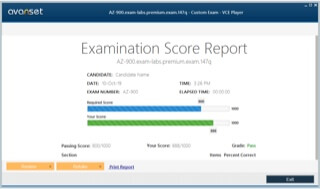

Premium File
67 Q&A
$76.99$69.99
IBM C2070-994 Exam Questions & Answers, Accurate & Verified By IT Experts
Instant Download, Free Fast Updates, 99.6% Pass Rate
67 Questions & Answers
Last Update: Sep 21, 2026
$69.99
IBM C2070-994 Exam Screenshots
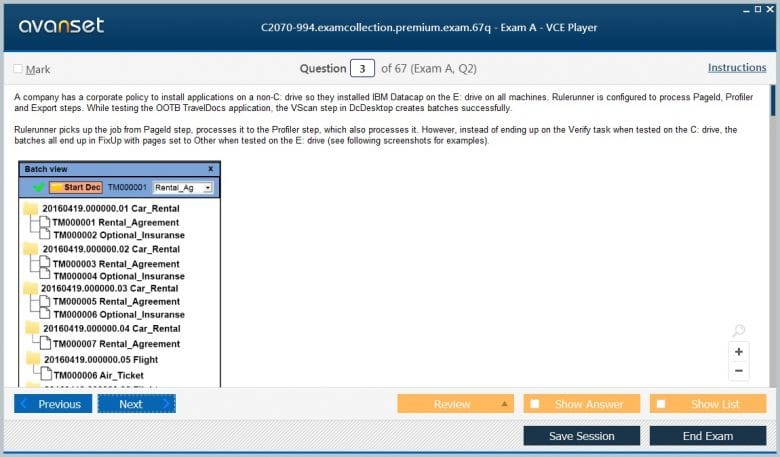
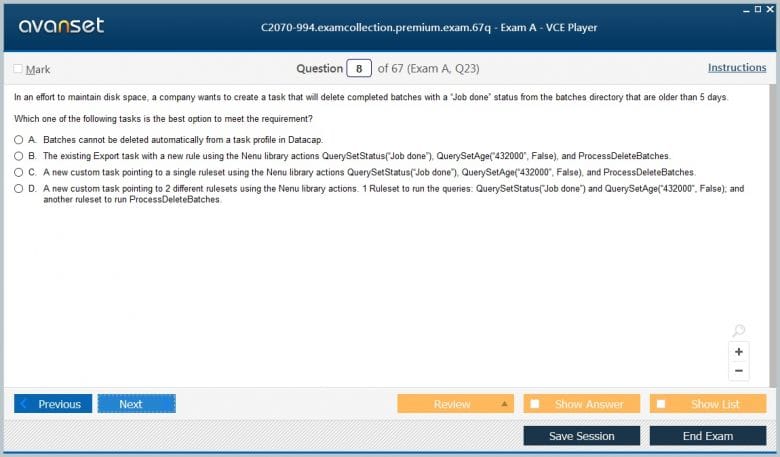
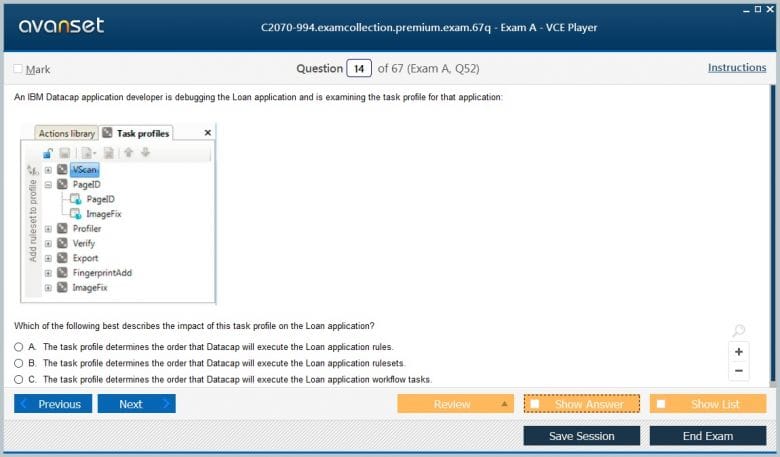
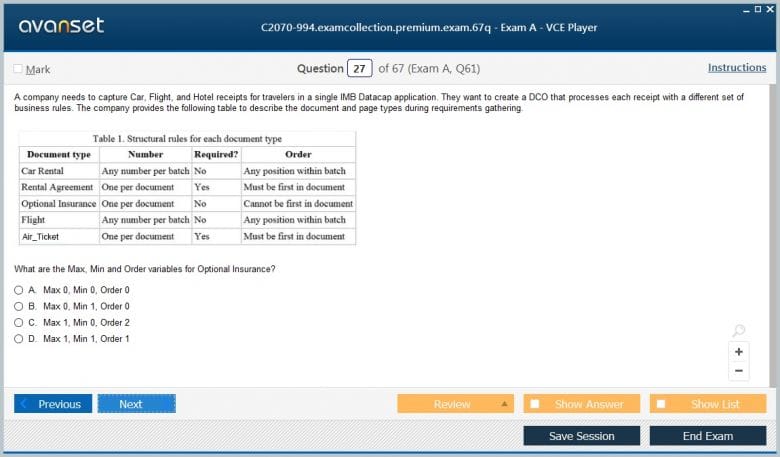
IBM C2070-994 Practice Test Questions in VCE Format
| File | Votes | Size | Date |
|---|---|---|---|
File IBM.Passcertification.C2070-994.v2026-08-22.by.Bat.39q.vce |
Votes 3 |
Size 95.29 KB |
Date Aug 22, 2026 |
IBM C2070-994 Practice Test Questions, Exam Dumps
IBM C2070-994 (IBM Datacap V9.0 Solution Designer) exam dumps vce, practice test questions, study guide & video training course to study and pass quickly and easily. IBM C2070-994 IBM Datacap V9.0 Solution Designer exam dumps & practice test questions and answers. You need avanset vce exam simulator in order to study the IBM C2070-994 certification exam dumps & IBM C2070-994 practice test questions in vce format.
C2070-994, IBM Datacap V9.0 Solution Designer, tested the design of document-capture solutions that ingest pages, recognize content, classify documents, extract fields, validate uncertain results, route human exceptions, and export trusted data or images to downstream systems. The Datacap V9.0 solution-design certification is historical, but Datacap remains an active IBM product family and the core design problem is still current: turn messy incoming documents into controlled business information.
Current IBM support materials show Datacap 9.1.9 receiving fixes and integrations, while intelligent document processing has expanded around AI-assisted classification and extraction. That means old exam objectives should be read as the foundation of a capture pipeline rather than a current certification promise. The strongest preparation focuses on batch architecture, rules, recognition, verification, security, scaling, monitoring, and export behavior that make a capture application dependable under production load.
A solution designer first inventories the documents: where they arrive, how many pages they contain, whether they are structured forms or variable layouts, what languages and image qualities are common, which fields are required, and which legal or operational rules govern retention. Scanners, watched folders, email, uploaded PDFs, mobile images, and other channels create different error patterns. Starting with OCR settings before understanding that variation leads to brittle applications.
The business process also matters. A supplier invoice may need vendor, date, invoice number, purchase order, amounts, and tax. An insurance claim may need policy, claimant, loss date, signatures, and attachments. The extraction target should be the minimum reliable information needed by the downstream process, not every visible character. Modern document automation follows the same principle even when machine learning replaces some of the older recognition techniques.
Datacap solutions organize work into batches and tasks such as scan, recognition, page identification, validation, verification, and export. Each task changes the state of the batch and may run on different stations or servers. Candidates should understand where rules execute, how batch variables and document hierarchy are used, and what makes a task eligible for the next step. A good flow prevents partially processed data from escaping into production systems.
Task design should also support restart. If recognition fails on page 800 of a large batch, operators should not have to repeat scanning. If an export target is unavailable, the batch should remain recoverable and clearly marked. Design checkpoints around expensive or irreversible operations, preserve logs, and decide which failures can retry automatically versus which need human review. These decisions determine throughput and supportability more than small recognition optimizations.
Documents can be recognized by barcodes, text zones, fingerprints, keyword patterns, page order, separator sheets, layout, or other rules. A robust application combines evidence appropriate to the document set instead of assuming every page will match a perfect template. Candidates should understand how the classification step affects downstream extraction because the wrong document type can apply the wrong field rules and produce plausible but incorrect data.
Confidence thresholds should be tuned with real samples. A high threshold reduces false classification but increases manual exceptions; a low threshold improves straight-through processing while risking incorrect routing. The right setting depends on the cost of each failure. The article on intelligent document extraction provides a useful modern comparison: automation should be judged by trustworthy output and exception handling, not simply by the percentage of pages processed without a person.
OCR, OMR, barcode recognition, and other extraction methods depend on input quality. Skew, noise, compression, faint printing, handwriting, stamps, background graphics, and poor scanning can produce uncertainty. Preprocessing may improve recognition, but it can also remove useful information if applied blindly. Designers should keep representative bad examples in the test set rather than validating only clean laboratory documents.
Field definitions should include expected data type, length, pattern, dictionaries, validation rules, and relationships to other fields. A date should be checked as a date; a total can be reconciled against line items; a purchase-order number can be checked against a downstream system. Combining recognition confidence with business validation is much stronger than accepting text merely because the engine returned a value.
Image normalization should be reversible where possible. Retain the original or a controlled master image when legal or operational requirements demand it, and record which processing steps produced the recognition copy. This is important when users dispute an extracted value or when recognition rules are improved later. Without the source image and processing history, teams cannot distinguish a bad scan from a bad recognition rule.
Human verification belongs where the expected cost of an incorrect value is higher than the cost of review. Datacap can route low-confidence or rule-failing fields for verification while allowing high-confidence documents to proceed. Designers should decide what the verifier sees, whether the image is highlighted, which fields can be changed, and what happens after correction. The goal is a fast, evidence-rich exception path.
Measure verification by cause. If the same field repeatedly requires correction, investigate scan quality, recognition configuration, template design, supplier variation, or an upstream document change. Simply adding more operators hides the defect. A mature capture service uses human corrections as operational feedback that improves rules and document standards over time.
Capacity testing should use realistic document mixes rather than a single clean sample. A batch of typed one-page forms may move quickly while long PDFs, handwriting, image enhancement, or complex recognition consume much more CPU and memory. Measure the slowest common document classes and model the verification workforce as part of the system. Straight-through automation can move the bottleneck from recognition to export or from machines to human queues, so end-to-end throughput is the only useful capacity measure.
High availability also needs a task-level design. If a recognition worker is lost, another worker should be able to take eligible work without corrupting batch state. Shared storage, queue ownership, service accounts, and station configuration must be understood before introducing failover. A resilient design avoids assumptions that a particular Windows host will always process one stage of the application.
Background tasks such as recognition and export can be distributed through Rulerunner services. Candidates should understand task scheduling, threads, stations, logging, and how server resources affect throughput. Capacity must be planned around peak arrival rates, page complexity, OCR cost, export latency, and the number of batches waiting for human work. Average daily volume can be misleading when most documents arrive in a short business window.
Operational monitoring should distinguish a healthy queue from a stalled one. Track throughput by task, oldest-batch age, retry frequency, recognition error rate, verification backlog, and export failures. Current Datacap 9.1.9 even includes dedicated health-monitoring capabilities, reinforcing the older exam lesson that capture is a production service. Performance is not only how fast one document is recognized; it is how predictably the entire pipeline drains under load.
Capture systems can process invoices, identity documents, claims, contracts, medical forms, or other sensitive records. Users should be authenticated appropriately, stations should have only the privileges they need, and service identities should be controlled. Designers must consider where images and extracted values are stored during processing, who can view failed batches, and whether logs expose confidential data.
Downstream export adds another trust boundary. Credentials, transport encryption, destination permissions, and duplicate prevention need explicit design. If a batch is retried after a network failure, the system should not create a second business transaction without detection. Security therefore intersects with recoverability: a controlled pipeline knows who performed an action, what data moved, and whether the target acknowledged it.
Archive and retention behavior should be tested at the export boundary as well. Some organizations keep original images, normalized images, extracted metadata, audit logs, and exception notes for different periods. Define which representation is authoritative and which can be purged after successful delivery. Without a retention model, capture platforms quietly become secondary content repositories and accumulate storage that nobody knows how to govern.
The capture process is only useful when recognized information reaches its destination with the correct metadata and document images. Export might create records in a content repository, line-of-business system, file structure, database, or integration service. Map fields explicitly, define naming and collision behavior, validate mandatory data, and test what happens when the destination rejects a record. Treat export as a transaction boundary rather than a simple file copy.
The modern Cloud Pak for Business Automation architecture offers a useful forward-looking context because document capture increasingly participates in broader workflows and decision services. The older Datacap exam still teaches the essential boundary: extraction should produce governed data that can safely enter those processes. A fast OCR result with weak validation and export controls only automates the creation of downstream defects.
Use V9.0 as a design baseline, then validate current Datacap behavior. C2070-994 is a legacy certification page, but the capture concepts remain concrete. Start from document variation, define the batch lifecycle, combine classification signals, validate extracted fields, route exceptions, distribute work, monitor queues, secure sensitive content, and test export recovery. Those disciplines remain relevant even as AI-assisted extraction changes the recognition engine.
For current work, verify functions and supported integrations against Datacap 9.1.9 and the surrounding IBM automation stack rather than assuming V9.0 procedures are unchanged. The IBM certifications catalog keeps C2070-994 in its historical credential context while current Datacap work follows supported product documentation. The best legacy study outcome is the ability to design a capture service that produces trusted business data under imperfect document conditions.
Go to testing centre with ease on our mind when you use IBM C2070-994 vce exam dumps, practice test questions and answers. IBM C2070-994 IBM Datacap V9.0 Solution Designer certification practice test questions and answers, study guide, exam dumps and video training course in vce format to help you study with ease. Prepare with confidence and study using IBM C2070-994 exam dumps & practice test questions and answers vce from ExamCollection.
Purchase Individually
Site Search:

SPECIAL OFFER: GET 10% OFF

Pass your Exam with ExamCollection's PREMIUM files!
SPECIAL OFFER: GET 10% OFF
Use Discount Code:
MIN10OFF
A confirmation link was sent to your e-mail.
Please check your mailbox for a message from support@examcollection.com and follow the directions.

Download Free Demo of VCE Exam Simulator
Experience Avanset VCE Exam Simulator for yourself.
Simply submit your e-mail address below to get started with our interactive software demo of your free trial.