



Premium File
61 Q&A
$76.99$69.99
IBM C1000-010 Exam Questions & Answers, Accurate & Verified By IT Experts
Instant Download, Free Fast Updates, 99.6% Pass Rate
61 Questions & Answers
Last Update: Sep 03, 2026
$69.99
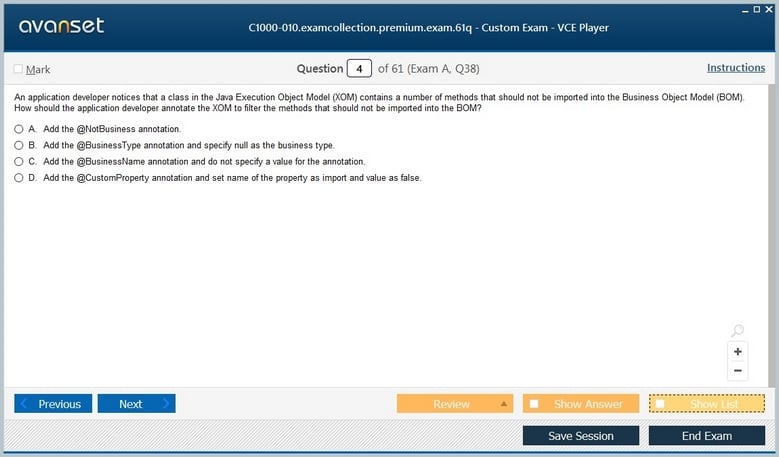
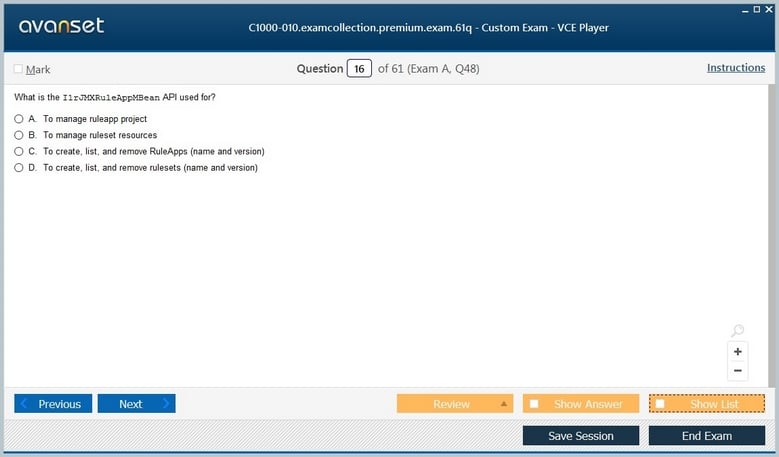
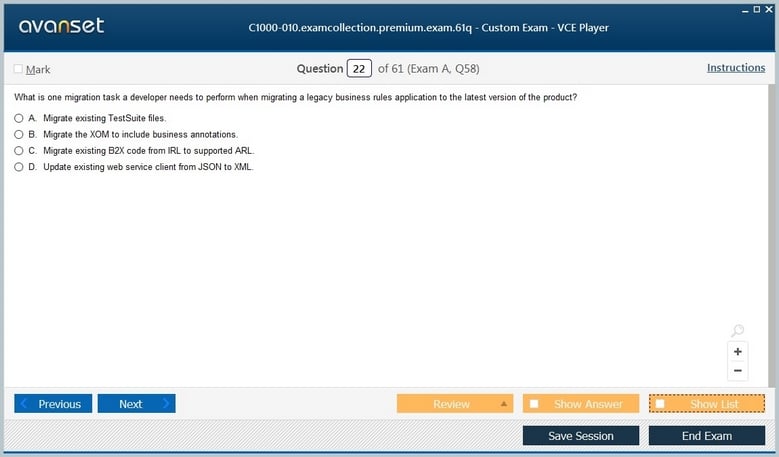
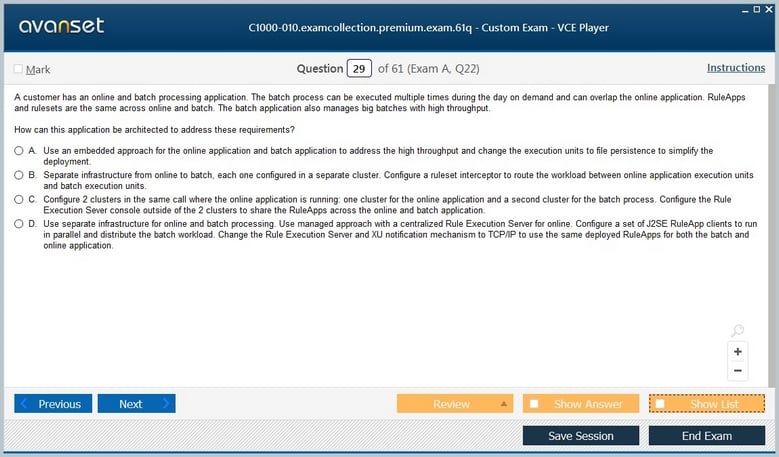
IBM C1000-010 Exam Screenshots
IBM C1000-010 Practice Test Questions in VCE Format
| File | Votes | Size | Date |
|---|---|---|---|
File IBM.examdumps.C1000-010.v2026-08-19.by.david.33q.vce |
Votes 1 |
Size 680.66 KB |
Date Aug 19, 2026 |
File IBM.Prep4sure.C1000-010.v2019-01-18.by.Mia.25q.vce |
Votes 2 |
Size 106.61 KB |
Date Jan 22, 2019 |
IBM C1000-010 Practice Test Questions, Exam Dumps
IBM C1000-010 (IBM Operational Decision Manager Standard V8.9.1 Application Development) exam dumps vce, practice test questions, study guide & video training course to study and pass quickly and easily. IBM C1000-010 IBM Operational Decision Manager Standard V8.9.1 Application Development exam dumps & practice test questions and answers. You need avanset vce exam simulator in order to study the IBM C1000-010 certification exam dumps & IBM C1000-010 practice test questions in vce format.
C1000-010 is the IBM Operational Decision Manager Standard V8.9.1 Application Development exam. Its scope centers on developers who build and manage decision services rather than burying business policy inside ordinary application code. The key idea is separation: applications provide data and request decisions, while rules and decision artifacts express policy that can be authored, governed, tested, versioned, and deployed on their own lifecycle.
Because the code and version are older, candidates should confirm the current IBM certification catalogue before assuming the exam is still the right scheduling target. The technical blueprint remains valuable, especially for organizations that still operate ODM 8.9.x or later systems with the same architectural concepts. Study it as a decision-automation discipline: model vocabulary clearly, organize rules, manage versions, test outcomes, deploy controlled rule sets, and monitor how applications consume them.
Rules are only maintainable when business concepts have stable names and meanings. ODM separates technical object models from a business vocabulary so authors can express decisions in language closer to policy. Developers need to understand how entities, attributes, relationships, and derived values become terms that rule authors can use consistently.
Build a simple underwriting or eligibility domain and challenge every ambiguous term. Does “customer age” mean age today or at application date? Does “annual income” include bonuses? Does “high risk” come from a score or a list of conditions? This exercise shows why vocabulary design is not cosmetic. Ambiguity at the model layer becomes inconsistent rules later.
ODM's separation between an execution object model and a business-facing vocabulary is important because policy authors should not need to think in application-class names. The technical model represents the data that an application can supply; the business model exposes understandable terms, phrases, and relationships for rule authors. When those layers drift apart, teams either expose implementation details to policy owners or hide transformations inside rules. Keeping the mapping explicit makes a decision service easier to test, explain, and evolve when application structures change.
A decision service is not just a collection of if-statements moved into another product. Rules need meaningful granularity, predictable priorities, clear dependencies, and an execution model that produces explainable results. Developers should know when a decision table is clearer than individual action rules, how rule flows sequence logic, and how to keep technical plumbing out of policy expressions.
The goal is to make change safer. When a threshold, classification, or exception changes, the organization should be able to update the decision artifact without rewriting unrelated application behavior. That is the practical value of automation as a controlled system: the automated step should have explicit inputs, outputs, ownership, and recovery rather than becoming invisible business logic.
Tables make multi-condition policy readable, but they can also hide gaps and conflicts. Candidates should practice checking whether rows overlap, whether every expected input range has a result, and whether rule order changes the outcome. Add boundary values deliberately because a policy that says “over 50” behaves differently at exactly 50.
Create tests directly from the table structure. For each boundary, choose a value on both sides; for each combination, verify the expected action. Then add a case that should match no row and decide whether that is valid or a defect. This converts a visual artifact into an executable specification and reduces the chance that an apparently tidy table contains contradictory logic.
ODM’s value increases when business and technical teams can collaborate without losing control. Decision Center supports rule organization, branching, review, testing, and governance. Developers should understand how a rule project moves from authoring through validation and approval, and how different roles interact with the same body of policy.
Versioning deserves particular attention. A business team may need to prepare next quarter’s policy while production continues to use the current version. Branches, baselines, merges, and release discipline let teams manage that overlap. The principle is similar to source control, but the review language and ownership may be business-focused rather than developer-focused.
Governance also includes how teams branch, review, and reconcile policy work. Multiple rule authors can legitimately change different parts of the same decision logic, so a controlled workflow should identify ownership, review gates, effective dates, and conflicts before deployment. A policy change that is syntactically valid can still contradict another rule or become effective at the wrong time. Treating Decision Center as a governed collaboration environment, rather than a shared file cabinet, is what allows business agility without losing traceability.
A production application needs a stable deployable unit. ODM packages decision logic into RuleApps and rulesets that can be versioned and deployed to the execution environment. Candidates should understand how project structure maps to those artifacts, how an application selects the correct ruleset, and what happens when a deployment changes without a coordinated application release.
Treat each deployed ruleset as an API dependency. Define input and output contracts, version expectations, rollback steps, and release evidence. API contract discipline is relevant because an apparently internal decision endpoint can still break consumers if vocabulary, types, or response structures change unexpectedly.
Runtime packaging should be designed for repeatability. A RuleApp or ruleset should have a known version, known dependencies, and a promotion path through test and production environments. Operations teams need to know which rules are active and how to return to a previous deployment if a policy change causes unexpected outcomes. That means decision deployment benefits from the same release controls used for application code, even though the change may have originated with business users rather than developers.
Rules may execute inside high-volume transaction paths, so latency, concurrency, caching, and availability matter. A technically correct decision that adds unacceptable delay can still fail the business requirement. Developers should know what belongs in the decision service and what data should be prepared before the call rather than fetched repeatedly during rule execution.
Model operational failures too. What should the application do if the decision service is unavailable? Can a request be retried safely? Is there a default outcome, a queue, or a manual-review path? Decision automation should reduce uncertainty, not create a single opaque dependency that stops the entire process when one service is unavailable.
Service design should also account for contract and query shape. A decision request that sends an oversized object graph wastes serialization and execution time, while a contract that omits decision-relevant context forces hidden lookups or duplicated rules. The interface should carry the smallest complete set of facts needed for the decision and return outputs that the caller can interpret without knowing internal rule structure. That boundary makes a decision service easier to reuse across channels and protects rule evolution from becoming an application-integration problem.
ODM supports testing because policy correctness is the central product. Build suites around representative and adversarial data: boundaries, missing fields, conflicting conditions, exceptional customers, and historical policy dates. A passing test should identify the rule outcome and, where relevant, the reasoning that produced it.
Regression testing is especially important when multiple rules interact. A change intended for one segment can alter another because of priorities or shared conditions. Keep scenario tests close to policy examples, and make them understandable to reviewers who are not programmers. The best test suite becomes a shared contract between policy owners and developers.
Regression testing is strongest when examples are organized around policy boundaries: just below and above a threshold, overlapping classifications, missing facts, effective-date transitions, and exceptions that override the normal outcome. Those cases catch errors that ordinary unit tests often miss. They also provide evidence for reviewers because the team can show not only that a ruleset executed, but that it produced the expected business decision for the exact combinations most likely to create ambiguity.
A decision typically tells a process what to do next: approve, reject, route, price, request evidence, or escalate. That makes IBM Business Automation Workflow a useful adjacent concept even though it is a separate product and credential. ODM answers the policy question; a workflow engine coordinates the work that follows. Keeping those responsibilities separate improves maintainability.
Practice with an end-to-end scenario. A claim arrives, a decision service classifies risk, the process routes low-risk cases automatically and sends unusual cases to an analyst, then later evidence triggers a new decision. The important design question is which component owns state, which owns policy, and how the system records enough evidence to explain the final outcome.
In a larger automation architecture, ownership of the decision should remain clear. The workflow can gather facts, route work, and react to the result, while ODM owns policy that changes on its own cadence. Duplicating the same threshold in a process script, user interface, and ruleset creates contradictory sources of truth. A cleaner design lets applications call a named decision service and records the returned outcome and rule version when auditability matters.
Study the blueprint as a decision-engineering discipline. Within the IBM certifications, product versions and exam codes change, but the ODM development skills remain recognizable: model the domain, create business-readable rules, control lifecycle and versions, deploy stable decision services, integrate through explicit contracts, and test policy behavior comprehensively.
Use the exam page as a version-specific technical reference and verify current IBM exam administration separately. If you support ODM V8.9.1, align every study topic with the documentation for that release. If you work on a newer automation platform, carry forward the architectural lesson: policy changes faster and is governed differently from ordinary application code, so it deserves its own engineering lifecycle.
Go to testing centre with ease on our mind when you use IBM C1000-010 vce exam dumps, practice test questions and answers. IBM C1000-010 IBM Operational Decision Manager Standard V8.9.1 Application Development certification practice test questions and answers, study guide, exam dumps and video training course in vce format to help you study with ease. Prepare with confidence and study using IBM C1000-010 exam dumps & practice test questions and answers vce from ExamCollection.
Purchase Individually
Site Search:

SPECIAL OFFER: GET 10% OFF

Pass your Exam with ExamCollection's PREMIUM files!
SPECIAL OFFER: GET 10% OFF
Use Discount Code:
MIN10OFF
A confirmation link was sent to your e-mail.
Please check your mailbox for a message from support@examcollection.com and follow the directions.

Download Free Demo of VCE Exam Simulator
Experience Avanset VCE Exam Simulator for yourself.
Simply submit your e-mail address below to get started with our interactive software demo of your free trial.