



Premium File
96 Q&A
$76.99$69.99
SAP C_TFIN52_67 Exam Questions & Answers, Accurate & Verified By IT Experts
Instant Download, Free Fast Updates, 99.6% Pass Rate
96 Questions & Answers
Last Update: Sep 15, 2026
$69.99
SAP C_TFIN52_67 Exam Screenshots
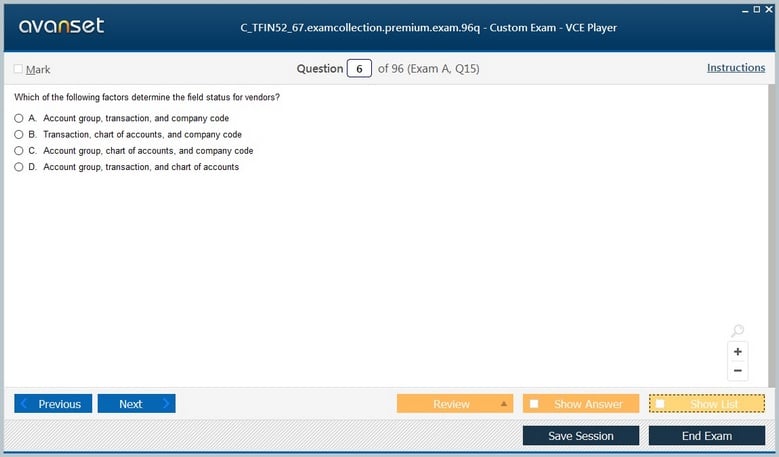
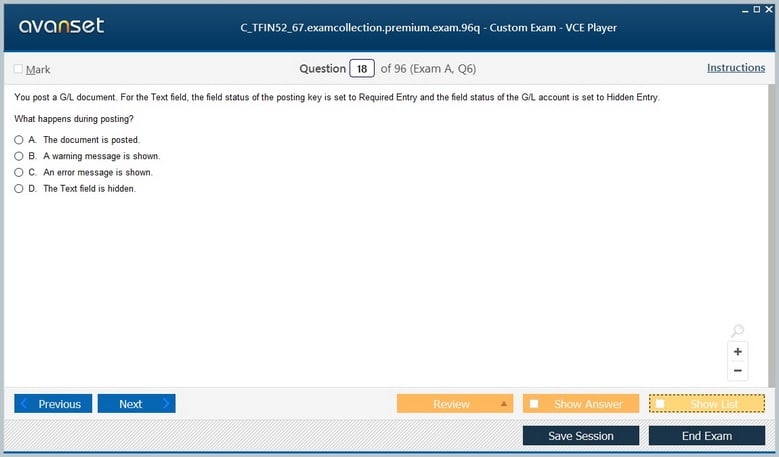
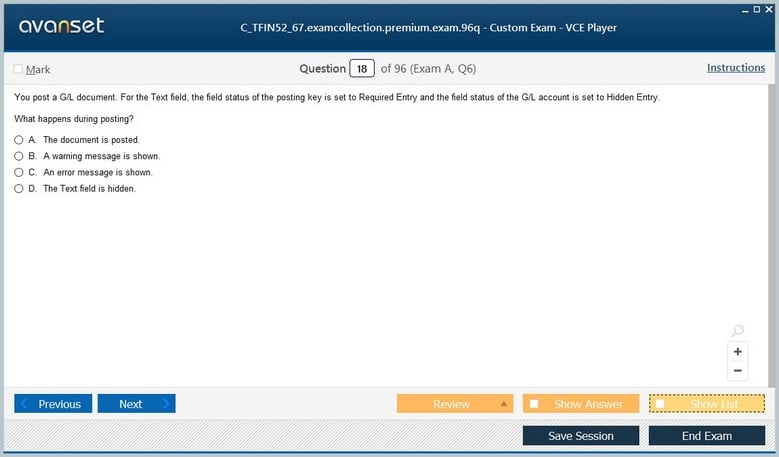
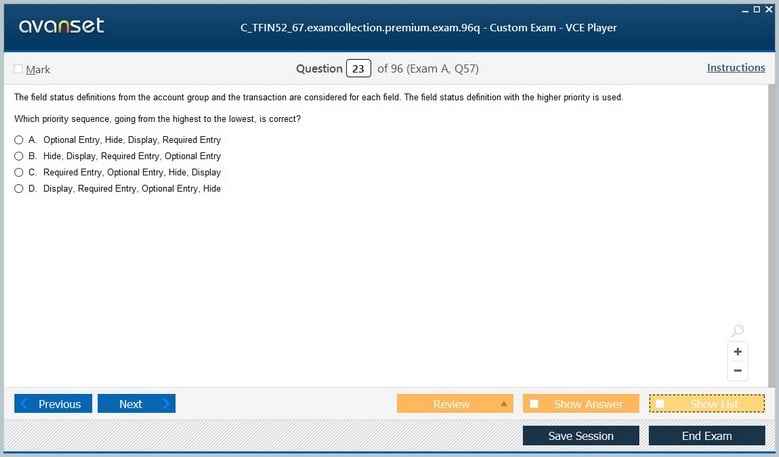
SAP C_TFIN52_67 Practice Test Questions in VCE Format
| File | Votes | Size | Date |
|---|---|---|---|
File SAP.onlinetest.C_TFIN52_67.v2026-08-18.by.wangyan.75q.vce |
Votes 1 |
Size 92.75 KB |
Date Aug 18, 2026 |
SAP C_TFIN52_67 Practice Test Questions, Exam Dumps
SAP C_TFIN52_67 (SAP Certified Application Associate - Financial Accounting with SAP ERP 6.0 EhP7) exam dumps vce, practice test questions, study guide & video training course to study and pass quickly and easily. SAP C_TFIN52_67 SAP Certified Application Associate - Financial Accounting with SAP ERP 6.0 EhP7 exam dumps & practice test questions and answers. You need avanset vce exam simulator in order to study the SAP C_TFIN52_67 certification exam dumps & SAP C_TFIN52_67 practice test questions in vce format.
C_TFIN52_67 was the SAP Certified Application Associate exam for Financial Accounting with SAP ERP 6.0 Enhancement Package 7. Its syllabus reflects classic FI work: general ledger, accounts payable, accounts receivable, asset accounting, closing, payment processing, taxes, and the organizational structures that make those processes consistent.
The exam code is historical, but the accounting discipline remains foundational. Companies still need controlled postings, complete subledgers, reliable payment runs, auditable asset values, and a defensible close. What has changed is how SAP S/4HANA represents and integrates that information, especially through the Universal Journal and newer cloud implementation models.
For current study planning, SAP S/4HANA Cloud Public Edition Financial Accounting is the more relevant current credential family. That does not make it a simple rename of C_TFIN52_67. The older exam belongs to an ERP generation; the current path assumes different architecture, implementation tools, user experiences, and release cadence within the broader SAP certification portfolio.
Company codes, charts of accounts, fiscal-year settings, currencies, and related assignments define the accounting boundaries within which postings are interpreted. These choices are not administrative housekeeping. They affect reporting, legal separation, period control, and how transactions integrate across logistics and finance.
A useful study exercise is to design a small multinational structure and justify each boundary. Decide where separate company codes are required, how accounts are standardized, which currencies matter, and how fiscal calendars differ. Then test a cross-company transaction. This forces the learner to connect configuration to financial governance rather than memorizing tables and transaction codes.
The general ledger must support legal accounting while still producing information that managers can use. Account structures, document types, posting keys, field controls, ledgers, and document splitting all shape the quality of that information. Poor design can create workarounds that later complicate reconciliation and close.
Study the lifecycle of one journal entry from source event through posting and reporting. Ask which fields are mandatory, which controls prevent an invalid combination, which ledger receives the entry, and which dimensions make the transaction analytically useful. This approach reveals why apparently small configuration decisions have long consequences for reporting quality.
Master-data governance is especially important because payment controls depend on supplier records being trustworthy. Bank-detail changes, duplicate suppliers, one-time vendors, and unusual payment terms should attract additional review. The finance configuration may be correct while the organization still loses money if master-data changes are approved casually. Treat supplier maintenance and payment execution as connected controls.
Supplier accounting connects invoices, payment terms, cash management, purchasing, taxes, and bank processing. The accounting team needs to prevent duplicate or unauthorized payments while still paying valid obligations on time. Vendor master quality and payment configuration therefore matter as much as the mechanics of posting an invoice.
Build a scenario that starts with a supplier invoice and ends with settlement. Include an exception such as a blocked invoice, incorrect payment method, or duplicate reference. Explain how the system should prevent or expose the problem and which person owns the resolution. This makes accounts payable a risk-control process rather than a list of transaction steps.
Cash application provides another realistic test. A bank receipt can arrive without enough remittance detail to identify the invoice, leaving an unapplied or partially cleared balance. Candidates should know how the accounting record preserves the uncertainty rather than forcing an artificial clearing. Operational accuracy sometimes means showing that the organization does not yet know the final allocation.
Customer accounting records invoices, incoming payments, residual items, disputes, and clearing. The important operational question is how accurately the system distinguishes what is owed from what has already been settled. Poor master data or clearing discipline can make receivables look larger or older than they really are.
Practice with partial payments, payment differences, and customer/vendor relationships rather than only clean invoices. Trace the open items after each event and explain what a collector or accountant would see. This creates a better understanding of subledger behavior and prepares learners to diagnose why a customer balance disagrees with business expectations.
Asset migrations require extra care because historical acquisition values, accumulated depreciation, useful lives, and depreciation keys must remain coherent after conversion. A technically successful load can still produce wrong future depreciation if the opening values or dates are inconsistent. Reconcile both balances and future calculation behavior before treating a migrated asset population as complete.
Fixed assets accumulate value over time through acquisition, capitalization, depreciation, transfer, and retirement. Asset classes and depreciation settings determine how those events are recorded and reported. A configuration error may remain hidden for months before it appears in a depreciation run or year-end balance.
Use a complete asset case. Acquire an asset, assign the correct accounting treatment, calculate depreciation, transfer it if needed, and retire or sell it. Compare planned and posted values at each stage. This teaches candidates to view asset accounting as a lifecycle with controlled valuation rather than as a separate set of transaction codes.
Bank determination and payment media add another layer of operational risk. A payment can be valid in accounting but still fail at the bank because the file format, account, signatory process, or transmission control is wrong. End-to-end testing should therefore include the handoff beyond SAP, not stop when the accounting document posts successfully.
The payment program selects eligible open items, applies payment methods, chooses banks, and creates output that can ultimately move money. Because the process can affect many transactions at once, small configuration errors have large consequences. Payment blocks, due dates, house banks, and exception logs deserve careful review.
A strong exercise is to run the payment proposal and stop before posting. Inspect why some items were selected, why others were excluded, and which warnings need attention. Then change one rule and predict the effect. This develops the habit of validating mass-processing output before committing it, a discipline that matters in every generation of SAP finance.
Closing governance should distinguish routine automation from judgment. Recurring entries and scheduled jobs can reduce manual effort, but estimates, unusual adjustments, and late corrections still need accountable review. Automation does not remove control responsibility; it changes the evidence required to prove that the automated rule is appropriate and that exceptions were handled deliberately.
Month-end and year-end closing bring together accruals, foreign-currency valuation, depreciation, reconciliations, open-item review, and period controls. Closing problems often reveal issues created earlier in the month. A late correction may be technically easy but can reduce confidence in the close if ownership and evidence are unclear.
Prepare with a close checklist tied to dependencies rather than a memorized sequence. Which subledger must finish before the general ledger step? Which valuation depends on exchange rates? Which reports prove completeness? Who can reopen a period, and under what approval? This converts closing from a series of jobs into a controlled financial process.
Integration with logistics is equally important. Goods receipt, invoice receipt, inventory movements, and customer billing all create accounting consequences from operational processes. Finance consultants should be able to trace those postings back to the originating business event and determine whether the problem belongs in FI configuration, material valuation, sales setup, or source master data.
The companion C_TFIN22_67 Management Accounting material helps explain the internal view of the same transactions. A supplier invoice can create a payable in FI while assigning expense to a cost center or order in controlling. A manufacturing variance can influence managerial analysis while the financial ledger preserves the legal accounting record.
Study integration by tracing one event across both perspectives. Identify the external accounting impact, the internal responsibility assignment, and the reconciliation needed if either side looks wrong. This is more useful than trying to learn FI and CO as isolated modules because productive SAP finance relies on the consistency of the combined process.
Keep a separate checklist for controls that must survive the platform transition: posting authorization, period control, reconciliation, approval of master-data changes, and evidence for financial close. A migration is successful only when the new process is not merely faster, but at least as explainable and controlled as the one it replaces.
Data migration is where the old and new models meet most visibly. Teams must decide which open items, balances, assets, and historical details move to the new environment, how they are reconciled, and which legacy reports remain necessary. A learner who understands the accounting purpose of each object can participate in those decisions more effectively than someone who knows only the transaction used to create it.
Modern SAP S/4HANA Finance has changed the technical model and implementation experience, so a C_TFIN52_67 study plan cannot be reused unchanged. Current S/4HANA Cloud Financial Accounting material reflects a different generation of product design, including more standardized cloud processes and a data model built around the Universal Journal.
The right transition is conceptual first. Preserve the accounting logic behind ledgers, subledgers, payments, assets, taxes, and close, then relearn how those responsibilities are implemented in the current product. If a learner can explain why a control exists and what financial statement risk it addresses, updating the SAP-specific configuration becomes far easier than starting from memorized ERP procedures.
Go to testing centre with ease on our mind when you use SAP C_TFIN52_67 vce exam dumps, practice test questions and answers. SAP C_TFIN52_67 SAP Certified Application Associate - Financial Accounting with SAP ERP 6.0 EhP7 certification practice test questions and answers, study guide, exam dumps and video training course in vce format to help you study with ease. Prepare with confidence and study using SAP C_TFIN52_67 exam dumps & practice test questions and answers vce from ExamCollection.
Purchase Individually
Top SAP Certification Exams
Site Search:

SPECIAL OFFER: GET 10% OFF

Pass your Exam with ExamCollection's PREMIUM files!
SPECIAL OFFER: GET 10% OFF
Use Discount Code:
MIN10OFF
A confirmation link was sent to your e-mail.
Please check your mailbox for a message from support@examcollection.com and follow the directions.

Download Free Demo of VCE Exam Simulator
Experience Avanset VCE Exam Simulator for yourself.
Simply submit your e-mail address below to get started with our interactive software demo of your free trial.