



Premium File
45 Q&A
$76.99$69.99
Blue Prism ATA02 Exam Questions & Answers, Accurate & Verified By IT Experts
Instant Download, Free Fast Updates, 99.6% Pass Rate
45 Questions & Answers
Last Update: Nov 01, 2026
$69.99
Blue Prism ATA02 Exam Screenshots
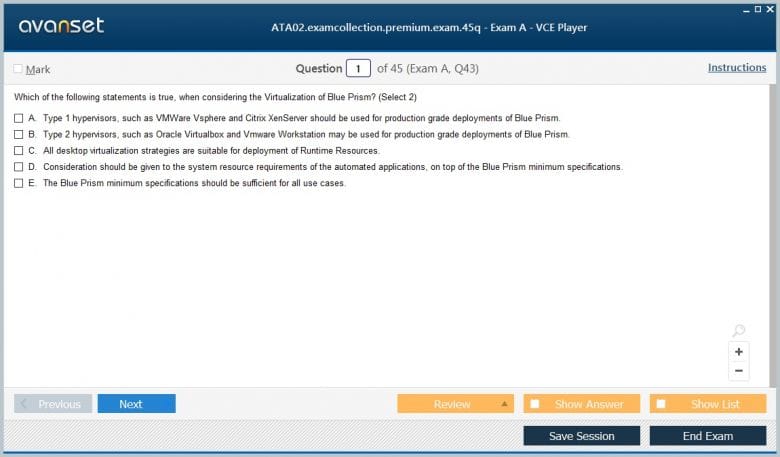
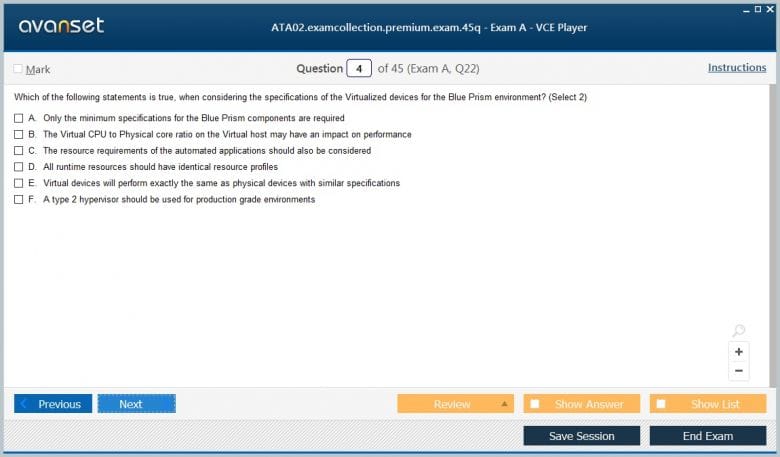
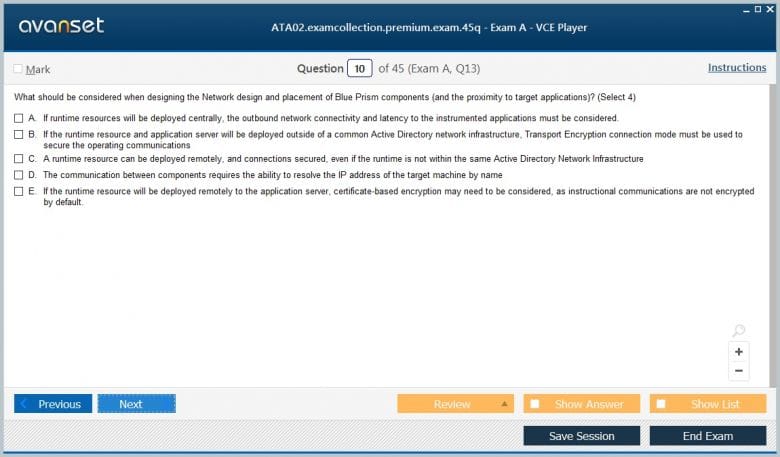
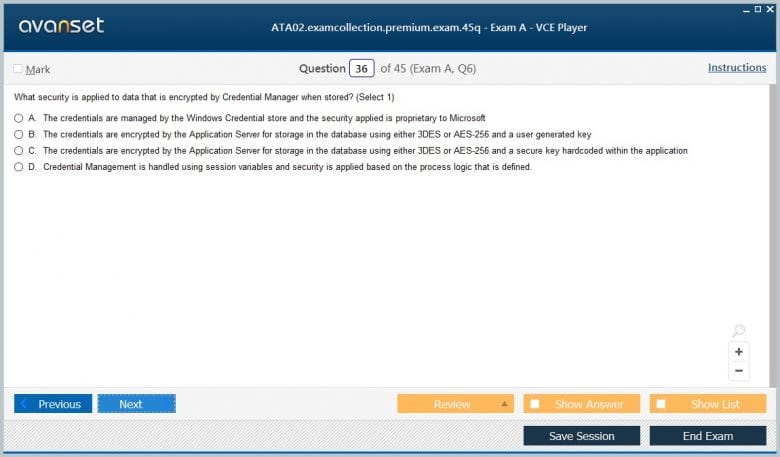
Blue Prism ATA02 Practice Test Questions in VCE Format
| File | Votes | Size | Date |
|---|---|---|---|
File Blue Prism.questionspaper.ATA02.v2026-09-26.by.abdullah.26q.vce |
Votes 1 |
Size 39.3 KB |
Date Sep 26, 2026 |
File Blue Prism.Prep4sure.ATA02.v2019-03-12.by.Frank.23q.vce |
Votes 3 |
Size 35.52 KB |
Date Mar 13, 2019 |
Blue Prism ATA02 Practice Test Questions, Exam Dumps
Blue Prism ATA02 (Designing a Blue Prism (Version 6.0) Environment) exam dumps vce, practice test questions, study guide & video training course to study and pass quickly and easily. Blue Prism ATA02 Designing a Blue Prism (Version 6.0) Environment exam dumps & practice test questions and answers. You need avanset vce exam simulator in order to study the Blue Prism ATA02 certification exam dumps & Blue Prism ATA02 practice test questions in vce format.
ATA02, Designing a Blue Prism Version 6.0 Environment, is the historical Technical Architect exam for the version 6 generation. It is not the current certification target. SS&C Blue Prism now offers a Technical Architect v7 certification with 60 questions, 90 minutes, and a content outline covering data and security, platform architecture and ROM, maintenance and troubleshooting, and solutions architecture.
The older ATA02 exam remains useful because it concentrated on durable infrastructure decisions: component topology, virtualization, Active Directory integration, secure credentials, remote access, monitoring, database provisioning, Windows authentication, and network security. The related AIE02 Installation Engineer exam focused on implementing a version 6 environment, whereas ATA02 asked how the environment should be designed.
The wider Blue Prism certifications help place technical architecture beside development and operating-model roles. For current work, however, the official v7 Technical Architect materials and product documentation take precedence. ATA02 is best used to understand the reasoning behind a secure, scalable RPA platform rather than to memorize old version-specific settings.
A Blue Prism environment should be sized and structured around the digital workforce it must support. The architect considers the number of developers, runtime resources, environments, schedules, peak concurrent sessions, target applications, geographic locations, and recovery expectations. A small departmental deployment and a regulated enterprise platform may use the same product components but require very different redundancy, segregation, and operational controls.
Requirements should distinguish capacity from availability. More runtime resources increase execution capacity, while redundant application servers or database infrastructure address component failure. Mixing those objectives can lead to expensive designs that still have single points of failure. The architect documents which failure scenarios the organization must survive and what recovery time is acceptable.
Environment separation is another requirement. Development, test, UAT, and production may need different databases, application servers, credentials, and network access so experimental work cannot affect live operations. The architect decides where strict physical separation is necessary and where logical controls are sufficient. Promotion paths between environments should be planned alongside the infrastructure, not improvised later.
Security classification should also influence topology. Processes that handle regulated or highly sensitive data may require stronger network segmentation, dedicated runtime pools, restricted administrator access, or separate credentials from lower-risk workloads. The architect should know which controls are driven by the business data, not only by Blue Prism itself. Platform standardization is useful, but it should not erase differences in risk.
Blue Prism stores substantial operational and configuration state in SQL Server, so database design affects the whole platform. The architect considers supported SQL versions, storage performance, backup and recovery, high availability, maintenance windows, network latency, and the security model used by application servers. A slow or unstable database can produce platform-wide symptoms even when individual runtime resources are healthy.
High availability also requires tested failover behavior. A clustered or availability-group database does not automatically guarantee that the application-server connection will recover as expected. Connection strings, DNS, certificates, service accounts, and retry behavior all participate. The design should state how failover is detected, how long sessions may be disrupted, and how the team validates database recovery without risking production data.
In enterprise designs, Blue Prism application servers provide a controlled middle tier between clients or runtime resources and the database. Architects choose how many servers are required, where they are located, which communication mode is used, and how clients reach a healthy instance. Load balancing may distribute connections, but the load balancer itself becomes an infrastructure dependency that needs monitoring and appropriate health checks.
Network placement matters as well. Developers, controllers, runtime resources, databases, and integrated applications may reside in different security zones. The architect should define allowed flows rather than opening broad port ranges between networks. Firewall rules, service identities, and certificate trust should be traceable to documented platform connections. Security improves when every permitted path has a clear purpose.
Connection-mode choices also influence certificate and firewall design. Direct database access, application-server mediation, and encrypted application-server connections create different trust boundaries. The architect should minimize direct database exposure in enterprise environments and ensure that whichever communication mode is chosen can be monitored, patched, and recovered without undocumented exceptions.
Blue Prism infrastructure is commonly virtualized, but placing many runtime resources on one physical host can create a hidden common failure domain. CPU overcommit, memory pressure, storage latency, host maintenance, and noisy neighbors can affect multiple robots simultaneously. Architects need to consider both average utilization and the peak demands created when scheduled work starts at the same time.
Resilience planning should spread critical resources across hosts or availability zones where appropriate and avoid assuming that a virtual machine is independent simply because it has its own operating system. The same principle applies to database and application servers. Virtualization makes deployment flexible; it does not remove the need to understand the physical or cloud infrastructure underneath.
Desktop automation adds session-specific requirements that ordinary server workloads do not always have. Screen resolution, console behavior, GPU or display settings, user profiles, and remote-session controls can affect how applications render. The technical architecture should standardize those characteristics for runtime resources and ensure that monitoring or administration tools do not unexpectedly steal focus or alter the interactive session.
Active Directory integration can provide centralized identity for Blue Prism users and services, but the architecture still needs a role model inside the platform. Authenticating a user proves who they are; authorization determines what they are allowed to do. Developers, controllers, release managers, and platform administrators should receive different permissions based on responsibility and separation-of-duties requirements.
Service accounts also need lifecycle management. Password rotation, group membership, interactive-login restrictions, and ownership should be documented. Shared administrator credentials make audit trails weaker and incident response harder. A strong design uses named identities where practical, protects service credentials, and ensures that removing a person from the organization also removes their platform access in a predictable way.
Blue Prism Credential Manager protects secrets used by automations, while platform encryption and certificate configuration protect sensitive information and communications. Architecture should define who can retrieve credentials, which processes and resources can use them, how keys are stored, and how certificates or encryption keys are backed up and rotated.
Security controls can create availability risks if recovery is ignored. Losing a key, allowing a certificate to expire, or rebuilding a server without the required trust material can stop production automation. The architect therefore designs both protection and recovery. Key ownership, renewal windows, emergency procedures, and test restores belong in the platform runbook before the first high-value credential is stored.
A scalable platform must reveal which layer is failing. Architects define monitoring for database health, application-server services, runtime-resource availability, Windows performance, network connectivity, authentication dependencies, and application-specific capacity. Platform logs should be retained and correlated with infrastructure monitoring so support teams can move from a user symptom to a specific component quickly.
The current Technical Architect outline gives substantial weight to maintenance and troubleshooting, which reflects this operational reality. An architecture is not complete if it can be deployed but cannot be diagnosed. Health checks should distinguish “service is running” from “service can perform its dependency,” and alerting thresholds should be based on business impact rather than every transient warning.
Baseline performance data is valuable before incidents occur. Record typical database response, application-server CPU and memory, runtime-resource utilization, queue throughput, session duration, and network latency during normal operation. When users later report slowness, support can compare against a known baseline instead of guessing whether current values are abnormal.
The modern SS&C Blue Prism Technical Architect certification includes current Enterprise documentation, authentication-server configuration, APIs, Hub and Interact, next-generation architecture, load balancing, and ROM 2 architecture. That scope shows how far the platform has moved beyond a version 6 infrastructure blueprint while preserving the original concern for secure, available, and performant automation.
ATA02 preparation should therefore focus on architectural reasoning: map dependencies, define trust boundaries, size for workload, distribute failure domains, protect identities and credentials, and design monitoring and recovery. Then use current product documentation for implementation details. The old exam code is historical, but the discipline it represented remains central to any enterprise RPA platform that must operate reliably after the design team has moved on.
Restoring infrastructure is only part of recovery. The team also needs to know what happened to work that was in progress when the outage occurred. Queue item status, external-system transactions, schedules, and partially completed files may need reconciliation after the platform returns. Recovery procedures should define which work can resume automatically and which items require business review.
Disaster-recovery exercises should therefore include a representative automation, not only database restoration. Bring up the alternate environment, verify identities and certificates, start runtime resources, process controlled queue items, and confirm external connectivity. Technical architecture is successful when the recovered platform can safely continue business processing, not simply when all Windows services report healthy.
Recovery priorities should be aligned with business schedules. A month-end finance automation, overnight customer processing, and an on-demand support process may have very different recovery objectives even if they share the same Blue Prism platform. The architecture should identify which services must return first, what capacity is required in the alternate environment, and which lower-priority workloads can wait while critical queues are stabilized.
Go to testing centre with ease on our mind when you use Blue Prism ATA02 vce exam dumps, practice test questions and answers. Blue Prism ATA02 Designing a Blue Prism (Version 6.0) Environment certification practice test questions and answers, study guide, exam dumps and video training course in vce format to help you study with ease. Prepare with confidence and study using Blue Prism ATA02 exam dumps & practice test questions and answers vce from ExamCollection.
Purchase Individually
Top Blue Prism Certification Exams
Site Search:

SPECIAL OFFER: GET 10% OFF

Pass your Exam with ExamCollection's PREMIUM files!
SPECIAL OFFER: GET 10% OFF
Use Discount Code:
MIN10OFF
A confirmation link was sent to your e-mail.
Please check your mailbox for a message from support@examcollection.com and follow the directions.

Download Free Demo of VCE Exam Simulator
Experience Avanset VCE Exam Simulator for yourself.
Simply submit your e-mail address below to get started with our interactive software demo of your free trial.