



Premium File
61 Q&A
$76.99$69.99
ISTQB ATA Exam Questions & Answers, Accurate & Verified By IT Experts
Instant Download, Free Fast Updates, 99.6% Pass Rate
61 Questions & Answers
Last Update: Oct 30, 2026
$69.99
ISTQB ATA Exam Screenshots
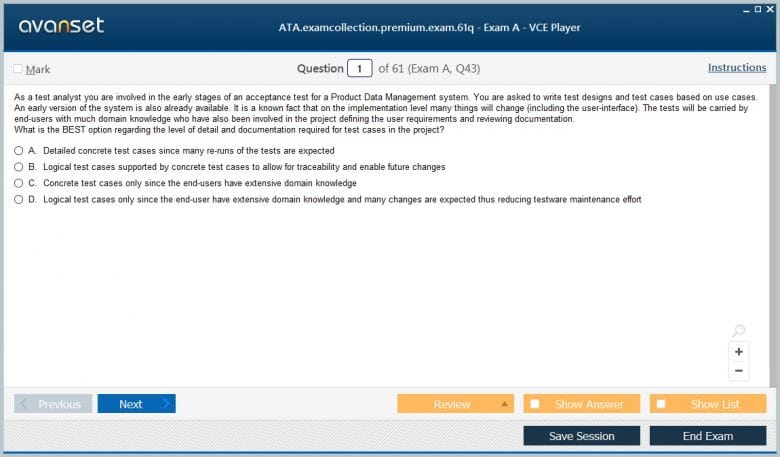
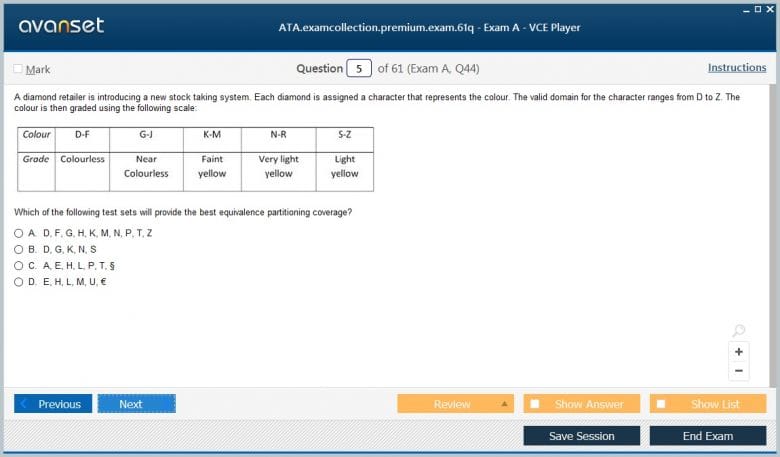
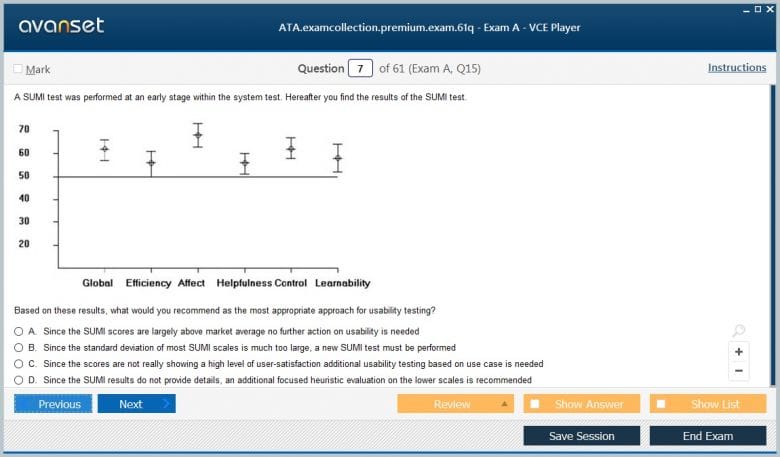
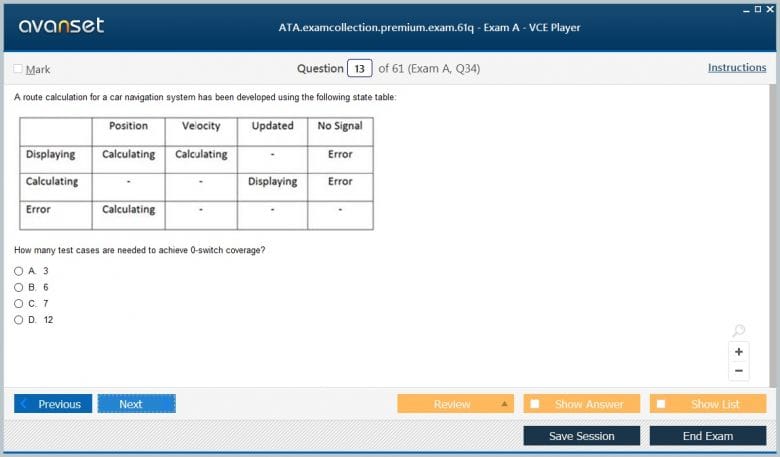
ISTQB ATA Practice Test Questions in VCE Format
| File | Votes | Size | Date |
|---|---|---|---|
File ISTQB.Testkings.ATA.v2026-10-13.by.Elwell.37q.vce |
Votes 3 |
Size 831.27 KB |
Date Oct 13, 2026 |
ISTQB ATA Practice Test Questions, Exam Dumps
ISTQB ATA (Advanced Test Analyst) exam dumps vce, practice test questions, study guide & video training course to study and pass quickly and easily. ISTQB ATA Advanced Test Analyst exam dumps & practice test questions and answers. You need avanset vce exam simulator in order to study the ISTQB ATA certification exam dumps & ISTQB ATA practice test questions in vce format.
ATA on ExamCollection refers to ISTQB Advanced Test Analyst, not the American Translators Association credential. The short ATA label is historical. ISTQB’s current official qualification is Certified Tester Advanced Level – Test Analyst v4.0, released in May 2025. The v4.0 exam has 45 questions, 78 total points, a passing score of 51, and a 120-minute base duration. Candidates must hold Foundation Level certification and meet practical-experience expectations set by their exam provider or member board.
The version transition is especially important on October 2, 2026. The previous CTAL-TA v3.1 English exams retired on May 16, 2026, while non-English v3.1 exams remain available only until November 16, 2026. Current English candidates should therefore study v4.0, and anyone using an old ATA practice set should compare its content against the active syllabus before relying on it. The wider ISTQB exam family also shows how the Test Analyst role fits beside Test Management and Technical Test Analyst pathways.
Test analysts focus on whether a product behaves correctly for users and business processes. They translate requirements, models, rules, and risk into test conditions and detailed coverage. The role is not “nontechnical”; effective analysis may require data design, interface understanding, environment knowledge, and careful use of tools. The distinction is that the primary viewpoint is externally visible behavior and customer or business need rather than structural code coverage.
Current ISTQB material describes the Test Analyst as using black-box and experience-based techniques, contributing to user-focused non-functional testing, and supporting defect prevention. That makes the role valuable in cross-functional teams where analysts can clarify behavior before implementation and then validate the delivered outcome. The strongest candidates understand both product intent and how to create evidence efficiently.
That business-facing perspective does not mean the role is limited to user-interface checks. Test Analysts often need enough understanding of data flows, service behavior, interfaces, state, and configuration to design realistic conditions and diagnose surprising results. The distinction is that their primary questions usually begin with externally visible behavior, business rules, user needs, and product quality rather than with internal structural coverage. They collaborate with developers and technical specialists when deeper implementation knowledge is needed to explain or isolate a failure.
Strong analysis also depends on testability. Ambiguous expected results, inaccessible logs, unstable environments, or uncontrolled test data can make defects difficult to reproduce and conclusions difficult to defend. Analysts can improve testability by asking for observable outcomes, deterministic setup where possible, meaningful identifiers, and controllable states. These needs should be raised before execution begins because late discovery of poor testability can consume more time than the test itself.
Test analysts contribute to risk identification and assessment because they often understand business workflows, user behavior, and failure consequences. Risk-based testing then uses that information to prioritize conditions, techniques, depth, and sequencing. A calculation that affects invoices, a permissions rule protecting sensitive records, or a workflow required for regulatory reporting may deserve deeper coverage than a low-impact personalization feature.
Risk should be revisited when the product changes. New dependencies, defects, customer behavior, or production incidents can alter likelihood or impact. The analyst should be able to explain why coverage changed rather than treating the original test plan as fixed. This adaptive use of risk is one reason current preparation matters: v4.0 is designed for modern delivery conditions where analysis and testing respond continuously to new information.
Equivalence partitioning groups inputs or outputs expected to behave similarly. Boundary value analysis targets edges where implementations often fail. Decision tables model combinations of conditions and resulting actions. State transition testing examines behavior across states and events. Other current techniques extend the analyst’s options for complex data, rules, and behaviors. The value of a technique is that coverage can be explained rather than selected by intuition alone.
Testers also need to know when techniques should be combined. A stateful business process may contain decision-table logic inside each state. Boundary conditions can exist within equivalence classes. Experience-based exploration can reveal scenarios not captured in the formal model. The approved black-box and white-box testing discussion can reinforce the conceptual boundary, while the official CTAL-TA syllabus defines the current techniques and learning objectives.
A test condition is only executable when the team has an environment, data, interfaces, and a way to determine the expected result. Current CTAL-TA gives explicit attention to test environment and test data requirements. Analysts may need representative account states, reference data, external-service behavior, time conditions, permissions, or generated datasets. Poor test data can hide defects or create privacy and compliance problems.
Test oracles determine how expected behavior is known. Requirements can act as an oracle, but so can models, calculations, standards, previous trusted outputs, independent implementations, or domain expertise. When the expected result is ambiguous, that ambiguity is itself an analysis issue. Candidates should learn to identify where the oracle comes from and whether it is sufficiently independent and reliable for the test objective.
Test data deserves explicit design because unrealistic data can hide defects while uncontrolled production copies can create privacy or security problems. Analysts should understand the characteristics a scenario needs—boundary values, combinations, relationships, permissions, lifecycle state—and obtain those characteristics through approved methods. The objective is not to mimic every production record; it is to create data that makes the intended risk observable while remaining repeatable and governed.
The same principle applies to test oracles. Expected results may come from requirements, calculations, standards, a trusted reference system, domain experts, historical behavior, or defined invariants. Each source has limitations. If the oracle is vague or wrong, a perfectly executed test can still produce a misleading conclusion. Advanced analysis therefore includes questioning the source of expected behavior and resolving contradictions before large amounts of test execution are built on a weak assumption.
Functional testing asks whether the product performs required behavior. User-focused non-functional testing can examine usability, adaptability, installability, interoperability, and related characteristics. A feature can calculate correctly while still being unusable in the intended workflow. The analyst helps translate quality expectations into observable conditions, target users, supported environments, and meaningful scenarios.
Non-functional requirements are often vague, so analysis matters before execution. “Easy to use” should be clarified into tasks, user groups, success criteria, error tolerance, or measurable outcomes. “Compatible” should identify platforms or systems and the required interaction. Test analysts add value by turning broad expectations into concrete evidence that stakeholders can evaluate.
Current CTAL-TA explicitly includes software defect prevention. Analysts can prevent defects by reviewing requirements and examples, identifying missing business rules, using models to expose inconsistencies, improving testability, and feeding recurring defect patterns back to the team. Finding a defect before code is written usually costs less than discovering the same misunderstanding during system testing or after release.
Defect classification and root-cause support also matter. If similar failures keep appearing, the analyst can examine whether the cause is ambiguous requirements, weak validation, architecture assumptions, coding patterns, insufficient review, or poor environment control. The goal is not to assign blame. It is to improve the delivery process so the same class of problem is less likely to recur.
Automation is useful for repeatable data-driven checks, regression coverage, combinatorial generation, and rapid feedback, but automated scripts are not a substitute for selecting good conditions. Automating a weak test faster does not improve its diagnostic value. Test analysts should understand where automation reduces manual effort, where it creates maintenance cost, and where human exploration remains necessary.
Current v4.0 includes the benefits and risks of automating test design as well as tool support. Generated cases can expand coverage, but the analyst needs to review assumptions, expected results, and data quality. Tool outputs should remain explainable to stakeholders. A test suite that produces thousands of failures without clear prioritization may create more noise than useful evidence.
Automation is most valuable when the analytical intent remains visible. Parameterized checks can exercise partitions and boundaries at scale, but a large data set is not automatically good coverage. The analyst should know which condition each automated case represents, how failures will be diagnosed, and when maintenance cost outweighs additional assurance. Exploratory work, usability observations, unusual business-rule combinations, and rapidly changing features may still need human investigation even in highly automated delivery environments.
CTAL-TA candidates must hold Foundation Level, and the current CTFL v4.0 provides the baseline vocabulary for lifecycle, techniques, risk, management, and tools. Professionals whose responsibilities move toward leadership may consider CTAL-TM v3.0, while more technical structural and technology-focused work aligns with the Technical Test Analyst path. These are complementary specializations rather than a simple ranking.
For anyone landing on the ATA legacy page, the practical rule is to identify the current version before studying. Use ATA to understand the historical Advanced Test Analyst label, but use CTAL-TA v4.0 for current English exam preparation. Candidates still considering a non-English v3.1 sitting must confirm provider availability before the November 16, 2026 sunset. Version awareness prevents outdated question sets from becoming the center of an otherwise strong preparation plan.
Go to testing centre with ease on our mind when you use ISTQB ATA vce exam dumps, practice test questions and answers. ISTQB ATA Advanced Test Analyst certification practice test questions and answers, study guide, exam dumps and video training course in vce format to help you study with ease. Prepare with confidence and study using ISTQB ATA exam dumps & practice test questions and answers vce from ExamCollection.
Purchase Individually
Top ISTQB Certifications

Site Search:

SPECIAL OFFER: GET 10% OFF

Pass your Exam with ExamCollection's PREMIUM files!
SPECIAL OFFER: GET 10% OFF
Use Discount Code:
MIN10OFF
A confirmation link was sent to your e-mail.
Please check your mailbox for a message from support@examcollection.com and follow the directions.

Download Free Demo of VCE Exam Simulator
Experience Avanset VCE Exam Simulator for yourself.
Simply submit your e-mail address below to get started with our interactive software demo of your free trial.