



Premium File
27 Q&A
$76.99$69.99
Blue Prism ASD01 Exam Questions & Answers, Accurate & Verified By IT Experts
Instant Download, Free Fast Updates, 99.6% Pass Rate
27 Questions & Answers
Last Update: Sep 27, 2026
$69.99
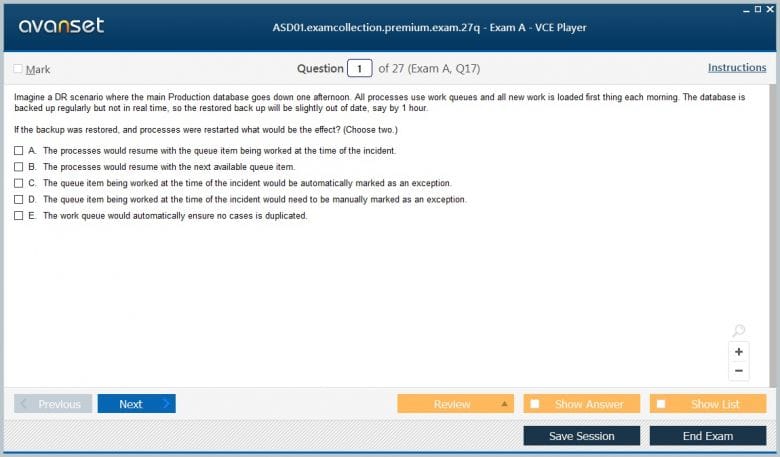
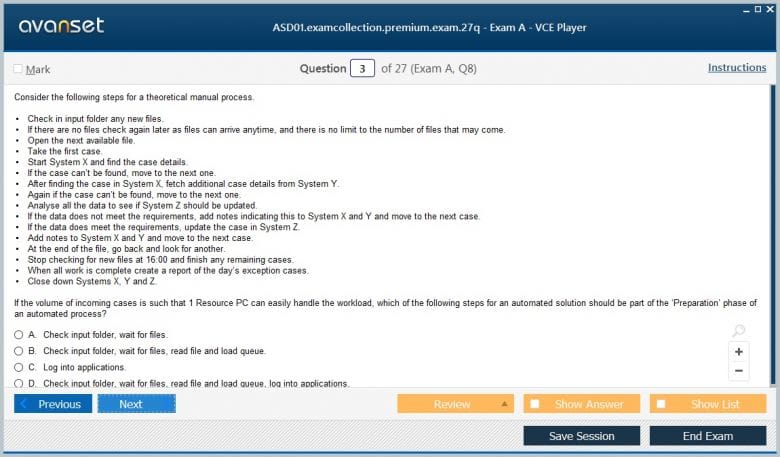
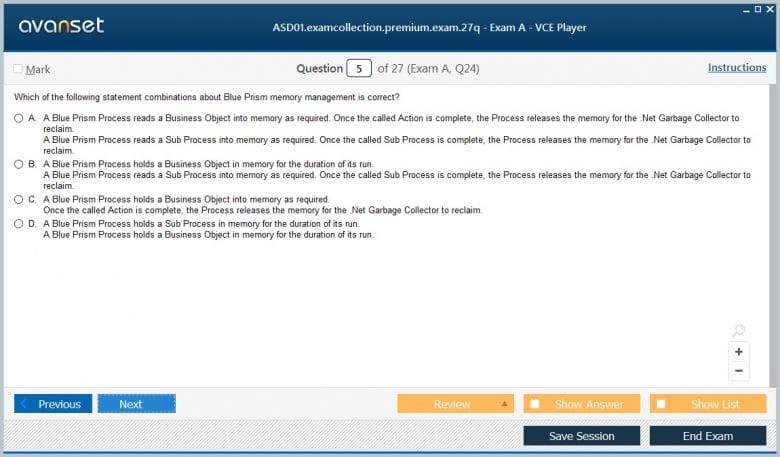
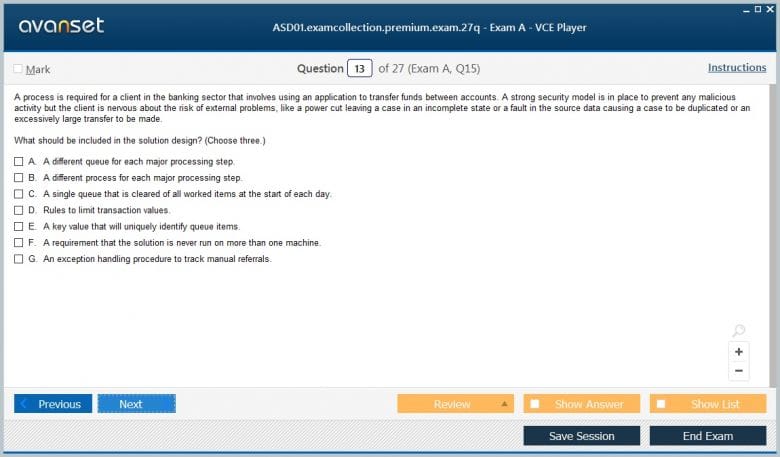
Blue Prism ASD01 Exam Screenshots
Blue Prism ASD01 Practice Test Questions in VCE Format
| File | Votes | Size | Date |
|---|---|---|---|
File Blue Prism.actualtests.ASD01.v2026-10-09.by.archie.14q.vce |
Votes 1 |
Size 344.57 KB |
Date Oct 09, 2026 |
File Blue Prism.Actualtests.ASD01.v2019-03-03.by.Evelin.10q.vce |
Votes 3 |
Size 631.81 KB |
Date Mar 10, 2019 |
Blue Prism ASD01 Practice Test Questions, Exam Dumps
Blue Prism ASD01 (Designing Blue Prism Process Solutions) exam dumps vce, practice test questions, study guide & video training course to study and pass quickly and easily. Blue Prism ASD01 Designing Blue Prism Process Solutions exam dumps & practice test questions and answers. You need avanset vce exam simulator in order to study the Blue Prism ASD01 certification exam dumps & Blue Prism ASD01 practice test questions in vce format.
ASD01, Designing Blue Prism Process Solutions, was the standalone Blue Prism Solution Designer exam. It is a legacy certification identity in 2026: SS&C Blue Prism’s current catalog no longer lists Solution Designer as a separate certification path. Its subject matter remains important, however, because the current Developer certification explicitly tests scalable, secure, and efficient process-solution design, and Professional Developer extends those expectations into implementation and delivery.
The original ASD01 scope covered unattended automation, sub-processes and wrapper objects, recoverability and scalability, object design, case management, workload management, data management, and web services. Those are durable design concerns rather than version-specific button locations. The value of the old page is therefore conceptual: it asks whether an automation is structured to survive change, scale across resources, and recover safely from failure.
The natural internal path is from Blue Prism Developer to Professional Developer, with the Blue Prism certifications providing broader context. ASD01 sits historically between coding competence and enterprise delivery discipline.
Good process design separates the business sequence from low-level application manipulation. A reader should be able to understand what the automation is trying to accomplish by following the process pages without opening every object action. This clarity matters in UAT, incident response, and change analysis because business owners and support teams need to locate decisions, retries, and outcomes quickly.
The design should also define the unit of work. Is one case a customer, invoice, order, account, or transaction? That choice influences queue structure, retries, reporting, and recovery. If the unit is too large, one error can force a large amount of work to be repeated. If it is too small, the process may lose business context and create excessive coordination overhead.
Business rules should be separated from interface navigation where practical. If a threshold or routing rule changes, the team should not need to edit a page that also contains dozens of application stages. Explicit rules can be tested with representative data and reviewed by business owners. This reduces the chance that a simple policy change accidentally affects screen automation or exception behavior.
A well-designed Visual Business Object represents a single application or coherent service boundary and exposes actions that make sense to the process. The object owns selectors, application attachment, navigation details, and low-level error handling. This protects the process from interface changes and prevents every workflow from reimplementing the same interaction patterns.
Wrapper objects can also isolate generic interfaces such as reusable utilities or legacy integrations, but abstraction needs discipline. Hiding every stage behind another wrapper creates indirection without value. The right test is whether the interface reduces coupling and clarifies responsibility. A reusable object should be easier to test and support than the duplicated logic it replaces.
An automation cannot recover safely if it does not know what state the external system reached before failure. A timeout after clicking “Submit” is different from a failure before the click. Retrying blindly could create a duplicate business transaction. Solution design should identify commit points, observable confirmations, and reconciliation methods for operations that are not naturally idempotent.
Recovery paths should restore applications to a defined state before the next item begins. That may mean returning to a menu, closing a dialog, restarting an application, or starting a new session. Recoverability is strongest when it is local: one item fails, is recorded appropriately, and the process continues without contaminating the next case. A design that requires restarting the entire batch after one failure does not scale operationally.
Idempotency is a valuable design property when external systems support it. If an API accepts a client-generated transaction key, or if the process can query whether a record already exists before creating it, retries become safer. Where idempotency is impossible, the design should include reconciliation and manual decision points rather than pretending that every timeout can be solved by trying again.
A process that works on one runtime resource may fail when several resources operate concurrently. Shared files, fixed temporary names, exclusive application sessions, rate-limited APIs, record locking, or global environment state can become bottlenecks. The solution designer should identify every shared dependency and decide whether it can support parallel execution safely.
Queues help distribute independent work, but parallelism should be limited by the slowest or most constrained downstream system. More robots are not always better. A five-resource design that overwhelms the target application can perform worse than two resources and create more failures. Capacity planning should use measured transaction times, concurrency limits, and realistic exception rates rather than assuming linear scaling.
File-based integrations are a common source of hidden contention. Multiple resources writing the same output filename or reading a file before another process finishes can create intermittent defects. Use unique working paths, atomic handoff patterns, or queue-based coordination so concurrency is intentional. The same reasoning applies to shared spreadsheets, desktop inboxes, and temporary folders.
Not all work items are equal. Some may have deadlines, customer-impact priorities, or dependencies that require controlled sequencing. Blue Prism queues support priority, deferred times, tags, and status information that can represent those needs. The solution design should explain how new work enters the queue, how duplicates are prevented, and how controllers identify items that need intervention.
Retry behavior is part of workload design. Transient application outages may justify automatic retries after a delay, while invalid business data should not consume repeated robot time. A clear exception taxonomy lets the queue support both automation and reporting. Operations can then distinguish a temporary service incident from a growing backlog of cases that require business correction.
Automations often handle personal, financial, or operationally sensitive data. Solution design should identify what must be held in process memory, what belongs in queue data, what should be retrieved only when needed, and what must never be written to logs. Large payloads can also make queues and audit records inefficient, so storing every source document inside the automation platform is rarely the best default.
Configuration data should be separated from business data. Environment-specific URLs, file paths, and control values belong in managed configuration rather than process logic. Secrets belong in Credential Manager with restricted access. These boundaries make promotion between environments safer and reduce the chance that test credentials, production endpoints, or confidential values are hard-coded into a release.
The historical ASD01 scope included web services because a good solution designer chooses the most stable interface available. If an application provides a supported API for a business action, using that interface may be more reliable and scalable than automating a graphical screen. APIs can reduce timing problems and make responses easier to validate, though they introduce authentication, rate limits, schemas, and network dependencies.
The decision should be based on supportability, not fashion. Some business functions exist only in the UI, some APIs omit required features, and some integrations have licensing or security constraints. A hybrid design may use APIs for data operations and the user interface for exceptional steps. The solution should document why each interface was selected and how failures will be observed.
API error models also need interpretation. HTTP success does not always mean the business action succeeded, and a transport timeout does not prove the server failed to process the request. The solution should understand status codes, response payloads, correlation identifiers, and retry guidance from the service. Robust integration design treats APIs as stateful business dependencies, not just faster buttons.
SS&C Blue Prism’s current certification catalog no longer presents Solution Designer as a standalone credential, but the design principles have not disappeared. Current Developer explicitly emphasizes scalable, secure, efficient solution design, and Professional Developer tests implementation, testing, deployment, and leadership. That evolution makes ASD01 a useful historical concentration of design topics rather than an active destination.
Candidates should use the old scope to challenge their own automations: Can the process scale? Can one failed item recover cleanly? Are objects cohesive? Is workload visible? Are data and secrets handled appropriately? Could a supported API replace brittle UI automation? Those questions remain current because they are architectural properties of the solution, not features of a particular exam generation.
A useful design review asks what will happen when the target application is slow, a credential expires, a queue contains bad data, a resource stops mid-transaction, or a business rule changes. Walking through those scenarios often reveals assumptions that are invisible in the happy-path diagram. Reviewers should challenge the boundaries and recovery model rather than spend most of the meeting on visual formatting.
The same review should identify likely change points. User-interface selectors, file layouts, service endpoints, policy thresholds, and application versions will evolve. Is each change isolated behind a clear component or scattered across the solution? ASD01’s enduring lesson is that good design reduces the number of places a future change can break, which is one of the strongest predictors of long-term automation support cost.
Reviews also benefit from evidence. A short prototype against the real target application can validate element identification, API behavior, transaction timing, and concurrency assumptions before the full build starts. That is especially useful when a design depends on technology the team has not used before. Early experiments should answer specific architectural questions and then be discarded or formalized deliberately rather than quietly becoming production code.
Go to testing centre with ease on our mind when you use Blue Prism ASD01 vce exam dumps, practice test questions and answers. Blue Prism ASD01 Designing Blue Prism Process Solutions certification practice test questions and answers, study guide, exam dumps and video training course in vce format to help you study with ease. Prepare with confidence and study using Blue Prism ASD01 exam dumps & practice test questions and answers vce from ExamCollection.
Purchase Individually
Top Blue Prism Certification Exams
Site Search:

SPECIAL OFFER: GET 10% OFF

Pass your Exam with ExamCollection's PREMIUM files!
SPECIAL OFFER: GET 10% OFF
Use Discount Code:
MIN10OFF
A confirmation link was sent to your e-mail.
Please check your mailbox for a message from support@examcollection.com and follow the directions.

Download Free Demo of VCE Exam Simulator
Experience Avanset VCE Exam Simulator for yourself.
Simply submit your e-mail address below to get started with our interactive software demo of your free trial.