



Premium File
51 Q&A
$76.99$69.99
Blue Prism APD01 Exam Questions & Answers, Accurate & Verified By IT Experts
Instant Download, Free Fast Updates, 99.6% Pass Rate
51 Questions & Answers
Last Update: Sep 15, 2026
$69.99
Blue Prism APD01 Exam Screenshots
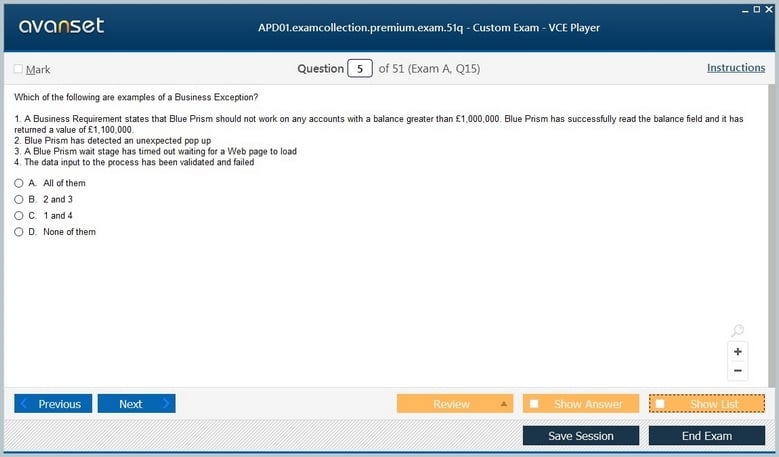
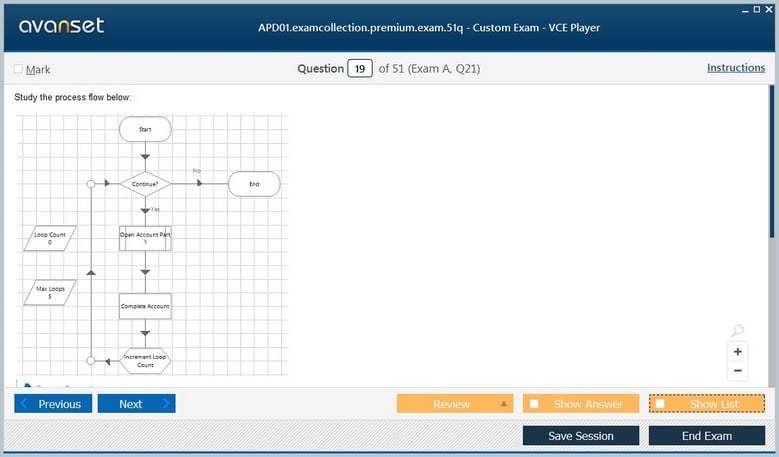
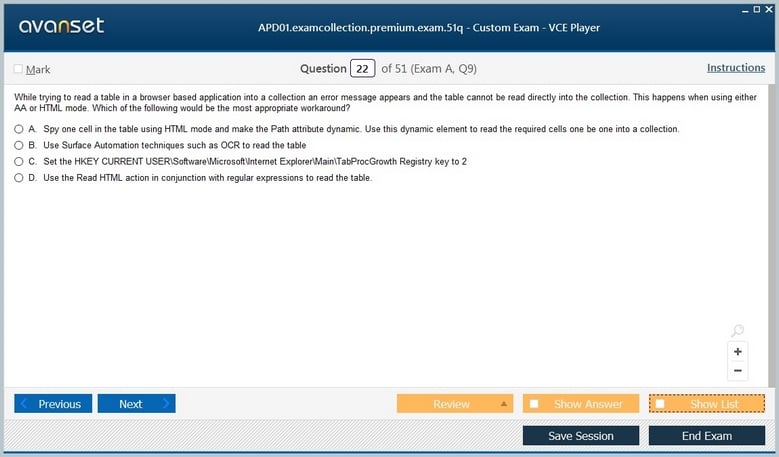
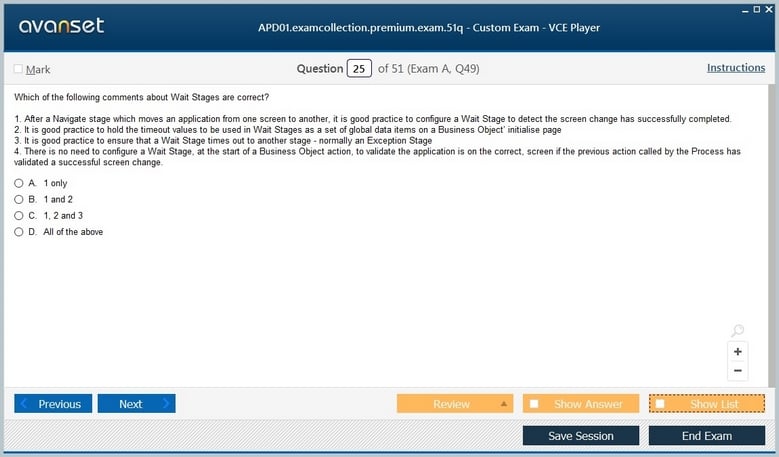
Blue Prism APD01 Practice Test Questions in VCE Format
| File | Votes | Size | Date |
|---|---|---|---|
File Blue Prism.passcertification.APD01.v2026-08-25.by.ethan.27q.vce |
Votes 1 |
Size 1.63 MB |
Date Aug 25, 2026 |
File Blue Prism.onlinetest.APD01.v2021-07-19.by.dylan.29q.vce |
Votes 1 |
Size 1.72 MB |
Date Jul 19, 2021 |
File Blue Prism.passguide.APD01.v2020-03-22.by.lola.26q.vce |
Votes 3 |
Size 841.01 KB |
Date Mar 22, 2020 |
File Blue Prism.Test-king.APD01.v2019-09-21.by.Porter.23q.vce |
Votes 3 |
Size 908.84 KB |
Date Sep 22, 2019 |
Blue Prism APD01 Practice Test Questions, Exam Dumps
Blue Prism APD01 (Blue Prism Professional Developer) exam dumps vce, practice test questions, study guide & video training course to study and pass quickly and easily. Blue Prism APD01 Blue Prism Professional Developer exam dumps & practice test questions and answers. You need avanset vce exam simulator in order to study the Blue Prism APD01 certification exam dumps & Blue Prism APD01 practice test questions in vce format.
APD01 is the long-running code associated with Blue Prism Professional Developer. The Professional Developer certification remains current in 2026, though SS&C Blue Prism’s public page now emphasizes the role and Certiverse registration rather than the legacy exam code. The current assessment has 50 questions in 75 minutes, uses a scaled score with 600 as the passing threshold, and requires the Blue Prism Developer exam as a prerequisite.
The current content outline is materially different from simply being “more developer questions.” Process Development carries 42%, Process Implementation 22%, Object Development 18%, and Leadership 18%. Blue Prism also recommends completion of the Professional Developer learning plan and about a year of practical development experience. Starting July 1, 2026, this certification moved to a three-year validity period under the new renewal program.
Within ExamCollection, AD01 Developer is the direct foundation, the historical ASD01 Solution Designer preserves design-oriented material, and the Blue Prism certifications provide the wider pathway. Professional-level preparation should connect those ideas to testing, deployment, support, and team leadership.
A senior developer should be able to look at a Process Definition Document and identify where business logic, application interaction, data transformation, queue handling, and external dependencies belong. The solution should not mirror every sentence of the document mechanically. It should create stable components that reflect responsibilities, support change, and allow operations to understand what is happening when a case fails.
Boundary decisions influence everything that follows. If application logic leaks into process pages, every workflow becomes fragile when the interface changes. If too much behavior is hidden inside large objects, the process loses visibility and testing becomes difficult. Professional developers balance abstraction with observability: components are reusable and cohesive, but important business states remain visible to support and audit teams.
Nonfunctional requirements belong in those boundaries too. Response time, batch window, concurrent resource count, audit requirements, data retention, and recovery expectations can change the design as much as the happy-path business rules. A developer who receives only functional steps should ask for these constraints rather than discovering them during performance testing or after production incidents.
At professional level, exception handling is about preserving business consistency rather than merely recovering the automation. A system exception may justify retrying an item after the application is restored, while a business exception may require a different route and no retry. A failure after an external system has already committed a transaction may require reconciliation instead of repeating the operation.
Developers should define recovery boundaries around units that can be safely restarted. They preserve original exception detail, perform cleanup in a predictable order, and record enough context to distinguish a transient infrastructure problem from a data defect. The strongest designs also consider what happens if recovery itself fails. A process that can only cope with the first error path is not operationally mature.
Professional developers use queues to manage concurrency, priorities, retries, deferred work, tags, and operational visibility. The design of the queue item determines how easily work can be distributed and reconciled. A good business key prevents accidental duplication, while item data contains what is required for processing without turning the queue into an uncontrolled copy of entire source systems.
Queue behavior should be tested under load and failure. What happens if two resources attempt related work at the same time? Can the process resume safely after a runtime resource stops? Are retry limits appropriate for external-service outages? Does priority create starvation of lower-priority work? These questions move beyond API familiarity and into production engineering, which is exactly where Professional Developer should differ from entry-level process construction.
Blue Prism’s current Professional Developer description explicitly includes creating and documenting test procedures and supporting User Acceptance Testing. A strong test plan traces requirements to scenarios and includes normal cases, boundary values, invalid data, business exceptions, system failures, retries, concurrency, restart behavior, and expected operational logs. Simply executing every page once does not prove the solution is safe.
Tests should also define the starting state and expected cleanup. RPA failures are often stateful: a window remains open, a file is partially written, a queue item is locked, or a transaction was accepted by another system even though the automation timed out. Professional developers create tests that reproduce those conditions and demonstrate the solution can return to a known, supportable state.
Test data deserves careful design. A useful suite includes realistic combinations that exercise routing logic without copying sensitive production data unnecessarily. Synthetic or masked data should preserve the characteristics that trigger business rules. If the only UAT cases are simple records chosen because they are easy to process, the test can pass while important edge cases remain completely unexamined.
Development, test, UAT, and production environments should differ in configuration rather than in ad hoc copies of process logic. URLs, file locations, environment values, credentials, schedules, and resource assignments need controlled promotion. A release package should make it clear which dependencies must exist before the process is imported and which settings must be verified afterward.
Professional developers work with release managers and infrastructure teams to reduce surprises. They avoid hard-coded machine names and secrets, document required application versions, confirm queue and credential setup, and provide smoke tests that can be executed after deployment. If a production release depends on one developer remembering a hidden step, the process is not ready regardless of how well it performed in the development environment.
Versioning helps operations know exactly what is running. Release notes should identify changed objects, processes, configuration values, and any required data or application updates. If a defect is reported, support should be able to map the production behavior to a specific release rather than ask which developer last changed the file. This is basic software configuration management applied to RPA.
Support teams need actionable information. Stage logging, queue status, exception messages, business identifiers, and timestamps should make it possible to determine which case failed and why without exposing sensitive data. Logs that say only “Error occurred” are technically accurate but operationally useless. On the other hand, logging full credentials or confidential payloads creates a new security problem.
A professional solution defines support ownership and escalation points. Which failures can operations retry? Which require application support? Which require a developer? What evidence should be collected before escalation? These questions belong in the solution design, not in the first incident call after go-live. UAT is also an opportunity to verify that operational users understand the controls they will own.
The current Professional Developer outline gives 18% to Leadership, signaling that advanced capability is not only individual coding skill. Professional developers review designs, mentor less-experienced developers, promote standards, identify recurring defects, and help teams choose patterns that improve reuse and supportability. They should be able to explain why a design is safer or simpler, not just enforce a template.
Code and process reviews are most useful when they focus on risk: unstable element identification, hidden retries, unprotected credentials, monolithic objects, uncontrolled data retention, or confusing exception behavior. Constructive leadership also recognizes context. A small automation may not need the same abstraction as a large program. The goal is consistent engineering judgment, not making every solution look identical.
Professional developers can also use defect trends to improve standards. If multiple automations fail because selectors depend on unstable attributes, the answer is not ten separate patches; it is a better object-development practice and targeted coaching. Likewise, recurring credential or queue mistakes suggest a reusable pattern, review checklist, or learning exercise. Leadership turns individual incidents into program-wide improvement.
APD01 materials from earlier generations remain useful for topics such as advanced queues, exception handling, object design, and development standards, but the current certification adds explicit testing, implementation, and leadership expectations. Candidates should use the current official content outline as the primary scope and treat legacy exam-code resources as supplementary practice rather than an authoritative blueprint.
The most effective preparation is to take an existing automation and evaluate it as if you were responsible for production: Can it recover? Can it scale? Can another team support it? Are secrets protected? Are test cases documented? Can it be deployed repeatably? Professional Developer is current because those questions remain central to enterprise RPA. Passing should reflect the ability to deliver and sustain automation, not just familiarity with Blue Prism stages.
RPA performance is often limited by the target application rather than Blue Prism itself. Developers should measure transaction time by major step, identify waits and remote calls, and understand whether parallel resources will increase throughput or simply overload the same backend. Removing unnecessary fixed delays and replacing them with state-based waits can improve both speed and reliability.
Capacity tests should include the failure behavior of the target system. When latency increases, do robots wait safely, time out, or create repeated retries that add more load? Professional developers design backoff and concurrency limits so an external outage does not cause an automation storm. Performance is therefore part of resilience, not only a race to reduce average execution time.
Production telemetry should feed future design decisions. If queue reports show that most time is spent waiting for one external application, adding more Blue Prism resources may not improve throughput. If failures cluster around one transaction type, that path deserves targeted redesign. Professional developers use operational evidence to decide where engineering effort will actually reduce risk or improve capacity.
Go to testing centre with ease on our mind when you use Blue Prism APD01 vce exam dumps, practice test questions and answers. Blue Prism APD01 Blue Prism Professional Developer certification practice test questions and answers, study guide, exam dumps and video training course in vce format to help you study with ease. Prepare with confidence and study using Blue Prism APD01 exam dumps & practice test questions and answers vce from ExamCollection.
Purchase Individually
Site Search:

SPECIAL OFFER: GET 10% OFF

Pass your Exam with ExamCollection's PREMIUM files!
SPECIAL OFFER: GET 10% OFF
Use Discount Code:
MIN10OFF
A confirmation link was sent to your e-mail.
Please check your mailbox for a message from support@examcollection.com and follow the directions.

Download Free Demo of VCE Exam Simulator
Experience Avanset VCE Exam Simulator for yourself.
Simply submit your e-mail address below to get started with our interactive software demo of your free trial.